Showing posts with label Afghanistan. Show all posts

Thursday, 26 August 2021

Why the Afghan Army Folded

America has historically struggled to train foreign militaries.

By Kori Schake
AUGUST 17, 2021


About the author: Kori Schake is a contributing writer at The Atlantic and the director of foreign and defense policy at the American Enterprise Institute.

The United States has spent $83 billion training, equipping, and even paying Afghanistan’s security forces since 2001, a mammoth amount. As the events of the past few days make clear, despite all that assistance, Afghanistan’s military and police have proved incapable of securing the country. Many analysts of the war anticipated the government failing to withstand Taliban assaults, but were surprised by the speed of the collapse, which is both a terrible tragedy for Afghanistan and a failure of American military training programs.

The U.S. history of training foreign militaries isn’t particularly impressive. Reconstruction of the German and Japanese militaries during the Cold War was a great success, but those countries had military traditions as well as recent experiences of military excellence. Other cases were not so straightforward. Some took a protracted period to exhibit progress; South Korea’s military struggled to root out corruption before becoming the superb fighting force it now is. Some, such as Plan Colombia, which assisted Colombian government forces in controlling an insurgency, were very positive. Programs in the Balkans during the wars of Yugoslav succession, in the 1990s, have a more mixed track record. A few have been disastrous: The School of the Americas, a training facility in Georgia for Latin American soldiers, became notorious for producing dictators and militaries that committed war crimes.

Why is it so difficult for the U.S. to train foreign military forces?

First, American soldiers training counterparts abroad operate in very different political and social conditions than does the U.S. military. As the retired General Michael Nagata, the former commander of U.S. Special Operations Command-Central, recently told me, “We don’t have to teach American soldiers to obey the law, not to take bribes, to respect human rights; they come into our force having internalized those things already.” We try to create militaries in our image, and that’s often not congruent with the political and social circumstances in which those forces are operating.

Second, many of the leaders of the forces we’re training have different objectives for their militaries than we do. As the political scientist Rachel Tecott has argued, “Leaders facing societal upheaval, insurgency and civil war often prioritize preventing coups, consolidating political power, personal enrichment or personal survival above the strength of their nation’s military.” That can lead to higher rates of corruption within the force, as political leaders seek to encourage military officers (and society at large) not to revolt. As the work of the political scientists Daron Acemoglu and James Robinson demonstrates, corruption is a rational political as well as economic choice in many societies, even though it delegitimizes the government to its own people.

All that’s even before you get to the challenges of training soldiers, many of whom are illiterate or surmounting divisive ethnic, religious, or tribal distinctions.

In sum, the degree of difficulty is extraordinarily high. We ought perhaps to marvel that such programs ever succeed, not that they mostly fail.

But our efforts to train foreign militaries also fail because of shortcomings particular to American policy choices. The U.S. tends to undertake large-scale train-and-equip programs when we don’t want to do the fighting ourselves; that has been the story in Iraq and Afghanistan. But sending that signal heartens adversaries and weakens the very forces we’re attempting to help. We convey the limits of our intentions.

The same message is transmitted by assigning the training task solely to the military. The surges of military forces in both Iraq and Afghanistan were supposed to have civilian counterparts. Remember General Stanley McChrystal claiming that we were bringing “government in a box” to Afghanistan when he took over command of allied forces there? Neither surge, in Iraq or Afghanistan, delivered on its aims to strengthen civilian governance, which is essential for military training programs not to outpace and thereby undermine their civilian counterparts.

Many U.S. training programs are also unsuccessful because we engage in short-term deployments that make it difficult to establish long-term influence. American military leaders seldom have tours longer than two years, and it’s been common for many units to have six-to-nine-month rotations in Afghanistan. By contrast, Iran—a country very good at training foreign forces, having successfully done so in Iraq, Syria, and Lebanon, to name a few—has relationships spanning decades. About the only time the U.S. even begins to get traction on longer-term partnerships is when military students participate in American command and staff colleges, and those are few in number.

Many experts on security assistance argue for making U.S. military assistance conditional, denying further support unless the policies we advocate are taken up. This approach has three drawbacks. The first is that militaries we might want to influence would refuse. We’re not doing other countries a favor in providing assistance; we’re doing it so that we don’t have to fight their wars.

The second is that denying assistance has consequences for us: We want other militaries to be strong enough to control their own territory and contribute to international missions. They will be less capable of doing so without U.S. military training and assistance. If you think the Afghan security forces are showing weakness now, imagine how they would have fared without years of American tutelage. (Moreover, those militaries cut off from U.S. assistance are likely to get the help they need from other sources, creating relationships detrimental to our interests. Pakistan’s military is deeply anti-American in part because of us cutting off assistance after Islamabad’s nuclear test. They sought help elsewhere, and we’re still reaping the consequences of it.)

The third problem with conditionality is that scared people rarely make brave choices. American assistance gives them the heart and confidence to stand their ground. Baghdad strikes deals with Iranian-backed militias because it believes it has no better choice than to accommodate the threat in Iraq’s midst. Afghan forces are compromising with the Taliban or surrendering because they think they have no other option.

And before castigating Afghan forces for those choices, remember that more than 69,000 Afghan police and soldiers have already been killed by the Taliban. We shouldn’t be surprised that many think the situation is hopeless after our abandonment and are surrendering. We should be amazed and respectful that any have volunteered to fight.

Kori Schake is a contributing writer at The Atlantic and the director of foreign and defense policy at the American Enterprise Institute.

https://www.theatlantic.com/ideas/archive/2021/08/us-afghanistan-taliban-training/619774/

WSJ: An American Rout in Afghanistan

 A Reckoning for Pakistan

The Taliban’s protector cheers the group’s Afghanistan takeover.


American strategists will be studying for some time how Afghanistan’s U.S.-trained security forces crumbled so quickly before what appeared to be an inferior Taliban militia. One place they should look for answers is Pakistan, whose leader on Monday cheered the Taliban takeover of its northwestern neighbor.

Afghans “have broken the shackles of slavery,” said Pakistan Prime Minister Imran Khan, according to Indian media. The offhand celebration of the U.S. retreat from Afghanistan came as Mr. Khan denounced English education in Pakistan as promoting cultural control.

That a U.S. security partner would say this out loud certainly raises eyebrows. But the sentiment should not surprise. As Walter Russell Mead notes nearby, a key obstacle to American success in Afghanistan was “unrelenting support for the Taliban from our ‘ally’ in Islamabad.” The Taliban safe-haven across Afghanistan’s southern border was crucial to the group’s longevity and eventual military success.

Over the last two decades, the U.S. depended on bases in Pakistan for its war-on-terror operations in Central Asia. Yet Islamabad is playing its own great-power games in the region. Its intelligence services want control over Afghanistan and have seen the Taliban as the best vehicle. They want to frustrate the objectives of their greatest regional rival, India, which would prefer a secular government in Kabul.

The U.S. relationship with Islamist-influenced Pakistan has arguably become a devil’s bargain. Americans caught a glimpse of that a decade ago when they found out Osama Bin Laden was hiding in the country, apparently unmolested. Now Islamabad has played a key role in restoring to power the Taliban that the U.S. sacrificed for two decades to keep from power in Kabul.

But Mr. Khan may rue what he wished for. Jihadists want to control Pakistan and its nuclear weapons, which would instantly become a dangerous Islamist caliphate. Mr. Khan’s glib anti-Americanism may be an effort to appease Pakistan’s extremists, but he should watch that they don’t come for him first.


http://www.greenfieldreporter.com/2021/08/24/another_viewpoint_questions_about_talibans_safe_haven/

https://www.startribune.com/pakistan-cheers-on-the-taliban/600089049/


https://www.wsj.com/articles/a-reckoning-for-pakistan-taliban-afghanistan-imran-khan-11629150736?mod=theme_opinioncommentaryribbon


Friday, 20 August 2021

China’s Afghan conundrum

Afghanistan is not reputed to be the “graveyard of empires” without reason.

HENRY STOREY

PUBLISHED DAILY BY THE LOWY INSTITUTE

Published 30 Jul 2021 10:30 


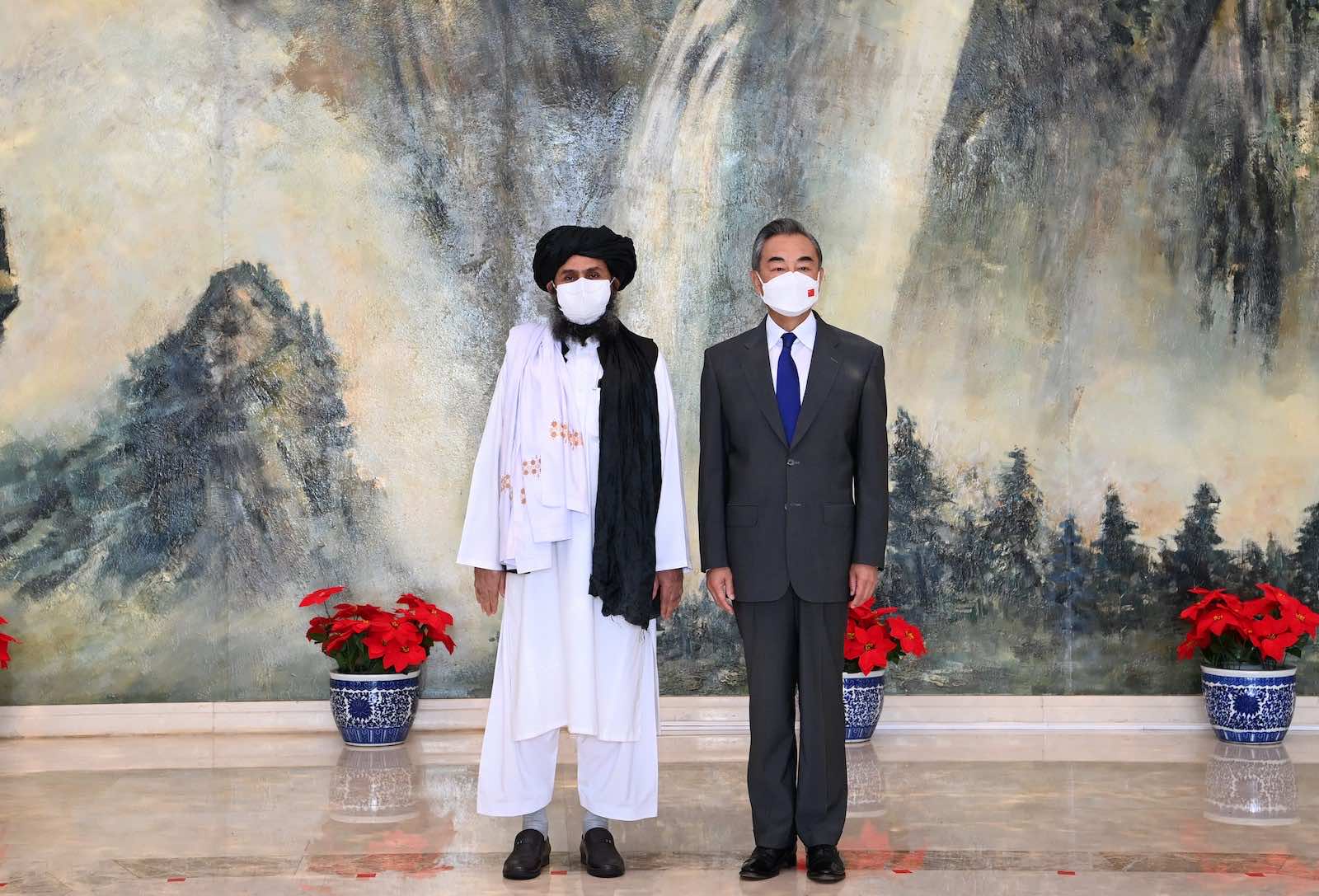
China’s Foreign Minister Wang Yi meets with Taliban political chief Mullah Abdul Ghani Baradar in Tianjin, 28 July (Li Ran/Xinhua via Getty Images)

China’s Foreign Minister Wang Yi meets with Taliban political chief Mullah Abdul Ghani Baradar in Tianjin, 28 July (Li Ran/Xinhua via Getty Images)

Beijing traditionally looked with discomfort at the presence of US troops in Afghanistan, urging Washington to withdraw. Now, as the security situation in Afghanistan deteriorates, China has changed tack, criticising the US for the “abrupt” nature of its exit. While not baseless, such criticism is indicative of Beijing’s growing anxiety about Afghanistan’s trajectory.

Partly this concern is economic. Chinese firms have first dibs on developing some of Afghanistan’s impressive natural resources. This includes the world’s second-largest copper deposit. But China’s overall economic relationship with Afghanistan is relatively small. It has other reasons to worry about its neighbour.

Chinese strategists have long sought to avoid what they view as the mistakes of the West in becoming militarily and even politically – beyond a certain level – entangled in unstable developing countries

The Taliban has traditionally had a close relationship with the ETIM. Most of Badakhshan is now under Taliban control, but according to some reports, Tajik, Uzbek, Uighur and Chechen fighters comprise the bulk of the local Taliban rank and file, rather than Pashtun fighters. This “transnational jihadi formation” may be difficult to preserve should the Taliban leadership adopt a “realpolitik” approach to cooperating with ETIM to allay China’s concerns.

First and foremost is maintaining a stable border. China’s most pressing security threat in Afghanistan is regularly said to be the independence-seeking militant Uighur East Turkestan Islamic Movement (ETIM). According to a recent United Nations Security Council report, ETIM has approximately 500 fighters in northern Afghanistan, mostly located in Badakhshan province, which adjoins Xinjiang in China via the narrow Wakhan Corridor.

Aside from the general stability of Central Asia, China is also alarmed at the potential for Tehreek-e-Taliban Pakistan (TTP), the so-called “Pakistani Taliban”, to benefit from the Taliban resurgence in Afghanistan. Though the relationship is complex, the Afghan Taliban has long provided sanctuary to the TTP, said to have even extended to joint operations.

The TTP has explicitly sought to target China-Pakistan Economic Corridor (CPEC) projects, the Pakistani leg of China’s flagship Belt and Road Initiative infrastructure plans. Attacking CPEC targets may have been an impetus for the TTP’s reunification in August 2020. The TTP claimed an attack on a Baluchistan hotel hosting the China’s ambassador to Pakistan in April and may well have behind the recent attack in Khyber Pakhtunkhwa, once known as the North-West Frontier Province.

So far, Beijing’s evolving Afghanistan strategy revolves around a growing panoply of diplomatic initiatives. Beijing has long cultivated ties with the Taliban, offering the armed group blandishments including “sizeable investments in energy and infrastructure projects” in exchange for peace. 

At face value, this strategy appears to be paying dividends. This month, Taliban spokesman Suhail Shaheen promised – in what was an explicit reference to Xinjiang – to refrain from interference in China’s “internal affairs”. Visiting Tianjin this week, the Taliban’s political chief Mullah Abdul Ghani Baradar again pledged to “never allow any force” to engage in acts detrimental to China.

It is also an open question how China and the at best loosely aligned Shanghai Cooperation Organisation will succeed in brokering peace where the US and NATO, with actual assets on the ground, failed

Regionally, China has unveiled a five-point plan with Pakistan to align the two countries’ Afghanistan strategies as well as laying out a three-part roadmap at the Shanghai Cooperation Organisation, which includes as members China, Russia, Pakistan, India, Kazakhstan, Kyrgyzstan, Tajikistan and Uzbekistan. China’s nebulous initiatives both prioritise facilitating intra-Afghan negotiations and unspecified measures to combat terrorism. Beijing has also pledged to host peace talks, making it clear to Baradar that it expects the Taliban to meaningfully engage in intra-Afghan talks with the government in Kabul.

Beijing’s initiatives should not be dismissed out of hand. However, success is far from assured. There are obvious questions around the willingness of the Taliban to negotiate and the feasibility of sizeable Chinese investments in active war zones. It is also an open question how China and the at best loosely aligned Shanghai Cooperation Organisation will succeed in brokering peace where the US and NATO, with actual assets on the ground, failed.

Above all, experience has shown that the Taliban’s word doesn’t mean a great deal. Pakistan, for all its assumed influence, is yet to convince the Taliban to renounce the TTP. Nor has the Taliban honoured its promises to disavow al-Qaeda.

These realities are unlikely to be lost on China. Yet a military footprint is far from an attractive option. Chinese strategists have long sought to avoid what they view as the mistakes of the West in becoming militarily and even politically (beyond a certain level) entangled in unstable developing countries. Even in Pakistan, despite its extensive economic interests, China has begrudgingly relied on local forces.

However, if the security situation in Afghanistan and Pakistan continues its downward spiral, Beijing’s current approach may not be enough to protect its interests. Rising domestic nationalism and Beijing’s rhetorical claim to great power status, in the face of persistent doubts, may also push Beijing to assume a more assertive role. If so, history suggests Beijing will step into a quagmire.


https://www.lowyinstitute.org/the-interpreter/china-s-afghan-conundrum