Showing posts with label Anti-semitism. Show all posts

Friday, 13 December 2019

A dramatic result that changes everything

The battle for Brexit is over. If Boris Johnson returns to Westminster with anything close to the majority predicted by the sensational exit poll, he will deliver his “oven ready” Brexit deal faster than a Deliveroo drone.
Friday 13 December 2019 2:45 am
https://www.cityam.com/a-dramatic-result-that-changes-everything/

Boris Johnson presents Brexit offer to MPs

We will leave the EU by the end of January and enter the transition phase. After that, Johnson will have sufficient support to drive the next stage of negotiations.

It won’t eradicate the difficulties and intricacies of a UK–EU trade deal, but those negotiations will not be conducted by a government under constant fire. Instead, for the first time since the summer of 2017, Her Majesty’s government will be confident and in command.

The political map of the UK has been redrawn, and while at the time of going to print we do not know all the details, it is safe — indeed, it is necessary — to recognise that we have now entered a new political era.

After a decade in office, the Tory party is embarking on a new age of dominance. The achievement is unprecedented and the impact will be profound. The turmoil of Brexit took this country to the edge, and a divided parliament was the consequence and the symbol of that division.

Can Johnson use his new position to bring the country back together? Because, as this newspaper has never tired of saying, there is more to life than the manner of our departure from the European Union.

From public services to housing, from the economy to infrastructure, issues that have been put on hold for years can now demand attention. As for Labour, the loss is entirely of its own making. An extreme, hard-left and intolerant project has been dismssed in the most emphatic way.

The humiliation of Jeremy Corbyn cannot be explained only by his Brexit ambiguity. His agenda, his character, his history and his philosophy were put to the British public and the British public rejected him.

Let us hope that with his departure from the stage, the stain of antisemitism can recede from our politics. While Corbyn’s loyal supporters last night refused to countenance the idea that Labour could rebuild as a mainstream, patriotic party of the centre-left, there is nowhere else for it to go.

The dust is yet to settle, and the full results will reveal surprises and challenges for all parties, but this result could restore a quality to our national life that has been sorely lacking: confidence.

Confidence in the government, in the markets, in Britain and in a people who, when offered socialism, rejected it.

Main image: Getty

City A.M.'s opinion pages are a place for thought-provoking views and debate. These views are not necessarily shared by City A.M.

https://www.cityam.com/a-dramatic-result-that-changes-everything/

Thursday, 12 December 2019

The chaos of Brexit is nothing compared to the risk of Jeremy Corbyn

Every election is important, but some elections are indisputably more important than others. In the British context, the clearest examples of the past century have been 1945 and 1979.

Thursday 12 December 2019 6:14 am

https://www.cityam.com/the-risk-of-jeremy-corbyn/

Jeremy Corbyn
In both cases, the electorate decisively rejected the pre-election consensus that had held sway for an entire epoch. 
In 1945, Labour’s New Jerusalem and capture of the commanding heights of the economy caught British imaginations. In 1979, the then “sick man of Europe” decided that only the dramatic rupture of the economic norms offered by the Conservatives could save the country from financial ruin. 
What was similar in these two elections was that one major party advocated seismic change, while the other offered essentially continuation with what had gone before. Those content with society as it had hitherto been construed knew who to vote for, as did the discontented who yearned for a new direction.
Today’s election is an entirely different proposition. The outcome will provoke a policy shift of the magnitude of 1945 and 1979, but neither of the two main parties is offering the status quo. 
The Conservatives are promising Brexit and a break with 46 years of British membership of the European Union, to complete the work of the 2016 referendum. Labour is advocating a tax, spend and nationalisation manifesto, red in tooth and claw, the likes of which would take us back half a century.
Just as with elections themselves, some policy changes are more definitive than others. 
With all due respect to minor parties — none of whom will furnish the Prime Minister come tomorrow — there is a straight choice to be made between Boris Johnson and Jeremy Corbyn in this regard. One will deliver transformation of a nature yet to be determined, the other of a kind only too obvious. 
Much has been written about the potential financial impact of Brexit, but economics remains the only field of study where a practitioner can be more wrong than right in pronouncements and yet still be considered an expert. Businesses and individuals do not stand still in the face of change, but adapt their economic behaviour to suit new circumstances, while broader global trends can disrupt the most finely honed local predictions. 
Whether Brexit will be a drag or a boon on the UK economy is therefore unknown, particularly as what might first appear damaging could prove to be our longer-term salvation, given the economic decline of Europe and rise in importance of other markets open to trade deals. 
The same cannot be said of Labour’s offering. The UK has been down the road of high tax, high spend, and a controlled economy before. It ended with stagflation, mass industrial strife, and the country begging for an IMF bailout.  
There has never been a successful socialist economy in the world that has lasted the test of time. The fundamental failure of theoretical socialist principles to survive contact with practical reality is not a script yet to be written, as Brexit is, but something that has already been tested to destruction worldwide. 
That said, Corbyn’s economic policies will at least be reversible by a future government. But there is a more sinister part of his political agenda that will be harder to unwind. 
Corbyn’s past embrace of Islamist extremists, terrorists of many stripes, and authoritarian regimes across the world have led to his being labelled a threat by not just the security policy community, but even by members of his own party. Jew hatred has flourished on his watch, with the party of equality descending into institutional antisemitism with its appalling response to the seemingly endless cases exposed. 
In his attitudes to these issues, he represents an approach that is fundamentally at odds with the tolerant country Britain has always been. 
Johnson may not be universally popular, but he can be located as a John Bull figure in the British political continuum. In contrast, there is something peculiar — and, dare it be said, un-British — about Corbyn’s obsession with turning society on its head, while consorting with those with contempt for our liberal democratic values.   
British Prime Ministers do not need majorities to enact change. Foreign policy can be revised by prime ministerial fiat, state grants doled out at a flick of the pen, and government qangocracy transformed unilaterally. As evidence for the latter, Labour has already threatened to “reform” the Equalities and Human Rights Commission after the election, a body due to rule on the party’s problem with antisemitism next year.
There is no doubt that Brexit will cause transient change. But we will still be the same country after it, even if shorn of our European trappings. Corbyn’s programme promises an entirely different outcome, with the organs of civil society facing the brunt of the assault.   
The UK therefore faces a clear choice today. Perhaps it is in the mood to gamble that the certainty of Corbyn is preferable to the uncertainty of Brexit. 
But if it does, let it be aware what it is signing up to. For there will be no turning back, or half measures, should the revolution Corbyn has spent his entire political life campaigning for come to pass.
The views expressed here are Alan Mendoza’s personally.
Main image credit: Getty
City A.M.'s opinion pages are a place for thought-provoking views and debate. These views are not necessarily shared by City A.M.

https://www.cityam.com/the-risk-of-jeremy-corbyn/

This Labour party does not deserve your support, however tactical or temporary you consider it to be

Today you’ll have the opportunity to vote in the most consequential election for 40 years. You’ll have your own motivations and concerns, your own views on what constitutes a good result.

Thursday 12 December 2019 6:00 am

https://www.cityam.com/this-labour-party-does-not-deserve-your-support-however-tactical-or-temporary-you-consider-it-to-be/


British Voters Go To The Polls In Local Elections

Today you’ll have the opportunity to vote in the most consequential election for 40 years. You’ll have your own motivations and concerns, your own views on what constitutes a good result.

Maybe one party’s victory is something you hope for, maybe it’s something you dread. For a lot of readers, the outcome may not be much more than something you can live with.

A lack of enthusiasm from all but the most devoted cheerleaders has been a hallmark of this campaign. People have talked about voting for the lesser of two evils, voting tactically or holding their nose and voting against their instinct.

Voting, even, against their principles. This newspaper has devoted tens of thousands of words to the task of criticising Labour’s economic policies, and it has deployed considerably fewer words than that in support of Boris Johnson — or indeed, of Brexit.

During the referendum three-and-a-half years ago, we remained neutral on the issue of Leave or Remain. Following the result, a respect for democracy and a faith in the City’s ability to adapt led us to support successive governments’ policies of leaving the European Union — with a deal.

That remains our position. But this election is not about Brexit. This election isn’t even about competing economic agendas. It’s about something much more profound.

Over the months, we’ve expressed our exasperation at the Tory party’s easy abandonment of fiscal prudence and we’ve shouted our disapproval of its immigration policy, its flirtation with state aid and subsidies and its inadequate response to the housing crisis and the problems of the property market.

But this election isn’t about any of that. We’ve also led the way in pushing back against the socialist dogma of the ageing Marxists in whose grip the Labour party finds itself.

It’s too late, now, to make any further arguments against the nationalisation of industry, high tax rates, hostility to private enterprise or the monstrous irresponsibility of its spending plans. But that’s OK, because this election isn’t about any of that.

What today’s vote comes down to is a simple question: are you prepared to make Jeremy Corbyn Prime Minister of this country?

Maybe you agree with his policies. Maybe you find yourself in full support of his diagnosis of this country’s problems. Maybe you just don’t like Brexit and you think he’s your best route to a second referendum.

Well, it’s the view of this newspaper that any form of Brexit is better than any form of Corbyn. In fact, the list of things that are better for this country than Jeremy Corbyn goes on and on.

Corbyn’s Labour is infected with anti-Jewish racism — and the leader of the party must take responsibility for that.

Corbyn’s Labour is being investigated by the Equalities and Human Rights Commission amid detailed and horrifying allegations that it is institutionally antisemitic.

The weight of evidence submitted to that inquiry (provided by former and current Labour party members and officials) should stop this country in its tracks.

The racism, paranoia and conspiracy theories swirling around the party is compounded by an inability or unwillingness to find it, stop it and sling it out. The correct response to this racism is not to weigh it up and conclude “yes, but…” — it’s to do all in your power to deny it a foothold in office.

Maybe Corbyn will spend more on the NHS, maybe he will give you a second referendum, but the price paid will be high. Too high. Jewish families have told you that they would leave the country if Corbyn walks up Downing Street.

The chief rabbi has begged you not to put this man and his supporters into government. That was not an intervention made lightly. The problem of antisemitism cannot be separated from Corbyn.

He has shared platforms with antisemites, campaigned on their behalf and called them his friends. He has failed to recognise antisemitism time and again — even when it’s right in front of his face, be it a grotesque mural or a book riddled with anti-Jewish tropes — both of which he has supported and endorsed.

He has appeared on Iran’s state TV and claimed to have detected “the hand of Israel” in attacks carried out by Islamists in Egypt.

Through his words and deeds he has allowed antisemitism to seek a home among the grassroots of his party and, whether by accident or design, he has presided over an organisation that has never appeared to grasp the seriousness of the situation. Corbyn — and Corbynism — must be defeated today.

From the ashes, a reformed party may emerge and it would be free to champion the same economic policies. That’s a Labour party you could support. But this Labour party? This Labour party does not deserve your support, however tactical or temporary you consider it to be.

Main image: Getty

City A.M.'s opinion pages are a place for thought-provoking views and debate. These views are not necessarily shared by City A.M.

https://www.cityam.com/this-labour-party-does-not-deserve-your-support-however-tactical-or-temporary-you-consider-it-to-be/
Tuesday, 10 December 2019

Brexit Panto

Billed as the most significant election since Clement Attlee’s 1945 Labour landslide, the outcome will determine whether Brexit happens at all.
DECEMBER 10, 2019|
by HELEN DALE


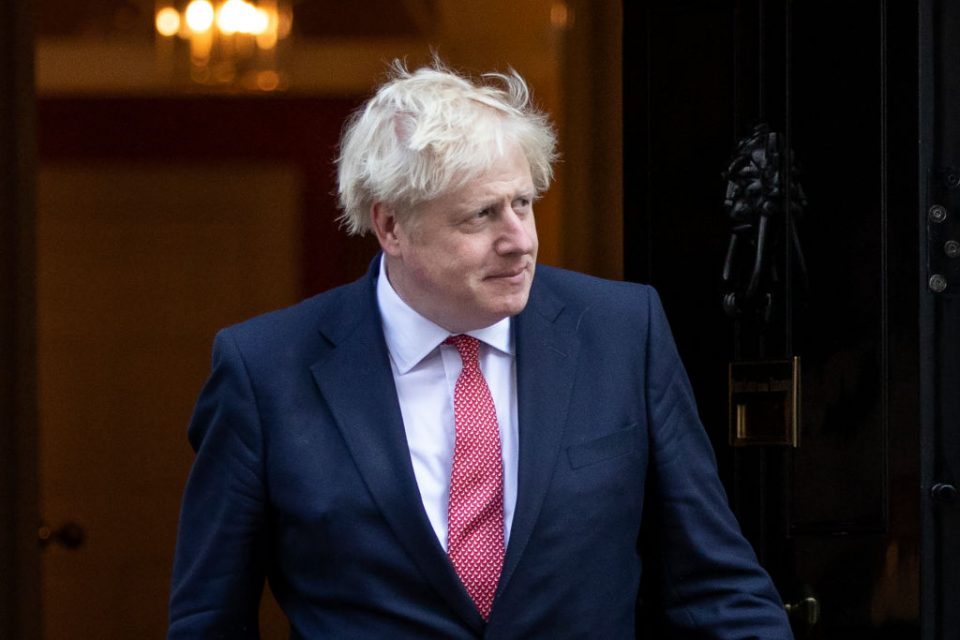
Prime Minister Boris Johnson speaks during a visit to the Kent Event Centre, Maidstone, while on the election campaign trail. December 6, 2019.(Stefan Rousseau/PA, Press Association via AP Images)


Here in Blighty, we’re having a General Election in prime panto season. Voting on December 12 means polling stations bumping elbows and butting heads in village halls across the country with Buttons, Mother Goose, and sundry pantomime horses. Shouty ex-Speaker John Bercow — now that he can no longer impose himself on the House of Commons — may be considering a star turn as Widow Twankey, or rather, “Widow Wanky.” Panto may be high-spirited fun and Bercow a laugh-riot but December in Britain is cold and dark. It means party activists canvassing at night while sunset this Thursday in Birmingham — roughly the middle of the country — is at 3:51pm.
Billed as the most significant election since Clement Attlee’s 1945 Labour landslide, the outcome will determine not only the form Brexit takes, but whether it happens at all. It will see 150 Labour MPs and three Liberal Democrats fighting to hold Leave seats while 80 Conservatives run in Remain seats. It also pits genuinely different political visions against each other in a way not seen in these Islands for decades: the days of Blair-Cameron technocratic politicians with identikit policies are over.
British voters are increasingly “up for grabs,” shopping around the political marketplace like first home-buyers. According to the British Election Study, around 35-45 per cent of all voters switched parties at each of the last two elections. “Rusted on,” tribal voters — “my family votes Tory so I’ll vote Tory” — while not yet an endangered species are becoming harder to find. Ironically, ever since Britain voted to leave the European Union, our politics have started to look more European, as in, our once stable two-party system has imploded. In addition, Scotland and England now have different political battles over entirely different issues. Scotland’s most popular political party, the SNP, doesn’t run candidates south of the border, and probably can’t.
Since 2016, a succession of polls has shown that most voters consider their identity as Leave or Remain far more important than their party identity. Yet, in 2017’s general election, this phenomenon seemed not to matter: the two majors got their highest joint share of the vote for many years. But this flattered to deceive. Both saw the composition of their vote change. Labour under Jeremy Corbyn did better among middle-class voters than Tony Blair did in 1997, advancing in the South. Meanwhile, the Conservatives got their highest share of the working-class vote since the 1960s and gained ground in the North and Midlands. Relatedly, the sharp division between Leave and Remain is strongest in England and Wales; Scotland’s existential polarisation is over “Yes” or “No” on the question of independence.
Survey after survey shows a majority of the British population agreeing with the statement “parliament does not represent or listen to people like me.” British political historian Stephen Davies observes that one of the worst things about membership in the European Union is that its rules on trade, freedom of movement, and state aid make both socialism and national populism politically impossible. “It’s not healthy,” he points out, “for a democratic society when the views and feelings of a large part of the electorate do not find expression.” In that sense, the 2016 referendum result was a catalyst for people to cast around for political alternatives.
That said, the parties themselves are now also changing. Their respective leaderships have come to appreciate the extent to which the divisions in the House of Commons and the labels “Conservative” and “Labour” no longer represent divisions present in the electorate. The Conservatives in particular are engaging in a significant internal reorganisation where they keep the name but become quite a different party. This last happened 100 years ago, when they stopped being an aristocratic and landed party and became instead a party of business and commerce. People who think Brexit and the Tory programme are all a cunning plan by “dark money” to bring about a free market revolution are in for a shock. The price of Conservative victory in traditional Labour seats like Wrexham and Don Valley will be a much more active and interventionist state. A couple of weeks ago, Boris proposed that, after Brexit, the government’s commissioning and procurement decisions should be used to assist British firms, something not permitted under EU rules. Corbyn suggested exactly this a year ago and the Tories rubbished him. How times change.
Labour, meanwhile, is still playing both ends against the middle, attempting to hold its electoral coalition together: that is, working-class Leavers in the North, Wales, and Midlands plus middle-and-upper-middle-class Remainers in London and various university towns. This is why its Brexit policy is utterly bonkers: negotiate a new deal and then (maybe) campaign to reject it in a second referendum. As should be reasonably obvious, the fudge is unsustainable and during the last month Corbyn has made a determined effort to move Labour’s campaign away from Brexit and onto redistributive economics and the NHS.
Where, then, does this leave us? It’s a truism that people love information about the future but it’s only really possible to know about the past. This means anyone in the business of predicting election results needs to engage in a fair bit of epistemic humility. Telegraph cartoonist “Matt” captured this superbly in 2017 (after every pollster in the UK save two fell spectacularly on their faces), when he drew two little kids catching fish and chatting. “My dad’s an opinion pollster,” one said. “I hope he never loses his sense of wonder and surprise at election results.”
This has not been a particularly high voltage election campaign, and in the final days, the Conservatives are hoping they can keep it that way. The polls have narrowed a little, so Boris Johnson’s party is now between nine and 12 points ahead of Labour. Meanwhile, analytics outfit Datapraxis have done an MRP poll, which suggests a working Tory majority of 38. “MRP” stands for “multilevel regression and post-stratification” and it’s designed to compensate for the UK’s historically poor-quality individual constituency polls. MRPs poll a very large, demographically representative voter sample across the four home nations. They then use census data to look for patterns in responses across constituencies that have similar demographic characteristics, and work out the implications of those patterns for each constituency. The system isn’t perfect, but YouGov managed to predict both the hung parliament and 93 per cent of all constituencies using this method in 2017.
A majority of 38 is roughly what most Conservatives started the campaign hoping they would get if they were lucky, but many of the seats they need to win to secure this majority are on a knife-edge, and after the 2017 experience, no one is going to relax until the exit poll. Datapraxis CEO Paul Hilder has also taken care to point out that there are a large number of people who have told pollsters they plan to vote but are still undecided. “We have never seen as many undecided voters this late in the campaign,” he says. “As many as 80-90 constituencies are still up for grabs. A much larger Conservative landslide is still possible — but so is a hung parliament.”
Some of this uncertainty is thanks to widespread dislike for the two leaders. While Boris Johnson is ahead (he’s about as popular as a national bout of diarrhoea), Jeremy Corbyn has plumbed new depths of unpopularity. The Financial Times had to insert a new line in its graph just for him — and he’s roughly on par with cancer as the most unpopular leader of a major party heading into an election since data was first recorded. At least some of this is in spite of the low-wattage campaign and not because of it; Labour generally and Corbyn personally have been dogged by accusations of anti-Semitism for what seems like months, even years.
Labour’s anti-Semitism problem is of a very distinctive sort; former Labour members have noted only some of it has roots in support for the Palestinian cause. Much of it is closer to what sociologists and historians call “the cultic milieu,” where a range of conspiratorial ideas present in a kind of subterranean, countercultural intellectual world have bubbled up and become more-or-less mainstream within a major political party. When the Jewish Labour Movement’s closing submission to the Equality and Human Rights Commission leaked last week, it disclosed a worrying crossover between Rothschild conspiracy theories, David “the Queen is a lizard” Icke, and bizarre fantasies of world domination. People expected infighting over a potential Labour government’s support for Israel or selling arms to Saudi Arabia. Instead we’ve got cranks that have set about reanimating the “blood libel.”
That said, although he may be personally unpopular, Labour’s overall position actually strengthened in the polls after Corbyn’s car-crash failure to deal with anti-Semitism in an interview with leading BBC journalist Andrew Neil. I suspect that next day poll bounce is what led the Conservatives to decide the broadcast media are surplus to requirements, with Boris refusing to submit to a similar Neil grilling. If nothing else, this is a reminder that the UK system is not (yet) presidential, with people holding their noses and voting for their party, if not its leader.
Given the country’s current political divisions, there will be a great seat sort with many constituencies changing hands. The LibDems will gain seats from the Tories. Labour will gain seats from the LibDems. The Tories will gain seats from Labour. The Tories also hope the Brexit Party in combination with First Past The Post doesn’t lead to yet another hung parliament. The SNP, meanwhile, are no longer a good bet to win every seat in Scotland because Scottish unionists are exceptionally good at tactical voting.
The end will only come with a majority government that can impress its will for long enough that a reversal of its policies after its eventual defeat would be impracticable in the medium-term (like Margaret Thatcher managed to achieve with economic policy, for example). For that to happen, someone has to win a majority on Thursday.
If no-one does, we can look forward to at least another year of Brexit panto.

Helen Dale

Helen Dale won the Miles Franklin Award for her first novel, The Hand that Signed the Paper, and read law at Oxford and Edinburgh. Her most recent novel, Kingdom of the Wicked, has been shortlisted for the Prometheus Prize for science fiction. She writes for a number of outlets, including The Spectator, The Australian, Standpoint, and Quillette. She lives in London and is on Twitter @_HelenDale
https://www.lawliberty.org/2019/12/10/brexit-panto/

Voting Labour is not just a mistake, it’s morally unconscionable

This is a miserable election. The least bad outcome would be another hung parliament, which is sadly not an option that exists on the ballot paper. 

I don’t wish Britain to embark on either the economic and diplomatic harm of the Conservative plans for Brexit or the delusions of state socialism.

15 November 2019
By 

Voting Labour is not just a mistake, it’s morally unconscionable
  • Under Corbyn, the Labour Party has abandoned both progressive values and the national interest
  •   It's not hyperbole to say Corbyn's lieutenants think the wrong side won the Cold War
  •   It's odd that someone as illiberal as Corbyn is considered a progressive politician

The Tory rhetoric of “getting Brexit done” is a dishonest euphemism for avoiding hard choices; no economic nirvana awaits by throwing up barriers to the cross-border movement of goods, capital and people, or deregulating labour and product markets. The Liberal Democrats’ appeal meanwhile is simultaneously frivolous, as if a damaging referendum vote can simply be wished away, and dismayingly sectarian, and it is coupled with the party’s customarily hazy grasp of policy areas where its activists aren’t really interested (defence, for example).
But my subject here is Labour, because it’s personal. For all its idiosyncrasies, faults and failings, the Labour Party has historical achievements to its credit. Trusting in this legacy, and holding to centre-left ideals, I’ve almost always voted for the party. Not this time. I’m heartbroken to conclude that a Labour vote in next month’s general election would, for me at least, be not only a mistake but a morally unconscionable act. Under Jeremy Corbyn’s titular leadership, the party has abandoned progressive values and the national interest. The party hierarchy has been taken over by people whose ideology is not merely misguided but malevolent. Intellectual honesty requires that I in turn abandon the instincts of tribalism and acknowledge what’s happened.
There’s a huge literature of how activists and pundits have moved from the idealism of the left to the purported pragmatism of the right. The greatest of these volumes is, to this day, Witness (1952) by Whittaker Chambers, an American Communist and Soviet spy who abandoned those allegiances and embraced Christianity and conservatism.
I’ve read these accounts and in several cases admire them but they don’t at all describe my own ideological trajectory, which (not that it’s a virtue, but it is a fact) has scarcely shifted an inch since I came of voting age in the 1980s. Though I deeply disagreed with such policies as unilateral nuclear disarmament, extensive nationalisation and import controls, I voted Labour even under Michael Foot and Neil Kinnock, never mind when the party was in a more electorally serious state under Tony Blair. Labour wasn’t then fit for government, but I didn’t feel there was a viable route to a moderate, centre-left government in Britain through the SDP-Liberal alliance so just hoped for the best.
On personal rather than party grounds, I even voted Labour in 2017 for an excellent constituency MP and public servant, Meg Hillier in Hackney South and Shoreditch. (It’s a tribute to her, and not to Corbyn, that she won almost 80 per cent of the vote, with a majority just shy of 38,000.) I did so because the party has a noble history, created by many fine people, that has advanced reform and internationalism rather than social engineering. It remains the case that Labour has many capable and moderate MPs who I’d wish to see returned to parliament. I don’t criticise them for remaining under Labour’s banner; I hope they’ll take the party back, but I’m not hopeful that they can. (I’ll single out Stella Creasy, an immensely effective parliamentarian who is facing a noxious campaign of personal attacks in her constituency from religious zealots.)
The Nato alliance, on which Britain’s security has rested for 70 years, was the brainchild of a Labour foreign secretary. The NHS is a broadly efficient and equitable provider of healthcare. The crucial turn in postwar economic policymaking from an unaccountable system of corporatism and inflationary public financing came not with the Thatcher government but with the chancellorship of Denis Healey in the 1970s. Labour governments have presided over social reforms that over half a century have made Britain a more tolerant and civilised society on such issues as capital punishment, censorship, race relations, abortion and gay rights.
Labour under Corbyn is not like this. It’s not hyperbole but the literal truth that senior lieutenants in his circle believe that the wrong side won the Cold War. The party’s equivocations over Brexit make a mockery of its claim to advance collective goals such as workers’ rights and environmental protection.  Corbyn’s own rhetoric on issues of immigration (he’s condemned the “wholesale importation of underpaid workers from central Europe in order to destroy conditions, particularly in the construction industry”) and free speech (he addressed a rally in 2006 protesting against publication of the famed Danish cartoons of the prophet Mohammed) is deeply illiberal. It’s weird that a man like this should be counted a progressive politician. He’s not only unfit to hold public office but is far to the right of where, for example, Roy Jenkins stood when he was Labour Home Secretary.
One reason above all, however, makes a Labour vote impossible for me. Perhaps I can give a little personal background. I was once on a panel with Corbyn many years ago when the moderator cited some ferociously anti-Semitic invective by Mahmoud Ahmadinejad, then president of Iran and an overt Holocaust denier. Corbyn was directly in my line of sight and he showed not a flicker of emotion. In responding, he made no mention of these inflammatory remarks but simply carried on with his castigation of the supposed imperialist designs of the United States and its allies on the region. I realised at that moment that Corbyn lacked the visceral revulsion for anti-Semitism that he ought to possess. I attributed it to an incomprehensible lack of imagination.
That, I now believe, was an unduly charitable interpretation of his strangely bloodless response. Polling evidence suggests that the overwhelming majority of British Jews (more than 85%) believe that Corbyn is anti-Semitic. That’s a view held by Labour MPs who’ve watched him closely, notably Margaret Hodge. And it’s my view too.
My paternal family has been in this country for more than 200 years. They moved from Strelitz in Germany to Liverpool, where they settled – one brother was a jeweller and the other was a rabbi. In generations since, the extended family became completely assimilated. I’ve always counted myself a friend, but not a part, of Anglo-Jewry (my late mother, Anthea Bell, who translated seminal Jewish authors such as Kafka and Freud, was not herself Jewish). Yet I feel not just dismay but revulsion at how common the tropes of anti-Semitism have become on the left – the conspiracy theories, the insults, and the way that the Israel-Palestinian conflict is interpreted not as a conflict of competing and legitimate national claims but as a saga of malign oppression by sinister forces.
The outcome is not merely a few cases of bad behaviour but a civic culture in which British Jews feel their apprehensions are rubbished and in which anti-Semitism is normalised. It’s not very long ago (you need only read the novels of Agatha Christie, GK Chesterton or John Buchan for examples) that a sort of drawing-room anti-Semitism permeated polite society, where Jews were conceived as somehow representative of “otherness”. You can see an echo of this in Corbyn’s notorious remark about pro-Israel protestors who lacked a sense of “English irony”. I fear that the damage Corbyn’s Labour has inflicted on community relations will be enduring and hard to undo. It is tragic and deplorable, and I will have no part any longer in acquiescing in so debased a discourse.
https://capx.co/voting-labour-is-not-just-a-mistake-its-morally-unconscionable/

Lord Sugar backs Boris Johnson at the general election

Former Labour peer warns that Jeremy Corbyn's spending plans would 'create economic chaos'
  • Lifelong Labour supporter Lord Sugar has urged a vote for the Conservatives
  • He said he hoped a Labour defeat would help the party by removing Mr Corbyn 
  • The Apprentice star cannot vote himself as a member of the House of Lords 
Lifelong Labour supporter Lord Sugar has urged voters to back Boris Johnson in the General Election.
Writing in The Sun, the Apprentice star described Labour's spending plans as 'complete madness' and said a government led by Corbyn 'would create economic chaos'.
The former Labour peer said that a vote for the Conservatives is the most effective way to save Labour in the long-term - by ridding the party of its leader. 
He said: 'Jeremy Corbyn has turned Labour into a negative anti-business party that is clueless on how the economy works. His £1.2trillion spending splurge is complete madness. His spending plans would create economic chaos.' 
Endorsement: Lifelong Labour supporter Lord Sugar (pictured earlier this year) has urged voters to back Boris Johnson in the General Election
Despite having campaigned for Remain in the referendum, Lord Sugar declared that 'enough was enough'.
'Business and families are crying out for economic certainty to plan for the years ahead with confidence. We just need to get Brexit over with.
'That won't happen in a hung parliament, or with Corbyn's Labour in power,' said Lord Sugar.
Describing Thursday's poll as the 'most significant election' of his lifetime, he claimed that his rise from council estate to boardroom executive would not be possible under a Corbyn-led government.
He said: 'Corbyn getting into power would affect everyone, from the person earning minimum living wage up to the CEOs of Britain's biggest companies.
'He'll clobber ordinary people, young and old, with sky-rocketing taxes: holiday tax, higher petrol tax, pensions tax or a tax for drivers. You name it, he wants to tax it.' 
Final stretch: Boris Johnson boards a plane at Doncaster Sheffield Airport on Monday with three days to go until the general election
Final stretch: Boris Johnson boards a plane at Doncaster Sheffield Airport on Monday with three days to go until the general election 
The lifelong Labour supporter said that a vote for Boris Johnson would actually help the Labour party in the long run, claiming that it's time for 'Corbyn to resign and get a sensible person to take the helm and make Labour great again'.
Likening Brexit to an 'awful Groundhog Day situation', Lord Sugar claimed that only a Conservative majority could end the delay.
The 72-year-old, who is Jewish, said he could not 'add to what's already been said' about Labour's anti-Semitism crisis.  
The former Labour peer resigned from the party in 2015 over its 'negative' attitude to business, before Mr Corbyn was elected leader.  
Last month he branded Mr Corbyn a 'millionaire hypocrite' and accused him of overseeing the 'destruction' of the Labour party.  
As a member of the House of Lords, he cannot vote in the election himself.  
The Conservatives are fighting to win at least 20 seats in Labour heartlands in the West Midlands and the North which will likely decide the fate of the election. 
Read more:

Wednesday, 27 November 2019

Boris Johnson apologises to Muslim community

Boris Johnson has apologised to the Muslim community for instances of Islamophobia within the Tory party.

Wednesday 27 November 2019 5:12 pm
https://www.cityam.com/boris-johnson-apologises-to-muslim-community/

Boris Johnson
Boris Johnson has apologised for instances of Islamophobia in his party (via Getty Images)

Johnson has previously been criticised for comparing women wearing niqabs as looking like letter boxes and bank robbers, and the party has said it would soon launch an inquiry into discrimination of all kinds within the party.

Read more: Jeremy Corbyn refuses to apologise to chief rabbi

The Prime Minister was asked in Cornwall this morning if he would apologise for examples of anti-Muslim sentiment in his party.

“Of course, and for all the hurt and offence that has been caused – of course we do,” he said.

“And all that is intolerable and it’s so important as a country that we don’t allow that kind of thing and that’s why we’re going to have the independent inquiry.”

The statement is just one day after Labour leader Jeremy Corbyn refused to apologise for instances of antisemitism within his party.

On Monday, the UK’s chief rabbi said Corbyn was “complicit in prejudice” against Jews and unfit to be prime minister.

Corbyn once again refused to apologise to the Jewish community or the chief rabbi at a press conference this morning.

After being asked if he would like to apologise to the Jewish community, Corbyn said: “I’ve made clear antisemitism is a complete poison in our society.

“I acknowledge what the chief rabbi said yesterday, but I’ll also point out there’s very large amount of other people in the Jewish community who have made it very clear they do support Labour.

“That they do recognise my absolute commitment that every community in our country will be safe in a Labour government.”

The Equality and Human Rights Commission is currently investigating whether Labour is institutionally antisemitic.

A group of 11 Labour MPs also left the party earlier this year partly due to the party’s handling of antisemitism allegations.

UK chief rabbi Ephraim Mirvis said claims by the Labour leadership that they would “tackle the scourge of anti-Jewish racism” were a “mendacious fiction”.

Writing in the Times, he said: “How complicit in prejudice would a leader of Her Majesty’s opposition have to be in order to be considered unfit for high office?

Read more: Tom Watson and Sadiq Khan decry Labour ‘antisemitism’ after Panorama probe

“Would associations with those who have openly incited hatred against Jews be enough?

“Would support for a racist mural, depicting powerful hook-nosed Jews supposedly getting rich at the expense of the weak and downtrodden be enough?”

Tuesday, 19 November 2019

Corbyn may not win, but his politics have already poisoned us

WHAT happened to the hope that a rare instance of direct democracy in 2016 would make British politics more representative and responsive? 

-

The same elite that had promised to deliver Brexit the day after a vote has failed to deliver it in three and a half years. Indeed, some Members of Parliament have shamelessly redefined themselves as not ‘representatives’ after all.
The ruling Conservative Party is on its third leader to promise but fail to deliver Brexit. Almost all other British political parties are committed to overturning the referendum result of 2016 and their own manifesto commitments of 2017 to honour the result.
Even the Brexit Party, led by people who prided themselves on ‘insurgent politics’, caved in to the Conservative Party’s self-serving argument that its fake Brexit would be better than splitting the Brexiteer vote. 
Then there is the Labour Party, led by Jeremy Corbyn, who must take the lion’s share of the blame for muddying British politics to the extent that popular will, constitutionality, freedom of speech, property rights, and Britain’s identity as Western are no longer sacrosanct. 
How does he do it? Corbyn is a thoughtless Marxist by any honest political philosopher’s assessment. He has stuck with the most reductionist, pretentious dogma of modern politics, yet remains so unprincipled that he has vacillated for and against Brexit, a second referendum, a withdrawal agreement, and even a general election. 
He epitomises the hypocrisies that result from the perversion of liberalism called ‘progressivism’. Progressives claim progress because advertisers and broadcasters under-represent white males, violence is an acceptable form of politics against anybody labelled a ‘fascist’, the solution to prejudice is to reverse the prejudice, downgrading crime on the grounds of the criminal’s ‘under-privilege’ is ‘social justice,’ and anybody is guilty until proven innocent as long as the accused is more representative of the ‘majority’ than the accuser.
Progressive politics are destructive politics and Corbyn would be Britain’s most destructive Premier since at least Tony Blair, if not Clement Attlee. He would not just destroy Britain’s identity, he would damage the West. While Corbyn vacillates on domestic policies, he has never vacillated in his distaste for Western civilisation. 
Corbyn allows for terrorism that is anti-Western, anti-imperialist, anti-Israel, and Republican, has shared platforms with former members of Hamas, Hezbollah, and the IRA, equates the Islamic State with the US military, blames Islamism on Western imperialism.
In 2014, he dismissed the Russian invasion of Ukraine as ‘not unprovoked,’ he welcomed ‘the resurgence of Russia and the enormous economic power of China’ as signs of the end of Western hegemony, and dismissed the EU and NATO as ‘the tools of US policy in Europe’. 
Weeks after Russia annexed Crimea in 2014, he gave a speech claiming that ‘NATO was founded in order to promote a Cold War’. In 2018, he doubted British indictments of Russian state-sponsored agents for the murder of British persons on British soil with a nerve agent, and called for attention to Russian accusations of British fakery.
Corbyn doubts the legality of British military intervention in Syria, but defends Russia’s intervention. Corbyn claims to be a democrat, but celebrates criminal autocrats in Cuba, Venezuela and Syria.
He claims that his moral relativism is about universal human rights, but he took money from Iran to present an official television channel that glorified Iranian human rights abuses. 
He claims that Labour ‘is an anti-racist party to its core’ but has not solved its anti-Semitism.  Corbyn claims to stand for ‘a better, fairer Britain’ and ‘for the many, not the few,’ but campaigns for racial and gendered quotas.
Before you get complacent that this list of hypocrisies and contradictions must discredit him, consider that Corbyn does well in post-modernist, post-truth Britain. A fringe member that nobody took seriously took over the Labour Party in 2015.
In the general election of 2017, he garnered more seats than surveys had forecast, and was a few seats away from coalition government. In 2018, struggling leftists on the European continent upheld him as their saviour. 
A critic (Robin Simcox) lamented that ‘he is now mainstream’ and ‘tantalisingly close to No. 10 Downing Street’. Simcox predicts that Prime Minister Corbyn would certainly reduce Britain’s role in Western institutions.
Another critic (Con Coughlin) has predicted that, if Corbyn were to become Premier, Britain would be excluded from the ‘Five Eyes’ intelligence alliance. Australia’s most recent High Commissioner to Britain (Alexander Downer) agrees.
We might take comfort from recent polls suggesting that Britons take Corbyn less seriously in 2019 than they took Michael Foot in 1983. On that basis, the other parties expect to do well in this general election. But Britons in 2019 have changed greatly in demographics and politics since 1983. They already baffled pollsters in 2017. 
Now consider this: Even if Corbyn doesn’t win a majority, he might still enter government if a hung Parliament can’t form a government without him. Even if Corbyn isn’t invited into a coalition, one or more of the other party leaders will be forming yet another government with no popular enthusiasm.
One third of Britons report that they will vote against their most-disliked candidate rather than for any liked candidate. 
I haven’t even got to the most discomforting consideration: Even though Corbyn might be unelectable as a person, his politics have already won. 
Six of the eight parties currently represented in Parliament are explicitly socialist and /or progressive (Labour, Scottish Nationalist, Liberal Democrat, Sinn Fein, Plaid Cymru, Green). The Conservative Party is nominally conservative, but in recent years its Parliamentary party has been dominated by socialists masquerading as ‘moderates.’
Some have quit for explicitly Left-wing parties (e.g., Heidi Allen); or lost the whip when they voted against Boris Johnson’s government (e.g., Ken Clarke); or postured as independents with vacuous claims to ‘new politics’ (e.g., Rod ‘Rory’ Stewart). Even without them, the Conservative Party’s manifesto continues to ape the Left-wing consensus.
All British political parties have embraced the nonsense of social justice. All the parties – competing to outspend each other on the NHS without reform – are committed to spending more, borrowing more, and inevitably taxing more.
All the parties show up to hear what a Swedish teenager has to say about climate change. None of the parties cares to admit the urgent issues of our time – declining tolerance, contentment, productivity, health, education standards, welfare dependency and abuse, security, social cohesion, manners, public safety, reliance on foreign investment/ownership, out-of-control immigration and population growth and skilled immigration dependency. Let alone examine the progressive political-social-cultural-moral reasons for them.
Even as Corbyn seems unlikely to win the premiership on December 12, his politics continue to ruin our civilisation.

Bruce Newsome
Bruce Newsome is a lecturer in international relations at the University of California Berkeley and an expert on global security risks, international conflict and counterterrorism.
https://www.conservativewoman.co.uk/corbyn-may-not-win-but-his-politics-have-already-poisoned-us/