Showing posts with label Ambrose Evans Pritchard. Show all posts

Monday, 30 March 2020

Who’s Next to Fail in the Post-COVID World?

As much as I hate to invoke The Ayn Rand lest I give off the impression I’m some kind of Objectivist, which I am most certainly not, the engine of the world is coming to a halt.
Money velocity has been falling for years. It is now cratering as we hide in our homes from a bug that eventually we will all have to reconcile with. Credit is the engine of the world of today.
It is the gas which fuels the engine of the world.
COVID-19 has cratered the global economy exposing the internal rot within our hyper-financialized global economy as nothing more than a pyramid of Ponzi schemes…
… piling credit on top of credit until there are no more greater fools to sell the new debt to.
That’s the system we have. And it is collapsing precisely because the world is situated at the point where there is little more productive capacity to monetize and pull that capital from the future to fund the new debt.
It won’t matter if we replace this system with pure helicopter money without debt as the Modern Monetary Theory proponents argue. We’re already doing a version of this by having the central banks buy debt they never intend to sell on the open market. So, the debt itself is without value. The money printed from those bonds is as much scrip as if the bond had never been issued.
But the time lost by people in pursuit of uneconomic ends by mispricing risk and servicing debt they are legally obligated to service is real.
The engine is sputtering as trillions are printed to kick it back over one more time. But the gas has too much ethanol in it. There’s not enough air.
The engine is dying.
And it can no longer outrun the abyss swallowing the world staring back at us saying, “Thanks for the snack, those frackers and restaurants are tasty, but I’m still hungry. Who’s next?”
I’ve been very clear that Europe is the next big meal for the Abyss.
In the end, a home builder here, an over-leveraged bank there are nice. These are but apĆ©ritifs in the grand scheme of things. They are like sugar to a starving child, revving it up but not fulfilling its real needs.
Europe’s troubles are multiplying because the basic premise of how to fight this virus and the deflation it is engendering is functionally flawed. More money dropped from helicopters isn’t the solution.
Freeing Europe from the euro is.
And it will set Italy in the post-COVID-19 world at odds completely with the rest of Europe.
Ambrose Evans-Pritchard adds more color to what happened at last week’s meeting of EU national leaders in which both sides of the fiscal divide dug in their heels.
Dutch premier Mark Rutte has become the spokesman for the hardliners – giving political cover to Germany – categorically ruling out emergency “coronabonds” or other forms of debt mutualisation. “It would bring the eurozone into a different realm. You would cross the Rubicon into a eurozone that is more of a transfer union,” he said. “We are against it, but it’s not just us, and I cannot foresee any circumstances in which we would change that position.”
Enrico Letta, Italy’s former-premier and an ardent EU integrationist, accused the Netherlands of leading the pack of “irresponsibles” and trying to “replace the United Kingdom in the role of ‘Doctor No’”. The reflexive use of the UK as a rhetorical foil evades of the true issue. It was not London that blocked moves to fiscal union over the last decade; it was Germany.
Pritchard brings up the spectre of Lega’s Matteo Salvini coming back into the picture, especially as the mood sours among even the most ardent Euro-integrationists like Italian President Sergio Mattarella.
Merkel is hiding behind her quarantine and letting Dutch Prime Minister Mark Rutte speak for her. And that is driving the Italians to the point of no return.
Giuseppe Conte’s government is at a loss to fight the virus. It was ignored by the EU when it asked for help it paid for when this began. As Pritchard points out, what purpose does the EU serve when it won’t act to help a member in need as it is supposed to do?
The answer is the EU’s purpose is to be obeyed.
Italy’s two ways out of this mess is leaving the euro or forcing the northern bloc to cry uncle. But that has to occur within the prospect of removing so many internal roadblocks to Italian economic growth, starting with the euro but entailing much wider reforms, which are most definitely not on the post-Keynesian/MMT technocrats’ agenda.
Italy’s debt numbers are a large part of the hunger of the Abyss and no amount of blackmail by them and France will get Germany to go along with bailing them out.
I discussed these issues and more at length with Alexander Mercouris of The Duran in this series of videos we recorded over the weekend (herehere, and here) in which we tie Europe’s collapse to all the other things we’re experiencing in the world right now.
Most EU economies are fundamentally hampered by the ossified bureaucracy of the EU which is an over-layer of domestic bureaucracies.
And, as such, these national systems are barely capable of acting in a coordinated manner normally, no less with the EU enforcing its fiefdoms at the same time in the face of overwhelming strain.
In all situations the primary objective of all organizations is survival. All else is secondary.
The more credible the threat the more extreme their response.
They will dig in to protect against that threat rather then fulfill their stated mission. In the case of the EU that means using this crisis as the excuse to force fiscal integration and monetary reform on those that don’t want it as a means to survive.
Because in a crisis period there is no time for such luxuries as national sovereignty. There isn’t any reflection that the organization itself is the source of the problem. The organization is a default setting.
And now both sides of the fiscal debate are seeing the other for what they are and the result will most likely be an irreparable fracturing of the European Union.
Italy has now seen the true face of the EU. Conte has now tried histrionics to get his bailout, which won’t actually solve anything, because he’s aligned with the Euro-integrationists. What his country needs is a new currency and different leadership.
But he’s held onto power because his opposition would have already broken with the EU.
Like the obsequious worm that he is, instead of doing the right thing, issuing mini-BOTs, to free up domestic liquidity issues, Conte is looking at putting up the whole of the Italian government’s holdings as collateral against new debt to pay for stimulus of Einsteinian proportions.
This is the ultimate sellout of Italy to the EU. As a proposal it is the ultimate betrayal of the Italian people. These buildings and infrastructure are their legacy and they will be sold as collateral to loan sharks as opposed to reclaiming their national dignity.
There is no market for these bonds. So,who will buy them? The ECB.
Who then owns all of this property, ultimately?
The ECB and therefore the EU.
This is a proposal designed for Merkel to take back to home to the Bundestag and sell to the German people. If they bail out Italy, they will get something in return for their risk.
It’ll be just like they did with Greece in 2015, except then it was Germany forcing this upon them rather than the satrap Italian government offering themselves up like lambs.
But even with this desperation attempt to find buyers for their debt, Italy is facing a bleak future without serious reform.
And the odds are about equal at this point as to whether Germany or Italy breaks the EU. Because neither side can live with the other under the other’s terms.
At it’s core, however, this fight is a symbolic one over the continued belief that government can provide the solutions to our problems rather than being the source of them in the first place.
Socialized markets with bureaucratic controls are incapable of reacting in real time to swiftly changing conditions. No amount of helicopter money will change that. No amount of taxation as social engineering tool will create preferred outcomes.
Because remember when you advocate for things like that, you’re putting in charge of those taxes the same people who are mismanaging them now. Our governments aren’t staffed and run by angels. These are the same misinformed, mal-educated, biased, myopic, flawed people as everyone else.
In short, they are human.
And they have the same pretense to knowledge everyone else does. And they will make the same mistakes as everyone else. Under the pressure of outrunning the Abyss the character of the people in charge of the money reveals itself.
All that does is create the false signal of stability while perpetuating systems that are wholly inadequate to the job. COVID-19 has exposed them ruthlessly.
And still the Abyss stares back, like an implacable kidnapper, demanding its payday. Because there is no escaping the it.
So, while you can chuck funny money in there for as long as you want it doesn’t create value. It doesn’t produce sustainable outcomes. It produces theft and graft, it extends the grift, bails out the unproductive and punishes those that honestly went about their business.
Digging holes and filling them in doesn’t produce wealth anymore than breaking a window stimulates aggregate demand for glass.
It just creates an accounting fiction which costs twice as much as having not dug the hole or broken the window in the first place. It may delay the Abyss from swallowing you until tomorrow.
Until, of course, you run out of time.
And then there won’t be enough credit in the world to keep the engine of the world from sputtering and dying. That’s when real leadership is needed.
Join my Patreon if you don’t want to stare into the Abyss.
https://tomluongo.me/2020/03/30/whos-next-engine-world-failure/


Published by Tom Luongo

Publisher of the Gold Goats n Guns. Ruminations on Geopolitics, Markets and Goats. 


Monday, 11 November 2019

UK Economy: 13 Quarters of Growth Since EU Referendum

The UK has once again defied the expectations of economists, enjoying the 13th quarter of growth since the 2016 Brexit referendum.

KURT ZINDULKA and OLIVER JJ LANE12 Nov 2019, 2:32 AM PST

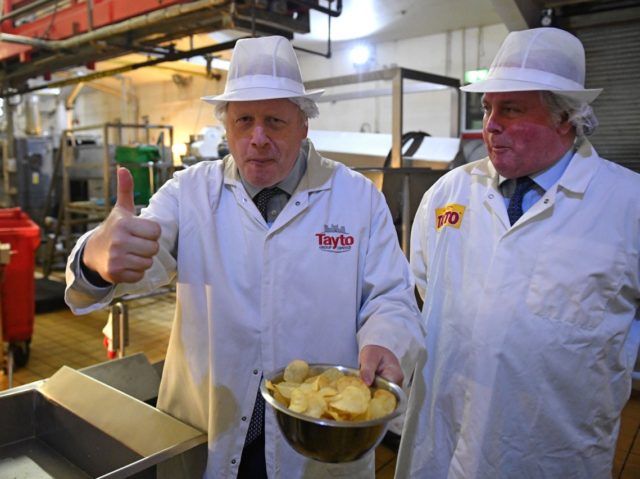
Britain's Prime Minister Boris Johnson (L) gestures besides Tayto Chairman Stephen Hutchinson (R) during a general election campaign visit to the Tayto Castle crisp factory in County Armagh, Northern Ireland, on November 7, 2019. - Britain's two main parties promised billions of pounds of investment for hospitals, schools and infrastructure …

The United Kingdom has once again defied the expectations of economists and project fear naysayers, enjoying the 13th quarter of growth since the 2016 Brexit referendum, outperforming Germany, and the Eurozone as a whole for much of the past two years.

The UK economy grew by 0.3 per cent in the third quarter of this year, meaning the country has enjoyed growth in 13 of 14 economic reporting quarters since the 2016 Brexit referendum, reports analysis in The Telegraph.
The new economic figures also take some wind out of the sails of a key Remainer argument, the claim that the economy is 3 per cent smaller than it would have been without the Brexit vote.
In his analysis of the latest economic good news, Ambrose Evans-Pritchard said: “Exaggerated claims by the anti-Brexit movement are part of an ideological battle within the UK and across the European political landscape. They are intended to shape opinion and change policy. They matter. They must, therefore, be confronted and debunked.” 
 He noted that since the EU referendum the UK has an accumulated growth of 4.9 per cent, compared to 4.7 in Germany and Belgium over the same time period. He also pointed out that the United Kingdom has outgrown the Eurozone over the past 7 quarters, with the UK growing by 2.2 per cent compared to 2 per cent growth in the Eurozone.
While the analysis conceded there could be an economic hit if the country ever did leave the European Union while the new realities of international trade settle in, Pritchard-Evans said it was a falsehood pushed by anti-Brexit activists to claim any had already taken place. Remain campaigners have persistently claimed that Britian needs to remain inside the European Union to perform well — just as a previous generation of campaigners before them through the 1990s into the 2000s claimed Britain needed to abandon the pound sterling and be a member of the Euro single currency to be a success.
Yet both claims have been proven false, not least by the United Kingdom’s persistent outperforming of major Eurozone economies including Euro currency members Germany and Italy. Germany’s slowing economic outlook, including its descent into what economists call a ‘technical recession‘ in past months, falling business confidence, and industrial orders have all come despite its membership of the European Union.
Indeed, if Germany’s economy contracts again in figures expected later this week, it will have entered a full-blown recession.
The good economic news came as Conservatives derided Jeremy Corbyn’s Labour Party for their exorbitant spending promises. Chancellor of the Exchequer, Sajid Javid, said last week that if elected the Labour Party’s spending plans would plunge the UK into an economic crisis ‘within months’.

Wednesday, 6 July 2016

Sterling slide is painful but what we need is a global deflation crisis

Britain faces a frightening array of economic risks if Parliament makes a mess of Brexit, but a sterling crisis is not one of them.

AMBROSE EVANS-PRITCHARD

6 JULY 2016 • 9:41PM

pound
The pound has had a spectacular fall but it is not such a bad thing
 in a deflationary world of currency wars
A weaker exchange rate acts as a shock absorber.  It cushions the downturn to some degree and strengthens our buffers against deflation. Those fretting about the inflationary risk of a lower pound are stuck in a timewarp, or living on the wrong planet.
Global bond yields are touching historic lows every day and signalling a deflationary depression into the next decade. This is not like the 1930s. It is worse.
Investors are so frightened - or so short of safe debt to buy - that Switzerland can borrow for 50 years at rates below zero, Germany and Japan for 15 years, and France and Holland for nine years. Roughly $10.7 trillion of sovereign debt and $1 trillion of corporate debt is now trading at negative rates worldwide.
British 10-year yields have collapsed to an all-time low of 0.73pc since the Brexit vote, and 30-year yields are down to 1.58pc. This would not be happening if the bond vigilantes had the slightest concern that Britain was heading into a stagflation trap.
Countries and blocs across the G20 are trying to drive down their currencies - or prevent them rising - hoping to pass the deflationary parcel to somebody else in a beggar-thy-neighbour world.
pound
Sterling's fall against the dollar is the sharpest since the Bretton Woods era, but it is less in other currencies CREDIT: BANK OF ENGLAND
As the central banks of the eurozone, Japan, Switzerland, and the Nordic states have discovered, it is very hard to devalue in these circumstances. This is the global context in which sterling is falling.
Mark Carney, the Bank of England's Governor, said on Tuesday that a weaker pound is a "necessary" adjustment and a tonic for struggling exporters. The Bank's Financial Stability Report offers a cool and clear analysis of what has gone right over recent days, and what could now go wrong. It is not seriously worried about sterling.
It warns that the epicentre of stress is in commercial property. The London market has frozen. Transactions fell by 53pc in the first quarter. Rental yields on prime West End offices have collapsed to 3.7pc, lower than the nadir of Lehman crisis.
Three quarters of small and medium-size companies rely on property as collateral for funding, so this could turn into a shock for the real economy all too easily. Six major institutions including Standard Life, Aviva, and M&G have suspended withdrawals from open-ended property funds, while Aberdeen has wiped almost £600m off the value of its fund, a sign of how rapidly the bubble is bursting.
You could argue that a weaker pound may ultimately help stabilise property prices as foreign investors move back into London in search of what is suddenly - for them - a bargain. This is what happened after the sterling slide in 2008.
Much of the stability report is surprisingly reassuring. Short-term loans to UK-based banks are 185pc of GDP, but most of this is owed by foreign groups operating in the City. Just a quarter is genuine UK exposure.
There has been no systemic seizure and no Lehmanesque stress in interbank lending. "Financial markets are doing their job. They have functioned pretty well," said Mr Carney.
As for sterling, it is trading exactly where it was in March 2013 when most people were not even aware of the exchange rate. The Bank of England's trade-weighted index has dropped to 78.5, a fall of 9pc over the pre-Brexit range, and 13pc since the start of the year. It is comparable to the devaluations of 1931 and 1992, both of which led to Gothic headlines at the time but ultimately proved benign.
The pound may have to fall yet further to restore equilibrium. The International Monetary Fund thinks it is still 3pc to 9pc overvalued even now based on the real effective exchange rate (REER) and other measures.
Or put another way, the REER has been creeping up for several years and was badly out of alignment in 2015. That is a key reason why the current account deficit ballooned to an all-time high of 7.2pc of GDP. It is not the only one, but it is the one most easily tackled right now.
pound
The UK current account deficit hit 7.2pc of GDP late last year, the worst in peace-time history CREDIT: BANK OF ENGLAND
And tackled it will be whether we like it or not because foreign investors are no longer willing to finance our insouciant levels of over-consumption. It was never sustainable to run the economy in this fashion. Brexit has merely brought forward what was going to happen anyway - in even less favourable circumstances - in the next global downturn. Count your blessings. Yes, it will erode real incomes. These were artificially inflated.
Whether we now muddle through or spin into a deep recession depends on whether our future prime minister comes up with a plan - and very quickly - that preserves full access to European markets and the passporting rights of the City, and prevents a collapse in investment. The majority of the country wants a compromise settlement by a large margin. That is what Parliament must impose.
George Osborne has already announced a cut in corporation tax to 15pc, and his "punishment budget" will never be heard from again. It is not enough. He should heed the call of Business Secretary Sajid Javid for a £100bn investment plan to steel the economy.
It is often said that a safe exit into the European Economic Area is a non-starter because it comes with obligatory free movement of EU migrants. This is not true. The EEA council approved immigration controls for Liechtenstein in 1997 and these later evolved into a quota system. The legal precedent exists.
This is purely a political issue. If Britain and the EU wish to resolve the dispute, they can do so easily, either with the Liechtenstein model or the Ukraine association model, which allows for much the same thing. All else is posturing.
What is imperative is that Conservative Party quickly dispels the narrative propagated by the entire global media that Britain is succumbing to reactionary nativism and turning its back on the post-war international order. Both the New York Times and the Washington Post ran stories after the vote deeming it to be the death of liberal globalisation. Variants of this corrosive theme have taken hold everywhere.
It is a little irritating since all we have done is to take back our sovereign self-government from a deeply dysfunctional organisation that has over-reached badly, plays fast and loose with democracy, and is itself a major cause of the crisis engulfing Europe. 
Britain is the first country to volunteer to lead one for the four NATO battalions being formed to defend the EU's eastern border in Poland, Lithuania, Latvia, and Estonia, and the Royal Air Force patrols the Baltics, two of many commitments that are a little too lightly overlooked.
pound
RAF jets are patrolling the Baltic states, defending the EU's eastern border CREDIT: NATO
Professor Alan Riley from City University says Britain should go further to demonstrate with absolute clarity to Washington and every European capital that the country is resiling from nothing and is an ally to be reckoned with.
He wants three British armoured divisions deployed in Germany or beyond, a Royal Navy squadron in the Baltic, and a boost in defence spending to 3pc of GDP to silence all talk of retreat and entirely change the strategic balance in what is now a disarmed and paralysed Europe. I agree. We need this anyway because the world is turning more dangerous by the day.
Sir John Holmes, a veteran diplomat and EU expert, told a forum at Chatham House this week that Britain could turn Brexit into a golden era of relations with Europe "if we play our cards right and in the right spirit".
"Paradoxically, it may be easier to work together once we are free of our own paralysing fear of supranational institutions and of abandoning our sovereign right to our own policy. Once the divorce is complete, we should be able to escape the endless wrangling," he said.
Sir John asked whether anybody really believes that the status quo ante was acceptable, or whether a narrow victory for Remain would ever have resolved the matter. The answer is obviously not, and if that is the case, what conclusions do you draw?
The task for the next prime minister is to convince EU leaders that it is better for everybody to have a good British neighbour rather than a truculent British tenant. She go to Brussels with a nuclear-armed smile.
http://www.telegraph.co.uk/business/2016/07/06/sterling-slide-is-painful-but-what-we-need-is-a-global-deflation/

Saturday, 2 July 2016

MUST READ: Was Brexit fear a giant hoax or is this the calm before the next storm?

Let us separate matters. We face a political upheaval of the first order, but this is a necessary catharsis. Governments come and go. So do political parties.

Ambrose Evans-Pritchard


We face a much more serious constitutional crisis. It is why some of us want a national unity government, keenly alert to the interests of Scotland and Northern Ireland.

As Professor Kevin O'Rourke from All Souls College argues here,  most Leavers waltzed into Brexit with scarcely a moment's thought for trauma inflicted on both sides of the Irish border. This carelessness must be rectified immediately.

What we do not yet face is a global financial crisis or a “Lehman moment”. The world’s central banks were ready for Brexit and have acted in unison.

The S&P 500 index of Wall Street stocks has shrugged off the vote. It is 13pc above its lows in February, when we really did have a nasty fright across the world.

Jerome Schneider from Pimco says there have been none of the tell-tale signs of systemic seizure. Rates on commercial paper have hardly moved. The Libor/OIS spread – the stress gauge – has been well-behaved. So have collateralised funding markets.

This may be no more than the calm before the real storm. The prime money market funds have much shorter maturities than in 2008, and this could lead to a “roll-over” crunch if fear returns. Assume nothing.

It was a dead certainty that the rating agencies would strip Britain of its AAA status. Standard & Poor’s told this newspaper before the vote exactly what it planned to do, and we reported the warning – not that it has made any difference to borrowing costs.

Carney: We are well prepared for Brexit
Carney: We are well prepared for Brexit Play! 04:23

More worrying is what S&P also said: that debt coming due over the next 12 months is 755pc of Britain’s external receipts and large sums have to be rolled over continuously. This is the highest for all 131 rated states, thanks to London’s role as a global financial hub. We will not know whether there is any mismatch, either in currencies or maturities, until the repayment deadlines hit and the skeletons come out of the closet. The test lies ahead.

What we have learnt from the market moves since Brexit is that Europe is just as vulnerable as Britain. The vote has already triggered a banking crisis in Italy, where the government is struggling to put together a €40bn (£33bn) rescue but is paralysed by the constraints of euro membership.

The eurozone authorities never sorted out the structural failings of EMU. There is still no fiscal union or banking union worth the name. The North-South chasm remains, worsened by a deflationary bias. The pathologies fester. 
Brexit
The pound has fallen hard but is still stronger against the euro than it was for several years, arguably too strong
The FTSE 100 index of equities in London is back to where it was on the eve of the vote, compared to falls of roughly 6pc in Germany and France, 10pc in Spain, 11pc in Italy, 13pc in Ireland, and 14pc in Greece.

My point is not that they we are in OK and that they are in trouble. That would be facile. The FTSE 100 is cushioned - or flattered - by the devaluation effect on foreign earnings of big multinationals. The broader FTSE 250 is a purer gauge, and that has dropped 8pc. Homebuilders Persimmon and Taylor Wimpey are still down by a third. It is not painless.

Yet it should be dawning on European politicians by now that the economic fates of the UK and the eurozone are entwined, that if we go over a cliff, so do they and just as hard, and therefore that their bargaining position is not as strong as they think. They cannot dictate terms.

How the world reacted to Brexit 
How the world reacted to Brexit Play! 02:26

Few seem to grasp this, much like the wishful thinking in September 2008 when so many supposed that Lehman posed little danger to them. Britain has "collapsed politically, monetarily, constitutionally and economically,” said Dutch premier Mark Rutte, almost seeming to enjoy the flourish of his own words. Our great ally William the Silent would not have been so frivolous.

Morgan Stanley says they need to wake up. It warns that the eurozone will suffer almost as much damage as Britain in a 'high stress scenario', and so do others. Danske Bank says the UK and the eurozone will both crash into recession later this year. 
Brexit
Morgan Stanley thinks the eurozone could suffer almost as much as the UK if Brexit is botched
If so - and that is not yet clear - it is hard to see how the eurozone could withstand such a shock, given the levels of unemployment and the debt-deflation dynamics of southern Europe, and given the intesity of political revolt in Italy and France.

Contrary to the supposition of Mr Rutte, the fall in sterling is a blessing for the British economy, and a headache for the eurozone. The exchange rate is acting as a shock-absorber, just as it did in 1931, 1992, and 2008,  all bigger falls, and all benign.

Devaluation strikes no fear in a chronic deflationary world where almost every major country is trying to push down its currency to break out of the trap, and largely failing to do so. It would facetious to suggest that Britain has pulled off this trick. Crumbling investor confidence is never a good thing. But the UK has stolen a march of sorts, carrying out a beggar-thy-neighbour devaluation by accident.

The pound needs to fall further. It is still too strong for a country with a current account deficit running consistently above 5pc of GDP. The International Monetary Fund said just before Brexit that sterling was 12pc to 18pc overvalued, and may have to fall more than this to force a lasting realignment of the British economy. 
Brexit
Britain's current account deficit is grotesque Credit: Morgan Stanley
This cure has hardly begun. As of today, sterling is 5pc below its trading range for the last month against the euro and the Chinese yuan. It is weaker against the US dollar but the dollar is on steroids, much to the horror of the US Treasury.

The more sterling falls, the greater the net stimulus for the British economy. The reverse holds for the eurozone. It is a further deflationary shock at a time when Europe is already in deflation, when inflation expectations are in free-fall and bond yields are collapsing below zero, and when the ECB is running out of options.

Osborne: 'Britain ready to confront what the future holds from a position of strength'
Osborne: 'Britain ready to confront what the future holds from a position of strength' Play! 01:06

There are two dangers for the world economy. One is that China is exporting deflation with alarming intensity. Morgan Stanley estimates that China's trade-weighted devaluation is running at an annual rate of 11pc, and factory gate deflation adds another 2pc. This is a tsunami coming from the epicentre of global overcapacity.
Brexit
Inflation expectations in the eurozone are collapsing, a sign the ECB is losing control Credit: Danske
The other danger is that British and European politicians fail to understand what is coming straight at them from Asia. Britain's Brexiteers must come up with a coherent policy on trade very fast, and the EU must come off their ideological high-horse and face the reality that they have absolutely no margin for economic error.

US Secretary of State John Kerry warned in stark terms on his post-Brexit swoop into Europe that nobody should lose their head, or go off half-cocked, or "start ginning up scatter-brained or revengeful premises."

John Kerry and Philip Hammond discuss Brexit 
John Kerry and Philip Hammond discuss Brexit Play! 01:38

Nobody seemed to heed his words at the EU's imperial summit in Brussels, an exercise in righteous anger but not much else. The markets may yet speak in harsher language.

http://www.telegraph.co.uk/business/2016/06/29/was-brexit-fear-a-giant-hoax-or-is-this-the-calm-before-the-next/