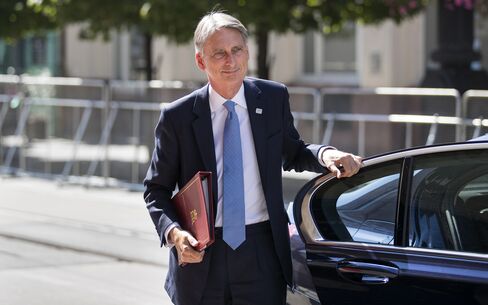
Following the shock resignation of Chancellor Sajid Javid, a new chancellor has been appointed.
By Tom EspinerBusiness reporter, BBC News
13 February 2020
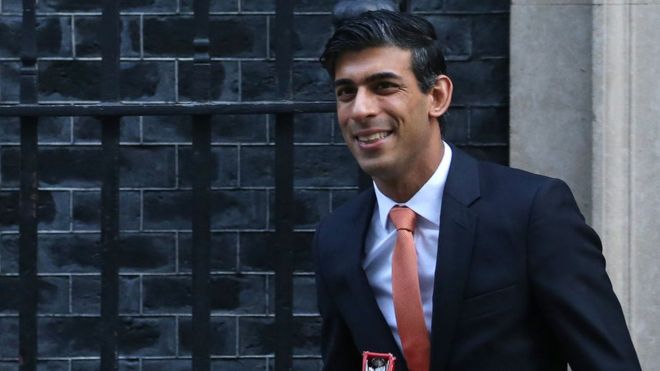
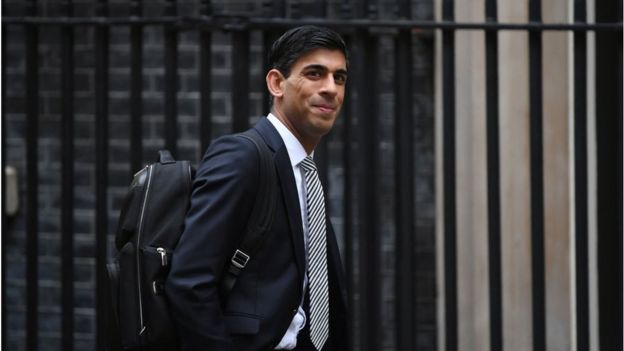
With just four weeks to go until the Budget, one of the main events in the calendar for the UK Treasury, Mr Javid has been replaced by 39-year-old Chancellor Rishi Sunak.
So who is Mr Sunak, and what is his background?
Mr Sunak has been the Conservative MP for Richmond in Yorkshire since 2015. He lives in Kirby Sigston, just outside the town of Northallerton.
His father was a GP, and his mother was a pharmacist. His parents - who are of Indian origin - came to the UK from east Africa.
He was born in 1980 in Southampton in Hampshire, and studied at the exclusive private school Winchester College.
Mr Sunak then went on to Oxford University to read Philosophy, Politics and Economics, a tried and trusted route for aspiring Westminster politicians. He also studied for an MBA at Stanford University.
Before entering politics he worked for investment bank Goldman Sachs and a hedge fund, then co-founded an investment firm.
His wife - Akshata Murthy - is the daughter of Indian billionaire and co-founder of IT services giant Infosys Narayana Murthy.
The couple have two daughters.
'The force is strong'
Mr Sunak campaigned for Leave in the EU referendum, and his constituency voted 55% Leave.
He voted for Theresa May's Brexit deal on all three occasions, and was an early supporter of Boris Johnson, making a number of media appearances in his support.
In July 2019 Mr Sunak was picked by Mr Johnson to be chief secretary to the Treasury, after being parliamentary under-secretary in the Ministry of Housing, Communities and Local Government from January 2018 to July 2019.
Image copyrightSAJD JAVID
Mr Sunak is seen as a rising star in the Conservatives, with endorsements from people including former Conservative Party leader Lord Hague of Richmond, who has described Mr Sunak as an "exceptional individual".
He was also endorsed by Mr Javid, who in a recent tweet said "The force is strong with young Sunak" in reference to a phrase from Disney's Star Wars franchise.
His hobbies include keeping fit, cricket, football and watching films, according to his website.
One of his childhood heroes was Southampton football player Matt Le Tissier.
"One of my prized possessions is an 18th birthday card signed by the entire Saints team, but Matt in the middle there, which I've still got," Mr Sunak told the BBC in an October 2019 interview.
'First generation immigrant'
Mr Sunak has said his Asian identity matters to him.
"I'm a first generation immigrant. My parents emigrated here, so you've got this generation of people who are born here, their parents were not born here, and they've come to this country to make a life," he said.
"In terms of cultural upbringing, I'd be at the temple at the weekend - I'm a Hindu - but I'd also be at the Saints game as well on a Saturday - you do everything, you do both."
Image copyrightGETTY IMAGES
In the interview he said he had been "fortunate" not to have to endure much racism growing up, but he said there was "one incident that sticks in my head".
"I was just out with my younger brother and younger sister, and I think, probably pretty young, I was probably a mid-teenager, and we were out at a fast food restaurant and I was just looking after them. There were people sitting nearby, it was the first time I'd experienced it, just saying some very unpleasant things. The 'P' word."
"And it stung. I still remember it. It seared in my memory. You can be insulted in many different ways, certainly in this job, but that stings in a way that is hard to explain."
However, he said he "can't conceive of that happening today" in the UK.
The Treasury has produced its 200-page report about the effects of Brexit on the economy. Predictably, it is highly negative. It is sad that the Treasury, for which I once worked for a few years, has become so politicised that it is reduced to rationalising the views of George Osborne.
Tuesday 19 April 2016 4:59 am
Tom Welsh Welsh Tom Welsh is City A.M.'s business features editor.
The modelling methods it has used to do Osborne’s bidding are the ones anyone would employ to rubbish Brexit. They involve estimating relationships over the past between such things as trade with the EU or Foreign Direct Investment, or tariffs and GDP. Unfortunately, as I pointed out in my book on the UK and the EU, these estimated relationships are highly unreliable when it comes to considering a whole new world of trading rules, which is what Britain would face after leaving the EU.
The basic point you have to ask is how the whole economy would react to the main alternative to our current regional EU rules, which is global trading rules under the World Trade Organisation (WTO). For this you need the sort of model I used in my book, a global world trade model. The results from such a model are perfectly intelligible to anyone and, what is more, they tally with what we all understand about free trade: that the wider the freedom we have to trade, the better the result.
Now consider what the EU arrangements we have actually are. The EU is a protectionist organisation known as a “Customs Union”; this raises barriers through tariffs and other non-tariff means against every country outside it. These barriers raise the price of goods sold inside the EU by the protectionist margin; so prices are higher for everything bought from anywhere that is protected against in this way. This is because, to sell into the EU, you must pay the tariff and also the extra costs of the non-tariff barriers.
The gainers from this Customs Union are the EU producers inside the protective wall: like children in a walled garden, they enjoy a cosseted life. EU producers sell their products inside the EU at inflated prices.
But the losers are the consumers who pay these inflated prices. It is a matter of some irony that our chancellor praises this Customs Union as a wonderful “free trade arrangement”! It takes your breath away that he should dare say this to UK voters and consumers. But of course they are blown away by his confident rhetoric, and who are they to argue?
When we measure the extent of the EU protective wall, we find that it is rather high, quite contrary to this rhetoric. Food prices are nearly 20 per cent higher on average, and average manufactured prices a bit more than 20 per cent higher. Even assuming, as I did in my book, that there is some reduction in this protection over time, to say 10 per cent on each, the overall effect of the EU on the consumer shopping basket is to raise it by 8 per cent – around £40 a week for the average consumer.
By leaving the EU, we move to global free trade; goods come in here from all over the world at world prices, without the EU add-on. Our consumers benefit. Our producers have to earn their way in the world at the true world prices of their products: the industries that do best will be our best industries, not our most protected ones.
But even the protected ones will not fare so badly: they will face world competition at home and they can still sell to the EU and pay the external tariff, which is only about 4 per cent on average. Under WTO rules, the EU would be unable to inflict the non-tariff barriers on them because our producers do not “dump” and they completely adhere to EU regulations already.
People ask: can we rely on the WTO to police these rules? Yes we can: the WTO is an active and powerful system of international courts that all members highly respect. Since all countries, including the US and the EU, use it repeatedly against others, they obey its judgements when they go against them. It enforces non-discrimination, the “most favoured nation” principle: that is all we need outside the EU because it means we sell our goods on a world market where no-one can arbitrarily discriminate against us, including the EU.
By leaving the EU, we go to global free trade and we rid ourselves of the intrusive EU regulation that bears down most heavily on our smaller firms who cannot afford huge HR and compliance departments. The gains to our economy from this are huge, as anyone would readily expect. The trade gain amounts to 4 per cent of national income, directly enjoyed by our voters even after spending some of it helping out those affected producers, including our farmers. The gain from getting out of the heavy-handed regulation of our whole economy by the EU is more again, and a boost to our growth rate. The Treasury report gets it precisely the wrong way round.
Patrick Minford is professor of applied economics at Cardiff Business School and author, with Sakshi Gupta, Mai Le, Vidya Mahambare and Yongdeng Xu of “Should Britain leave the EU?” (Edward Elgar, second edition, 2015).
City A.M.'s opinion pages are a place for thought-provoking views and debate. These views are not necessarily shared by City A.M.
There will soon be a sequel, analysing what the short-term impacts of leaving the EU might be. One doubts you’ll need the foresight of those who successfully predicted a Leicester City Premier League victory to guess what this will conclude.
Yet the economic methodology of the Treasury’s work really does need to be questioned. Due to the rapid response nature of modern media, it was impossible for those favouring Brexit to offer up a thorough critique of the first report quickly. One could only show it was riddled with bizarre assumptions. Not least, it assumed away by construction any benefit of Brexit in terms of signing third-party trade deals or deregulating the economy.
For those on the Remain side, of course, it sufficed to merely herald the Treasury’s results as reflecting the “economic consensus”. Surely if anything has been proven in the economic history of post-war Britain, it is that economic consensuses are a weak appeal to authority.
To fill the void of analysis on the Treasury study comes the second publication by the new group Economists for Brexit. In this report, professor Patrick Minford provides an accessible history of trade theory before critically evaluating the Treasury’s work.
Minford explains that the way the Treasury models Brexit is to focus on “openness”, the sum of imports and exports relative to GDP, and foreign direct investment (FDI). These two factors are each assumed to follow a so-called gravity model – where openness is related to things such as distance – estimated from multi-country data. The degree of openness and FDI are then assumed to determine productivity – the ultimate driver of living standards, estimated from industrial data. Finally, this productivity effect is added into a macro model to find the general effects on investment, GDP etc.
The broad story the Treasury tells is thus this: Brexit will make the UK less open and less attractive for FDI. This will lead to lower productivity and therefore less investment and lower living standards.
There are several major problems with this method. The first relates to identifying the effect of EU membership per se. In order to find this, large regressions over time and across countries are run to isolate the “EU effect”. But this is estimated using a binary assessment of whether a country is in or out. This throws up all sorts of potential biases because it calculates the EU effect across periods with many other different policies. Many of these factors may be related simultaneously to a country’s openness or FDI and its decision to be an EU member.
The second problem is that the Treasury modelling assumes that openness and trade drive improved productivity. While intuitive and in many cases true, this need not be the direction of causation. In fact, it might be that an industrial shock can cause increased trade, FDI and productivity simultaneously. In other words, the UK may receive FDI precisely because an industry becomes more productive. To assess how Brexit would affect this, you’d need to do far more extensive work on industries and causal testing than the Treasury attempts.
Finally, the Treasury comes to vastly different conclusions to Minford’s previous Economists for Brexit modelling (which suggests that we would be better off out of the EU) primarily because it assumes that, if we leave and do not sign a trade deal or remain in the Single Market, Britain will maintain EU-style tariffs on EU partners and non-EU trading partners who have EU trade agreements. These assumptions therefore generate large effects on openness and on FDI – and hence living standards.
In fact, if instead Britain were to adopt unilateral free trade (abolishing all tariffs), exiting the EU’s protected customs union would lead to UK consumers enjoying lower prices and would shift the structure of production towards non-protected sectors, enabling us to focus on real areas of comparative advantage and raising productivity. We would, of course, have full control over regulation too.
The need for a smoothed transition may prevent this “big bang” disruptive approach. As Roland Smith of the Adam Smith Institute pointed out this week, the government and Parliament that will negotiate our exit settlement will be overwhelmingly pro-Remain and may well choose the least disruptive short-term path: remaining in the Single Market in the European Economic Area. But the largest long-term gains from Brexit require an independent, free-trading Britain.
City A.M.'s opinion pages are a place for thought-provoking views and debate. These views are not necessarily shared by City A.M.
For the UK’s economic establishment, particularly forecasters, introspection is more appropriate. Complete with their New Keynesian models, most have been proven utterly wrong so far that voting for Brexit would lead to a short-term downturn ...
Forecasters implicitly made judgements on long-term political outcomes for which they had no particular expertise (Source: Getty)
The end of a calendar year and the start of a new one provides a chance for reflection.
For the UK’s economic establishment, particularly forecasters, introspection is more appropriate. Complete with their New Keynesian models, most have been proven utterly wrong so far that voting for Brexit would lead to a short-term downturn. As the most significant economic event since the financial crisis, this is some failure.
Much proverbial ink has been spilled in recent weeks about what this “failure to forecast” tells us about the underlying economics. Was it simply some faulty assumptions or fundamentally misguided models? Did modellers take for granted things that are as yet unknowable? Are their models better for short-term analysis but just bad for the long-term assessment in hand? Some of the country’s top economic commentators and forecasters are currently jousting on these questions via email. Sadly, those whose forecasts have proven so faulty have not offered up any rigorous assessment of why they failed.
I do not claim to have all the answers either. But the lack of humility has been astonishing. In a recent Times article defending the Treasury and other forecasting bodies, David Smith explained away the Treasury’s mistaken prediction of recession by claiming they had not appreciated the Bank of England might act, nor that Article 50 would not be triggered straight away.
This is dire sophistry. That these two things could swing an economy from immediate recession to sustained growth goes against most received knowledge about the time lags through which monetary policy operates and the forward-looking nature of consumers and investors.
If we really want to improve policymaking, far more self-critical analysis needs to be undertaken on both the assumptions of the analysis and the nature of these models in the first place.
The importance of this cannot be understated. As John Llewellyn outlined in an interesting Financial Times article, forecasting as a general concept is very important in facilitating planning. Get it wrong, and the results can be disastrous. And the truth is that economic forecasting, in seeking to predict the results of billions and billions of daily choices, actions, purchases and investments, is likely to be less easy than that in many scientific fields. This requires acknowledging uncertainties and the limits of knowledge.
That something is difficult does not mean one should not try, of course. But that something is difficult does not mean one can explain away large errors by repeating that the task is difficult.
This long-term finding that Brexit could only have downsides, and make us poorer, was fed into shorter-term forecasts. Customers and investors, foreseeing a worse economic outlook, would (it was thought) cut investment and spending now. Add in the uncertainty of political negotiations, and a short-term downturn looked inevitable.
This was not forecasting per se, but scenario analysis fed into forecasts. At least one problem of the forecasts then was that forecasters implicitly made judgements on long-term political outcomes for which they had no particular expertise. They overreached, without acknowledging this clearly in public debate. Since the referendum, economic agents are not acting as if they expect Brexit to be economically disastrous, of course. Maybe the voters have more faith in our political processes developing better outcomes on trade and regulation than the experts envisaged!
But biased assumptions only get us so far in explaining away failures. These models also seem less adept at ever foreseeing anything out-of-the-ordinary occurring (see the financial crisis), or predicting downturns and recoveries (see 2010 to 2013).
Theses could be written on why. But as a starter, you might be surprised to learn that the basic models utilised by the alphabet soup of acronyms mostly do not even incorporate modelling of banking and money, an observation long-lamented by the economist professor Tim Congdon. If such components of modern economies are missing, then what hope have these models of assessing fundamental policy regime change, such as Brexit?
If this all seems like a lament without a solution, it is. Economies are complex organisms, and there’s not a top-down answer or perfect replacement model available. What we must hope for is that Brexit can catalyse the humility necessary for continual improvement. Forecasters should spell out their assumptions and model limitations more clearly. And we, particularly the media, must always be careful not to raise them to the pedestal of truth. How’s about that for two geeky New Year Resolutions?
Once an unrivaled center of power within government, the department is now being sidelined in its push to maintain some access to the single market once the U.K. has left the European Union. This has ...
Chancellor being sidelined in his push for free trade ties
BOE sees many negotiating objectives floated to be unrealistic
The U.K. Treasury is feeling under siege.
Once an unrivaled center of power within government, the department is now being sidelined in its push to maintain some access to the single market once the U.K. has left the European Union. This has resulted in Chancellor of the Exchequer Philip Hammond clashing with colleagues including Brexit Secretary David Davis, who favors a more radical break from the EU, and to be excluded from some meetings, according to Treasury officials who asked not to be named.
The sense that Hammond is fighting for status may add to concern in financial markets that Prime Minister Theresa May’s government is putting a reduction in immigration ahead of the potential economic benefits from Britain’s continued membership of the single market.
A weekend of newspaper revelations fanned speculation of a split. The Telegraph and the Times reported a growing rift between the Treasury and the rest of the government over migration controls, while the Mail on Sunday suggested that Hammond may be on the brink of resigning over the differences. The prime minister’s office expressed confidence in her chancellor on Monday.
“We need to stop perceiving people as Remainers and Leavers,” said Gerard Lyons, a pro-Brexit economist who advised Boris Johnson when he was London mayor and is now chief economic adviser at Policy Exchange. “The cabinet has to start looking at what’s the best for the U.K.”
The finance ministry has found sympathy at the Bank of England, where the lack of common ground over Brexit among ministers has caused concern with some monetary policy makers considering the strategy now being outlined as unrealistic. Governor Mark Carney himself has publicly skirmished with May, saying officials won’t “take instruction” from politicians after her recent comments highlighting the costs of ultra-loose monetary policy.
May, who has promised to trigger formal Brexit negotiations by the end of March, is unlikely to be guided by Hammond, who is acting more as a mitigator between some of the government’s more hardline ideas and a business community increasingly alarmed by the prospect of a “hard Brexit,” the officials said.
Soft Immigration
While Hammond, who campaigned to stay in the EU, has given up hope the U.K. will remain a member of the single market, he still favors a softer Brexit than many of his cabinet colleagues on issues such as immigration, as he wants to prioritize agreements mirroring single-market access for the finance industry, the officials said. He is keen to keep Britain open to skilled workers, particularly in the financial sector, and wants a longer period of transition to allow the City of London to adapt to the new relationship with the EU.
The need for a measured change was echoed by Bank of England Deputy Governor Jon Cunliffe, who told lawmakers on Oct. 12 that Brexit needs to happen in a “smooth and ordered way.”
Banking Concerns
Concern among bank chiefs is mounting. Much of Hammond’s trip to the U.S. this month was spent softening the perception that a hard Brexit is inevitable. Meetings with executives from banks including Morgan Stanley and Goldman Sachs Group Inc. in New York focused on allaying concerns Britain may abandon many of the EU agreements that lenders see as essential to maintaining London’s dominance as a financial center.
Unfortunately for the City, Hammond does not have the influence on May that his predecessor George Osborne had over David Cameron. May has kept the chancellor in the dark about much of her strategy, and does not share his desire to prioritize the needs of the City.
Hammond is also at odds with Davis and Trade Secretary Liam Fox over their push for Britain to leave the customs union, expressing concerns about the potential costs.
WTO Rules
Britain has two years to clinch a Brexit deal once Article 50 of the Lisbon Treaty, the formal process for leaving the EU, is triggered. If it fails, companies would be subject to trade tariffs under standard World Trade Organization rules. When the Times newspaper reported what it said were leaked government papers suggesting Britain could lose 66 billion pounds ($80 billion) a year under such a scenario, there was criticism the Treasury was still biased against Brexit.
The prime minister has “full confidence” in Hammond and his work, spokeswoman Helen Bower told reporters on Monday.
She has evaded talk of a rift with Carney, who has yet to announce whether he’ll stay on as governor for a full eight years.
“The prime minister is clear in her support of the governor and the leadership he’s shown in last few months,” Bower said.
Khan also warned against the impact of migration reform on the City (Source: Getty)
London mayor Sadiq Khan is pushing the Treasury to announce fresh devolution of powers to London within weeks.
Speaking exclusively to City A.M., Khan said he had recently met with Philip Hammond, and was optimistic the chancellor would make an announcement in the Autumn Statement. Khan also expressed fears that any reform to migration might hit City employers.
Hammond will take to the despatch box for his first fiscal event as chancellor on November 23.
“I've been impressed by the willingness of the government to recognise that London is the powerhouse for our country,” Khan said.
“More so now than ever before the government needs to give Londoners more control over our city.”
New York mayor Bill DeBlasio controls education, skills, healthcare and social service systems, as well as taxes on income, tobacco, alcohol and property, on top of equivalent powers in Khan's remit of housing, transport and policing.
“There's a coalition that we have formed with business leaders, businesses, the City of London Corporation, council leaders and London MPs of all parties and we all agree that London needs more control.
“The government understands that and I'm optimistic that there will be good news from the government in the Autumn Statement. I certainly hope so.”
And Khan added that his officials are drafting proposals to prevent any national reforms to migration harming City businesses.
“Whether it's insurers or banks or tech entrepreneurs, a key concern they have got is whether losing EU membership will mean they find it more difficult to get talent to London,” he said.
“The government recognises that.”
He added a London work permit is one possibility being evaluated at City Hall, although he admitted the finer details of how such a scheme would operate are still being finalised.
“There are business groups working with us on how we can make it work, and we are still working on the details, but the main thing is that the government recognises those concerns,” Khan said.
“We can't afford to give the impression that we are going to stop being open minded or outward looking.”
In this, my last column before D-Day, I want to discuss some key features of the case for Brexit that, in my view, have been misrepresented or ignored.
The Treasury, and some other bodies, have subjected the Brexit option to trial by macro-economic model. Various assumptions were fed into a series of equations which, on the basis of past experience drawn from a number of countries, are supposed to embody wisdom about how the key economic variables will respond. The model whirred and then spewed out forecasts for our post-Brexit future.
These methods are unsuitable for assessing the impact of such a seismic politico-economic event. Moreover, the assumptions that have been plugged into the models have typically been bizarre. For instance, the Treasury study assumed no regulatory changes.
The Treasury's models made some surprising assumptions
Equally, it assumed we would not be able to do any new trade deals with the EU or anyone else. Nevertheless, we would continue to impose the EU’s tariff on imports from the rest of the world. No wonder this exercise concluded Brexit would cause an economic loss from reduced trade.This conclusion derives further loss from lower investment and even weaker productivity growth. But if trade does not fall, there is no reason for these effects to occur.
To these trade-related effects is added the impact of uncertainty, which will supposedly persuade people and companies to defer spending. Yet if there is a loss of confidence after Brexit, the responsibility for this will rest with the Prime Minister and Chancellor for spreading pessimism about our prospects outside the EU.
David Cameron will have to take responsibility for spreading pessimism about the impact of Brexit Credit: Valentina Petrova
In fact, a loss of confidence could be addressed by an appropriate policy response. Admittedly, the Chancellor has warned that interest rates would have to go up. But the City is assuming that the Bank of England would reduce interest rates. I know who I would rather believe.
Meanwhile, a Brexit-inspired fall of the pound is being portrayed as a disaster, just as it was before our ejection from the ERM in 1992. In fact, just as happened then, this is exactly what the economy needs.
Forget the Government’s attempts to scare you – focus on five key issues:
First, over the past two decades, the EU’s average growth rate has been low by comparison with almost all other developed countries. The most important reason is the introduction of the euro, which has devastated the economies of southern Europe. But even Germany has not grown strongly and France is weaker. The euro was not an accident. It was introduced as part of “the European project”. Heaven knows what further delights Team Europe has in store.
Second, you do not need a trade deal in order to trade. Britain does not have a trade deal, for instance, with the US. Nor do you need to be an EU member to trade with “the single market”.
The US, China, India, and countless other countries export successfully into the EU without belonging to it. Indeed, their exports to it have risen faster than ours. So much for the much-vaunted sitting at the table when regulations and standards are debated and established. These countries don’t have a seat at the table nor a single MEP or EU commissioner, but this doesn’t hinder their exports.
The City might see some financial companies leave because of Brexit, but the majority would remain Credit: REUTERS/Metropolitan Police
Third, although the loss of “passporting rights” may cause some financial business to move from the City to European centres such as Paris or Frankfurt, most would remain. Moreover, this is just one part of a more complex whole. The City has already felt the icy touch of the EU’s regulatory tentacles. There could be much worse to come. One of the greatest threats to the City’s prosperity comes from the EU’s potential imposition of a financial transactions tax. The City can thrive outside the EU.
Fourth, suppose the euro finally collapses, with new currencies having to be constructed and, for a time, financial and economic chaos reigning across Europe. We would be better able to withstand the blow if we were outside the EU.
Fifth, the EU’s direction of travel is towards more integration and heavier regulation, which would bring added costs to business.
If the euro collapses, Britain having its own currency will bring advantages
Several of the points I make here against EU membership apply to what may happen in the future. Some on the Remain side see these as serious dangers but they deploy a beguiling counter-argument. If the EU does turn into the economic and political monster that many have been warning about, that is the time to leave, not now. We should stay, do our best to improve matters, and see how things turn out. We have an option, which we can choose to exercise later.
This is extraordinarily naive. It has taken more than 40 years since the last referendum on the EU for us to be given the chance to vote again. It might be another 40 years until the next one. By that point, unless you think the Prime Minister’s “renegotiation” has protected us, surely it would be too late. Britain as we know it would have dissolved in some common European mush.
If this is not an attractive prospect, then do not let economic fears, or the self-interested bluster of big business, or the model-based prognostications of the gloom merchants deflect you. There is a strong economic argument for Brexit that sits alongside all the others. It is really quite simple. It is about taking control and running our own affairs, just like plenty of other thriving non-EU countries around the world.
The Remainers say the issue of our EU membership will affect the future of our children and grandchildren. They are right. It is just the conclusion that they have got wrong.
Roger Bootle is executive chairman of Capital Economics. The new referendum edition of his book, The Trouble with Europe, is published by Nicholas Brealey.
 SAJD JAVID
 GETTY IMAGES