Gravitas Plus:
Premiered on 19 Jun 2021

Gravitas Plus:
Premiered on 19 Jun 2021

China’s state-run Global Times ran an op-ed Wednesday denying charges that Beijing is using huge “Belt and Road” infrastructure loans to buy political influence in Africa.
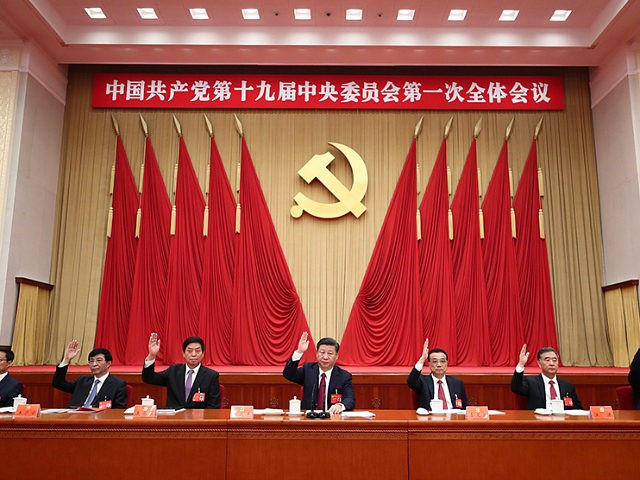
The Global Times wrote that African entrepreneurs are hailing “China’s offer of $60 billion in financing for the development of the continent” and anticipating “huge business opportunities in the future.”
The latter talking point is an effort to refute allegations that some of the expensive projects Beijing is bankrolling in Africa can never turn enough of a profit to repay the loans. China’s response is that Belt and Road projects are necessary to access Africa’s oil and mineral wealth, which will generate the profits needed to make the loan payments.
As for the loans that have so many observers worried, the Global Times found analysts who said there is little reason to worry about huge debt loads taken on by private corporations in Africa. The theory is that China would only be able to use its loans as political leverage if African government entities were borrowing all the money. Also, Chinese leaders promise they have no political motivations and would never dream of interfering in the governance of African nations.
This defense is disingenuous for several reasons, not least of which is that the line between private corporation and public entity has a way of blurring in the Third World. Even when African governments do not wholly or partially own corporations, they would likely feel obliged to step in to prevent the collapse of major enterprises. And in any event, African government entities are borrowing huge amounts of money from China, in many cases crossing the threshold of debt above 50 percent of GDP, which is considered dangerous for developing economies.
Even as the Global Times was publishing its apologia, news broke that Sri Lanka is even further in debt to China than previously believed, and Sri Lanka already lost an entire city to its Chinese creditors. Sri Lanka’s total debt load currently stands at roughly 77 percent of its GDP.
The Global Times defensively insisted that Chinese loans are not “free money” for Africa, which is exactly the point: the money comes with strings attached, but the strings are woven of pure Chinese geopolitical interest. Those strings are longer and harder to see than the fiscal reforms demanded by Western lending institutions.
Chinese loans look attractive to Third World governments precisely because they do not expect the kind of fiscal discipline the International Monetary Fund does. Instead, the Global Times frets over establishing anti-corruption measures to ensure “good governance” and prevent local “corruption and bureaucracy” from hindering Chinese investment. That sounds a lot like the kind of interference with local government China supposedly avoids.
It should also be noted that even some defenders of Beijing’s lending policies to Africa have complained about policies that require Chinese companies to be hired for work on projects financed with Chinese loans.
The L.A. Times on Monday detected a growing backlash from within China against Belt and Road, despite incessant government propaganda, as Chinese citizens wonder why so much of their national wealth is being diverted to other countries.
“Why is China, a country with over 100 million people who are still living below the poverty line, playing at being the flashy big-spender? How can such wanton generosity be allowed?” law professor Xu Zhangrun asked in July.
China’s extravagant spending in Africa was one of the topics 84-year-old retired professor Sun Wenguang was talking about in early August in a live interview with Voice of America when police barged into his home and dragged him away. Sun was released after ten days but said he believes he is still under surveillance. His wife was forced to issue a false statement that the couple went on vacation.
https://www.breitbart.com/asia/2018/09/05/china-insists-loans-to-africa-are-not-free-money/
Countries already deeply indebted to Beijing through its Belt and Road Initiative (BRI) face increasing economic hardship caused by the Wuhan coronavirus pandemic, the South China Morning Post reported on Tuesday.
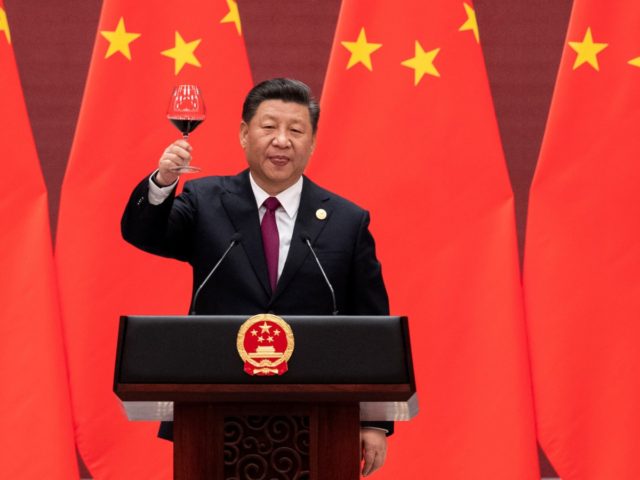
China uses the BRI to establish economically predatory infrastructure projects across the globe, expanding its sphere of influence. Chinese loans fund infrastructure projects in over 100 developing nations across Asia, Africa, Europe, and Latin America through the BRI, an initiative estimated to be worth $8 trillion.
According to the Center for Global Development (CGD), 15 out of 68 BRI partner countries face a significant risk of debt distress due to economic challenges caused by the Wuhan coronavirus pandemic.
Many countries around the world have practically shut down their economies in an effort to comply with mandatory government lockdowns meant to curb the spread of the Wuhan coronavirus, significantly disrupting global supply and demand chains. For heavily indebted countries like China’s BRI partners – already struggling before the Wuhan coronavirus pandemic – the looming economic recession may spell disaster.
In Africa, Niger and Angola will likely encounter difficulties. Ecuador, run by pro-China socialists for much of the decade, and Venezuela, rapidly approaching failed state status, are among the more at-risk Latin American countries. The study noted that smaller economies in Asia such as Laos, Cambodia, and the Kyrgyz Republic may also fall deeper into debt.
Experts estimate that developing countries’ “hidden debts” to China totaled $380 billion before the emergence of the Wuhan coronavirus pandemic.
BRI loans often require debtor nations to use specific Chinese contractors and materials for their infrastructure projects, in a practice known as circular lending. These Chinese contractors include Huawei, ZTE, China Harbor Engineering, and China Road and Bridge Corporation (CRBC). China demands massive amounts of collateral for loans, crafting a “debt trap” for impoverished nations.
In 2017, Sri Lanka handed over a port to China in an effort to pay off its BRI debts. Having defaulted on BRI loans to Chinese firms, the nation formally surrendered the strategic port of Hambantota to China on a 99-year lease, in a deal that threatens Sri Lanka’s sovereignty.
The warning for BRI-member economies comes as Chinese state media recently criticized the U.S. and Europe for wanting to restart their economies amid the ongoing coronavirus pandemic.
“An economic shutdown can be more detrimental to the ruling parties of the U.S. and European countries than the pandemic,” an editorial in the People’s Daily, an official Chinese Communist Party (CCP) newspaper, claimed on Tuesday.
“For the U.S., it is a capitalist country after all, where maintaining economic activities is given higher priority than humanitarianism and is the basic way to keep society running,” the author added.
https://www.breitbart.com/economy/2020/04/16/belt-and-road-debts-to-china-skyrocket-under-coronavirus-lockdown/
Beijing uses its Belt and Road Initiative (BRI) infrastructure projects in Africa to embed Chinese surveillance technology into government buildings and telecommunication networks, according to a report published Wednesday by the Heritage Foundation.
This enables the Chinese Communist Party (CCP) to spy on and better manipulate top government officials, furthering its influence across the continent and throughout the world.
In Africa, Chinese contractors have built at least 186 government buildings and at least 14 “sensitive intra-governmental telecommunication networks.”
In addition, the Chinese government has donated computers to at least 35 African governments in recent years.
“[A]t least 40 of Africa’s 54 countries have a government building constructed by a Chinese company,” according to the report.
The danger of China’s access to official African government buildings became clear in 2018 when reports surfaced that Beijing had been spying on the African Union (AU) headquarters building it constructed for at least the past five years.
[S]ervers installed by the Chinese telecommunications giant Huawei in the African Union headquarters were daily uploading their content to servers based in Shanghai, China.
An inspection of the building—built by the state-owned China State Construction Engineering Corporation—also uncovered listening devices hidden throughout the building.
Although the CCP’s ruthless spying tactics are well established – especially with regard to its stealing technology and intellectual property from the West to build up its own formidable tech industry – the systematic espionage by China in Africa stands out. This is due to Beijing’s extensive and numerous BRI projects there, which allow China unprecedented access to sensitive government data.
By requiring African nations to use Chinese contractors to build the infrastructure – in this case, government buildings and telecommunication networks – Beijing provides itself with a unique opportunity to implant Chinese surveillance technology into the projects from the ground up.
According to the report, China’s outsized presence on the African continent, of which it is the single largest creditor, provides Beijing with “better surveillance access to Africa than anywhere else.”
In recent years, Africa’s internet and cellular industries have been dominated by Huawei, China’s premier telecom giant. The company has been contracted to help construct a vast amount of Africa’s telecommunication backbone.
At the behest of the CCP, Huawei has dutifully embedded its signature “safe city system,” a monitoring apparatus used by China to spy on its own citizens, into the cyber networks of certain African nations.
According to the report, “Chinese law requires that internet companies cooperate with the Chinese government to reduce users’ anonymity. Chinese government documents reveal that data collected from ‘smart city’ technology is sent back to China for analysis that helps the CCP in its public diplomacy efforts.”
The report details Huawei’s prevalence in Africa, which continues to grow:
Huawei has built more than 70 percent of the 4G telecom networks in Africa and is proceeding with plans to deploy 5G networks on the continent. Huawei, ZTE (another Chinese telecommunications giant), and other Chinese telecoms have built and/or equipped at least 14 government networks, including dedicated military and police telecoms systems.
In Uganda, Huawei has secured several major contacts in recent years, building the majority of the country’s 3G and 4G cellular towers.
In 2018, authoritarian ruler Yoweri Museveni’s government contracted Huawei technicians to hack into opposition leader Bobi Wine’s personal cell phone data. Government security forces used the data to carry out a surveillance operation on the politician that resulted in his capture and physical torture.
According to the report, “[t]he risk to U.S. companies [by the CCP] is perhaps higher than it has ever been.”
Over the past few years, China has increased its espionage of U.S. technology and intellectual data, stealing America’s commercial secrets as part of a greater objective known as “Made in China 2025.”
The stratagem, proposed by Chinese dictator Xi Jinping, aims to “lessen Chinese dependence on Western technologies, and gain leverage against Washington in the ongoing trade war,” according to the report.
Systematic espionage remains one of the CCP’s key weapons in its escalating war against the West, whose ultimate goal is to enact a global shift in power from the U.S. and Western nations to China and its Communist party system.

Chinese Communist Party Chairman Xi Jinping's grand thoroughfares are now global in scope, extending as far as Djibouti, a strategic maritime chokepoint in Africa, just west of the Arabian Peninsula, or Ecuador, home to South America's third-largest oil reserves.
The economic benefits, however, of some of these deals between China and poor "Third World" countries in Africa and Latin America are questionable. A few of these bilateral packages appear contrived to imprison already impoverished states into realms of permanent economic vassalage to China.
The objectives of China's global BRI programs are clearly as much strategic and political as they are economic. BRI projects seem not designed so much to win new friends as to win new dependents, especially in areas either neglected by the West or in the Western sphere of influence.
The ultimate objective of the global dimension of China's BRI enterprise appears to be geared toward replacing the existing political, military and economic dimension of the West's liberal democratic order -- again not surprisingly -- with one dominated solely by the Communist Party of China.
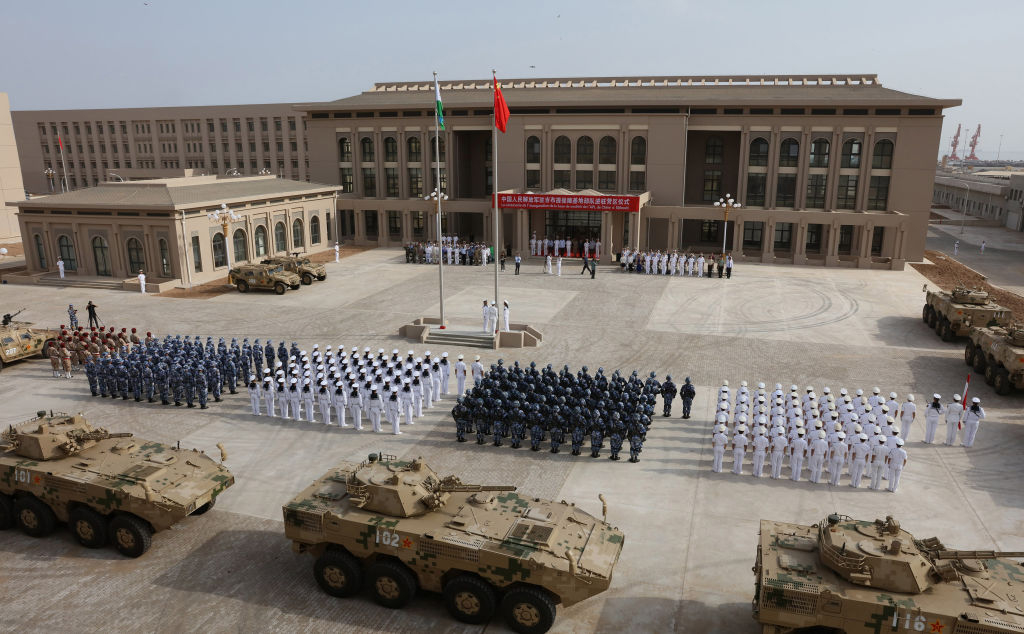 Chinese Communist Party Chairman Xi Jinping's grand thoroughfares are now global in scope, extending as far as Djibouti, a strategic maritime chokepoint in Africa, just west of the Arabian Peninsula, or Ecuador, home to South America's third-largest oil reserves. Pictured: Soldiers of the Chinese People's Liberation Army at the opening ceremony of China's military base in Djibouti, on August 1, 2017. (Photo by STR/AFP via Getty Images) |
Chinese Communist Party Chairman Xi Jinping's signature foreign policy proposal has been the "Belt and Road Initiative" (BRI) commercial and strategic program. At first, the network was pitched as a restoration of the ancient overland trade route, the "Silk Road," that linked China to Europe. This "New Silk Road," like its predecessor, would traverse the vast steppes of Central Asia -- but the contemporary BRI is allegedly meant to serve also as an economic boon for all the countries along the route.
Xi quickly followed the overland BRI with a maritime version, presumably to connect Chinese ports on the South China Sea to seaports in the Indian Ocean, continuing on to the Middle East states and ultimately reaching European ports. Initially, these proposals had only involved countries along BRI routes. Now Xi's grand thoroughfares are global in scope, extending as far as Djibouti, a strategic maritime chokepoint in Africa, just west of the Arabian Peninsula, or Ecuador, home to South America's third-largest oil reserves. The economic benefits, however, of some of these deals between China and poor "Third World" countries in Africa and Latin America are questionable. A few of these bilateral packages appear contrived to imprison already impoverished states into realms of permanent economic vassalage to China.
The BRI networks clearly intend to benefit China, either by stimulating an enormous increase in commerce, or, when debts cannot be repaid, by appropriating whatever assets China selects. China, as the world's largest importer of oil, will be able to diversify its sources of petroleum as a consequence of several bilateral BRI deals. China most likely also hopes to secure political benefits through BRI arrangements. Countries participating in China's BRI, and generally friendly to the US and its allies, might shy away from supporting the West's national security concerns for fear of losing large Chinese investments in their local economies.
There is already plenty of evidence concerning some BRI participating states of muting criticism of China's poor record on human rights. Many Islamic countries, for example, remain silent on China's near-genocidal treatment of millions of Muslim Uyghurs in its northwestern province of Xinjiang. Some Muslim states have even praised China's domestic policies toward Xinjiang's ethnic Uyghurs. Not one Muslim-majority state voted to condemn treatment of the Uighurs in support of the West's UN resolution to publicly sanction Beijing.
Critics of China's BRI program point out that Chinese loan agreements lack transparency and that contracts sometimes serve China's interests in a racketeering way, oblivious to local concerns. Sri Lanka, for instance, after having failed to meet its debt obligations to China, ceded the port of Hambantota to Beijing. Venezuela delivers oil to China instead of its worthless currency. Ecuador, in the first full year of Xi's presidency, already was exporting 90% of its oil to China, perhaps even below the world market price. In addition, Ecuador cannot seem to prevent the rape of its marine life just on the edge of its sovereign maritime economic zone by hundreds of Chinese fishing boats near the Galapagos Islands. "They just pull up everything!" said a sea captain who asked not to be named.
Critics also accuse China of favoring BRI contracts with countries that have authoritarian regimes. Beijing has invested in Zimbabwe in Africa, Laos in Southeast Asia, and Venezuela in South America. A new, particularly ominous Western criticism is that China distributes its facial recognition technology to BRI-affiliated countries where Chinese surveillance systems have been installed, in states such as Bolivia, Venezuela and Ecuador.
China's disregard for the human rights of its own citizens not surprisingly extends to the rights of the citizens of its host nations. China's extraction of raw materials and minerals in Ecuador, for instance, has elicited protests by the Shuar and Waorani natives, concerned about the environment. While some of China's infrastructure projects are beneficial but costly -- such as the construction of a rail line in Kenya from the capital Nairobi to the main port of Mombasa -- others are "white elephants." One such marginally useful project is a road built by Chinese engineers from Uganda's capital Kampala to the country's international airport at Entebbe. The project is expected to improve traffic but will have little to no other benefits -- apart from moving local resources to China.
An additional shortcoming of the massive outlay of Chinese loans that finance infrastructure projects are that host nations are forced to put up with what CCP Chairman Xi calls "Chinese characteristics." When Beijing settles on an infrastructure project, large numbers of Chinese workers arrive in the host country, establish their own living area, complete the project and then leave. There is little or no hiring of local workers or training of locals in skills that could exact a benefit from the extended presence of China's skilled professionals. Some Chinese teams even bring their own chefs and rarely engage in social activities with the citizens of the host nation.
The objectives of China's global BRI programs are clearly as much strategic and political as they are economic. BRI projects seem not designed so much to win new friends as to win new dependents, especially in areas either neglected by the West or in the Western sphere of influence.
The ultimate objective of the global dimension of China's BRI enterprise appears to be geared toward replacing the existing political, military and economic dimension of the West's liberal democratic order -- again not surprisingly -- with one dominated solely by the Communist Party of China.
Dr. Lawrence A. Franklin was the Iran Desk Officer for Secretary of Defense Rumsfeld. He also served on active duty with the U.S. Army and as a Colonel in the Air Force Reserve.
https://www.gatestoneinstitute.org/16396/china-debt-trap-diplomacy
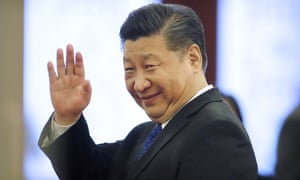 |
| President Xi Jinping. ‘Central Europe is very much part of China’s ambition to ‘move to the centre of the world stage’.’ Photograph: Mark Schiefelbein/AP |
