The Brexit Secretary has accused the European Parliament’s chief Brexit negotiator of “scaremongering” after they clashed over the rights of EU citizens living in Britain.
Steve Barclay told Guy Verhofstadt he was “feeding the anxiety” of migrants by tweeting demands they all be given identity cards, which the Government has already ruled out.
During a meeting in Whitehall, Mr Verhofstadt also told Mr Barclay that EU citizens should not have to apply for settled status – effectively continuing freedom of movement. But Mr Barclay pointed out that the UK scheme for EU citizens is far more generous than the EU scheme for British citizens living abroad, who are still facing huge uncertainty about their future. – Telegraph (£)
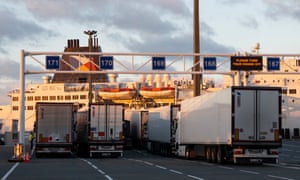
A former customs officer at the English port of Dover has said that Remainer predictions of huge delays in cross-Channel shipping in a no deal Brexit have been massively exaggerated.
Robert, who used to run the Customs terminal at Dover, Kent, said of claims that there would be food shortages if the UK leaves the EU’s Customs Union on October 31st: “I think you’re going to have to go out of your way to be delayed. A consignment from Europe has a document which is then lodged at the port.”
He continued to tell Iain Dale on LBC on Tuesday: “It will then arrive in Dover in transit, exactly like it is today. Your first import declaration in a no-deal Brexit environment is due at the end of six months. You’ve got six months to do the import entry… That is the no-deal plan. In a no deal plan, the only thing that’s going to happen differently from [that day] — in terms of food going from the EU to the UK — is the EU exporter needs to raise an export declaration. That’s the end of Brexit no-deal planning.”
Robert went on to say that if there are any delays it would likely be on the export side — bearing in mind that the UK actually has a imbalance in trade with the EU, with some 30 per cent of the lorries from Dover to Calais currently travelling empty — but said that “the government have literally today released a project which I’ve been working on for quite a few months, which is 150 pop-up stations and truck parks across the UK — and Europe — where drivers can call in and have their paperwork checked so that they can approach the border, ‘border ready’ so they can proceed on their journey.”
“These will be all over the UK, so don’t come into Kent unless you are border-ready, is the message,” he said.
The Customs specialist added that if there were problems, it would affect the Continent more than the UK, saying: “There will be a shortage of cheddar in Carrefore, but there won’t be a shortage of brie in Tesco.”
Last month, Calais’s port boss also dismissed alarmist claims that there were be long delays in France in a no deal Brexit, saying they were “bullshit”.
“There are certain individuals in the UK who are whipping up this catastrophism for their own reasons. This has provoked a lot of concern but basically ‘c’est la bullshit’,” Jean-Marc Puissesseau said in August, adding that his port has been ready for no deal Brexit since January and that British authorities were also ready.
“Nothing is going to happen the day after Brexit,” Mr Puissesseau said, continuing: “Britain will be a third country, that’s all, and there is no reason why this should lead to any problems. If both sides do their homework traffic will be completely fluid.”
France has prepared by employing more staff and building more checking lanes, the port chief explaining earlier in the year that more than 90 per cent of hauliers coming from the UK will use the ‘green’ lane with nothing to declare and no controls.
In January, President of the Calais region Xavier Bertrand added that his region was doing everything it could to prepare for the continuation of the smooth flow of goods, “because cross-Channel trade matters for the whole of Europe”, recognising how important a clear trade route with the UK is for European jobs and commerce.
Prime Minister Boris Johnson has pledged to deliver Brexit on October 31st, with or without a deal, and has ramped up clean Brexit preparations. However, his efforts may be thwarted by a Parliament of Remainers who have passed a law stopping a no deal and forcing Johnson to ask an extension to January 31st, 2020, if a deal is not agreed by Parliament in October.
The Treasury has produced its 200-page report about the effects of Brexit on the economy. Predictably, it is highly negative. It is sad that the Treasury, for which I once worked for a few years, has become so politicised that it is reduced to rationalising the views of George Osborne.
Tuesday 19 April 2016 4:59 am
Tom Welsh Welsh Tom Welsh is City A.M.'s business features editor.
The modelling methods it has used to do Osborne’s bidding are the ones anyone would employ to rubbish Brexit. They involve estimating relationships over the past between such things as trade with the EU or Foreign Direct Investment, or tariffs and GDP. Unfortunately, as I pointed out in my book on the UK and the EU, these estimated relationships are highly unreliable when it comes to considering a whole new world of trading rules, which is what Britain would face after leaving the EU.
The basic point you have to ask is how the whole economy would react to the main alternative to our current regional EU rules, which is global trading rules under the World Trade Organisation (WTO). For this you need the sort of model I used in my book, a global world trade model. The results from such a model are perfectly intelligible to anyone and, what is more, they tally with what we all understand about free trade: that the wider the freedom we have to trade, the better the result.
Now consider what the EU arrangements we have actually are. The EU is a protectionist organisation known as a “Customs Union”; this raises barriers through tariffs and other non-tariff means against every country outside it. These barriers raise the price of goods sold inside the EU by the protectionist margin; so prices are higher for everything bought from anywhere that is protected against in this way. This is because, to sell into the EU, you must pay the tariff and also the extra costs of the non-tariff barriers.
The gainers from this Customs Union are the EU producers inside the protective wall: like children in a walled garden, they enjoy a cosseted life. EU producers sell their products inside the EU at inflated prices.
But the losers are the consumers who pay these inflated prices. It is a matter of some irony that our chancellor praises this Customs Union as a wonderful “free trade arrangement”! It takes your breath away that he should dare say this to UK voters and consumers. But of course they are blown away by his confident rhetoric, and who are they to argue?
When we measure the extent of the EU protective wall, we find that it is rather high, quite contrary to this rhetoric. Food prices are nearly 20 per cent higher on average, and average manufactured prices a bit more than 20 per cent higher. Even assuming, as I did in my book, that there is some reduction in this protection over time, to say 10 per cent on each, the overall effect of the EU on the consumer shopping basket is to raise it by 8 per cent – around £40 a week for the average consumer.
By leaving the EU, we move to global free trade; goods come in here from all over the world at world prices, without the EU add-on. Our consumers benefit. Our producers have to earn their way in the world at the true world prices of their products: the industries that do best will be our best industries, not our most protected ones.
But even the protected ones will not fare so badly: they will face world competition at home and they can still sell to the EU and pay the external tariff, which is only about 4 per cent on average. Under WTO rules, the EU would be unable to inflict the non-tariff barriers on them because our producers do not “dump” and they completely adhere to EU regulations already.
People ask: can we rely on the WTO to police these rules? Yes we can: the WTO is an active and powerful system of international courts that all members highly respect. Since all countries, including the US and the EU, use it repeatedly against others, they obey its judgements when they go against them. It enforces non-discrimination, the “most favoured nation” principle: that is all we need outside the EU because it means we sell our goods on a world market where no-one can arbitrarily discriminate against us, including the EU.
By leaving the EU, we go to global free trade and we rid ourselves of the intrusive EU regulation that bears down most heavily on our smaller firms who cannot afford huge HR and compliance departments. The gains to our economy from this are huge, as anyone would readily expect. The trade gain amounts to 4 per cent of national income, directly enjoyed by our voters even after spending some of it helping out those affected producers, including our farmers. The gain from getting out of the heavy-handed regulation of our whole economy by the EU is more again, and a boost to our growth rate. The Treasury report gets it precisely the wrong way round.
Patrick Minford is professor of applied economics at Cardiff Business School and author, with Sakshi Gupta, Mai Le, Vidya Mahambare and Yongdeng Xu of “Should Britain leave the EU?” (Edward Elgar, second edition, 2015).
City A.M.'s opinion pages are a place for thought-provoking views and debate. These views are not necessarily shared by City A.M.
Philip Hammond has suggested he is prepared to vote to bring down a Boris Johnson government should the likely new prime minister go for a no-deal Brexit.
In an outspoken intervention just days before Johnson is expected to win the keys to Downing Street, the chancellor said it was “absolutely necessary” for the UK to extend its EU membership beyond 31 October.
Asked whether he would rule out voting in favour of a no-confidence motion against Johnson, Hammond told the Le Monde and Süddeutsche Zeitung newspapers: “I will take steps to avoid an exit without agreement apart from an explicit parliamentary approval.
“There should be a new and sincere attempt to reach a consensus. If we do not find a solution with the members, we may have to ask the British to give their opinion again, in one form or another.”
Asked again to rule out supporting a motion of no confidence, Hammond responded: “I do not exclude anything for the moment.”
The chancellor was one of four cabinet ministers who broke ranks with the government to abstain on a vote on Thursday, the result of which prevents Johnson from proroguing, or suspending, parliament in order to push through an exit from the EU without a deal.
He also reportedly encouraged others to vote to ensure that parliament continues to sit through September and October.
In his interview with the two papers, Hammond said he could not see any prospect of a successful negotiation with the EU before 31 October, when Johnson says the UK will leave, “do or die”.
He added that he did not think it a good idea to continue endlessly extending the UK’s membership of the EU to avoid no deal, but could not accept the economic damage that would be inflicted on leaving this autumn. The Office of Budget Responsibility warned this week that a no-deal Brexit would require an additional £30bn in government borrowing.
Hammond told the newspapers: “In practice, extending the deadline is absolutely necessary. Between the summer break, the arrival of the new commission and the change of the British government, it is simply impossible to negotiate anything before October 31.
“If the next government is sincere in its desire to reach an agreement with Europe, it must try to get more time. If it does not, the British parliament will insist on getting a new postponement.
“I will remain a member of the House of Commons. I will do everything in my power from my position to make sure that parliament blocks a Brexit without agreement.”
There is little love lost between Johnson, a former foreign secretary, and the chancellor, who has despaired at the spending promises made by the leadership hopefuls and has refused to endorse either of the candidates.
“He is actually a more complex personality than it sometimes seems,” Hammond said of Johnson in his interview. “He is a mainstream conservative on all topics except Brexit. I very much regret his attitude to Brexit. His own story, which is multicultural, multinational and liberal, speaks for itself.”
But Hammond admitted he could understand the frustration in EU capitals at the state of the Brexit process “because some of my compatriots are deliberately noisy, rude and inconsiderate”.
“Some are trying to make the Europeans so tired that they ask us to leave,” he said. “But please, do not listen to the the few noise-makers.”
Hammond said that the expected exodus of companies from the UK had not yet happened but that he feared for a future in which the EU’s member states would “have the power” to establish heavy controls on UK goods coming to the continent.
“I hope there will be intense competition between European ports,” Hammond said. “I believe that the Belgian and Dutch ports are preparing for a fierce competition to take advantage of this commercial traffic.”
In the financial sector, the chancellor said there had yet to be an exodus from the City of London.
He said: “Some banks have moved a handful of their staff to the EU to deal with the situation. My concern is more about what will happen in a year or two if we do not reach an agreement with the Europeans. In this case, the European authorities will demand that risk control be strengthened and more capital relocated to the continent.
“For the rest, I am surprised that there is no debate in Europe about the risk that a large financial sector represents for taxpayers.
“In the United Kingdom, they had to pay £180bn to avoid the bankruptcy of the banks in 2008 and 2009. Do the Europeans really want to assume such a burden?”
Hammond added that the dropping away of financial activity in the City “could be a slow process”. “But it is not certain that this would benefit Paris or Frankfurt,” he said. “It is equally likely that US banks will repatriate their employees to New York and serve the European market from there.”
In voting against No Deal, MPs have devastated the 2016 vote for greater democratic control. Brendan O'Neill 13th March 2019 It isn’t surprising that, this evening, MPs voted down the possibility of a No Deal Brexit, twice, first by embracing the Spelman amendment against No Deal and then by voting against Theresa May’s bizarre whipped attempt to keep No Deal in the mix — they rejected that by 321 to 278 votes. But it is nonetheless shocking.
It isn’t surprising because the vast bulk of the political class has been whipping up panic about No Deal for months, hysterically talking about it as a 21st-century apocalypse that will plunge Britain into a Cormac McCarthy-style dystopian nightmare in which cheese will run out, the whole country will be criss-crossed by traffic jams, and there will be a devastating outbreak of ‘super-gonorrhoea’ (Evening Standard). But it is still shocking because it is just so craven. It represents the political elite’s fullest effort yet to emasculate the Brexit process and to lay themselves – and by extension the UK – at the mercy of the Brussels bureaucracy. It is their clearest snub yet, among many snubs, to the spirit of the vote for Brexit – the desire to take back democratic control.
The vote against No Deal may have been smaller than expected. But right now, nothing better captures the aloofness and hollowness of the British establishment than their hissy-fitting over No Deal. They talk about No Deal in the way politicos used to talk about MAD (mutually assured destruction) in the Cold War 1980s. Indeed, the film about nuclear war that us 80s kids watched at school – The Day After – could easily be refashioned into Remoaner propaganda about ‘the day after’ No Deal. It’s all there: disease, hunger, the descent into communal savagery. Sadly for the Project Fear machine, many of us remember unhinged panics from the past and that has built up our immunity to this blackmail style of politics that essentially says: ‘Do as we say or you will suffer terribly.’ And yet, exactly as the establishment loses its head over No Deal, the public warms to it. A ComRes poll at the weekend found that 44 per cent of the public favours leaving with no deal if Brussels makes no further concessions. That’s a six-point rise from January. Deltapoll has found that the things voters believe are ‘needed to honour the referendum’ amount to what the political class refers to as a ‘Hard Brexit’.
It is so striking: ‘Hard Brexit’ and ‘No Deal’ are bogey-words within elite political circles – including, in fact especially, among Corbynista cliques – and yet these are seen as decent, even desirable political positions by significant sections of the public. Say No Deal in Islington and watch people wail and boo; say it in Stoke and you’ll have a lot of people saying: ‘Yes, let’s do that.’ The No Deal divide captures the Two Britains phenomenon: on one side the Britain of the well-connected and right-on, who see life outside of Brussels’ purview as virtually impossible, and on the other the Britain of ordinary people who consider that democracy is the greatest guard against abuse by either foreign technocrats or domestic lawmakers. But as well as speaking to the gaping moral and political chasm between Them and Us, today’s vote against No Deal is a form of political suicide, a crystal-clear indicator that our political class has utterly given up on even negotiating with the EU, never mind being faithful to the vote of June 2016.
Taking No Deal off the table is the end of the Brexit negotiations. For the simple reason that you cannot negotiate in a serious, grown-up, meaningful way if you do not reserve the option of walking away – or ‘crashing out’, to use another phrase that strikes fear into the heart of the establishment and a nod of approval from much of the public. The establishment is making itself subservient to the EU. That is the signal sent by this. No Deal may have been turned into a political swearword in recent months, but in truth it was always an incredibly honourable position. It was the UK saying to the EU: ‘We value the vote of June 2016 so much that we are willing to walk away if the thing you offer us doesn’t measure up to it.’ Now, with the obliteration of No Deal, many MPs have made clear what we all knew to be the case – that they do not value the vote of June 2016. These anti-No Dealers have now signalled, openly and frankly, their disdain for the thing that we the people want: democratic control over political negotiations, over treaties, over trade, over our borders. This is the divide that will define Britain for decades – that between an establishment that despises the burdens of democratic governance, and ordinary people who know that democratic governance is a people’s best protection against tyranny and abuse.
No business would enter into negotiations without being prepared to walk away – losing a no-deal Brexit option would weaken our position Peter Lilley Tue 22 Jan 2019 14.07 GMT ‘Calais is determined and confident that traffic will flow freely – not to be nice to Britain but to avoid losing trade to Belgian ports.’ Photograph: Sean Smith for the Guardian
Jeremy Corbyn has always been a unilateralist. He wanted to scrap our nuclear deterrent against the Soviet Union at the height of the cold war. So it should be no surprise that he insists Britain should unilaterally disarm in its negotiations with the EU. That is what his demand that Theresa May take no deal off the table means. If we rule out leaving with no withdrawal agreement, we would have to accept whatever terms the EU dictates. Whatever the price tag (£39bn is just for starters), whatever the loss of control over our borders and laws, however great the humiliation – we would have to accept it to avoid no deal.
What is surprising is that the CBI apparently agrees with Corbyn’s unilateralism. It, too, wants to abandon the option of leaving with no withdrawal agreement on 29 March. Yet would a single successful business in this country enter into negotiations with a customer or merger partner without being prepared to walk away without a deal if it could not get a satisfactory one?
Moreover, if a director publicly said during negotiations that the firm could not walk away without an agreement, they would be sacked for undermining the firm’s bargaining position.
Yet that is what the chancellor, Philip Hammond, and Greg Clark have done – most recently in their briefing of 300 business leaders – thereby weakening May’s bargaining position. Of course, the CBI (to which so few businesses belong that it refuses to reveal how many direct members it has) is led by bureaucrats, most of whom have never run a business in their lives and whose track record on policy is lamentable. It warned that it would be a disaster not to join the European exchange rate mechanism (ERM), a disaster to leave the ERM and a disaster not to join the euro.
A real businessman I spoke to recently was despairing of the CBI approach. He gave a vivid example of how essential it was to be ready – and seen by your negotiating partner to be ready – to walk away with no deal. Having discovered an offshore oilfield, he had to negotiate a contract with the only nearby pipeline company to bring the oil ashore. The company thought he had no alternative so demanded an exorbitant fee. He therefore not only declared that he was prepared to build his own pipeline but hired headhunters to recruit people to build it. Word reached the pipeline company and a reasonable deal was negotiated. The businessman said: “The £20k we spent on headhunters was the best investment I ever made – it showed I was prepared to walk away.”
So, let’s not begrudge a few million spent on preparing to leave with no withdrawal agreement. Those preparations may prove unnecessary – but only because they persuade the EU to agree a last-minute withdrawal agreement shorn of the intolerable backstop and commitment to pay £39bn for nothing in return.
Of course, it would be best to agree a Canada-style free trade deal (which Donald Tusk offered in March and again in October) so that we can continue to trade with the EU with zero tariffs. But we must be prepared to leave on WTO terms if the EU will not revert to a free trade deal immediately.
Leaving on WTO terms has three big positives. First, we keep £39bn – we would be cashing in not crashing out. Second, we would end the corrosive economic and political uncertainty that would otherwise grind on for more than two years. Third, we would force Ireland, the UK and the EU to resolve the Irish border issue by administrative means, without checks at the border – as all have said they will do if we leave without a withdrawal agreement. This would clear the way for a Canada-style deal covering the whole of the UK.
Moreover, it is increasingly obvious that the supposed downsides of leaving with no withdrawal agreement have been exaggerated or eliminated.
Most of the scares about shortages of medicines, food etc assumed there would be delays at Dover or Calais. But HMRC says it will carry out roughly the same number of checks as at present because checks relate to the risk of smuggling drugs and cigarettes, and illegal immigrants – none of which will increase post Brexit. Moreover, it will “prioritise flow over compliance” and wave vehicles through even if their customs declarations are incomplete.
Now the Calais port chairman has claimed that Calais will have no more checks than at present. He says he is confident that traffic will flow freely. The port is installing three extra lorry lanes, an inspection post for animals away from the port, and a scanner for trains moving at 30km/h.
And it is indignant that the British government is – unnecessarily in its view – hiring ferries to take trade to other ports.
The EU itself has removed other fears. It is legislating that planes will fly, lorries will get licences, Airbus can export its wings, and that live animals and animal products will be “swiftly” allowed entry. This is all subject to the UK reciprocating. It could be described as a “managed no deal”.
Many of those urging us to reject the option of leaving with no withdrawal agreement know it would, as Aneurin Bevan warned of unilateral nuclear disarmament, mean sending British ministers “naked into the conference chamber”. But they want us to be forced to accept such humiliating terms that Britain might choose to return with its tail between its legs to beg to be allowed to stay in the EU. They misjudge the resolve of the British people.
• Lord Lilley is a former Conservative MP who was trade and industry secretary from 1990 to 1992
For months the European Union has been whipping up fears about what Brexit might do to Ireland. As soon as negotiations between Theresa May and EU leaders began, the Irish border was invoked as an unfixable problem. As far as the EU was concerned, there were two options: create a hard border in Ireland to accommodate the fact that the North would be outside of the EU and the South still inside it, and in the process give rise to the Troubles 2.0; or just give up on Brexit and keep Northern Ireland and ideally the whole UK inside the Customs Union.
Brussels whipped up fears about the Irish border to bash Brexit.
Now, however, it seems the Brussels bureaucrats are changing their tune. Newspaper reports tell us the EU is ‘secretly preparing to accept a frictionless Irish border after Brexit’. So perhaps the Irish border wasn’t such a big problem after all. The Times reports that, ‘EU negotiators want to use technological solutions to minimise customs checks between Northern Ireland and the Irish Republic’. This would include using barcodes on ‘trusted trader’ shipping containers. As for the much talked-up problem of congestion at the border, EU negotiator Michel Barnier’s deputy Sabine Weyand is now assuring EU ambassadors that, ‘for the main part, these controls would not have to happen at a border’.
Hold it right there. After months and months of scaremongering about the danger of a hardened Irish border, EU officials are now open to the idea of having a straightforward hi-tech border? The Guardian reports that Barnier has ‘repeatedly insisted that the issue can be “de-dramatised”’. Really? Perhaps we need to remind ourselves of Barnier’s own penchant for drama in relation to Ireland and Brexit.
‘Brexit created a specific problem in Ireland’, he wrote in the Irish Sunday Independent in April this year. If the UK withdraws from the Single Market and Customs Union, that will ‘make border checks unavoidable’, he reportedly said to colleagues in Brussels in January. When visiting a food-export business in County Monaghan in May last year, he said talks about the border would be ‘very complex and difficult’.
Anyone who is still defending the EU as the reasonable, honest side in the Brexit negotiations must now admit they were wrong. It is scandalous that EU officials sought to profit politically from scaremongering about violence in Ireland, as a way of weakening Brexit, and yet now essentially admit that what Brexiteers have long argued – that the border is a fixable problem. Even Taoiseach Leo Varadkar played the EU’s cynical game. Having spent months warning that Brexit would be bad for Ireland, and would endanger border country, he now seems rather chirpy – he gave a speech to workers in Donegal recently in which he said he is confident that Brexit will happen quite swiftly.
The EU cannot be trusted. It says one thing and means another. It has no qualms about stereotyping Irish citizens as gunmen in waiting, ready to be propelled into a new round of violence by any kind of trading disagreement. And it lies, too. As Kate Hoey told spiked in July: ‘They’re forgetting that there is a border there already… and if you stand at the border you will see, every now and again, vehicles being stopped on either side.’ The idea that Brexit would change everything in Ireland was always a fallacy.
Technical, logical, sensible solutions to the Irish border question have long been available, but the EU chose to ignore them in order to bash Brexit. It exploited Irish history and Irish concerns to try to weaken British democracy. It sees nations as mere playthings in its power plays. The Irish border discussion is a reminder of the EU’s ruthlessness.
Ella Whelan is a spiked columnist. Her book, What Women Want: Fun, Freedom and an End to Feminism, is published by Connor Court. Buy it on Amazon UK and Amazon US.