Professor Robert Tombs is a Fellow of the new Centre for Brexit Policy think tank. This is the preface of their launch document.

The great liberal historian H.A.L Fisher is supposed to have concluded that history was no more than “one damned thing after another.” Or, more elegantly, that it was governed by “the play of the contingent and the unforeseen.” Few of us are wholly satisfied by such thin gruel: we want, especially when trying to understand great public events, to think that history has a meaning, and that things happen for deeper reasons than the ambitions or errors of individual politicians and officials, or slogans on the sides of buses. Few arguments are more powerful than those that confidently enlist the forces of history on their side: thus, Brexit is wrong because a united Europe is inevitable; or Brexit is right because our ancient political culture makes Brussels power unacceptable.
European federalism has always made use of deterministic historical argument. Integration was the wave of the future, hence those who opposed it were “nostalgic” for a dead past, and had to be educated by their enlightened leaders to embrace the inevitable: “We have made Europe”, wrote a leading French politician; “now we have to make Europeans.”
We should be wary of this kind of historical determinism, whoever uses it, for it seeks to constrain our choices by telling us that only one future is conceivable. It also, as we have seen, tends to polarize and envenom political debate.
So let us try to get away from competing pseudo-histories and attempt a rational analysis. In trying to decide how Brexit fits into history, we are really asking two slightly different questions which have considerably different answers. First, why did the UK leave the EU? Second, why did the UK leave the EU in 2016-19? The first question may indeed involve long-term developments, even going back centuries. The second will bring in “the play of the contingent”, even the slogan on the bus. Both questions are relevant, indeed indispensable, for trying to understand what has happened.
Were we always destined to leave the EU because “ever closer union” was incompatible with our long history? Brexiteers may like to think so, but the evidence is less than compelling. We voted in 1975 by a sizeable majority to stay in. If David Cameron had negotiated more successfully in 2015, it might have tipped the balance towards remaining. And if we had adopted the Euro, as Tony Blair and business lobbies had wanted, is it not almost inevitable that we would have voted to remain? Not because of a sudden love for the EU, but because of the financial risks that tie Eurozone countries to the system however much they suffer. In 2016 we voted to leave by only a small majority, and a succession of polls over three years showed that the country was deeply divided. So if European integration was indeed incompatible with our history, half of us failed to realize it. Indeed, part of the country, and a powerful part, did all it could to cling on the EU, even at the risk of a constitutional crisis—a subject to which I shall return.
Are we so different, then, from other Europeans? Not in our sentiments about the EU. Neutral polling in June 2016 (days before our referendum) showed that the EU was as unpopular in the Netherlands, Germany and Spain as in Britain, much more unpopular in France, and hugely more unpopular in Greece.
Nevertheless, there is a crucial difference between ourselves and our neighbours. In most of Continental Europe, dissatisfaction with the EU often means wanting it to be more effective, even more interventionist, whereas in Britain, of course, it means the opposite: “less Europe” and even “no Europe”, rather than “more Europe”. Opinion polls over the years have shown this consistently. If we look back before the post-referendum turbulence, the UK was the country in which fewest people—only 6 percent—wanted more power to be given to Brussels; whereas in France and Spain (where more people than in Britain expressed “unfavourable” views of the EU) over 30 percent wanted it to be more centralized. Far fewer people in Britain (only 5 percent) felt “more European than national”, and fewer wanted the European flag to fly on public buildings. Finally, Britain was the only member country in which a majority felt more confident in facing the future outside than inside the EU. The obvious conclusion—well before the referendum brought the issue to the fore—was that people in Britain were less emotionally committed to the “European project”.
These sharp differences in feelings and world view are evidently the results of a different history. It is helpful to take a few steps back and trace our relationship with the idea and reality of European federalism. Federalism had, and has, two main motives. First, the wish to prevent war in Europe; second, the wish to create a great European power. Both go back roughly a century, beginning in the 1920s, and revived in the 1950s.
Supranational systems, federalists believed, would ensure peace. Nation states and national identities were an obstacle, even an evil, bringing war and division. This was a misreading of history. Both world wars were caused not by popular nationalism, but by the perverse decisions of authoritarian elites. Neither Hitler nor Mussolini (let alone Stalin) had been elected by a majority; and war was deeply unpopular, even in Hitler’s Reich. Healthy democracy, not supranational bureaucracy, is the true guardian of peace.
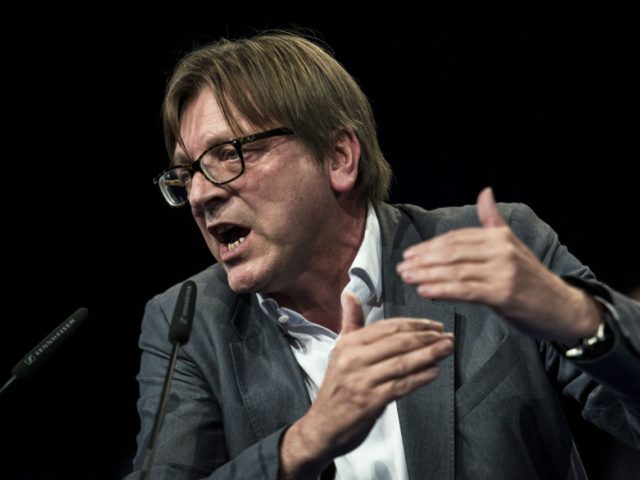
The wish to enhance European power is linked to the perception of a declining Continent, and to the rise of other major powers, originally the United States and the USSR. Though it was at first assumed on all sides that Britain was too global a power to be involved, some of the earliest federalists were British imperialists who accepted colonial secretary Joseph Chamberlain’s 1902 dictum that “The days are for great Empires and not for little States.” Little states offended all who thought in terms of rationality, order and power rather than of disorderly democracy: these included diplomats, administrators, economists and academics of right and left. They also offended those who saw the outside world as a threat that could only be resisted by size. The latest avatar is Guy Verhofstadt, echoing Chamberlain: “the world of tomorrow is a world of Empires.”
Europe experienced a barely precedented cycle of horrors: war, defeat, occupation, civil war, dictatorship and—perhaps even longer lasting—a sense of moral catastrophe and shame. General de Gaulle, although a symbol of French resistance, thought that his country’s leaders had “sold its soul”. The idea of a united Europe therefore appealed not only to a longing for security and prosperity, but for a psychological escape from past failures, even past crimes. Former dictatorships—Germany, Italy, Spain, Portugal, Greece—and newly escaped subject peoples of the Communist empire saw Europe as a proof of their emancipation and a safeguard against the return of a frightening past. To be “European” was to be free and modern—worth paying a huge price for.
The twentieth century was experienced very differently in Britain. However great the traumas, Britain had emerged victorious and with a sense of national pride and vindication, and at the same time a realization that it had survived with the support of countries outside a hostile or defeated Europe. For Britain, European integration had nothing to do with past horrors, and everything to do with a sudden fear of a declining future. In the 1950s and 60s its political elites were assailed by a tide of pessimism about the country and about themselves. Loss of empire seemed to threaten Britain with becoming one of Chamberlain’s “little States”. Its economy seemed in decline. Its institutions and those who ran them were mocked as archaic, decadent, even ridiculous. Britain, said a prime ministerial advisor, was “the sinking Titanic”, and Europe its lifeboat. Outside the European Community, wrote Sir Con O’Neill, chief official negotiator, we would be merely “a Greater Sweden”.
So we joined, rather duplicitously: hoping that “Europe” would be a substitute for lost empire, while pretending that it was no more than a trading association whose commitment to “ever closer union” was empty rhetoric.
The simplest explanation for Brexit would be that these perceptions and realities changed. On one hand, the EU was determined to move towards genuine political federation—the only way it could survive, according to President Macron. On the other, Britain no longer needed a lifeboat, and even if it had, an economically and politically floundering EU was not it. There were several landmarks on this route: Margaret Thatcher’s clashes with the socialist Commission President Jacques Delors (which tilted the Conservative Party towards Euroscepticism and Labour towards Europhilia); Britain’s decision not to adopt the Euro; and the Eurozone’s manifest economic and social failings, turning Britain into the employer of last resort for southern and eastern European youth. Hence, the majority view in Britain—unique in the EU—that we could face the future better outside.
If Britain’s uneasy relationship with European integration goes back to the 1960s, and even at a stretch to the 1920s, is there a longer history too? Certainly, even if it is one that Remainers have mocked as “nostalgia for a world where passports were blue, faces were white and the map was coloured imperial pink.” From the 18th century onwards, the new United Kingdom turned outwards from being a clutch of weak coastal European kingdoms to a dynamic global trader and power. This is of course a vast story, during which profound economic, demographic, cultural and political changes took place which still operate centuries later. For example, the commercial pattern in which Britain runs a deficit with Europe and a surplus with the rest of the world already existed in the 19th century. Britain was far less economically integrated with the EU than its other members. More broadly, we can only guess at the psychological difference caused by having most of the world speaking our language, and having old-established global relationships such as the Commonwealth and the alliance with the United States. The idea of “global Britain” is simply more feasible and meaningful than would be (let us say) “global Poland” or even “global Germany”. It may also prove a more realistic plan for the future than integration into a troubled EU.
Does even older history contribute to Brexit too? I would say a cautious yes. Brexiteers argue that a strong sense of parliamentary government and the ancient practices of the Common Law separate us from the procedures of the EU. But the history of the last two years shows that Members of Parliament themselves and the Supreme Court did not share this view, and indeed pseudo-historical claims about “parliamentary sovereignty” were actually used to try to block or neuter Brexit. Moreover, we should not forget that while some EU states have recent and shallow democratic traditions, others have their own ancient and proud histories of struggles for independence and democracy which so far they find compatible with European federalism—but that is another subject. Nevertheless, it seems clear that at the very least we have a national story that has nourished Brexit. This we might call the “Magna Carta myth”: the idea that when fundamental choices have to be made, it is the people who decide, and the rulers who must obey. Some of our leading European neighbours have very different national stories. France was the creation of monarchs, emperors and revolutionary minorities. Germany and Italy were established in the 19th century by a combination of visionary ideologists and autocratic politicians: “we have made Italy, now we have to make Italians”, said one—a task still not complete after 150 years. In these countries, the people, if they were consulted at all, were merely summoned to accept and approve what their enlightened elites had done: active authority, passive democracy. This still colours the political practices of the EU, as France, Denmark, Ireland, the Netherlands, Italy and Greece have all discovered. But it is not how we instinctively think of our own politics, and events since 2016 have emphasised the dogged determination of British voters to be obeyed. How much European anger at Brexit is a result of the embarrassing contrast?
But what about the others—the 48 percent who voted Remain? They clearly did not see—and many still do not see—our history in the way I have outlined it. So either I and other Brexiteers are wrong in our understanding of history, or Remainers have placed themselves outside that history, whether by indifference or choice. For some, it is clearly by choice: those ideological Remainers who vehemently reject Britishness or Englishness, whether because they reject national identity or because they espouse nationalism—Scottish, Irish or Welsh. Other Remainers seemed motivated more by personal or corporate interest—business lobbies, politicians, academics, diplomats etc.—or by a conviction of belonging to a social and intellectual elite in conflict with an ignorant and prejudiced majority. Underlying this are years of Europeanization and/or globalization, which have created important trans-national interest groups and also produced what has been called a “void” in democratic national politics. But most Remainers were simply motivated by economic worries, fanned by an interminable Project Fear, which promised inevitable economic disaster as a result of Brexit. These fears are similar to those deployed in other EU countries. In our case there is a further element: every Remain strand also draws on the post-imperial declinism referred to earlier, which sees Britain as a weak and impotent satellite of the EU, and even wants it to be. Though the ideological minority of this Remain coalition is irreconcilable, most is based on short-term calculations and fears, and is likely to fade. Doubly so if I am right in seeing it as contrary to major historical trends.
Despite three years of political turmoil and unsettling cultural conflict, the decision has been made and confirmed. There is no doubt that it is historic, for both the United Kingdom and Europe. Of the two determinist narratives I have sketched—that European integration is the inevitable future, or that British history demands that we assert our independence—one will prove to have been an illusion. But history does not determine the future—not, at least, in any way that we can discern, otherwise predicting it would be easy. But one prediction does seem secure. We shall loosen our relationship with our nearest neighbours, and strengthen our links with the wider world. As I have suggested, this renews a three-century global history, and if it succeeds, it might suggest that nearly a half a century of European integration was an aberration. But half a century is too long a time to be dismissed as a mere mistake: rather, we might conclude that our very long history—nearly 2,000 years of it—has been of oscillating relationships with the near continent, and that our uneasy attempt to be at “the heart of Europe” has been one more episode, alongside Plantagenet ambitions to be Holy Roman Emperors and Kings of France. Brexit was a vote of confidence in the ability of the nation to survive and prosper in an uncertain world. If it is to be more than a defiant gesture, it must galvanize society and government to make us a country in which citizens are not despised, ignored or abandoned as surplus to requirements. If we succeed, we shall, in Pitt’s words, have saved ourselves by our exertions, and we may save Europe by our example.
Click here to go to their launch paper.