 |  |

"As a society, for too many years we have not made the necessary demands of newcomers. We have had far too low expectations for the refugees and immigrants who came to Denmark. We have not made sufficiently tangible demands on jobs and self-sufficiency. Therefore, too many immigrants have ended up in prolonged inactivity." — Danish government report, "Showdown with Parallel Societies."
The number of residential areas on the government's most recent "ghetto list," published in December 2020, has declined by half in three years, from 29 in 2018 to 15 in 2020. The number of "hardened ghettos" has declined from 15 in 2018 to 13 in 2020. Interior and Housing Minister Kaare Dybvad Bek attributed the decline mainly to more people finding employment or pursuing an education.
"As a society, we must step more into character and stick to our Danish values. We must not accept that democracy is replaced with hatred in parallel societies. Radicalization must not be protected. It must be revealed." — Danish Prime Minister Mette Frederiksen.
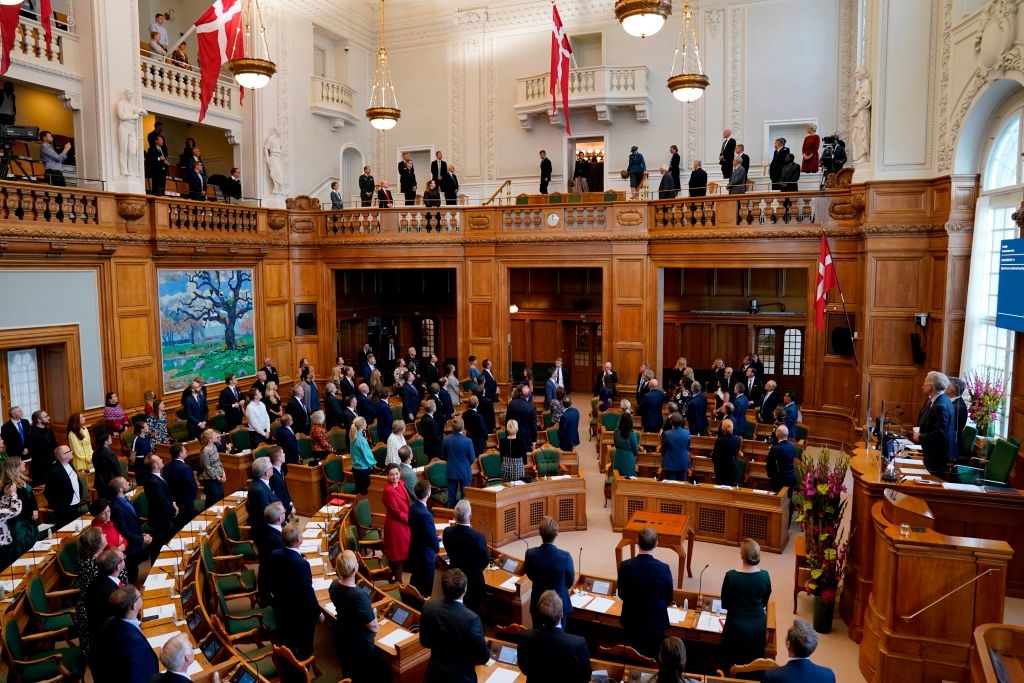 The Danish government has announced a package of new proposals aimed at fighting "religious and cultural parallel societies" in Denmark. A cornerstone of the plan includes capping the percentage of "non-Western" immigrants and their descendants dwelling in any given residential neighborhood. Pictured: The official opening session of the Danish Parliament in Copenhagen, on October 6, 2020. (Photo by Mads Claus Rasmussen/Ritzau Scanpix/AFP via Getty Images) |
The Danish government has announced a package of new proposals aimed at fighting "religious and cultural parallel societies" in Denmark. A cornerstone of the plan includes capping the percentage of "non-Western" immigrants and their descendants dwelling in any given residential neighborhood. The aim is to preserve social cohesion in the country by encouraging integration and discouraging ethnic and social self-segregation.
The announcement comes just days after Denmark approved a new law banning the foreign funding of mosques in the country. The government has also recently declared its intention significantly to limit the number of people seeking asylum in Denmark.
Denmark, which already has some of the most restrictive immigration policies in Europe, is now at the vanguard of European efforts to preserve local traditions and values in the face of mass migration, runaway multiculturalism and the encroachment of political Islam.
The new proposals, announced by Interior and Housing Minister Kaare Dybvad Bek on March 17, are contained in a 15-page report, "Mixed Residential Areas: The Next Step in the Fight Against Parallel Societies."
A main element of the plan calls for relocating residents of non-Western origin to ensure that, within the next ten years, they do not comprise more than 30% of the total population of any neighborhood or housing area in Denmark.
The plan also calls for phasing out the term "ghetto areas," which has been criticized as being derogatory, and replacing it with the more politically correct "prevention areas" (forebyggelsesområder) and "transformation areas" (omdannelsesområder).
The term "ghetto," which refers to areas with high concentrations of immigrants, unemployment and crime, first came into official use in Denmark in 2010 with the release of a government report, "Reinserting Ghettos into Society: A Showdown with Parallel Societies in Denmark."
A "ghetto area" currently refers to a residential area with at least 1,000 inhabitants, where the proportion of non-Western immigrants and their descendants is higher than 50%, and where at least two of the following four criteria are met:
- The proportion of residents aged 18-64 who are not in work or in education exceeds 40%.
- The proportion of residents who have been convicted of violating the Penal Code, the Firearms Act or the Narcotic Drugs Act is at least three times the national average.
- The proportion of residents aged 30-59 who have only a primary school education exceeds 60% of all residents in the same age group.
- The average gross income for taxpayers aged 15-64 in the area (excluding education seekers) is less than 55% of the average gross income for all residents in the area.
In 2018, the Danish Parliament, with support from all of the country's main political parties, adopted the "parallel society package" (Parallelsamfundspakken), also known as the "ghetto plan" (Ghettoplan). The 22-point plan states that there will be no "ghetto areas" in Denmark by 2030. Details are included in a government report, "One Denmark Without Parallel Societies."
At the time, the government, explained the need for a comprehensive strategy to combat parallel societies:
"The government wants a cohesive Denmark. A Denmark that is based on democratic values such as freedom and the rule of law, equality and freedom. Tolerance and equality. A Denmark where everyone participates actively. Over the past 40 years, Denmark's ethnic composition has changed markedly.
"In 1980, we were 5.1 million people in Denmark. Today we are close to 5.8 million. The growth of the population comes from outside. Both immigrants and descendants of immigrants. The majority of the new Danes have a non-Western background.
"In 1980, there were about 50,000 people with non-Western backgrounds in Denmark. Today there are almost half a million. This corresponds to an increase from approximately one percent of the population to approximately 8.5 percent....
"What has gone wrong? At least three things.
"First, the individual immigrant has the responsibility to learn Danish, to get a job and become part of the local community and to be integrated into his new homeland. Far too few have seized the opportunities that Denmark offers, despite the fact that Denmark is a society with security, freedom, free education and good job opportunities.
"Second, as a society, for too many years we have not made the necessary demands of newcomers. We have had far too low expectations for the refugees and immigrants who came to Denmark. We have not made sufficiently tangible demands on jobs and self-sufficiency. Therefore, too many immigrants have ended up in prolonged inactivity.
"Third, for decades too many refugees and family-reunified people have not been integrated into Danish society. They have been allowed to clump together in ghetto areas without contact with the surrounding community, even after many years in Denmark, because we have not made clear demands on them to become part of the Danish community....
"It's about to be the last call. In parts of Western Europe, massive challenges have arisen with ghettos and very ingrained parallel societies. Denmark is not there yet. And that is why we must make a massive effort now, so that we can stop the development before the problems become impossible to solve.
"There is only one way. The ghettos must be completely eradicated. Parallel societies must be broken down. And we must make sure that new ones do not arise. Once and for all, the very big task of integration must be tackled whenever immigrants and their descendants have not embraced Danish values and isolate themselves in parallel societies."
The 2018 agreement stipulates that if a residential area ends up on the so-called ghetto list, local councils must choose between four measures: 1) demolish public housing; 2) build new housing for private rental; 3) convert public housing to elderly or youth housing; or 4) sell public housing to private buyers or investors for private rental.
The plan seeks to reduce the share of public housing to no more than 40% in the most vulnerable areas by 2030. The overall goal is to transform the ghetto areas into normal residential areas.
Interior and Housing Minister Kaare Dybvad Bek says that the plan is working. The number of residential areas on the government's most recent "ghetto list," published in December 2020, has declined by half in three years, from 29 in 2018 to 15 in 2020. The number of "hardened ghettos," which refers to any area that has been included on the ghetto list for four years in a row, has declined from 15 in 2018 to 13 in 2020.
Bek attributed the decline mainly to more people finding employment or pursuing an education:
"It is fantastically positive that it is progressing in so many areas, and we are already seeing the effect of the parallel society package. There is a historically large decrease in the number of vulnerable areas on all lists, especially because far more residents have come to find work or pursue education.
"The large drop in the number of vulnerable areas is especially a pat on the back to the housing organizations and municipalities that in recent years have worked hard to ensure mixed housing areas, so that all children have the same opportunities, no matter where they grow up."
Bek's newly named "prevention areas" are to be designated on the basis of the same criteria as the existing "ghetto areas," but with lower limits. A "prevention area" refers to a residential area with at least 1,000 inhabitants, where the proportion of non-Western immigrants and their descendants is higher than 30%, and where at least two of the following four criteria are met:
- The proportion of residents aged 18-64 who are not in work or in education exceeds 30%.
- The proportion of residents who have been convicted of violating the Penal Code, the Firearms Act or the Narcotic Drugs Act is at least two times the national average.
- The proportion of residents aged 30-59 who have only a primary school education exceeds 60% of all residents in the same age group.
- The average gross income for taxpayers aged 15-64 in the area (excluding education seekers) is less than 65% of the average gross income for all residents in the area.
A total of 58 residential areas in Denmark will be categorized as "prevention areas" in the government's new proposal, which will affect approximately 100,000 people of non-Western origin. Bek explained:
"For far too many years, we have closed our eyes to the development that was underway, and only acted when the integration problems became too great. Now we want to make sure that we do not once again stick our heads in the sand while new parallel societies emerge. We will do this by preventing more vulnerable housing areas and by creating more mixed housing areas throughout Denmark.
"Today, municipalities and housing organizations do not always intervene in time if large public housing areas enter into a negative spiral. Therefore, we will now provide access to most of the tools that apply to vulnerable residential areas. For us, it is about helping the residents and creating equal opportunities for all children, regardless of where they grow up in Denmark.
"The 'ghetto' term is misleading. I do not use it myself, and I think it overshadows the important work that needs to be done in the residential areas. This whole effort is about fighting parallel societies and creating a positive development in the residential areas, so that they are made attractive to a broad section of the population."
Denmark's governing center-left Social Democratic Party has pursued strong anti-immigration policies, partly in an effort to blunt the appeal of populist parties on the right.
Prime Minister Mette Frederiksen, who has been in office since June 2019, recently announced that her government intends significantly to limit the number of people seeking asylum in Denmark. The aim, she said, is to preserve "social cohesion" in the country.
Denmark, which has a population of 5.8 million, received approximately 40,000 asylum applications during the past five years, according to data compiled by Statista. Most of the applications received by Denmark, a predominately Christian country, were from migrants from Muslim countries in Africa, Asia and the Middle East.
In recent years, Denmark has also permitted significant non-asylum immigration, especially from non-Western countries. Denmark is now home to sizeable immigrant communities from Syria (35,536); Turkey (33,111); Iraq (21,840); Iran (17,195); Pakistan (14,471); Afghanistan (13,864); Lebanon (12,990) and Somalia (11,282), according to Statista.
Muslims currently comprise approximately 5.5% of the Danish population, according to the Pew Research Center, which forecasts that this figure will double or possibly triple by 2050, depending on the migration scenario.
On January 22, during a parliamentary hearing on Danish immigration policy, Frederiksen said that she was determined to reduce the number of asylum approvals:
"Our goal is zero asylum seekers. We cannot promise zero asylum seekers, but we can establish the vision for a new asylum system, and then do what we can to implement it. We must be careful that not too many people come to our country, otherwise our social cohesion cannot exist. It is already being challenged."
In her 2021 New Year's address, Frederiksen said that in the year ahead, her government would continue to insist that immigrants integrate into Danish society:
"As a society, we must step more into character and stick to our Danish values. We must not accept that democracy is replaced with hatred in parallel societies. Radicalization must not be protected. It must be revealed.
"The government will rethink its integration efforts so that it is based to a greater extent on clear requirements and clear expectations with a focus on law and duty.
"Basically, it must be the case that once you have been granted residence in Denmark, you must of course support yourself. If this is not possible for a period of time, the government will propose that you — in return for your social welfare benefit — be obliged to contribute the equivalent of a normal working week of 37 hours. These are some of the tasks ahead of us in the new year."
Soeren Kern is a Senior Fellow at the New York-based Gatestone Institute.
https://www.gatestoneinstitute.org/17197/denmark-parallel-societies