Showing posts with label Car. Show all posts

Friday, 18 October 2019

Brexit Boost: Supercar Manufacturer ‘Born and Bred’ in UK to Stay No Matter What

The CEO of British supercar manufacturer McLaren has insisted the Brexit will not stop the iconic marque from succeeding — and it will stay in the United Kingdom where it was “born and bred”.

JACK MONTGOMERY18 Oct 2019, 9:45 AM PDT

Brexit


The CEO of British supercar manufacturer McLaren has insisted Brexit will not stop the iconic marque from succeeding — and it will stay in the United Kingdom where it was “born and bred”.

“If you look six months, twelve months down the line, I think we can be equally successful whether Brexit happens or it doesn’t, so I’m not worried about that,” said Mike Flewitt, in an interview with CNBC at the Forbes Global CEO Conference in Singapore.

“We’ve grown up in Woking, we’ve grown the talent base, our workforce is there, and fundamentally McLaren is the people who work there — so we couldn’t just shift it somewhere else,” he insisted, ruling out any move from the automaker’s current home in Surrey, south-west England.

“Manufacturing is a part of what we do, but we build 5,000 cars a year; you only need one manufacturing location for 5,000 cars a year, it would be uneconomic to do anything else,” he explained.

“So we’ve started and grown in the UK, and staying in the UK is the most logical, the most commercially sensible thing for us to do; we’re a UK company born and bred, since 1963, in fact, if we go back all the way,” he promised, adding that morale at the company “is really good; the automotive company is growing very strongly year on year. 2018 was a record, 2019 we’re doing even better. Our cars are getting five-star reviews around the world, and everybody likes to be part of a success story, so people are really proud of that… morale’s very good and confidence is high.”

Flewitt did suggest that McClaren were concerned about possible disruption to supply chains in the event of a clean, no-deal break with the EU — although he described the potential impact as “short-term” — but stressed that the real issue was not so much no-deal trade terms in and of themselves but the fact that businesses are still in the dark about whether they are looking at a no-deal Brexit, a negotiated Brexit, or no Brexit at all with just days to go until the current October 31st deadline.
Similar comments have been made by Nigel Wonnacott of Brittany Ferries, who has been clear that No Deal does not present any serious issues and that even a single week would “absolutely” be enough time to prepare for it — but the issue is that three years on from the 2016 vote for Brexit there is still no clarity as to whether or not the United Kingdom will even leave the EU, thanks in large part to the efforts of Remain-voting politicians who never accepted (or only pretended to accept) the result of the referendum and have been working to undermine or outright overturn it ever since.


https://www.breitbart.com/europe/2019/10/18/brexit-boost-supercar-manufacturer-born-and-bred-uk-stay-no-matter-what/

Wednesday, 16 October 2019

Jaguar Land Rover show faith in the UK economy

Far from what the gloomsters proffer, the UK’s car industry looks like it’s shifting into top gear as Britain speeds towards the Brexit finishing line

October 16, 2019 at 2:20 pm


Far from what the gloomsters proffer, the UK’s car industry looks like it’s shifting into top gear as Britain speeds towards the Brexit finishing line; with the announcement by Jaguar Land Rover of a new three million-square-foot distribution centre in Leicestershire, supplying to 80 markets worldwide. Fueling confidence in global Britain…

The new campus is expecting to create a sizable number of new jobs in the area and shows Jaguar Land Rover plan on having a stake in Britain’s sizable car industry for many more years to come. Remainers must be quite exhausted and tired of making wrong predictions, Guido doesn’t think they’ll give us a brake any time soon…

Monday, 11 February 2019

BREXIT SHOCK: Europe panics as hundreds of THOUSANDS of jobs at risk from no deal EU exit

HUNDREDS of thousands of European Union citizens are at risk from a no-deal Brexit, sending shockwaves throughout the bloc, a shock new study has revealed.

The forecasts from economists at the Economic Research Halle and Martin Luther University Halle Wittenberg in Germany have warned 612,000 people’s jobs could be affected. 

From that number, 179,000 live in the EU. Germany would be most significantly impacted, with 100,000 jobs under threat if Britain tumbles out of the EU without a deal. 


British imports from the EU would plummet by 25 percent in such a scenario, but Germany’s lucrative motor sector would suffer significant damage.
Germany sold 770,000 vehicles to the UK in 2017, with 15,000 jobs - one percent of the total working population - reliant on this famous trading area.
Wolfsburg, home to Volkswagen and BMW, would feel the brunt of a no-deal Brexit, with 500 jobs or 0.4 percent of the workforce in the German city under threat.
In no other country is the effect on total employment as great as in Germany, where around 100,000 people are affected. The employment effects of a hard Brexit would be noticeable above all at the automobile locations
Oliver Holtemöller

"The employment effects of a hard Brexit would be noticeable above all at the automobile locations.”

Brexit news job losses
Brexit news: Hundreds of thousands of jobs are under threat in the event of a no-deal (Image: GETTY)

Last year, the Volkswagen Group delivered 10.83 million vehicles to customers around the world - up by around 90,000 vehicles from the year before.
In 2017, the German sector had an annual output of six million and a 31.5 percent share of the European Union.
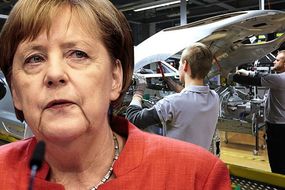
Brexiters have warned the the country’s car industry will put pressure on Angela Merkel to ensure the UK gets a favourable deal due to the high risk threatening the lucrative manufacturing sector.
But the industry has continued to throw its support behind the German Chancellor and has so far supported the Government’s Brexit stance.
Brexit news Angela Merkel
Brexit news: Angela Merkel is under pressure to ensure the UK gets a favourable deal (Image: GETTY)
German auto industry association VDA, which represents the likes of BMW, Volkswagen and Mercedezx-Benz parent Daimler, said: "The consequences of a no deal would be fatal.
“Without an orderly and practical solution for business, jobs in the car industry, particularly on the British side, are on the line.”
BMW, which builds 60 percent of its Mini cars at a plant in Oxford, warned: "Uncertainty is not good for business.
We must therefore continue to prepare for the worst-case scenario, which is what a no-deal Brexit would represent.
"We strongly urge all relevant stakeholders to do everything possible in order to establish much needed certainty for our business and to maintain the truly frictionless trade on which our international production network is based.”
Brexit news Volkswagen
Brexit news: Volkswagen Group delivered 10.83 million vehicles to customers globally last year (Image: GETTY)
The study found 726 jobs would be at risk in the Swabian district of Böblingen, where technology giants including IBM and Siemens are based.
Elsewhere, the research found 50,000 jobs in France would also be under threat in the event of a no-deal Brexit, while in Austria, 6,000 jobs would be at risk.
But despite the fears for Germany amongst other countries, the findings revealed a no-deal Brexit would impact Ireland and Malta most.
The report warned around 1.7 percent of Maltese and one percent of Irish workers could be left unemployed if Britain and the EU fail to agree on a deal.

The Latest: UK, 3 non-EU nations ink ex-pat residency deal (on 11 Feb 2019)

LONDON (AP) - The Latest on Britain's plans to leave the European Union (all times local):
 Feb 11, 2019 12:32 PM EST
APTOPIX_Belgium_Brexit_65616.jpg82036929
5:05 p.m.
The British government has agreed to allow citizens of Norway, Iceland and Liechtenstein already living in Britain to remain after Brexit even if the country leaves the European Union without a deal.
The agreement finalized on Friday should remove the uncertainty a "hard" Brexit scenario posed for some 15,000 citizens of the three non-EU nations who live in Britain.

British PM Theresa May meets Norway's PM Erna Solberg outside 10 Downing Street in the summer of 2018 | Ben Stansall/AFP via Getty Images
The deal's reciprocal arrangement also clarifies plans for some 17,000 British citizens who reside in Norway, Iceland and Liechtenstein.
Those countries aren't EU members, but belong to the much-smaller EEA EFTA group. EEA EFTA spokesman Thorfinnur Omarsson said Monday the agreement secured their citizens' rights in Britain "regardless of the outcome of negotiations between the EU and the U.K."
The four governments struck an initial agreement in December after British Prime Minister Theresa May reached a divorce deal with the EU that British lawmakers later rejected.
___
4:35 p.m.
A Dutch consumer watchdog is urging companies that do business with Britain to register now for digital systems that are used to process import and export checks and to issue certificates, warning there could be a rush if there is a no-deal Brexit.
The Netherlands Food and Consumer Product Safety Authority said Monday that registration usually takes around two weeks, It warned the time frame "can rise significantly if many businesses register at the last minute because of a no-deal Brexit."
With British lawmakers yet to approve a divorce agreement with the European Union, it remains unclear which import and export regime will apply from the exit date now set for March 29.
Dutch business groups and authorities have long warned local companies to "hope for the best and prepare for the worst" ahead of Brexit.
___
3:00 p.m.
Luxembourg Prime Minister Xavier Bettel says the U.K. is a "disunited kingdom" where pro-Brexit politicians lack ideas and courage.
With the country's March 29 date for leaving the European Union closing in, Bettel said "a disunited kingdom is more a reality today than a United Kingdom."
His remarks to reporters came after talks with EU Brexit negotiator Michel Barnier.
For remaining EU members, Bettel says the ongoing uncertainty in London "puts us in a position where we don't know what is likely to happen tomorrow."
Bettel said: "The position of the Brexiteers today, to sum it up in one sentence is 'No. No, no and no." There aren't any alternative proposals from them."
Laughing as he spoke, he said: "It is, in fact, the same protagonists for Brexit and a no-deal who do not have the courage either to put the issue to a peoples' vote."
___
2:40 p.m.
The European Union's Brexit negotiator is urging Prime Minister Theresa May to spell out how she plans to win over Parliament less than two months before Britain leaves.
Michel Barnier said Monday that he still doesn't see a "clear and stable majority" of support among British lawmakers for any Brexit plan, especially one that would also respect the EU's demands.
EU and U.K. officials are discussing what concessions the Europeans could make to help May push a deal through Parliament by Brexit day on March 29.
Barnier says that if "the United Kingdom wants to show greater ambition, we are also immediately ready... to be more ambitious" in a political declaration on their future ties.
But he insists the legally-binding divorce agreement between them can't be renegotiated.
___
2 p.m.
In its last full-year as a member of the European Union, Britain recorded a record trade deficit with the bloc.
The Office for National Statistics said the country's trade in goods deficit with EU countries widened by 0.2 billion pounds in 2018 to a record 94.9 billion pounds ($122 billion).
That's a big number that is likely to concentrate minds on all sides of the Brexit discussions as Britain's March 29 date of departure nears.
The great worry is if Britain crashes out of the bloc without a trade deal that would put serious impediments including tariffs on EU-U.K. trade, which will damage both sides.
Seven of Britain's top 10 export markets are in the EU, with Germany second behind the United States. And seven of Britain's top 10 import markets are in the EU, with Germany on top of the pile.
___
1:10 p.m.
Economists say a no-deal Brexit would affect more than 100,000 jobs in Germany that depend on trade with Britain, with the auto industry hardest hit.
The researchers at the Halle Institute for Economic Research said Monday they modelled what would happen if British imports from the European Union fell 25 percent due to lack of a negotiated trade arrangement.
Among the places with the most jobs at stake would be Wolfsburg in north-central Germany, where Volkswagen is headquartered, and the Dingolfing-Landau region in southern Bavaria, where BMW has manufacturing facilities. If Britain leaves the European Union without a trade deal, that would mean a 10 percent import duty on cars and car parts.
The authors cautioned the figures do not predict that many people would be laid off. German companies could put workers on shorter hours or find markets other than Britain.
___
11:20 a.m.
Switzerland and Britain have finalized a deal to maintain their trade and economic ties as they are - whether or not Britain reaches a deal with the European Union over its exit from the 28-nation bloc.
The government of Switzerland, which is not an EU member, says the agreement "replicates the vast majority of the trade agreements with the EU that currently govern relations between Switzerland and the United Kingdom."
British International Trade Secretary Liam Fox and Swiss Federal Councilor Guy Parmelin, who heads the Federal Department of Economic Affairs, finalized the deal between their countries in Bern on Monday.
The accord follows a Swiss "Mind the Gap" strategy developed after British voters approved Brexit. It covers issues like free trade, public procurement, agriculture and the fight against fraud.
___
10 a.m.
British Prime Minister Theresa May is seeking a compromise with opposition leader Jeremy Corbyn in hopes of securing a divorce deal with the European Union.


Justice Minister Rory Stewart told the BBC on Monday that differences between the two aren't as great as some suggest, but the government can't accept a customs union that would prevent Britain from negotiating trade deals with other countries. He says May's agreement can achieve "a great deal of what Jeremy Corbyn is interested in without taking away that option of having other trade deals."
Britain is due to leave the EU on March 29, but Parliament has rejected May's divorce deal. EU leaders have rejected any changes to the legally binding withdrawal agreement.
The impasse risks a chaotic departure that would hurt the economy.
https://www.wboy.com/news/business/the-latest-nodeal-brexit-to-affect-100000-german-jobs/

No-deal Brexit could cost Germany 100,000 jobs, according to study

A no-deal Brexit could cost more than 100,000 jobs in Germany, hitting the auto and technology industries worst.
11 February 2019
08:48 CET+01:00
No-deal Brexit could cost Germany 100,000 jobs, according to study
The BMW plant in Dingolfing, Bavaria. Photo: DPA

That’s according to a new study by an economic research centre, which found Germany would be the worst hit EU country when it comes to jobs in the event that the UK leaves the EU without a withdrawal agreement in place.

The research, conducted by the Leibniz Institute for Economic Research Halle (IWH) and the Martin Luther University Halle-Wittenberg, looked at the effect of a hard Brexit on different parts of Germany, and showed the automobile and technology industries would bear the brunt.
"In no other country is the effect on total employment as great as in Germany," one of the authors of the study, Oliver Holtemöller, told the newspaper Welt am Sonntag.

The study came as fears continue to grow over the outcome of Brexit. The UK is still scheduled to leave the bloc on March 29th, but there is currently no deal in place.

Business leaders in Germany have long been warning of the consequences of the UK leaving with no withdrawal agreement in place, saying it could cause huge disruption to trade.

Nonetheless, the financial capital Frankfurt has seen positive effects in the run up to Brexit, as several companies have relocated there or plan to in future.

On Sunday, a spokeswoman for the British government confirmed to DPA that Prime Minister Theresa May wanted to ask the parliament in London for more time for renegotiations with the EU. A vote on how to move forward is now scheduled for February 27th.

Car industry would be worst hit

After a so-called unregulated or disorderly Brexit, customs duties would be levied on imports to the UK. The  study captured how a resulting slump in exports would affect the job market in Europe. Further Brexit dangers for the labour market, such as unwillingness to invest, were not taken into account in the figures.

The researchers believe the states in most danger in the event of a no-deal are Baden-Württemberg, Bavaria and North Rhine-Westphalia, where car companies such as Audi, BMW, VW and Mercedes are based. States in eastern Germany, on the other hand, would not face the same high risks.

The car industry would be hit the hardest by a decline in exports, the study found. Measured in terms of the total number of employees, the greatest effects would be felt at VW's Wolfsburg location and at BMW's Dingolfing-Landau location in Lower Bavaria.

For Wolfsburg, research showed that 500 employees were potentially affected, for Dingolfing-Landau it was 265. In both cases this amounts to about 0.4 percent of the total workforce.

Many employees (726 or about 0.3 percent) would also have to fear for their jobs in the Böblingen district near Stuttgart. Technology companies such as IBM and Siemens are located there, and Daimler also has a plant.

The situation is similar in Märkischer Kreis in southern Westphalia, where many medium-sized companies with foreign business are located – according to the study, 703 jobs or 0.3 percent of employees are potentially threatened here.

Over 600,000 jobs worldwide

The study showed that 612,000 people worldwide could lose their jobs after a no-deal Brexit. In France almost 50,000 workers would be affected, according to researchers' calculations, while in China it's 59,000.

In the study the authors assumed that British imports would collapse by 25 percent after a no-deal Brexit – a value that corresponds to to current estimates. They developed a formula that allowed them to calculate how such an import slump would affect which industry and which country. This was based on data from the World Input Output Database (WIOD).

Other Brexit news, on the other hand, should give hope to workers in the EU. The Dutch Ministry of Economic Affairs announced on Saturday that 42 British companies had moved to the Netherlands since 2018. According to their statement, €291 million has been invested in the move and some 2000 jobs have been created.

https://www.thelocal.de/20190211/no-deal-brexit-could-cost-germany-100000-jobs-according-to-study

Also:

Merkel urges EU and UK to find Brexit compromise (21 January 2019)

Germany to UK: We will miss you, please stay  (24 January 2019)

With creativity, we can find Northern Ireland solution, Merkel says (4 February 2019)

Merkel says 'still time' to find Brexit solution (05 February 2019)

Thursday, 11 October 2018

'Horror scenario': How Brexit could affect Germany

A so-called hard Brexit would cost German companies billions of euros, according to a new study.

11 October 2018
12:05 CEST+02:00
'Horror scenario': How Brexit could affect Germany
Frankfurt am Main, home to Germany's financial centre. Photo: DPA
German firms would have to pay more than three billion euros in customs duties in the case of a hard Brexit, and UK-EU trade could be halved, a report by the Cologne-based German Economic Institute (IW) says.

Although the bulk of the consequences will impact the profit of firms, consumers in Germany could face higher prices on products as companies react to the shake-up to trade in Europe.

It came as the German government on Thursday slashed its growth forecasts for 2018 and 2019, blaming "a weaker international trade environment" for sapping the export powerhouse, AFP reports.

Gross domestic product should expand by 1.8 percent this year and next, the economy ministry said in a statement, lowering its outlook for 2018 by 0.5 percentage points and for 2019 by 0.3.

A hard Brexit arrangement is commonly seen as the UK leaving the EU's customs union  - an agreement that allows countries to set common external tariffs - and the single market, which allows free movement of goods, services, money and people in the bloc.

Initially, this would mean the UK would likely fall back on World Trade Organisation (WTO) rules for trade with its former EU partners.

“The instability and disorientation of the British negotiation position increases the risk of a hard Brexit that would cut off most ties with the EU in a more or less chaotic and sudden manner,” the report authors said.

This scenario could cause “considerably high costs on both sides of the channel," the report authors say.

In the short term, companies on both sides of the channel could be faced with more than €15 billion of annual tariffs, and in the long term, UK-EU trade could be reduced up to 50 percent, the report estimates.

However it should be noted that Brexit is also set to provide a boost, as companies have been planning to move away from the UK to Germany. Frankfurt, the country's financial capital, is one city that will particularly benefit from this.

Meanwhile, there are still ongoing concerns that a no-deal scenario could take place where no agreements are in place when the UK leaves the EU at the end of March next year. Politicians are hoping to finalize the terms of the increasingly bitter divorce at a two-day summit beginning next week on October 17th.

SEE ALSO: Brexit planning - what you'll need to do if there's a no-deal

High costs of Brexit

Assuming WTO rules are in place, the report estimates that Germany would have to pay on average 4.3 percent more for exports to the UK. For its part, the EU could impose an average tariff of 2.8 percent on British products, reports Zeit.

If the volume of trade remained the same, EU companies would incur costs of more than €10 billion per year, with German companies having to pay more than three billion euros in custom duties. 

According to the study, the British government could even impose 3.6 percent tariffs on goods from the rest of the EU and exports from Germany to the UK could fall by up to 57 percent.

The researchers believe this would hit the car industry in Germany particularly hard: Around 60 percent of the additional costs from the extra tariffs would be incurred by this sector. Germany’s auto industry is one of the country’s biggest exporters, employing around 800,000 people.

Companies in Germany are likely to react to the additional costs with higher prices and import and export products via new trade routes, the report states.

'Horror scenario'

The IW institute said they hoped the research would help show country leaders that action was needed. In the conclusion of the report, the authors recommended that "negotiations should not only be aimed at avoiding a hard Brexit but should explicitly seek a customs union".

"This horror scenario should drive politics towards constructive action," warned IW researcher Markos Jung.

The UK is currently the third biggest trading partner of German firms, says IW. A total of five percent of Germany's gross domestic product is linked to trade with the UK.

The Federation of German Industries (BDI) also expressed concern about Brexit consequences.

"A hard Brexit would be a disaster that would put tens of thousands of companies and hundreds of thousands of workers on both sides of the English Channel in great difficulty in Europe," said Joachim Lang, managing director of the BDI.

Meanwhile, German media reports that the government expects tens of thousands of German employees in the UK to be directly affected by the EU withdrawal.

The government gathered the data from the British Statistical Office which showed that in the years 2014 to 2016 about 80,000 German citizens were employed in Britain.
https://www.thelocal.de/20181011/horror-scenario-how-brexit-could-affect-germany


Thursday, 5 October 2017

Prepare now for over-the-cliff Brexit, German industry says

Image result for brexit images


BERLIN (Reuters) - German firms active in Britain should make provisions now for a “very hard Brexit”, Germany’s biggest industry group said on Thursday, because the government in London does not know what it wants.

OCTOBER 5, 2017 / 3:29 PM / UPDATED 12 HOURS AGO


The Federation of German Industries (BDI) said British Prime Minister Theresa May’s government lacked a clear strategy on how to exit the European Union following last year’s referendum.
“After four rounds of negotiations, German industry looks with concern at the progress of the Brexit negotiations,” BDI Managing Director Joachim Lang told reporters in Berlin. “The British government is lacking a clear concept despite talking a lot.”
To prepare for a disruptive British departure from the EU, the BDI said it had set up a task force including major companies, which trains-to-turbines group Siemens (SIEGn.DE) said it was part of.
This week’s annual conference of May’s Conservatives showed her party remained deeply divided over Brexit and that a lack of strategy was complicating the negotiations with the EU about Britain’s divorce talks, Lang said.
“German companies with a presence in Britain and Northern Ireland must now make provisions for the serious case of a very hard exit. Anything else would be naive.”
A hard Brexit would mean no agreement with the EU, and Britain falling back on World Trade Organisation rules rather than being in a tariff-free single market and customs union with the bloc.
Britain is Germany’s third most important single export destination and its fifth biggest overall trading partner.
“The aim of the task force is to identify potential and acute risks arising from Britain’s departure and to present constructive proposals for solutions,” Lang said.
Sources told Reuters in September that big players such as Airbus (AIR.PA) and Deutsche Bank (DBKGn.DE) were participants.
Siemens, which employs more than 15,000 people in Britain including a wind-power joint venture Siemens Gamesa (SGREN.MC), said it was joining too. “Obviously we’re very interested in this whole endeavour,” a spokesman said.
Germany’s VDA automobile association, which represents major manufacturers such as BMW (BMWG.DE), is also involved, a VDA spokeswoman said.
The UK is the second-biggest export market for German car manufacturers with a value of nearly 29 billion euros (25.86 billion pounds). German carmakers and suppliers also employ roughly 9,000 people at 95 production sites in Britain.
The BDI and VDA did not name individual companies taking part in the task force meetings.

GROWING UNEASE

The industry preparations are the result of growing unease after slow and acrimonious negotiations so far between Britain’s Brexit minister David Davis and his counterpart at the European Commission, Michel Barnier.
In Europe’s biggest economy, companies are now preparing for the worst, including the imposition of tariffs and the risk of a loss of access to London financial markets.
Foreign direct investments from both sides amount to some 140 billion euros and German companies employ roughly 400,000 people in the UK, according to BDI.
The task force, established in early summer, is accelerating its work in regular meetings in Berlin, Lang said. It is expected to present conclusions in December and this could also help shape the position of Germany’s next coalition government.
Chancellor Angela Merkel has repeatedly made clear that she regrets the British decision to leave the EU but that London should not expect a special deal and that keeping the remaining 27 member states together was more important for her.
Dampening hopes among some Brexiteers that London could succeed in driving a wedge between governments and companies in other European countries, Lang said German industry fully backed the EU’s negotiation strategy.
“To make it clear: Yes, German industry wants to keep a very close relationship with Britain. But have no doubt: We prioritise the further development of the EU,” Lang said.
“The ball now lies in Britain’s court. The speech by the British prime minister in Florence two weeks ago by no means brought the clarity that had been hoped for,” Lang said, referring to May’s attempt to speed up negotiations.
European Commission President Jean-Claude Juncker said on Tuesday that the fourth round of negotiations did not produce enough agreement for the EU to yield to May’s demands for immediate talks on a free trade deal and a transition to it after Brexit.
https://uk.reuters.com/article/uk-britain-eu-germany/prepare-now-for-over-the-cliff-brexit-german-industry-says