Showing posts with label MEPs. Show all posts

Friday, 31 January 2020

The EU have learned nothing from Brexit but our future is bright

MANY tears were shed on the other side of EU Parliament as I waited for the vote on Boris Johnson’s withdrawal agreement earlier this week.
John Longworth MEP

Never have I heard so much drivel, principally from long serving left liberal UK MEPs who have been on the Brussels gravy train for years.
 The overarching EU superstate is so intimidated by our tiny little flags, but thank goodness we'll be able to fly free from tomorrow
2
The overarching EU superstate is so intimidated by our tiny little flags, but thank goodness we'll be able to fly free from tomorrow  Credit: SWNS:South West News Service
Amazingly, many of them voted against us leaving - and declare we will be back!
Beware Britons, the forces of the establishment have not given up. The EU bureaucracy are still at work and determined to bring us back into their fold.
They have even tried to ban national flags on the desks of MEPs - something all nationalities have been keen to avoid.
But several MEPs couldn't resist one final pop at the establishment and sneaked them in anyway.
It is a symptom of the overarching EU Superstate that they are even intimidated by little flags, and that the love of country must be crushed.
Thankfully Britain will be able to fly free once again from tonight at 11pm.
This week's speeches showed that the EU have learnt nothing from Brexit.
They still don't understand why we're leaving, and can't see why on earth we're going through with it.
The word from Brussels is only sadness, sorrow and shame - but those in power are determined to do nothing to grow from their mistakes.
When even Guy Verhofstadt's warnings that the EU must change or die are ignored, there's little hope left for this failed project.
But as soon as the benefits of finally breaking free begin being realised - hopefully from February 1 - perhaps they will see the light.
Trade deals, even with the EU, are merely the cherry on the icing on the Brexit cake - most of the benefits of Brexit are in our gift
John Longworth MEP
Trade deals, even with the EU, are merely the cherry on the icing on the Brexit cake.
Most of the benefits of Brexit - from being able to set our own laws, to striking out our own free path - are in our own gift.
We can remove tariffs, and remove costs for ordinary Brits.
We can take back control of our money, and use the contributions we send everyday to the EU off to the regions instead.
We can reduce taxes, and boot the economy too.
Britain will once again be able to be a beacon of liberty, leading the way for others to follow.
And who knows, perhaps another EU nation might one day join us, after we chart the path for them? I'll remain hopeful on that.
The future is bright, the future is Brexit.
The next stage will be no walk in the park, but it will be worth it.
The EU will play hard. We should be equally hard and be prepared to simply walk away if necessary at the end of 2020.
Demonstrating the freedom we have fought for for the last three and a half years, and being unafraid of going alone.
The EU had better watch out - they will be the ones to lose out if we do.

 MEP John Longworth (centre) raises a glass with fellow MEPs to mark their final day in Brussels
2
MEP John Longworth (centre) raises a glass with fellow MEPs to mark their final day in BrusselsCredit: AFP or licensors
Tonight I'll be ignoring dry January and celebrating... as I have done all week.
As we drank English Sparkling wine the Parliament sang Auld Langsyne and the officials didn’t quite know what to do.
Glass half full I would say.
John Longworth is an MEP, former chairman of Leave means Leave, and former Director General at the British Chambers of Commerce
https://www.thesun.co.uk/news/10864627/the-eu-have-learned-nothing-from-brexit-but-our-future-is-bright/

Monday, 27 January 2020

Auf wiedersehen, arrivederci, adieu: UK MEPs face final week

They are clearing their desks, handing in passes and tweeting their final pictures as EU politicians: at the end of next week the UK’s 72 members of the European parliament will lose their jobs.

Jennifer Rankin in Brussels and Strasbourg

View photos
Photograph: Thierry Monasse/Getty Images
They are clearing their desks, handing in passes and tweeting their final pictures as EU politicians: at the end of next week the UK’s 72 members of the European parliament will lose their jobs.
The country that has been represented in Brussels and Strasbourg by the likes of Barbara Castle, Stanley Johnson, Nick Clegg and Robert Kilroy-Silk will no longer have any MEPs after 31 January.
Even those who campaigned tirelessly for this day admit there are things they will miss. For the Brexit party MEP Nathan Gill, the job has become a way of life. “The travel is nice and you get to meet lots and lots of people and have experiences you would never normally have. So of course I will miss that.”
The Wales MEP, who ran the family care home business before going into politics, was inspired to join Ukip after seeing Nigel Farage on Question Time in 2004. A former Conservative party member, Gill had never “really thought there was a big issue with the EU” but wanted to keep the pound.
Farage was not like any other politician he had seen. “I realised at the very beginning that he got the zeitgeist of the British people.” After some internet research he signed up to the scrappy Eurosceptic party, enlisting friends and family. Although he failed to win a seat as councillor, he was elected in 2014 when Ukip stormed to the top of the polls, unleashing a political earthquake under David Cameron’s Conservatives.
Even then, Gill did not expect Britain would vote to leave less than two years later. “I’ve had a front-row seat to history and that is something I feel very privileged about.”
He hadn’t bargained on doing the job of an MEP, having been assured by Ukip, he tells the Guardian, that he could work from Wales, avoiding having to travel to Brussels and Strasbourg. That ploy collapsed when the party was lambasted for failing to attend meetings and votes.
“I got elected kind of on false pretences by the party. Because they said: ‘We’ve changed our mind; we need you to attend your committees, we need you to make sure you’re voting as much as possible, because we’ve got to change the image that the party has in the eyes of the public.’” For Gill, who has five children, one newborn at that time, it came as “a little bit of a shock”.
Re-elected in 2019 for the Brexit party, he is now ready to take a break from politics: “I need to rest. I have given everything to this cause.”
Colleagues on the other side of the Brexit divide are no less weary. Catherine Bearder, a Liberal Democrat MEP for South East England, says she is “physically and mentally exhausted” but “still angry” about what she calls the “stolen” referendum, where “the country was lied to”. Now 71, she is retiring, but will continue to campaign to protect nature, one of her priorities as a politician.
The Brexit result has left her and colleagues shattered. “It’s an emotional rollercoaster. Not just me, but there are thousands of Brits [working in the EU] and our staff. For staff, who are going to lose their jobs, it’s going to be tough.”
She will miss friends she has made in 11 years as an MEP, where she has worked to strengthen EU efforts to protect biodiversity and clamp down on human trafficking. Traversing the long corridors of Brussels and Strasbourg it’s easy to bump into people. “When I first arrived, it’s like going to a new school – you don’t know anybody. And now just walking through the buildings of Brussels … you just see so many friends and that is always a pleasure. And I will miss that.”
The feeling is mutual. “I think the European parliament will get more boring without the Brits,” says one MEP from a northern member state. “In our group it was always the Brits that organised the Christmas dinner.”
Philippe Lamberts, who sits on the Brexit steering group, says he will miss British pragmatism and scepticism of big schemes, the “Anglo-Saxon attitude: this thing has to work”. The Belgian Green MEP, who triumphed over George Osborne on EU plans to rein in bankers’ bonuses, said the British government was an ally in cleaning up the financial system after the crisis: “Oftentimes I was fighting shoulder to shoulder with the British government against Paris and Berlin.”
View photos
‘Good luck, Britain’: Labour’s Seb Dance with anti-Brexit demonstrators. Photograph: Nicola Tree/Getty Images
The perceived power of France and Germany unsettled Geoffrey Van Orden. The former brigadier, who has been a British Conservative MEP for two decades, has been a staunch opponent of EU defence and security cooperation which he sees as “essentially a bureaucratic project guided by the Élysée and Berlin”.
Being an MEP, he says, has enabled him to promote Britain in the world, defend British farmers and help constituents in trouble, such as British planespotters accused of being spies by the Greek authorities in 2001. “All those sorts of things have been challenging, very satisfying, and it has been a great privilege to have been an MEP.”
A self-described “reluctant remainer”, he was the last Conservative MEP to make up his mind in 2016. Leaving is “a bit of a wrench personally. Although I’ve had no great affection for the European Union, I’ve enjoyed enormously what I do.”
The Labour MEP Seb Dance is even more emphatic. “This is the best job in British politics. You get to actually influence things and work with people from around Europe with different experiences.”
The London MEP jokes that he may even miss the monthly schlep to Strasbourg, as his 66th trip to the pretty French city draws to a close. “What on earth am I going to moan about incessantly now?” The European parliament’s ecologically costly two parliaments policy – protected by the French presidential veto – is the only thing that unites British MEPs in complaint.
This week, Dance served his last stint as vice-chairman of the parliament’s environment committee. Next Wednesday he is invited to a ceremony led by the European parliament president to say farewell to the British MEPs. On Friday 31 January, he will return the keys to his Brussels flat and hand in his MEP badge.
Sitting in the airy atrium cafe in the Strasbourg parliament, he hopes he will be back in a different role. “I don’t see the point of despairing because there is a whole world out there and if Britain wants to commit economic hara-kiri that’s up to it. But the world moves on … The interesting stuff will still happen here. And that is quite exciting.
“Good luck, Britain. We will see where we end up.”
https://uk.news.yahoo.com/auf-wiedersehen-arrivederci-adieu-uk-053043390.html

Monday, 1 July 2019

Lib Dem leadership: The candidates trying to stop Brexit

A great deal of attention is focused on the Conservative Party as it chooses the next prime minister after Theresa May's resignation, but the Liberal Democrats are also busy picking a new leader. The outcome could have an impact on what happens with Brexit.

  • 1 July 2019

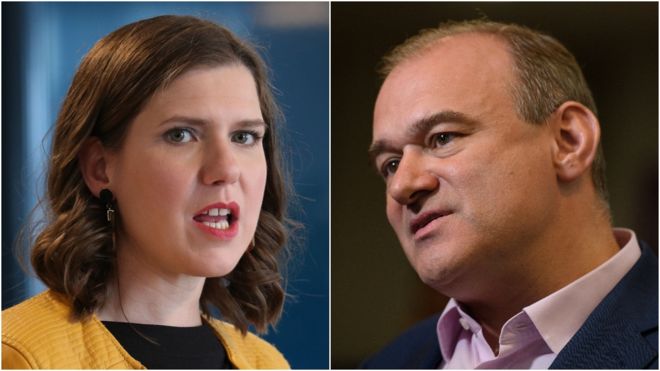
  • Jo Swinson and Ed Davey

    Why does the Lib Dem leadership matter?

    Despite only having 12 MPs, the Lib Dems have tried to position themselves as the main anti-Brexit party.
    They are calling for another Brexit referendum and - if that happened - would campaign for the UK to remain in the European Union.
    By contrast, both Labour and the Conservatives have been plagued by infighting over their Brexit strategies.
    The splits in the two main parties appear to have benefited the Lib Dems.

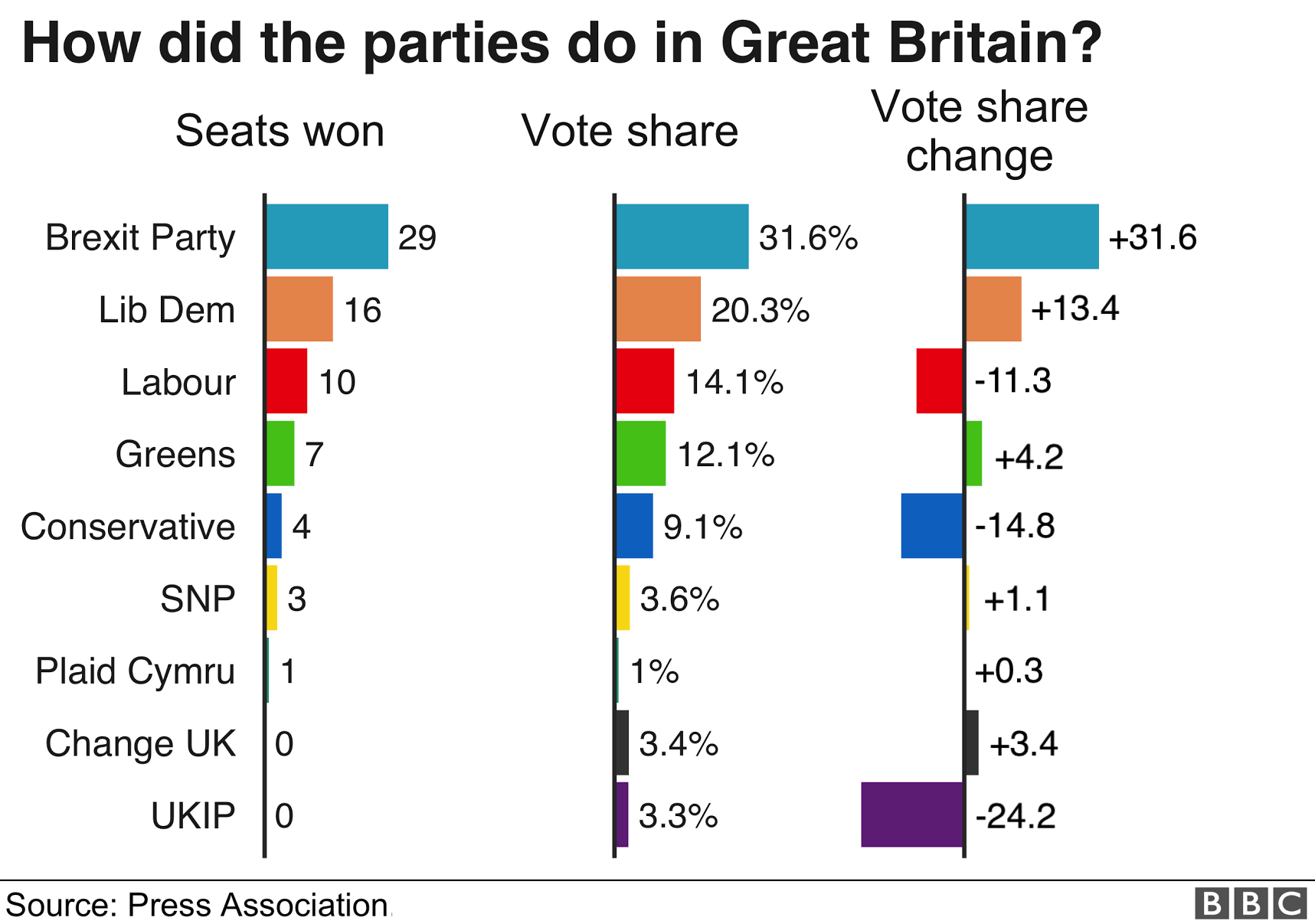
    The Brexit Party and Lib Dems have made gains
    Image captionThe European elections, held at the end of May, saw significant Lib Dem gains

    That result, accompanied by recent surges in the opinion polls, represents a remarkable turnaround.
    In the 2014 European elections - when the Lib Dems were in a coalition government with the Conservatives - they lost all but one of their MEPs (Members of the European Parliament).
    It got worse. In the 2015 general election they lost 49 of their 57 MPs and left government.
    The party was written off by many as a spent force. But its anti-Brexit position appears to have breathed new life into the party, at least for the time being.

    Who are the contenders?

    The current leader, Sir Vince Cable, told party members in May he was standing down after two years in charge.
    The 76-year-old said it was time "to make way for a new generation".
    In the race to take over, two contenders have emerged: Jo Swinson and Sir Ed Davey.
    Jo Swinson
    Jo Swinson has been Sir Vince's deputy for two years, and speaks for the party on foreign affairs.
    In the 2015 general election she lost her East Dunbartonshire seat to the Scottish National Party, but won it back two years later. She has also served in government - as a business minister in the coalition government until 2015.
    On Brexit, Ms Swinson wants to block a no-deal Brexit - an outcome she compares "to planning for your house to burn down".
    She says some Conservative MPs would support her, when faced with a "disastrous" outcome for the country.
    Ms Swinson has ruled out joining forces with Labour to form a government, describing leader Jeremy Corbyn as a "Brexiteer".
    Instead, she wants to work informally with MPs from all parties.
    If she wins, Jo Swinson would become the first female leader in the Lib Dems' 31-year history.
    Sir Ed Davey
    A key figure in the Conservative-led government, Sir Ed Davey became energy and climate change secretary in 2012.
    Sir Ed also had an unplanned break from Parliament. In 2015 he was defeated in his Kingston and Surbiton seat after 18 years as an MP, but won it back from the Conservatives in 2017.
    He says a vote of no confidence in the government could prevent a no-deal Brexit - something he describes as the "nuclear option".
    In such a scenario, Sir Ed says he would push for the Lib Dems to form a temporary government with other parties.
    "That would just be a temporary government for one purpose and one purpose alone - to pass the legislation for a people's vote," he said, making the case for another public vote on the issue.
    Like Ms Swinson, he has ruled out working with Jeremy Corbyn - but he's said he would be willing to work with other Labour MPs, including Yvette Cooper.
    On many of the other key issues, there are few big differences between the contenders.
    That's because Lib Dem policy is decided by its members at party conference, and not by the leader.

    Who gets to choose the leader?

    The leader will be chosen by Lib Dem party members. Just over 106,000 people have been sent ballot papers.
    Research carried out by the Party Members Project - run by professor Tim Bale of Queen Mary, University of London - shows the average Lib Dem member is around 50 years old - younger than the Conservatives and Labour, but not quite as young as the Greens.
    It also reveals most members are relaxed about immigration, and 90% voted Remain in the referendum.
    The poll will close on 23 July. But the timing for the announcement is yet to be set, because another announcement that day could overshadow the Lib Dems.
    It's also the day the the new prime minister is expected be revealed.

    https://www.bbc.com/news/uk-politics-48770368

    Friday, 14 June 2019

    ‘Gravy train?’ A first taste of life as an MEP

    At last, I’ve had my first taste of being an MEP: over in Brussels on Monday and Tuesday signing up with the administration and being briefed on and by the bureaucracy. Quite an experience. It was even more absurd than I expected.


    14 June 2019


    When a rather obsessive pseudonymous troll published a series of photos of me eating on the Eurostar, I realised just how much my life had changed. “Brexit Party MEP has nose in trough of gravy train,” the shock-horror exposé was to show me travelling business class.

    But if critics think business class travel is the extent of the gravy train, they haven’t been looking very hard. The EU’s financial excesses are grotesque.

    It’s creepy enough that just by being elected seems to have given the green light for a stranger to intrude on my privacy to take secret photos, but it’s also bemusing that my secret paparazzi was travelling in the same carriage, at the same costs; presumably a fellow elected official or a EU bureaucrat?

    While outraged #FBPE Remainers gloated that I was travelling at taxpayers’ expense, they might like to know it is the EU who recommends business class for expediency. It is paid for by them apparently because these tickets are easier to change if there are travel problems. It’s an exorbitant extravagance, but it is only the tip of the iceberg.

    I’ve never really focused on the financial costs of belonging to the EU: my main objection is its undemocratic nature. But I must confess, I’m shocked by the wanton waste lavished on MEPs. The above-mentioned voyeuristic troll tweeted, “my spy tells me she spent much of the journey looking mournfully out of the window as the French and Belgian countryside fled by.” Factually accurate.

    I was reflecting on just how grubby I felt being embroiled in an organisation awash with money, perks, chauffeurs, bulging with endless incentives designed to suck you in. It felt potentially corrupting and you don’t have to be a supporter of Brexit to feel queasy about the EU’s obscene opulence.

    Don’t get me wrong: on arrival, I was excited, if nervous, about being formally registered in my new role. As a democratically-elected MEP, I feel an enormous responsibility to the over half a million voters in the North West of England who chose three of us from the region to represent them.

    Our mandate is to get us out of the EU, but it is also a broader task of popularising the importance of national and popular sovereignty and ensuring that the democratic vote is delivered.

    And what an amazing setting to pursue such noble aims. The buildings are imposing: a vast campus with hairdressers, shops, tens of thousands of staff, researchers, endless committee rooms and auditoriums, top of the range technology, smoking booths (phew), bars, every conceivable amenity. A real city on the hill. As someone new to this official politics game, I confess I was wowed, impressed, a little thrilled to be so close to power. But then I checked myself…

    Listening to briefings detailing descriptions of how the parliament works was sobering and I realized just how powerless MEPs really are. Any plans to make trouble ran into the practical reality of the way time is stitched up via the arcane Group system, allowing little possibility of speaking.

    Incredibly, the EP isn’t even a talking shop: it actually blocks people from talking!

    Facing the stark reality of joining a body that cannot initiate change, restricted to amending proposals, it feels more like a rubber stamp of legislation handed down from the unelected EU Commission on high. Enough to make a democrat’s heart sink. We do get to elect the next Commission president, but this seems small fry compared to having real democratic, mandated power.

    I kept wondering how all the pro-EU MEPs could justify being mere insignificant cogs in a toothless technocratic wheel. Yet the paraphernalia and trappings, the payments and pay-offs are obviously an important prop in the grand illusion that your job matters. Surely no-one would throw such extravagant rewards at you unless you are crucial, right?

    For example, according to recent Treasury figures, the annual cost of an MEP is three times the cost of an MP in the House of Commons. Indeed, most Remainer MEPs are easily flattered into believing they deserve every penny. But this is delusional. Wherever you stand on the Brexit divide, I think voters deserve a more honest critique of the ludicrous excesses on offer to MEPs.

    Never mind the business-class travel, surely even Remain-and-Reform advocates might be keen to challenge whether every new MEP needs a free iPad, two offices in Brussels, one in Strasbourg, an office and staff budget for the UK.

    It was jaw-dropping to hear administrative staff – who made us all feel incredibly welcome (despite the irony of us being a group committed to leaving the very institution they were initiating us into) – spell out what benefits are on offer.

    We were issued with a mind-boggling 110-page booklet “on Members’ financial and social entitlements.” I had to get the finance staff to repeat exactly what the “daily subsistence” meant. Apparently, on top of a hefty salary, you are paid just to turn up to work. Actually, you automatically collect £300 plus if you sign in to the building, which MEPs do regardless of the fact that the Parliament is infrequently in session.

    Then there is a general expenditure allowance paid as a lump sum into MEPs’ personal bank accounts on top of our salary, without having to provide any receipts or proof of expenditure. It’s a lavish anti-transparency measure only recently upheld by Eurocrats. The allowances – i.e. extras, bits and bobs – costs £35 million-a-year for 751 MEPs. Do the maths.

    Unsurprisingly, the website for UK MEPs seldom mentions these perks. Rather, we read grandiose claims for the importance of the number of committees they sit on, the foreign delegations they join and boasts that “MEPs, as individuals and working in their political groups” are having “a real impact on the drafting and amendment of European legislation.” I suspect that the financial rewards reinforce the sense of one’s own inflated importance.

    I officially start as an MEP when the parliament meets in Strasbourg on 2 July. I am still gob-smacked that every month the Brussels machine moves its 751 members and its (our!) 7,500 staff to France at an annual cost of €114 million. This is an obscene, modern-day Versailles. While I’m going to try and enjoy every moment of what I hope will be a short stay, I will be documenting its real inner workings.

    If the EU insist on business class Eurostar, the very least I can do is repay them by writing a regular exposé of its excesses as I travel home. Watch this space.

    By Claire Fox, Brexit Party MEP-elect for the North West Region.

    Molly Scott Cato MEP has responded to this piece with her own perspective as a Green Party MEP for the South West region since 2014. See her rebuttal here.


    https://ukandeu.ac.uk/gravy-train-a-first-taste-of-life-as-an-mep/