Showing posts with label Extension. Show all posts

Friday, 5 June 2020

No Progress: EU Won’t Drop Demands, UK Won’t Surrender on Fishing

The EU’s chief Brexit negotiator, Michel Barnier, has accused the UK of backtracking from pledges it made in the Political Declaration, signalling that Brussels would not budge on its demands on fishing and regulatory alignment.
VICTORIA FRIEDMAN
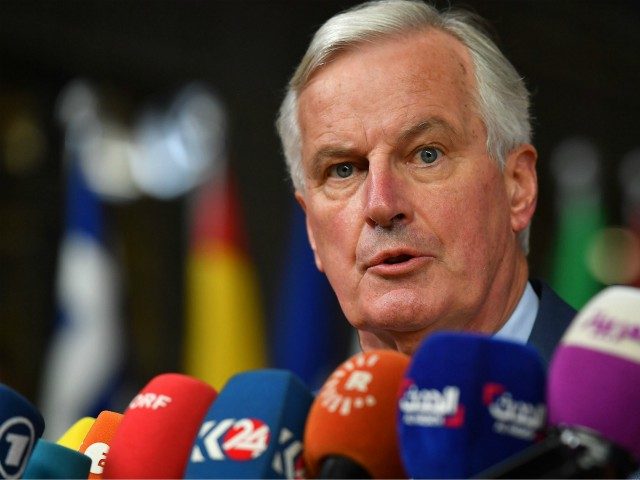
EU Chief Brexit negotiator Michel Barnier answers to journalists upon her arrival at the European Council in Brussels on October 17, 2018. - British Prime Minister Theresa May is due to address a summit of European Union leaders in which Brexit negotiations are expected to be top of the agenda. …
The fourth round of post-Brexit trade negotiations concluded on Friday, with Mr Barnier telling media during a press conference, effectively, that the British government has not moved on its pledges to the British people to regain control of the United Kingdom’s fishing waters, regulations, and laws.
The EU demands continued access to Britain’s territorial fishing waters, with the Common Fisheries Policy currently allowing EU trawlers to land approximately 60 per cent of the fish caught in the waters around the United Kingdom while British fishermen go bust.
Brussels also wants Britain to deliberately make itself less of a competitive threat to the EU by abiding by “level playing field” rules on state aid for British businesses and other issues.
The EU also wants its own European Court of Justice to oversee the governance of any future trade deal.
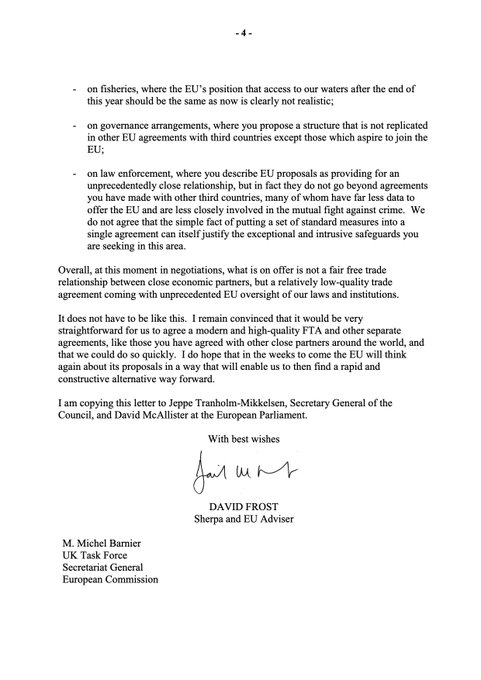
Tremendous letter from @DavidGHFrost to @MichelBarnier on the absurdity of the EU position. "Your text contains novel & unbalanced proposals which would bind this country to EU law or standards...You must see that this is simply not a provision any democratic country could sign"


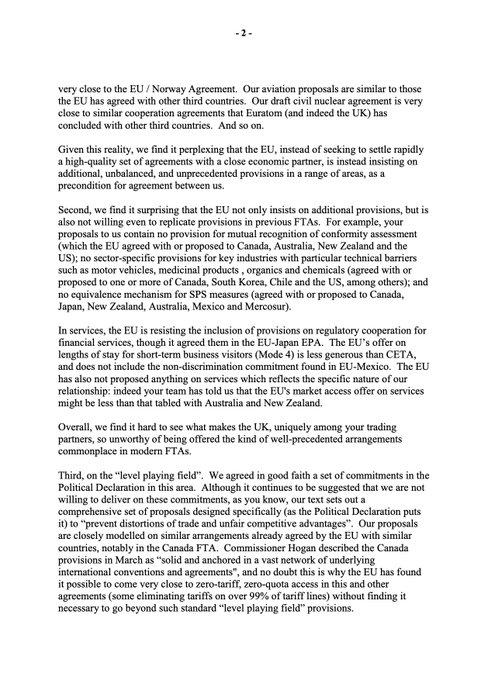
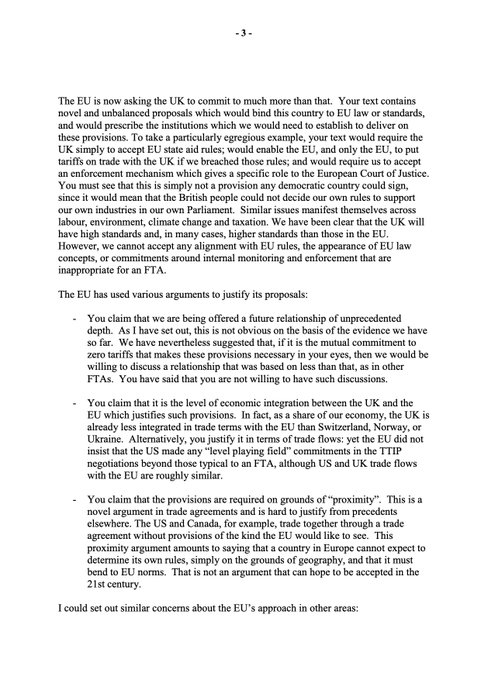
View image on TwitterView image on TwitterView image on TwitterView image on Twitter

On all these matters, Mr Barnier said: “This week, there have been no significant areas of progress.”
“On fisheries, the UK has not shown any true will to explore other approaches beyond zonal attachment for the sharing of quotas. They continue to condition access to waters to an annual negotiation, which is not possible for us, not even technically possible. The EU wants to construct a stable, economic partnership. That’s always been our desire,” the former French minister said, signalling that the EU wants a permanent deal, set in stone, on accessing Britain’s territorial waters.
Speaking from the European Commission — the EU’s powerful unelected executive — in Brussels, Belgium, he continued: “I don’t think we can go on like this forever.
“On top of that, the UK has refused to extend the transition period, which would allow us more time for negotiations. We have always been open from our side to extending this period by one or two years… Our door is still open to that end.”
The United Kingdom officially left the EU on January 31st, 2020, but has entered an 11-month “transition period” in which it continues to abide by the EU’s rules on Free Movement and membership of the Single Market and Customs Union.
Effectively leaving the UK in the EU in all but name, but with no representation in the nominally-democratic European Parliament or other EU institutions, the transition period was supposed to provide time for the two parties to agree on a future trade deal.
If an agreement is not made by December 31st, 2020, the United Kingdom will fully leave the EU’s institutions and trade with the bloc on World Trade Organization (WTO) terms. Extension of the transition period has been ruled out, despite pressure from the EU and anti-Brexit MPs to extend it by two years, with its end date currenty confirmed in British law.
While the United Kingdom has asked for a deal similar to the one the EU struck with Canada — where the vast majority of tariffs are lifted — the EU has insisted that the British remain closely aligned to the bloc. Negotiators came to blows — albeit at a distance, due to coronavirus — when Mr Barnier’s British equivalent, David Frost, said last month that the UK would not accept the EU’s “low-quality” deal that no “democratic country could sign”.
In response, the Frenchman said that he did not like Frost’s “tone” and rejected calls for a deal based on a partnership of equals.
“We must stick to our commitments if we want to move forward,” Mr Barnier said on Friday, complaining that the UK was trying to “distance” itself from terms outlined in the Political Declaration, which sets out a framework for negotiating a future trade deal.
Both Mr Barnier and Germany’s ambassador to the EU, Michael Clauss, have said in recent days that the British must be “realistic” and accept a surrender of sovereignty in exchange for a trade deal.
The British government has said that there will be no progress on a deal until the EU drops its unreasonable demands, while Mr Barnier still thinks a deal can be done on the EU’s terms in the next few months.
The Bank of England, however, is more “realistic” in recognising the possible outcomes, telling British banks to prepare for a no-deal style exit on World Trade Organization (WTO) terms by New Year.


https://www.breitbart.com/europe/2020/06/05/no-progress-eu-wont-drop-demands-uk-wont-surrender-fishing/#

There is nothing to gain from a Brexit extension

The more the Brexit negotiations drag on, the longer the UK will remain subject to the EU’s rules. Agreeing to continue to accept decisions of the EU’s institutions, regulators and courts raises serious questions of democratic legitimacy, argues regular contributor John Baron MP

JUNE 5, 2020
|IN BREXIT
As worldwide efforts to counter the coronavirus outbreak continue, there are signs that things are beginning to get back to normal – or at least a ‘new normal’, as we learn to live with this virus whilst going about our usual business. Lockdowns across Europe are unwinding at differing speeds, and while it will be a long time before life returns to pre-pandemic patterns, issues which were parked at the height of the coronavirus outbreak are raising their heads.
In the United Kingdom, recent events have shown that after a brief period of consensus, the usual run of party politics is back. Sir Keir Starmer has moved quickly to set his own imprint on to the Labour Party, overseeing the appointment of David Evans as General Secretary whilst Jeremy Corbyn, leader for nearly five years, failed even to be elected to Labour’s delegation to the Council of Europe – despite there being ten applicants for eight places. The Liberal Democrats, for their part, have announced there will be a leadership election this year after all.
The return of Parliament this week is a welcome development. The ‘virtual Parliament’ was an essential adaptation to extraordinary circumstances, and the Parliamentary staff who worked hard to set it up deserve thanks and congratulations in equal measure. However, it was a pale imitation of the real thing – debates became a procession of set speeches rather than a genuine back-and-forth investigation of the issues, and scrutiny of the Government suffered.
The return of Parliament is also imperative because of the serious programme of legislation to be passed before the expiration of the Transition Period at the end of the year. The EU negotiations will come back to the fore this month, ahead of the crucial decision whether to extend the transition period or not, and will prove an important focus for Parliamentary time.
The British Government has quite rightly ruled out any extension – it would take much of the urgency and impetus out of the talks, would mean the UK is subject to EU rules and institutions for considerably longer (whilst having no say over either) and may mean the UK is on the hook for whatever coronavirus bailout scheme the EU designs – in addition to covering its own costs of the outbreak.
The European Union would very much like an extension, largely for the inverse of the reasons above. The more the negotiations drag on, the longer the UK will remain subject to its rules and institutions, and it would be helpful if one of the world’s largest economies contributed to any bailout mechanism. Michel Barnier’s letter to opposition MPs, in which he floated the idea of a two-year extension to the transition period, shows the EU is still acting as if the Conservatives did not win a strong majority at last December’s General Election.
Taking this point further, negotiations with the EU would make much better progress if the EU were to start treating the UK like any other independent country. Agreeing to accept decisions of the EU’s institutions, regulators and courts would raise serious questions of democratic legitimacy, as these would trump the decisions of the elected government at Westminster, without even the fig-leaf of MEPs in the European Parliament.
The UK would not get very far if it demanded that the EU accept all the laws passed in Westminster, now and in the future, and that it be legally bound to abide by the unknown future decisions of British regulators and courts. Yet the inverse of this is what the EU is insisting the UK agrees to as the price of a trade deal. Indeed, the more the EU complains that Britain should not benefit from ‘unfair competition’, the more it would seem to be a good idea to do so.
Also coming back to the fore after a coronavirus hiatus is the fate of Hong Kong. After a bruising few years during which the city’s freedoms and autonomy, guaranteed for 50 years from handover by the 1984 Sino-British Joint Declaration, have become a thorn in the side of the Chinese authorities, Beijing is poised to pass a law which will ban any acts or activities which undermine China’s authority. This presents obvious risks to Hong Kong’s special status, as charges of separatism, subversion or terrorism are open to wide interpretation by the Chinese authorities.
So far it has been the United States which has led international condemnation, fitting in to the Trump administration’s general animus against China. The US Secretary of State has declared to Congress that the security law will mean the end of Hong Kong’s autonomy, significant because it risks rendering the city ineligible for the special trading terms it enjoys with the US. This would have a serious effect on the levels of investment into Hong Kong but also into China itself, as much US investment is channelled through the city.
The British Government is beginning to find its feet, jointly authoring a statement along with the US, Canada and Australia condemning the new security law. More productively, the Foreign Secretary has also announced that should China press on with the new law, Britain will offer a passport to British citizenship for BNO passport-holders.
This is the right course of action, recognising Britain’s historic debt to Hongkongers and firing an important warning shot across Beijing’s bows. Whilst the Chinese authorities will be relieved if pro-democracy activists leave Hong Kong, they will be less relaxed when wealth creators make the same journey. In an interesting echo of the end of my last column, if China wants to take its place in international affairs it must also live up to its responsibilities – and that includes abiding by the treaty it freely signed with Britain in 1984.
4.86 avg. rating (95% score) - 7 votes


https://commentcentral.co.uk/there-is-nothing-to-gain-from-a-brexit-extension/

Germany: UK Must Surrender Sovereignty for an EU Trade Deal

A German official has said that the UK must surrender sovereignty if the country wants to strike a trade deal with the European Union.
VICTORIA FRIEDMAN
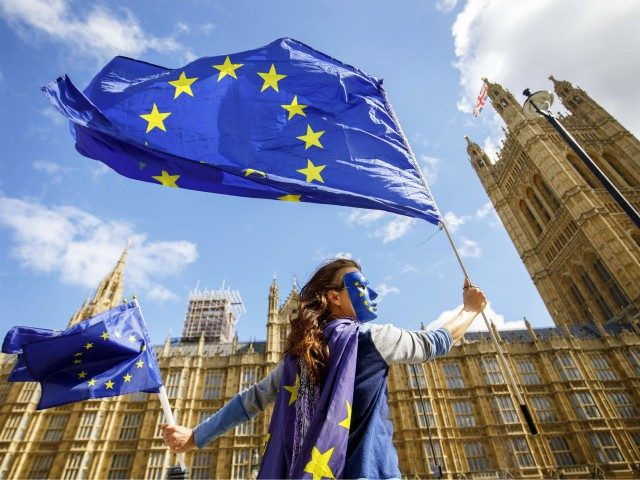
Pro-European Union demonstrators protest outside the Houses of Parliament against the first vote today on a bill to end Britain's membership of the EU on September 11, 2017. - MPs hold their first vote today on a bill to end Britain's membership of the EU, which ministers say will avoid …
Germany will take over the rotating presidency of the Council of the European Union, a council of EU member-states’ ministers, in July and the country’s ambassador to the bloc is already lining up Germany as a key player in crunch negotiations between Brussels and London.
Michael Clauss said at an event hosted by the European Policy Centre think tank that there will be a trade deal — if the UK takes what he calls a “more realistic approach”.
“To put in short, I think you cannot have full sovereignty and, at the same time, full access to the internal market,” Mr Clauss said, according to The Guardian.
The EU’s chief negotiator Michel Barnier used similar language over the weekend when he said the UK must become more “realistic” if it wants access to the Single Market, complaining that the UK was “cherry-picking”.
Barnier’s British counterpart David Frost has told the EU that it needs to treat the UK as an equal trading partner and offer a deal at least equivalent to others it had offered countries like Canada — but without the demands on alignment.
The UK will only regain full national sovereignty from the globalist superstate once it can take back control of its laws, borders, trading rules, and regulations.
However, the EU has demanded the UK remain aligned by the Brussels playbook to maintain a “level playing field” — with the likes of France fearing the UK could become competitive on the global market to the detriment of the bloc — including abiding by EU rules on environmental standards and state aid.
The EU also wants the European Court of Justice to be the arbiter of any future trade deal with the UK and demands continued access to Britain’s territorial fishing waters.
Failure to strike a deal will see the UK and EU trade with each other on World Trade Organization (WTO) terms. Clauss said: “We work under the assumption the United Kingdom is not going to ask for an extension. That means a deal needs to be struck in the next six months.”
However, given that the UK has said it will not move on issues such as laws and fishing, a WTO relationship by the end of December 2020 looks likely. Downing Street has said that there will be no progress on a trade deal unless the EU drops demands for regulatory alignment, and rejected claims that the British government was about to capitulate on fishing waters.
The Bank of England is taking no-deal seriously, telling British banks to prepare for WTO rules, according to reports on Wednesday.
Despite the exit date being set in law, London mayor Sadiq Khan has called for an extension to the transition period because of coronavirus.
Conservative MP and Brexiteer David Davis warned that the EU would want an extension so it can have access to more of Britons’ cash.
“They want our money for another two years,” the former Brexit secretary said on Monday.
Mr Davis also warned that extending weakens the UK’s negotiating hand, saying “every single time we extend, we weaken our position and strengthen theirs”.


https://www.breitbart.com/europe/2020/06/05/germany-uk-must-surrender-sovereignty-eu-trade-deal/