Showing posts with label Benn Act. Show all posts

Tuesday, 22 October 2019

What is the Withdrawal Agreement Bill?

In the Brexit process, we've had a Withdrawal Bill and we've got a withdrawal agreement.
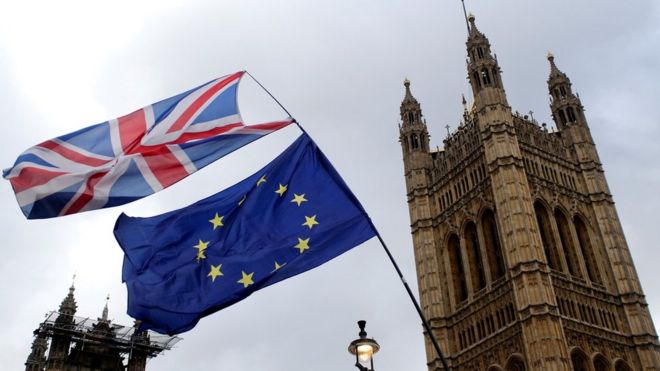
Flags outside parliamentImage copyrightREUTERS
In the Brexit process, we've had a Withdrawal Bill and we've got a withdrawal agreement.
Now the government has published the Withdrawal Agreement Bill (WAB).
Its purpose? To turn the withdrawal agreement, which is a draft international treaty, into UK law and to give the government permission to ratify it.
The terms on which the UK will leave the EU have now been agreed between Boris Johnson's government and those of the other 27 member states.
Theresa May's government got to the same stage, but failed to win approval in Parliament for the settlement it had negotiated.
Mr Johnson hopes to go one better, by turning the agreement into legislation and getting the House of Commons to approve it.
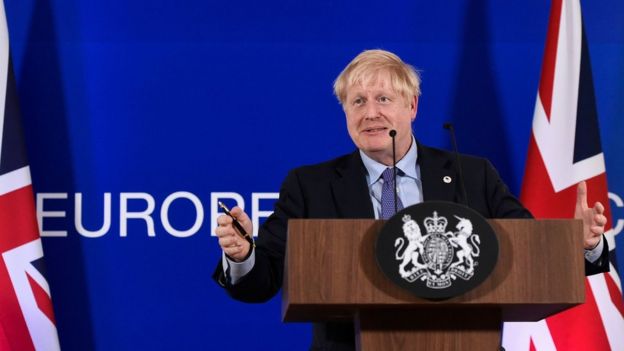
Boris Johnson in BrusselsImage copyrightAFP
He wanted that to happen to fulfil his promise to leave the EU by 31 October, but it was a tough ask, to say the least.
Bills to implement major European treaties usually take several weeks to get through Parliament, and sometimes considerably longer.
If the government had a solid majority in the House of Commons, it could have pushed the bill through pretty quickly. But it doesn't, and its opponents insisted on more time to scrutinise the legislation properly.
It is, they argue, one of the most important pieces of legislation in decades, and MPs need to be sure they know exactly what it says and does.
Media captionConfused by Brexit jargon? Reality Check unpacks the basics.
So what does the WAB actually cover? Among other things:
  • It sets out exactly how the UK will make "divorce bill" payments to the EU for years to come
  • It repeals the European Communities Act, which took the UK into the EU, but then reinstates it immediately for as long as a post-Brexit transition period lasts
  • It contains language on how the new protocol on Ireland - setting up a customs and regulatory border between Northern Ireland and Great Britain - will work in practice. An accompanying impact assessment lays out some of the costs and bureaucracy that companies doing business in Northern Ireland will face
  • It sets out areas in which the European Court of Justice still plays a role in the UK, and makes the withdrawal agreement in some respects "supreme" over other areas of UK law
  • Its language on workers' rights - an important issue for many MPs - is pretty vague, because Mr Johnson's deal moves obligations in this area from the withdrawal agreement to the non-binding political declaration on future relations
  • It suggests that if the government doesn't ask for an extension of the transition period beyond the end of 2020, parliament won't have a say in changing that, even if a free trade deal isn't ready in time
  • In the section on citizens' rights it sets up an independent monitoring authority (IMA) with which EU nationals in the UK can lodge any complaints about the way the government treats them
  • In several policy areas, particularly in Northern Ireland, the bill gives ministers a lot of power to change the law (through secondary legislation) without MPs getting to vote
On Tuesday 22 October the bill passed its first hurdle, the second reading, with a majority of 30. But the government also lost a critical vote over the timetable of the bill.
The 31 October deadline is now extremely difficult to meet and the EU will consider an extension. In the meantime, Mr Johnson has paused the bill.
Whatever the eventual timetable, there will still be opportunities for the legislation to be amended. It's expected some MPs will try to add a provision for holding a confirmatory referendum on Brexit, for example, and for the UK to remain in a customs union with the EU.
That's why the WAB is tricky for the government: sensitive issues which can be fudged a bit in political communications have to be set down in black and white - and in precise legal language - for all to see.
The government still insists that it has the numbers to get this legislation through Parliament.
If it fails to do that in time, then the default position is currently that the UK would leave the EU without a deal on 31 October.
But under the terms of the Benn Act the prime minister sent a letter to European Council President Donald Tusk making a formal request for an extension to the Brexit process until 31 January 2020.
The EU are now deciding how to respond to the extension request.

https://www.bbc.com/news/uk-politics-50125338

Monday, 21 October 2019

A parliamentary dictatorship - MUST READ

This zombie parliament is holding the nation to ransom.

Brendan O'Neill

BRENDAN O'NEILL
EDITOR


‘Super Saturday’, they called it. Which is ironic because the events in parliament on Saturday demonstrated just how pathetic and exhausted our parliament has become. Once again parliamentarians were presented with a Brexit deal, and once again they dithered and dodged and shirked their democratic duties. In backing the Letwin amendment, which says Boris’s Brexit deal cannot be approved until implementing legislation has been passed, MPs signalled their desire to continue frustrating Brexit, and to continue using parliament as a weapon against the people’s will.

This parliament is not simply out of touch with public sentiment – something we already knew from the fact that 70 per cent of MPs, and a staggering 95 per cent of Labour MPs, voted Remain, while 52 per cent of the electorate voted Leave. No, it feels increasingly illegitimate, too. It lacks all political and moral authority. It is a zombie parliament. It has no real democratic mandate to govern. ‘But we voted for these MPs just two years ago!’, Remainer apologists for the zombie parliament will cry. True, but 80 per cent of those MPs were elected on manifestos that promised to take the UK fully out of the EU. And vast numbers of them are now reneging on those manifestos. They are tearing apart their contract with voters and in the process obliterating their own right to govern.

We have a Remainer parliament defying the wishes of a Brexit electorate. Numerous parliamentary devices have been deployed to the end of frustrating the people’s will. From the speaker John Bercow’s cynical manipulation of parliamentary processes to sideline the enactment of Brexit and boost the cause of Remain, to the anti-democratic Benn Bill that has now come into force and legally cajoled Boris to ask the EU for another extension, parliamentarians are using their power and their mechanisms not to enact the will of people, but to fetter it and block it. This is why they get so angry if anyone says the key divide in Britain today is between parliament and the people – because they know it’s true. And somewhere deep in the recesses of their anaemic moral consciences, that truth still stings.

‘Super Saturday’ continued this foul process of using parliamentary devices to stymie progress on Brexit. This isn’t about whether you back Boris’s treaty or are sceptical of it (as spiked is). The important thing is that in triggering the Benn Act and forcing an unwilling PM to plead with the EU for a further extension, our Remainer parliament has once again put off the fulfilment of the people’s will. The wild cheering among the reactionary middle classes of the ‘People’s Vote’ lobby who were gathered outside parliament as the Letwin amendment was passed made it clear to the entire nation what was happening here. This was not about giving MPs more time to pore over Boris’s deal, as they ridiculously tried to convince us it was. No, it was yet another underhand Remainer assault on the people’s democratic desire to break from the EU.

MPs are now doing things in parliament that they explicitly told voters in the General Election of 2017 they would not do. The two main parties promised they would not prevent the enactment of the 2016 referendum result. Candidate after candidate in the General Election said they would not seek a second referendum. Millions upon millions of people voted for them on this basis. Now, numerous MPs are betraying – yes, betraying – those voters by doing the very things they said they wouldn’t. They’re blocking Brexit. They’re campaigning for a second referendum. Many MPs are no longer even in the parties they stood for in 2017. They’ve switched to parties whose political positions, especially on Brexit, are entirely contrary to the outlook of their voters. This parliament, in the words of the attorney-general Geoffrey Cox, is a disgrace.

And yet it stays. It cannot be moved. Why? Because, not content with frustrating the democratic will of 2016, these parliamentarians are also blocking a General Election today. The shamelessness is quite staggering. They plot ceaselessly against the people’s democratic wishes and then they cushion themselves from our judgement by continually blocking a General Election. The end result is something like a parliamentary dictatorship. We now live under a parliament that is acting against the democratic interests of the people and which is preventing us from protesting about this fact at the ballot box. Such is their determination to stop Brexit that they have turned parliament into an entirely anti-democratic institution, into a tool of the elites against the public.

And then they say they are defending parliamentary sovereignty. This is a lie, and they know it is. In truth they are doing grave harm to parliamentary sovereignty. Parliamentary sovereignty derives from the will of the people. Where else could it derive from? And yet this parliament explicitly agitates against the will of the people, to the end of continuing to sacrifice this country’s sovereignty and to outsource its law-making power to the foreign technocracy in Brussels. To sideline the British people and cling to the interfering technocracy of the EU is to trash the history and meaning of parliament, its sovereignty, and its relationship with the people.

In a sense, the events of the past few days – and of the past three years – have been valuable. They have made it clear that the greatest block to democracy in the UK is right here in the UK itself. It is our own out-of-touch and morally emaciated elites who represent the greatest threat to democratic life in this country. To use a radical old slogan: the enemy is at home.

Brendan O’Neill is editor of spiked and host of the spiked podcast, The Brendan O’Neill Show. Subscribe to the podcast here. And find Brendan on Instagram: @burntoakboy

https://www.spiked-online.com/2019/10/21/a-parliamentary-dictatorship/

BBC: Brexit: Jargon-busting guide to the key terms

Confused by all the Brexit jargon in the news? Here's a glossary to demystify commonly used EU-related terms.

Your guide to Brexit jargon

Use the list below or select a button

16 key terms


Article 50

  • Part of an EU treaty that sets out how member countries can leave, with a two-year timetable for leaving.
  • Article 50 was triggered by former Prime Minister Theresa May at the end of March 2017.
  • However, the deadline was extended to 31 October 2019 after MPs rejected Mrs May's Brexit deal.
  • The UK is allowed to stop the Article 50 process completely - but if it only wants to extend it, all the other EU countries must agree.

Backstop

  • The backstop was an insurance policy negotiated by former Prime Minister Theresa May, to avoid checks along the Irish border.
  • Had it come into effect, the backstop would have kept the UK effectively inside the EU's customs union but with Northern Ireland also conforming to some rules of the single market.
  • Boris Johnson, the new prime minister, removed the backstop after renegotiating the withdrawal agreement and replaced it with a new customs plan.

Benn Act

  • In September 2019, MPs passed a new law - introduced by Labour's Hilary Benn - designed to stop Boris Johnson pushing through a no-deal Brexit on 31 October.
  • Under the "Benn Act", Mr Johnson was required to request a three-month Brexit delay by 19 October. Mr Johnson complied with the Benn Act and sent the extension request letter after MPs failed to approve the PM's new Brexit deal by the deadline.
  • Opponents of the legislation, including Mr Johnson, have referred to the law as the "Surrender Act".

Consent mechanism

  • Under Boris Johnson's revised Brexit deal, Northern Ireland will follow some EU rules. In order for the arrangement to continue, the Northern Ireland Assembly will need to give consent.
  • This will come in the form of a vote every four years. If the Northern Ireland Assembly votes against, the arrangement will come to an end two years later during which time the "joint committee" would make recommendations to the UK and EU on "necessary measures".
  • Once the joint committee is set up, it will consist of a panel of UK and EU representatives.

Customs plan

  • The revised Brexit deal proposes a new custom plan. Under it, some goods entering Northern Ireland from GB will have to pay EU import taxes (known as tariffs).
  • The tax will only have to be paid on goods which are deemed "at risk" of entering the Republic of Ireland.
  • The list of "at risk" goods will be decided at a later date.
  • If goods subsequently remain in Northern Ireland (ie do not travel to the Republic of Ireland), companies will be able to apply for a refund on the tax they've paid.

Customs union

  • The EU customs union is an agreement between EU countries not to charge taxes called tariffs on things coming from other EU countries, and to charge the same tariffs as each other on things coming from outside the EU.

Divorce bill

  • The money the UK agrees to pay to the EU as part of a Brexit deal.
  • Under Theresa May's deal it was widely expected to total about £39bn, to be paid over a number of years. It was based on the UK's share of EU budgets up to 2020 as well as continuing liabilities such as EU civil servants' pensions.
  • Some of that money has been paid as part of the UK's normal membership contributions already. The Office for Budget Responsibility (OBR) estimates that the bill is now around £33bn.

Irish border

  • The border between Northern Ireland and the Republic of Ireland. After Brexit, it will become the only land border between the UK and the European Union.

No deal

  • A no-deal Brexit would mean the UK leaving the European Union and cutting ties immediately, with no agreement in place.
  • The UK will leave with no deal on 31 October unless a Brexit deal is agreed, the Brexit deadline is extended, or Article 50 is revoked.
  • In a no-deal scenario, the UK would follow World Trade Organization rules to trade with the EU and other countries, while trying to negotiate free-trade deals.

Northern Ireland Assembly

  • Also known as the Stormont assembly, it is the devolved legislature for Northern Ireland.
  • The assembly is made up of 90 seats and has the power to make laws in a wide range of areas.

Operation Yellowhammer

  • The code name for the government's contingency plans for a no-deal Brexit, drawn up in August 2019.
  • After The Times obtained a leaked copy of the documents, MPs voted for them to be made public.
  • The "worst-case scenario" documents warn of a rise in public disorder, food price rises and reduced medical supplies.
  • The government says more progress has been made towards planning for a no-deal Brexit since the documents were written.

Political declaration

  • Document which sets out proposals for how the UK's long term future relationship with the EU will work after Brexit.
  • Unlike the withdrawal agreement, the political declaration is not legally binding - it sets out the hopes of both sides for the future on things like trade.

Single market

  • A system that enables goods, services, people and capital (money) to move between all 28 EU member states, as well as Iceland, Norway, Liechtenstein and Switzerland.
  • Countries in the single market apply many common rules and standards.
  • A UK company can sell its product (goods) in Portugal as easily as it can in Portsmouth, bring back the cash (capital), offer maintenance (services) and despatch a repair team (people).

Tariff

  • A tax or duty to be paid on goods being imported or, very occasionally, exported.

Transition period

  • The transition period is intended to allow time for the UK and EU to agree their future relationship.
  • The UK would have no say in the making of new EU laws during the transition but would have to follow all EU rules, including freedom of movement.
  • This period is due to expire on 31 December 2020, but could be extended by up to two years if both the UK and the EU wanted.

Withdrawal agreement

  • Theresa May agreed a deal with the EU on the terms of the UK's departure. It included how much money the UK must pay to the EU as a settlement, details of the transition period, and citizens' rights.
  • It also covered the so-called "backstop", which ensures that no hard border exists between Northern Ireland and the Republic of Ireland after Brexit even if there's no deal on the future relationship in place by the end of the transition period.
  • After it was voted down three times and Mrs May resigned, Boris Johnson negotiated changes to the withdrawal agreement where the backstop was replaced with a new Northern Ireland proposal.

Presentational grey line

Brexit explained

Brexit - British exit - refers to the UK leaving the EU. A public vote was held in June 2016, to decide whether the UK should leave or remain.

Presentational grey line

Correction 1st October 2019: An earlier version of this story suggested the Yellowhammer document had referred to the potential risk of rioting; it has been amended to more closely reflect the paper's exact wording, which referred to protests and "a rise in public disorder and community tensions".

https://www.bbc.com/news/uk-43470987