Last week’s talks ended in some acrimony after London accused Brussels of rowing back on an October 3rd commitment to “intensify” negotiations, with the prime minister determining that talks had failed and the UK would trade with the EU on World Trade Organization (WTO) terms at the end of the transition period on January 1st.
Number 10 also told Brussels on Friday that there was no point in sending its negotiator Michel Barnier to London if the bloc is unwilling to budge on its demands.
While the government’s rhetoric appeared to soften over the weekend — with Michael Gove saying that the door to negotiations was still “ajar” in hopes of a Canada-style trade deal — the senior minister told the House of Commons on Monday that the EU had refused to intensify talks “and would not engage on all the outstanding issues”.
“They declared that all future moves in this negotiation had to be made by the UK… This unfortunate sequence of events have in effect ended the trade negotiations because it leaves no basis on which we can actually find agreement. There’s no point in negotiations proceeding as long as the EU sticks with this position,” Mr Gove said, calling any negotiations with the EU as it stands “meaningless”.
At the same time, Mr Barnier issued a statement following a telephone conversation with his British counterpart David Frost claiming that he was “available to intensify talks in London this week, on all subjects, and based on legal texts”.
While it appeared that the EU had relented by returning the word “intensify” to the dialogue, Mr Barnier ended with the rather combative: “We now wait for the UK’s reaction.”
Downing Street did react, and despite the return of the pledge to intensify talks, Number 10 stood by its position, as Brussels had still not provided a new “basis to resume talks”, with concessions.
The statement said according to City A.M.: “The UK has noted the EU’s proposal to genuinely intensify talks, which is what would be expected at this stage in a negotiation.”
It continued: “However, the UK continues to believe there is no basis to resume talks unless there is a fundamental change of approach from the EU.
“This means an EU approach consistent with trying to find an agreement between sovereign equals and with acceptance that movement needs to come from the EU side as well as the UK.
“The two teams agreed to remain in close touch.”
The UK has been trying to negotiate a Canada-style free trade agreement, to which Brussels is resistant, it says, given the UK’s proximity to the bloc. Claiming the prospect of unfair advantage, the EU demands the UK abides by ‘level playing field rules’, allows the deal to be arbitrated by the European Court of Justice, and expects continued access to Britain’s fishing waters.
Mr Johnson said last week that if a deal cannot be struck, the UK will leave on WTO terms, or as the prime minister phrases it, an “Australia-style” arrangement with agreements in place that facilitate trade.
Gove repeated that the UK is ready for this option come the New Year, telling the Commons on Monday: “This country should get ready for 1 January 2021 for arrangements that are more like Australia’s – based on simple principles of global free trade.”
Charles Burton is associate professor of political science at Brock University in St. Catharines, Ont., senior fellow at the Macdonald-Laurier Institute’s Centre for Advancing Canada’s Interests Abroad, and former counsellor at the Canadian embassy in Beijing.
CHARLES BURTON
SPECIAL TO THE GLOBE AND MAIL
Last week, Chinese President Xi Jinping’s government acknowledged that the numbers it originally cited for coronavirus deaths in Wuhan had been under-reported by 50 per cent. Foreign ministry spokesman Zhao Lijian said the virus’s rapid spread had contributed to undercounting, and insisted this was not a cover-up: “We’ll never allow any concealment."
This assertion is certainly belied by foreign intelligence briefings. As Steve Tsang, of the China Institute at the University of London, put it, “The statistics have been changed most probably because the old figures were so ridiculous that even the Communist Party Propaganda Department knows it was unsustainable. Hence, a revision to a level less incredible, but one that will still present the Party under Xi as having done a vastly better job than Western democratic governments.”
Moreover, an earlier absurd statement by Mr. Zhao – that COVID-19 may have been brought to China by U.S. participants in last October’s controversial World Military Games held in Wuhan – suggests that China’s leaders likely know something they desperately want to hide about the origins and spread of this pandemic, and are panicking by disseminating ludicrous propaganda.
Looking back, many governments grappling with the pandemic would have responded differently if they’d known then what they know now. As late as March 6, Canadian health officials were saying the risk posed by coronavirus in this country remained low. U.S. President Donald Trump’s early missteps have proven tragically disastrous for our American friends. We weep for the people of Italy, Spain, France and the U.K., whose governments could have responded much sooner.
So, the question looms: Did politically motivated misinformation issued by Beijing, and uncritically relayed to the world via the WHO, lead to massive numbers of unnecessary deaths and economic hardship around the world?
The People’s Republic of China insists it offered honest and timely data about the spread of this virus in China and abroad, but the facts on the ground – including the persecution and disappearances of brave citizens who tried to get the truth out, and the Communist Party’s historical reluctance in moments like the 2003 SARS epidemic to acknowledge facts unfavourable to their rule – strongly suggest otherwise.
This is the same regime that insisted “not one person died on Tiananmen Square”; who state that a million Uyghurs are happy to be in crowded prison camps, forbidden from practising their religion, because there they have an opportunity for vocational training and learning Mandarin Chinese; who claim that people in Taiwan yearn to give up their hard-won democracy in favour of being ruled by a one-party autocracy out of Beijing.
This is the same regime, indeed, that claimed that Kevin and Julia Garratt, Michael Spavor, and Michael Kovrig are spies in service of Canadian dark forces. And that Canadian canola shipments are so full of contaminants that billions of dollars of PRC export contracts must be cancelled indefinitely.
Canada faces difficult decisions about how to restore its economy after the pandemic, including the long-stalled one on whether to let Chinese telecom Huawei into our 5G network. H.R. McMaster, the former U.S. National Security Advisor whose credibility is enhanced by having been fired by Mr. Trump (Gen. McMaster called the President “a dope”), recently indicated that many Huawei workers are simultaneously employed by China’s Ministry of State Security and the intelligence arm of the People’s Liberation Army.
The U.K., Australia, France and the United States have called for an international investigation of the PRC and WHO’s apparent mismanagement of the COVID-19 pandemic. If China were found culpable, would Canada still accept Beijing’s assurance that Huawei poses no threat to the security of Canadian 5G infrastructure, or that China will not seek to use it to further its cyber-espionage program in Canada? And in the background, of course, is China’s broad disregard for international rules-based order in trade and diplomacy.
Canada must carefully evaluate the extent to which we can engage with China economically, and whether that would require compromising our national security or conceding an “if you can’t beat them, join them” abandonment of Canadian support for justice, fairness, reciprocity and human rights. While our front line health workers work heroically to stave off more tragic death, we should spend our isolation weighing our own integrity.
The UK "will not negotiate any arrangements in which the UK does not have control of its own laws and political life"
The UK's aim is for a trading relationship with the EU similar to the ones the 27-nation bloc has with Canada, Japan and South Korea
There will be no jurisdiction for EU law or the European Court of Justice in the UK
The UK will rely on World Trade Organization rules under an arrangement with the EU similar to Australia's if progress on a comprehensive deal cannot be made
A separate agreement on fisheries is needed, to reflect the fact that "the UK will be an independent coastal state at the end of 2020"
The government wants to agree a "broad outline" of a deal with the EU "capable of being rapidly finalised by September" in the next four months
If that does not happen it will decide whether to switch focus to leaving on WTO terms at the end of December
The UK officially left the EU at the end of January, but is continuing to abide by many EU rules while talks on a permanent trading relationship take place.
Mr Johnson has pledged to get a deal with the EU by the end of the so-called transition period - 31 December 2020 - and has said he is not prepared to extend that deadline.
The UK's negotiating team will be led by Mr Johnson's Europe adviser David Frost.
Analysis from BBC Political Correspondent Leila Nathoo
Thought Brexit was done?
Sorry to disappoint, but the process of defining Britain's new relationship with the EU as a non-member state is only just getting going.
We'll soon be back to the days of crunch talks, the prospect of no deal and the two sides locking horns.
What's different now though?
Boris Johnson has a huge majority and gone are the days of disunity in the Conservative party that we saw under Theresa May.
So the government is being forthright about what it wants from these negotiations - to pull away from the EU and form a new relationship with the bloc as other non-member states have already done.
We can already see where the flashpoints are likely to be.
But the Conservative manifesto promised a negotiated trade agreement this year - we'll see in the coming months how likely that's looking.
How far apart are the two sides?
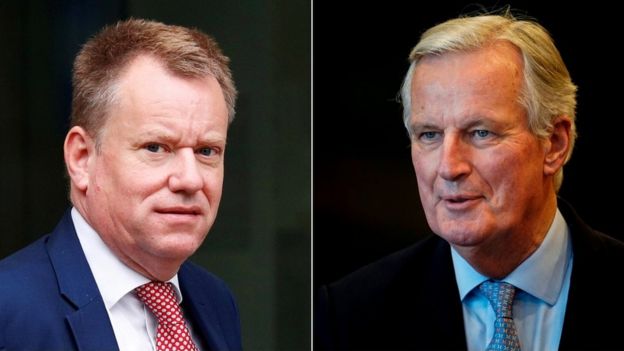
Image copyrightREUTERS/AFP/GETTYImage captionDavid Frost (l) and Michel Barnier (r) will lead the negotiating teams
Both sides agree that the UK will not undercut existing regulations on the environment, workers rights, competition and international tax principles.
But, says BBC Brussels reporter Adam Fleming, there are "some big obvious flashpoints".
'Dynamic alignment': The UK does not want to follow EU legislation as it is updated in the future. The EU is concerned about the UK gaining a competitive advantage.
State aid: The UK wants the freedom to subsidise domestic industries of its choice. Brussels wants state aid restrictions to continue "in perpetuity".
Governance: The EU wants a "blockbuster" agreement covering everything from fisheries, aviation, energy to immigration. The UK wants different deals in these areas.
Fishing: The UK wants quota deals like the EU has with Iceland or Norway. The EU wants continued access to UK waters.
The EU's 46-page negotiating document, published on Monday, indicated that the UK could be expected to keep aligned with changes to EU rules covering state subsidies for industry, environmental standards and workers' rights in future.
Any trade agreement "should uphold common high standards, and corresponding high standards over time with Union standards as a reference point", it added.
But Prime Minister Boris Johnson told BBC News: "The whole objective of doing what we're doing is so the UK can do things differently and better."
He added: "All we want is mutual recognition of each other's high standards and access to each other's markets.
"We wouldn't ask the EU to follow every particular change in UK legislation so it doesn't make any sense for them to make the same requirement of us and that's where we are."
A Canada-style deal?
The EU's chief negotiator Michel Barnier has said Brussels is prepared to give the UK "super-preferential access" to the EU market of 450 million people.
But he said the UK has to accept alignment with EU rules as they develop to ensure fair competition with EU states, effectively ruling out a Canada-style deal.
"The UK says that it wants Canada. But the problem with that is that the UK is not Canada," Mr Barnier told an event at the European Parliament on Wednesday.
"This is because of Britain's proximity to the EU and the much larger trade volumes it has with the EU than with Canada."
Michael Gove, the minister in charge of delivering Brexit, hit back in his statement to MPs, saying: "Geography is no reason to undermine democracy.
"We will not be seeking to dynamically align with EU rules on EU terms governed by EU laws and EU institutions."
What are the opposition parties saying?
Labour's shadow Exiting the EU minister Paul Blomfield said the government's negotiating strategy was "frankly underwhelming".
He told MPs the government had a "cavalier disregard" for the consequences of failing to conclude a deal in the next 10 months and the uncertainty that would mean for business.
The Scottish National Party's Pete Wishart said: "This is nothing other than a routemap to the cherished no-deal - the real ambition of these Brexit zealots."
Critics say leaving without an agreement and going to World Trade Organisation rules - the terms countries use to set tariffs (taxes) on goods when they do not have free-trade deals - could damage the economy.
The government will decide in June whether to abandon talks with the EU and prepare for no trade deal on World Trade Organization terms.
The decision will be made if insufficient ground has been covered in talks with the EU.
The acid test will be if what it calls "good progress" has not been made on areas such as financial services and data, which the government sees as the easiest areas to negotiate.
The approach was revealed in the publication of its negotiating mandate for the talks, which begin next week.
It echoes the EU approach to sequencing negotiations in the first phase of Brexit talks, seeking to settle issues of significant importance to the UK early, over which the EU has unilateral power.
The EU has so far refused, for example, to negotiate its power to determine whether UK financial services have "equivalent" standards for its trade with the EU, or whether UK's data regulations are adequate in terms of the flow of electronic information.
Canada model
The government has also played down the prospect of doing an immediate numerical economic assessment of the introduction of new trading arrangements with the EU, although a public consultation will begin in the spring, after the formal start of negotiations.
The UK mandate emphasises the government's wish for a trading relationship with the EU based on its existing precedents with Canada, Japan and South Korea.
It allows no jurisdiction for EU law or the European Court of Justice in the UK.
"The government will work hard to agree arrangements on these lines," the document says.
"However if it is not possible to negotiate a satisfactory outcome, then the trading relationship with the EU will rest on the 2019 Withdrawal Agreement and will look similar to Australia's."
The mandate seeks a suite of different agreements on fisheries, aviation, energy and migration, unlike the EU mandate, which seeks one whole agreement covering everything.
The document also says that it hopes the broad outline of an agreement should be clear by June, and capable of being "rapidly finalised" by September.
In the meantime, the government will push on for preparations for the reintroduction of customs and regulatory formalities on trade with the EU in January 2021, and expects businesses to follow suit.