Showing posts with label Dominic Cummings. Show all posts

Sunday, 15 November 2020

15.11.20 Dominic Cummings and Lee Cain departure: what really happened?

 Did they leave with a row or a good-natured chat, is the PM indecisive, and what of Carrie Symonds’ role?

15 Nov 2020
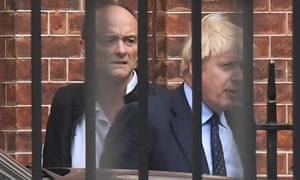
Dominic Cummings and Boris Johnson
 Dominic Cummings and Boris Johnson in September last year. Photograph: Victoria Jones/PA

One account had them swapping jokes and reminiscing about better times, another depicted a furious showdown. Just what went on this week between Boris Johnson and his senior aides Dominic Cummings and Lee Cain as they departed Downing Street has been subject to intense speculation.

What actually happened? The Guardian has attempted to unpick the competing versions apparently briefed by warring factions in Westminster.

The furious row v the good-natured farewell chat

On Friday, Johnson held a 45-minute meeting with Cummings and Cain in which, the Financial Times reported, he confronted the pair with text messages forwarded to his fiancee, Carrie Symonds, showing they had briefed against her. “In tense exchanges,” the paper reported, “Mr Johnson accused his aides of briefing against him and his partner Carrie Symonds and criticised them for destabilising the government in the midst of tense Brexit negotiations.” It added: “Mr Johnson … told them to get out and never return.”

A very different atmosphere was described in the Sunday Times. “Both [Cummings and Cain] told friends the meeting was ‘warm with lots of laughter’ as the trio recounted their battles together. ‘When you split up with a girlfriend, it’s best to move out quickly,’ a friend said.” It also quoted a senior No 10 source as saying the PM said the briefings had to stop.

The report added: “Having ousted his key aides … Johnson, typically, sought to minimise the confrontation, telling officials: ‘I told them we should get the gang back together’ to fight the next election.”

Johnson is said to have visited Cain in his office, signed a pair of “Get Brexit Done” boxing gloves, and made a farewell speech. “He’s the only one of my staff who always answers the phone calls … day or night,” Johnson reportedly said, adding: “I sometimes wait for days for Dom to return them.”

What’s clear is that, despite Cummings’ claim that he was always planning to leave at the end of the year (on which, more below), the dramatic and public nature of his and Cain’s departure was not what they or the prime minister had envisaged. All parties may have put on a good-natured front on Friday, but anger, shock and hurt on both sides are difficult to deny.

Symonds calls Johnson 20 times an hour and has been nicknamed ‘Princess Nut Nut’ v she gives much-needed advice as ‘one of the few around the PM who understands the Tory party’

One ally of Cain and Cummings claimed Johnson’s fiancee calls his private office “more than 20 times a day demanding that he leave meetings to call her back”. This was dismissed as untrue by Symonds’ allies and civil servants – the latter described as “impartial” by the Sunday Times.

The Mail on Sunday reported on a nickname for Symonds apparently circulating among Cummings loyalists: Princess Nut Nuts, or Princess Nut Nut (there is division over this, too), sometimes expressed in emojis. The Daily Telegraph, citing sources, reported that the prime minister was particularly riled by the nickname.

A source told the Guardian that neither Cummings nor Cain themselves used this expression, though someone perceived as being in their camp did.

The Sunday Times, which also highlighted a former cabinet minister’s concern over Symonds’ influence in non-ministerial appointments, quoted a friend of Symonds hitting back: “Carrie was deliberately dragged into it at a key moment to damage her and to undermine the case she was making. They want her to look like Lady Macbeth. She is one of the very few people around the prime minister who understands the Conservative party.”

There were also claims that misogyny lay behind the attacks. It is notable that Symonds’ position on Cain – which led to Cummings’ exit – was echoed by Allegra Stratton, the new No 10 press secretary, and Munira Mirza, director of the policy unit. Johnson has previously been accused of presiding over a “blokey” government.

The prime minister is ‘indecisive’ v Cummings is ‘trying to blame everyone else but himself for his demise’

Cummings left No 10 with a broadside against his boss, the Daily Telegraph reported, telling allies that Johnson was “indecisive” and that he and Cain had to rely on the Cabinet Office minister, Michael Gove, to provide direction. This allegation was backed by a source speaking to the Guardian.

However, the Telegraph carried the counter-claim from “sources loyal to the prime minister” that complaints of dithering were simply “the occasions when the PM won’t do what he [Cummings] wants him to” and accusing Cummings of “trying to blame everyone but himself” for his demise.

The paper quoted a source as saying: “The truth is that Dom will pay no attention to something for months, then he will get interested in it and expect it to happen in two or three days. That’s not how government works. When he says Boris is indecisive, what he actually means is that Boris won’t do something he wants. That’s not the same thing.”

Those whose memories go back four years will recall Johnson admitting that he penned two articles on Brexit – one for and one against staying in the EU – though he described the former as “semi-parodic”. So indecision is not new to him, it seems.

Cummings was always planning to go by the end of the year v he was given the boot

While it has been widely reported that the prime minister ordered Cummings to leave Downing Street on Friday, Johnson’s top adviser sought to spin a different version of events a day earlier.

In a series of tweets, the BBC’s political editor, Laura Kuenssberg, reported late on Thursday evening that Cummings was off. She wrote: “Senior No 10 source says Dominic Cummings is out by Christmas – after hours of speculation HE tells me ‘rumours of me threatening to resign are invented, rumours of me asking others to resign are invented’…”

She added: “He said ‘tonight’s rumours that somehow the Brexit negotiations are involved are invented and comical to anybody who knows whats happening in no10’ but when asked about rumours he would quit at Christmas Cummings said … ‘My position hasn’t changed since my January blog’ – when he planned to make himself ‘redundant’ by the end of 2020 – he’s off.”

In fact, his lengthy January blog – in which he infamously said Downing Street wanted to hire “weirdos and misfits” – was not quite so explicit about when he would go. Cummings wrote at the time: “We want to improve performance and make me much less important – and within a year largely redundant.”

On Friday the Guardian was told by two sources that Johnson had ordered Cummings and Cain to leave Downing Street with immediate effect rather than stay until Christmas. That account stands.

https://www.theguardian.com/politics/2020/nov/15/dominic-cummings-and-lee-cain-departure-what-really-happened


15 Nov 20 What led to top adviser Cumming's departure?

The events of the past 48 hours feel like a political explosion, with Dominic Cummings now departing from Downing Street.


Laura Kuenssberg
Political editor
@bbclaurakon Twitter

Published
15 Nov 2020


But while it's tempting to see this is as a dramatic and sudden eruption, it has been a longer-term burn.

The prime minister's chief adviser stepped back somewhat from some of the brutal day-to-day politics he had helped create after the election.

He had been spending more time focusing on trying to rewire Whitehall - trying to increase the importance of science and data in government - hoping to be less involved in the moment-by-moment political rush.

But given his profile, and his nature, was that ever a realistic plan?

Since the summer, there have been conversations about shifting some of the senior roles around to make No 10 run more smoothly - including, perhaps, a total exit for Mr Cummings or a different, more specific role.

Campaigning style

But in the Conservative Party, the adviser - who is not a Tory member, which rubs party people up the wrong way in itself - has been a lightning rod for irritation for years, and he became a focus for public rage too after he ignored lockdown rules and drove to Durham.

As the government's handling of the pandemic came under increasing attack, MPs became more convinced day-by-day that there needed to be change in No 10 - with Mr Cummings at the top of the list - and they grew more determined in making that case to Boris Johnson.

Even those who reviled the PM's most senior adviser would acknowledge his strategy - forcing conflicts to win and drawing sharp divides between Leavers and Remainers - was effective.

But as soon as the prime minister had his general election majority, there were concerns that the campaigning style was just too toxic to run a Downing Street operation with different pressures.

Campaigns have to win, governments have to lead and persuade.

Shaping the future

What's burst into the open this week, with all the bitter briefings, is an acceleration of a change that was already coming.

But what it won't change is the personality of the one person, the prime minister, who is meant to be in charge.

Dominic Cummings' many foes absolve the PM of responsibility if they pin all the mistakes and mess on him.

It's up to Boris Johnson now to build a new and more stable team, and shape what happens next.

More on this story


https://www.bbc.com/news/uk-politics-54933509 


Dominic Cummings and Lee Cain: Exits give chance to 'reset government'

Saturday, 14 November 2020

14.11.20 End of macho era: what to expect now Dominic Cummings has gone

 Out will go open hostility towards journalists, centralised power around Boris Johnson’s office and the ruthless dispatch of those who oppose the prime minister.

14 Nov 2020 

Rajeev Syal, Dan Sabbagh and Peter Walker

© Photograph: Henry Nicholls/Reuters Dominic Cummings is seen carrying boxes from Downing Street on Friday.


In, or so it is suggested, will come an attempt to win over the media, a collegiate approach to government and meaningful contact with the parliamentary party.

In Whitehall, every spin doctor has a story to tell. And those close to No 10 were insisting there will be a marked change following confirmation that Dominic Cummings has finally left the building.

His sudden and theatrical departure on Friday – photographers snapped him carrying boxes out of Downing Street – will undoubtedly create a significant hole in the middle of the No 10 machine.

What has been described as the “Vote Leave model”, which was fashioned around Cummings and his close ally Lee Cain, will leave with them.

Their methods – tough messages and discipline, and the sidelining or sacking of ministers and officials who stood in their way – helped them make many enemies around Downing Street and parliament.

Those tasked to fill the vacuum are still to be finalised, but they will include James Slack, the prime minister’s official spokesman and the former political editor of the Daily Mail, who is set to take over Cain’s role as director of communications.

Recruited by Theresa May, softly-spoken Slack survived the tricky transition to Johnson’s government.

He is respected by lobby reporters and No 10 officials, although he continues to be vilified on social media for writing the Daily Mail article about judges that appeared beneath Paul Dacre’s notorious “enemies of the people” headline.

Allegra Stratton, a former ITN, BBC and Guardian journalist, has joined No 10 to front the new daily televised press briefings, and will be influential in defining Downing Street’s attempts to win over the media.

Her appointment was said to have sparked the decision by Cain to threaten to resign, after she was employed above his head, and it was made clear that she would only answer to the prime minister.

Sources have confirmed that Stratton and Cain clashed over how to handle the White House-style briefings, with Stratton insisting that they had to be seen to attempt to answer queries and be seen to be open to questions.

Friends of Stratton said she has had to mount a “lonely battle” against Cain’s ideas, which cut journalists out of the proceedings. “It would have been cosmetic and pointless,” the friend said.

It remains to be seen what role Johnson’s fiancee, Carrie Symonds, will play in the new operation.

Sources have claimed that she persuaded Johnson to let go of his Vote Leave allies, Cummings and Cain. She blames them for isolating him from his own MPs, turning the media against the government and for overseeing a series of missteps on the Covid-19 pandemic.

Her role in the future refashioning of No 10 is an intriguing one. Former Vote Leave advisers claimed that she could cement her position as a significant force. “She has moved the PM’s political position on several occasions,” said one.

Few inside government doubt a change is urgently required. Ministers and MPs have become exasperated by a series of U-turns around the managing of the coronavirus pandemic: on NHS staff visa charges, MPs’ voting procedures, school openings and the failure to build an effective £12bn test-and-trace app.

Perhaps most damaging, the free schools meals fiasco forced MPs to make climbdowns following a campaign led by the footballer Marcus Rashford and an intervention by the leader of the opposition, Keir Starmer.

Conservative commentators blame an over-centralisation of power as one of the reasons for avoidable scandals and gaffes. But will this trend be reversed? And will other changes be anything more than cosmetic?

Fraser Nelson, the Spectator’s editor, wrote that there could be a return to a cabinet-led government, with a restoration of powers to secretaries of state.

“Attempts to suck power to the centre always fail: you end up with U-turns and resignations. This means restoring the independence of the Treasury and having power centres in each government department,” he wrote in the Telegraph.

Some ministers are also expected to lobby for a return to a system which allows them to recruit and retain their own special advisers.

Since Cummings’s intervention in September 2019, the Cabinet Office has required advisers to sign new contracts, which say the responsibility for their conduct and discipline will be jointly held between the appointing minister and the PM’s chief of staff.

Conservative MPs say they have been assured there will be greater attempts to bring them closer to the orbit of the prime minister in the new year.

One said: “I want to see an MP as chief of staff and a second to none political operation which stops walking into traps laid by Labour. We need a parliamentary relations unit to transform relations with MPs.”

Sir Bernard Jenkin, the senior Tory backbencher who chairs the Commons liaison committee, which scrutinises the work of government, said he hoped Cummings’s departure was a chance to restore “respect, integrity and trust” between No 10 and Tory MPs.

“I’m not surprised in a way that it is ending in the way it is. No prime minister can afford a single adviser to become a running story, dominating his government’s communications and crowding out the proper messages the government wants to convey. Nobody is indispensable,” he told the BBC.

On Friday morning, Cummings was expected to stay until Christmas. By Friday afternoon, he had gone.

Before the last twist in this drama, Grant Shapps, the transport secretary, told Sky News: “He will be missed, but then again we’re moving into a different phase.”

https://www.msn.com/en-gb/news/uknews/end-of-macho-era-what-to-expect-now-dominic-cummings-has-gone/ar-BB1b02eb

Monday, 29 June 2020

Mark Sedwill was a roadblock to Dominic Cummings's vision ...

... for the civil service – so he had to go

The Independent


Boris Johnson, Mark Sedwill standing in a room
© Provided by The Independent

When Boris Johnson was being treated in hospital for coronavirus, Mark Sedwill, the cabinet secretary, played an important role in holding things together at the heart of government. He told ministers, bluntly, that they could not afford the luxury of petty squabbles while the team captain was off the pitch.
Sedwill received little thanks. By then, it was already clear Johnson and his allies had lost confidence in a man who also had two other jobs, as head of the civil service and the prime minister’s national security adviser. Crucially, they judged that Sedwill was like Macavity the Mystery Cat when the Covid-19 crisis erupted. The Cabinet Office is said by ministers to have under-performed in the pandemic, and in need of serious reform.
Characteristically for this government, Sedwill was the subject of anonymous briefings that made clear his time at the top was running out. The First Division Association, representing senior officials, accused Downing Street of undermining Sedwill by using “self-defeating, corrosive and cowardly” tactics.
His crime was to be seen as a roadblock to Dominic Cummings’s post-Brexit mission – to shake up the civil service. The end for Sedwill came quickly, unusually in a hurried Sunday evening statement designed to minimise media coverage, and to be soon eclipsed by Johnson’s efforts to kickstart the economy.
In a handwritten note, Johnson showered praise on Sedwill, ironically including his work on “the modernisation of the civil service”. Clearly, he had not modernised it enough. Sedwill jumped before he was pushed. He said in his resignation letter that he and Johnson had agreed the PM would need a separate national security adviser and cabinet secretary for the next phase of his administration.
There is already speculation that Johnson might look outside Whitehall for Sedwill’s successor, possibly bringing in someone with a track record in the private sector as a signal that “hard rain” is coming for the civil service, as Cummings put it last week.
This will raise genuine fears of politicisation, and of Johnson surrounding himself with “Yes” men and women. Significantly, the national security post has been handed to David Frost, Johnson’s Europe adviser and EU trade deal negotiator. He is, and will remain, a special adviser, a political appointment rather than a civil servant (although he used to be one as a diplomat). It is a break with tradition for someone with a party political label to brief the PM and cabinet on national security strategy, policy and capability and civil contingencies.
While the new cabinet secretary will focus on the domestic agenda, Frost will in effect become “Mr Global Britain”, championing the UK’s role on the world stage when the EU transitional period ends on 31 December. A very different animal to Sedwill’s securocrat.
There will also be fears that the Whitehall reforms are designed to concentrate power in No 10. Johnson and Cummings deny the charge, insisting that is about ensuring more effective, efficient departments with a small centre. They want ministers to change too, as Michael Gove, the Cabinet Office minister, made clear in a 7,500-word lecture at Ditchley Park on Saturday. “Reforming how government works requires ministers who can reform themselves,” he said.
Gove, like his former aide Cummings, wants a data-driven approach, noting that only 8 per cent of the government’s 108 major programmes are assessed to see if they get the desired results. In a candid self-appraisal, Gove rightly admitted that “we politicians are principally to blame. We go for the sugar rush that comes from announcing radical initiatives, unveiling dramatic overhauls, launching new spending programmes, ramping up this and rolling out that”.
The problem is that the confrontational approach to Whitehall reform, epitomised by the way Sedwill was shown the door, has its limits. Any team manager knows that you don’t always get the best out of your players by telling them they are all useless.
At some point, Johnson and Cummings will need to take the civil service with them, if they are going to get the best out of it.
https://www.msn.com/en-gb/news/uknews/mark-sedwill-was-a-roadblock-to-dominic-cummingss-vision-for-the-civil-service-%e2%80%93-so-he-had-to-go/ar-BB164RM2

Thursday, 28 May 2020

Cummingsgate — BBC Bias Is Beyond a Joke

“Maitlis broke BBC rules with Cummings rant,” says the front page picture story of the Daily Telegraph and, quite possibly, various other newspapers.
JAMES DELINGPOLE
Cummings Maitlis
Emily Maitlis, in case you don’t know, is the interviewer on a BBC current affairs show called Newsnight.
On the Tuesday night edition this week, Maitlis launched straight into a diatribe about Prime Minister Boris Johnson’s special advisor (and chief Brexit architect) Dominic Cummings.
Cummings is currently in deep water for having supposedly broken the lockdown rules and his future as Boris’s special advisor hangs in the balance. Some people think he should go; some people think he should stay.
But Maitlis left viewers in no doubt what the correct answer was. She began:
“Dominic Cummings broke the rules. The country can see that, and it’s shocked the Government cannot.”
After a number of complaints over this blatantly biased political commentary, the BBC has issued a mealy-mouthed semi-apology.
“As it was, we believe the introduction we broadcast did not meet our standards of due impartiality.”
No, indeed. Maitlis’s rant was undoubtedly in breach of the BBC Charter obligation “to do all we can to ensure controversial subjects are treated with due impartiality in our news and other output.”
Nothing unusual there, of course: the BBC is forever breaching this particular Charter obligation, especially on the subject of things like climate change.
It’s just normally not quite this blatant. At least on the subject of climate change, it has the fig leaf of being able to claim that it is merely ‘following the science.’ Here, though, there’s little doubt that Maitlis was quite shamelessly politicking on behalf of a particular cause.
Because of his significant role in Brexit, Cummings is loathed by the Remainer Establishment which, even now, is trying to find ways of delaying or even nixing Brexit.

He is loathed especially by the Civil Service because of his avowed intention to slim it down and make more efficient — and less of a law unto itself. Cummings wants to make the public sector answerable to the people who pay for its services: taxpayers. Naturally, the Civil Service would much prefer to be left alone and carry on as usual — being rewarded for failure, having its employees remain largely unsackable, secretly running the country according to its own resolutely left-leaning principles.
My personal view on Cummings is that he is not the hero many of us thought he was a few months ago. Yes, he was great on Brexit but he has proved signally useless since. He has not checked Boris’s leftist tendencies, nixed HS2, cancelled the Huawei deal, poured cold water on the ‘Net Zero by 2050’ lunacy, nor has he drained the swamp of the Deep State. Not only has he failed to do the bracing things he was supposed to do but he has actually done real harm to the economy by agitating for the unnecessary lockdown and for the even more unnecessary quarantine.
As Philip Johnston has written in the Telegraph:
All of those defending Mr Cummings as though he is some doughty champion for ending the lockdown have got it completely the wrong way round. In fact, the excessive caution now being exhibited in No 10 can partly be attributed to him…
and
My beef with Mr Cummings is not that he travelled to Durham but that he is a pivotal figure in a government whose excessively cautious policy is a reflection of his own paranoia.
Yes, quite. I’m astonished how many Brexiteers appear willing to give Dominic Cummings a free pass simply because he was sound on Brexit.
As my brother Dick says, it’s a bit like Father Christmas burning your house down as he leaves through your chimney. “Yes but he did bring those lovely presents,” doesn’t really constitute a defence.
That said, however bad Cummings is, the BBC, Emily Maitlis and the ragbag of Remainer Establishment figures trying to destroy Cummings — most especially his nemesis, Cabinet Secretary (ie head of the civil service) Mark Sedwill — are much much worse.
This is the main reason Cummings deserves our support. Not because he’s good, just because he’s preferable to any of the alternatives.
Yes, Cummings is probably our best hope of keeping this government honest on Brexit — and stopping any unnecessary extensions. But we ought to remember that Brexit is no longer the defining issue of our times. Like it or not we are now living in a post-Coronavirus world where our economic future has been irreparably harmed by poor government policy. It’s remedying that mess as best we possibly can which ought to be our most urgent priority. The era when we can judge a person’s soundness purely on where they fought in the great Brexit war is — or ought to be — ancient history.