Showing posts with label Debt Trap. Show all posts

Sunday, 6 December 2020

China Insists Loans to Africa Are Not ‘Free Money’

 China’s state-run Global Times ran an op-ed Wednesday denying charges that Beijing is using huge “Belt and Road” infrastructure loans to buy political influence in Africa.
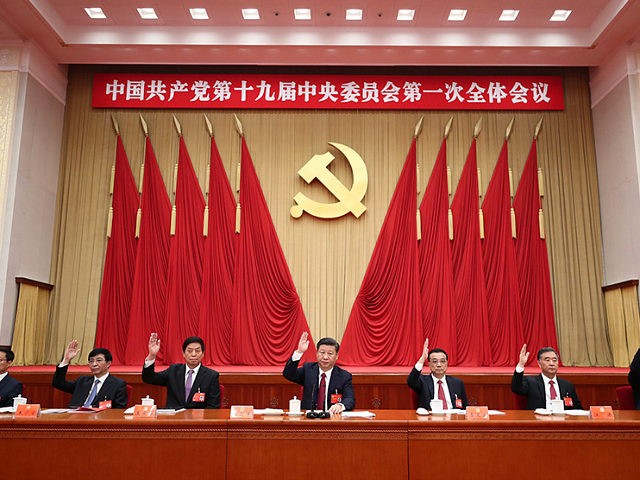
BEIJING, Oct. 25, 2017 -- Xi Jinping (C), Li Keqiang (3rd R), Li Zhanshu (3rd L), Wang Yang (2nd R), Wang Huning (2nd L), Zhao Leji (1st R) and Han Zheng (1st L) attend the first plenary session of the 19th Communist Party of China (CPC) Central Committee at the …
Xinhua/Ju Peng via Getty Images

The Global Times wrote that African entrepreneurs are hailing “China’s offer of $60 billion in financing for the development of the continent” and anticipating “huge business opportunities in the future.”

The latter talking point is an effort to refute allegations that some of the expensive projects Beijing is bankrolling in Africa can never turn enough of a profit to repay the loans. China’s response is that Belt and Road projects are necessary to access Africa’s oil and mineral wealth, which will generate the profits needed to make the loan payments.

As for the loans that have so many observers worried, the Global Times found analysts who said there is little reason to worry about huge debt loads taken on by private corporations in Africa. The theory is that China would only be able to use its loans as political leverage if African government entities were borrowing all the money. Also, Chinese leaders promise they have no political motivations and would never dream of interfering in the governance of African nations.

This defense is disingenuous for several reasons, not least of which is that the line between private corporation and public entity has a way of blurring in the Third World. Even when African governments do not wholly or partially own corporations, they would likely feel obliged to step in to prevent the collapse of major enterprises. And in any event, African government entities are borrowing huge amounts of money from China, in many cases crossing the threshold of debt above 50 percent of GDP, which is considered dangerous for developing economies.

Even as the Global Times was publishing its apologia, news broke that Sri Lanka is even further in debt to China than previously believed, and Sri Lanka already lost an entire city to its Chinese creditors. Sri Lanka’s total debt load currently stands at roughly 77 percent of its GDP.

The Global Times defensively insisted that Chinese loans are not “free money” for Africa, which is exactly the point: the money comes with strings attached, but the strings are woven of pure Chinese geopolitical interest. Those strings are longer and harder to see than the fiscal reforms demanded by Western lending institutions.

Chinese loans look attractive to Third World governments precisely because they do not expect the kind of fiscal discipline the International Monetary Fund does. Instead, the Global Times frets over establishing anti-corruption measures to ensure “good governance” and prevent local “corruption and bureaucracy” from hindering Chinese investment. That sounds a lot like the kind of interference with local government China supposedly avoids.

It should also be noted that even some defenders of Beijing’s lending policies to Africa have complained about policies that require Chinese companies to be hired for work on projects financed with Chinese loans.

The L.A. Times on Monday detected a growing backlash from within China against Belt and Road, despite incessant government propaganda, as Chinese citizens wonder why so much of their national wealth is being diverted to other countries.

“Why is China, a country with over 100 million people who are still living below the poverty line, playing at being the flashy big-spender? How can such wanton generosity be allowed?” law professor Xu Zhangrun asked in July.

China’s extravagant spending in Africa was one of the topics 84-year-old retired professor Sun Wenguang was talking about in early August in a live interview with Voice of America when police barged into his home and dragged him away. Sun was released after ten days but said he believes he is still under surveillance. His wife was forced to issue a false statement that the couple went on vacation.

https://www.breitbart.com/asia/2018/09/05/china-insists-loans-to-africa-are-not-free-money/

Experts: China Pushing ‘New International Order’ Through Communism in Africa

 WASHINGTON, DC — China is using its economic clout in Africa to promote a “new international order” and encourage countries to adopt its communist ideology, experts told lawmakers on Wednesday.

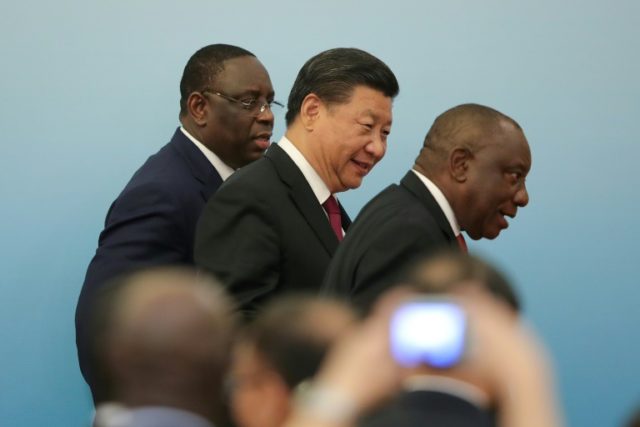
Chinese President Xi Jinping (C) with South African President Cyril Ramaphosa (R) and Senegalese President Macky Sall (L) attend a joint press conference
AFP Lintao Zhang
4:20

While testifying before the Senate Armed Services Subcommittee on Emerging Threats and Capabilities, Judd Devermont, the director of the Africa program at the Center for Strategic and International Studies (CSIS) think-tank, acknowledged that not all Chinese activities in Africa are anti-ethical to U.S. goals, noting that “some are neutral or complementary to U.S. objectives and may actually benefit American interests.”

Nevertheless, some of the witnesses noted that communist China is actively pursuing a new Beijing-led order on the continent.

Yun Sun, Co-Director, the director of the East Asia and China program at the Stimson Center think-tank, told lawmakers via written testimony:

Through its economic engagement, China is pursuing a targeted list of political, ideological and strategic goals in Africa. As China’s global ambition grows under President Xi Jinping, Africa is increasingly tied into the Chinese orbit that advocates for a new international order and a community of common destiny. … China’s economic statecraft in Africa has become one of the most prioritized and effective instruments in China’s challenge to the current international order.

Beijing is also promoting its communist political and economic system as a solution to Africa’s ills.

“In recent years, China has begun to actively promote other developing countries to adopt such [communist] political and economic policies. China uses its own development model, which combines political authoritarianism and economic capitalism, to prove to some African countries that economic development and political stability could exist without a democratic system,” Sun testified.

Echoing Sun, Joshua Meservey, an Africa expert at the Heritage Foundation think-tank, warned that Chinese activities in Africa would undermine America’s efforts to promote democracy, telling lawmakers:

Beijing’s activities create an influence towards, and facilitation of, illiberal governance in Africa. This undermines the U.S.’s decades-long attempts to encourage the global growth of democracy. Chinese officials criticize democracy to African counterparts, claiming that the West’s advocacy of it is a Trojan horse to enable meddling in African affairs. Chinese officials have also blamed multi-party democracy for bringing chaos and poverty to Africa, and cheer what they see as the continent’s increasing rejection of Western-style democracy.

The Trump administration has accused China of encouraging dependency among African countries by using predatory lending practices “to mire nations in debt and undercut their sovereignty.”

However, Devermont told lawmakers that “the debt trap narrative is overdone and glosses over the facts.”

“It is my view that Chinese investments and loans are not necessarily contrary to U.S. interests. When executed in a transparent and responsible manner, Chinese infrastructure projects address a critical deficiency and persistent drag on African economies,” he argued.

The CSIS expert stressed that no all Chinese engagements in Africa harm U.S. objectives on the continent.

Devermont did concede that “Chinese engagement undercuts and potentially degrades U.S. capacities and influence in sub-Saharan Africa.”

However, he added, “it is important to draw a finer distinction between which Chinese activities threaten U.S. national security priorities and which Chinese engagements are neutral or complimentary to U.S. objectives.”

“I believe Chinese activities pose the greatest danger to U.S. military access and operations, U.S. information and communication platforms, and U.S. relations with current and emerging African leader,” he also declared.

China established its first overseas military base in Djibouti. In March, Gen. Thomas Waldhauser, the top U.S. commander in most of Africa, told lawmakers he expects Beijing will build more military bases in Africa.

China has emerged as the chief U.S. competitor in Africa, the experts testified.

https://www.breitbart.com/national-security/2018/12/12/experts-china-pushing-new-international-order-through-communism-africa/

Wednesday, 2 December 2020

SCMP - Coronavirus runs roughshod over debt-laden belt and road projects


Developing countries’ ‘hidden debts’ to China totalled US$380 billion well before the global health and economic crisis, analysts estimate

Montenegro, which has a US$750 million Chinese loan for highway construction, is among the borrowers seeing commodity prices plunge and exchange rates shift


In 2014, the tiny Eastern European country of Montenegro saw an opportunity to catapult onto the world stage when it borrowed US$750 million from China to build a highway between the Adriatic Sea and Serbia. The highway, funded as part of President Xi Jinping’s signature Belt and Road Initiative, would spur the economy and help pave the young nation’s entry into the European Union.


Six years later, with the coronavirus pandemic destroying lives and economies worldwide, massive debt and “highway to nowhere” concerns hound the 103-mile Bar-Boljare venture and scores of other BRI projects across Asia, Africa and Eastern Europe.

The project has increased Montenegro’s public debt to 80 per cent of its gross domestic product (GDP). Its vital tourism industry is reeling. And rating agency Moody’s in March downgraded its credit outlook to stable, citing the highway project.

“The Bar-Boljare motorway is not just a roadway, it is a path to the Western value system,” Prime Minister Dusko Markovi said last month in the capital of Podgorica, defending his pet project. A government statement added: “Markovi underlined that there was no talk of bankruptcy or ‘debt bondage’, as it has often been speculated.”

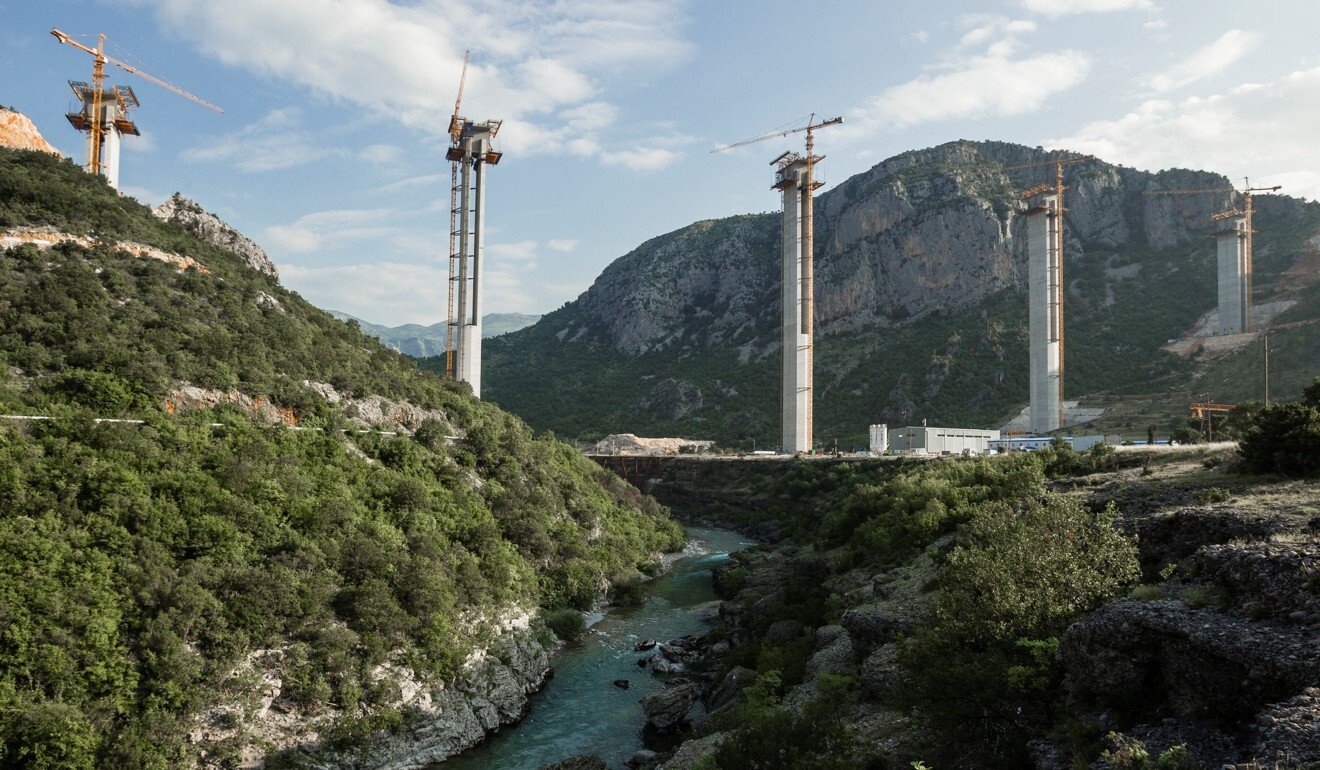
Cement pillars rise above the Moraca River as part of the Bar-Boljare highway construction project in Montenegro in 2018. Photo: Reuters


BRI countries such as Montenegro, already deeply indebted to Beijing, face mounting difficulties related to the pandemic as commodity prices plunge, trade falters and exchange rates shift.

“A debt crisis with Chinese characteristics?” warned Germany’s Kiel Institute for the World Economy in a report last year citing growing default risks.

Adding to the challenge of managing mounting global indebtedness is Beijing’s characteristic lack of transparency.

“The Chinese government considers the details of its overseas lending programme a state secret. No one really knows the numbers,” said Brad Parks, executive director of AidData, part of the College of William & Mary in Virginia, and co-author of a study on Chinese lending practices released last month by the Centre for Global Development (CGD).


Experts estimate that developing countries’ “hidden debts” to China totalled US$380 billion well before the crisis, more than their obligations to the Paris Club, a group of 19 wealthy creditor nations, combined; the World Bank; or the International Monetary Fund.


“It’s hard to identify one weak link in the chain,” said Scott Morris, co-author of the study, titled “Chinese and World Bank Lending Terms: A Systematic Comparison Across 157 Countries and 15 Years”, and a CGD fellow. “It’s the whole chain.”


Chinese loans have helped fund much-needed energy, mining, hydropower and other infrastructure projects in more than 100 developing nations under the estimated US$8 trillion Belt and Road Initiative, spurring economic growth and improved living standards.

But analysts say China’s singular lending practices leave many developing countries increasingly vulnerable in the current environment.


Kiel cites eerie similarities with the 1970s debt crisis that devastated many of the same vulnerable countries in Latin America and Africa for over a decade.


“It is stunning that almost all of these characteristics apply to the ongoing Chinese overseas lending boom,” the institute said, citing weak oversight and limited transparency. “The two lending booms can largely be seen as ‘twins’.”


Among the more at-risk countries, analysts say, are commodity-dependent Angola, Ecuador, Niger and Venezuela; smaller Asian economies such as Laos, Cambodia and the Kyrgyz Republic; and countries in Sub-Saharan Africa and Latin America.


CGD finds that 15 of some 68 belt and road countries face significant risk of debt distress – essentially a default or related inability to repay what they owe – with another eight are at high risk.


China has huge hard currency reserves, and its economy is expected to surpass the US’ in absolute size in coming years. But any BRI defaults would hit as China’s economy staggers, unemployment hits a record 6.2 per cent, bad debts from “zombie” state-owned companies mount and 460,000 Chinese firms close permanently.


Drawing on 2,453 Chinese loans to 157 countries, Parks and Morris found that 23 per cent went mostly to the poorest countries on preferential terms, even at zero interest, essentially becoming an extension of China’s foreign policy. These include loans to Cameroon, Botswana, Lesotho and Sudan that have been forgiven in recent years.


Most of these involve projects that bind the nation’s leadership to Beijing, including stadiums, convention centres and vanity projects in a leader’s hometown, Parks said. Also in this category was the US$200 million African Union headquarters in Ethiopia, built amid allegations that Chinese construction crews embedded listening devices in “China’s gift to Africa”.


China has “selflessly” bolstered African economic development while other countries have their own agendas, Chinese Foreign Minister Wang Yi said in 2018 in response to the bugging allegations, which he called a bid to divide Africa and China.


“The payoff that China is getting is not economic or commercial, it’s political,” said Parks. “It helps China get countries to vote with them in the UN General Assembly.”


But the other roughly 77 per cent of the Chinese loans, more worrisome as developing countries founder, are quasi-commercial. These carry, on average, interest rates 2 percentage points higher, of shorter durations with larger collateral requirements than IMF, World Bank or Paris Club counterparts.


While 2 percentage points may sound small, the difference would cost a poor country US$56 million to repay over the 17-year life of an average US$300 million loan.
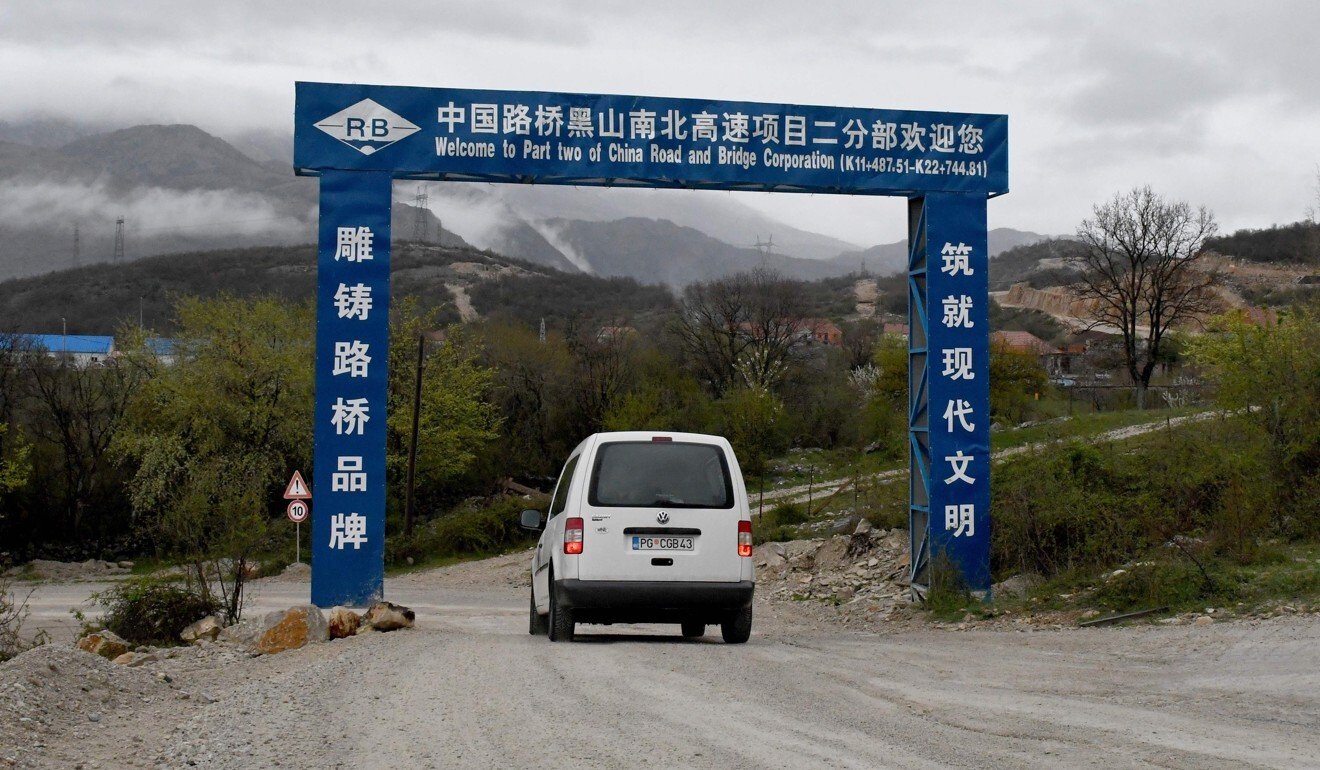
A van drives along a section of the Bar-Boljare highway under construction in 2019. Photo: AFP
A van drives along a section of the Bar-Boljare highway under construction in 2019. 
Photo: AFP

The poorest countries have tended in recent years to borrow more Chinese quasi-commercial loans from China’s four largest commercial banks, the China Development Bank (CBD) and the Export-Import Bank of China that holds Montenegro’s debt, analysts say, which are extremely reluctant to forgive debt.


In recent weeks, the IMF, World Bank, UN Economic Commission for Africa and the Jubilee Campaign, a civic movement to reduce developing nations’ debt, have urged wealthy lenders to restructure and forgive the massive sums owed by poor nations, so far with little response from Beijing or other capitals.


Complicating matters, analysts add, is Beijing’s secrecy, lack of creditor experience during a debt crisis and tendency to go it alone, seen in its turning down repeated invitations to join the 65-year-old Paris Club, a repository of hard-won lessons.


“They have their own set of rules,” said Morris. “But they lack transparency so it’s hard to judge those rules.”


China doesn’t set out to ensnare BRI countries in a “debt trap”, encouraging them to get in over their heads for political control, as Western critics allege, according to the Centre for Global Development.


But the huge collateral it demands for quasi-commercial loans can achieve some of the same results, say Parks and Morris, as seen when Sri Lanka defaulted and China acquired the port in Hambantota.


Chinese loan documents routinely mandate specific Chinese contractors – including Huawei, ZTE, China Harbour Engineering and China Road and Bridge Corporation (CRBC) – and tax-free imports of Chinese steel, glass, aluminium and other materials, which helps China absorb some of its excess factory production.


The IMF, World Bank and others generally avoid this so-called circular lending and insist on competitive bidding to stem corruption and nepotism.


“The cake is baked from the beginning,” said Parks.


Montenegro’s highway project follows the typical pattern, analysts say. It’s held by the Ex-Im Bank of China, names CRBC as the lead contractor.


Collateral – should the loan default – includes coal mines, ports and railroads, said Dejan Milovac, the Podgorica-based investigative director of the civic group Network for Affirmation of the NGO Sector. “It could be all the property of Montenegro,” he added.


The loan only covers the highway’s initial 26-mile phase, now behind schedule, with the remaining 77 miles slated to cost up to US$1 billion more. Before China arrived, two international consortiums rejected the plan after feasibility studies suggested that it needed at least 22,000 vehicles using it daily to break even compared with actual traffic of 6,000.


A tunnel construction site along the Bar-Boljare highway in 2018. Photo: Reuters

“The government offered incentives, including tax-exempt salaries and materials, that no country in the region was ready to offer the Chinese,” said Jovana Marovic, executive director of Politikon Network, a Montenegrin civic group.


The IMF suggested in September that Montenegro stop building, at least until the economics improved. The loan at 2 per cent interest is priced in dollars with recent exchange rate shifts increasing repayment costs by up to 18 per cent.


A further concern is corruption. Dealings between China and Montenegro’s ruling party are kept secret, opening the way for questionable subcontracting deals with cronies of the party in power, Milovac said, adding: “It’s like a paradise for investigative journalists.”


The Montenegrin and Chinese embassies in Washington did not respond to requests for comment.


Watchdog Transparency International rated Montenegro 45 out of 100, with 100 considered squeaky clean, on its most recent corruption perception index in 2019, the same year a video surfaced purportedly showing a ruling party politician receiving an envelope with 100,000 euros (US$110,000) for election expenses. The party has been in power since Yugoslavia broke apart in 1989.


“Corruption is prevalent in many areas and remains an issue of concern,” the European Commission said in a 2019 country report, citing infrastructure deals as particularly vulnerable. It added: “The ‘envelope’ affair requires a credible, independent and effective institutional response.”

Some 80 per cent of the Montenegro highway’s first 26 miles are bridges and tunnels through rough terrain, making it among the most expensive per mile in Europe.


The project has left Montenegrins divided between those who welcome the infrastructure, the country’s first ever highway, and those who see it as inordinately expensive given the tiny economy and 600,000 population, said Jacob Mardell, a researcher with Germany’s Mercator Institute for China Studies, who has reported from the Balkan country.


Most Montenegrins who oppose the project tend to be more angry at their government than China, said Mardell and Milovac.


“The Chinese are just behaving like they’re meant to behave,” Milovac said. “China is here to gain a profit. Our government is supposed to protect us.”


The project is attractive to China for its challenging engineering, an opportunity to learn business practices on western Europe’s periphery – and it gives Beijing a beachhead if Montenegro eventually enters the EU, said Mardell.


“It’s good practice for working in the EU market, which is their end game. In theory, they have nothing to lose,” he said, before adding, “well, as long as the loan is paid back.”


https://www.scmp.com/news/china/diplomacy/article/3079918/coronavirus-runs-roughshod-over-debt-laden-belt-and-road