Showing posts with label Hong Kong. Show all posts

Thursday, 2 July 2020

Raab: China could stop Hong Kong residents from moving to Britain

Little could be done by Britain to “coercively force” China if it tried to block Hong Kongers from coming to the UK, the Foreign Secretary has said. 
 

Dominic Raab in a suit standing in front of a building: Foreign Secretary Dominic Raab said the UK could not force China’s hand (Yui Mok/PA)
© Yui Mok Foreign Secretary Dominic Raab said the UK could not force China’s hand (Yui Mok/PA)
Up to three million residents of the former British colony have been offered the right to settle in the UK and ultimately apply for citizenship after Beijing imposed a controversial national security law.
The UK Government believes the new legislation breaches the Sino-British Joint Declaration which aimed to smooth the transition when the territory was handed back to China in 1997.
But Dominic Raab said that if Beijing tried to stop people with British National (Overseas) status from leaving Hong Kong, there would be little that could be done by the UK.
He told ITV’s Peston programme: “Ultimately if they follow through on something like that there would be little that we could do to coercively force them.”
Mr Raab continued: “There is an issue around freedom and human rights in Hong Kong, and there is an issue around China keeping its word on an international obligation it made to the United Kingdom back in 1984.
“I wouldn’t want to be naive about this: I think we need to be realistic. But I do think that China as a rising, leading member of the international community is sensitive to the reputational risk in all of this but clearly not sufficiently that it hasn’t proceeded anyway…
“There is diplomatic leverage, there are other ways that we can persuade China not to fully implement either the national security law or some of the reprisals you talk about.
“But ultimately we need to be honest that we wouldn’t be able to force China to allow BN(O)s to come to the UK.”
As of February, there were nearly 350,000 BN(O) passport holders, while the Government estimates there are around 2.9 million BN(O)s living in Hong Kong.
Asked how many people the Government anticipated would come to the UK from Hong Kong, he said: “It’s difficult to give a precise forecast but I think it is fair to assume that only a proportion of those that are offered the new status that we set out in the House of Commons today will take it up.
“I think the majority of people will probably hunker down in Hong Kong and others would move to other countries in the region.”
Downing Street said those with BN(O) status will be eligible to travel to the UK immediately ahead of the details of the scheme being finalised “in the coming weeks” and that they will not face salary thresholds.
The security law in Hong Kong – which came into effect on Tuesday night – makes activities deemed subversive or secessionist punishable by imprisonment, and is seen as targeting anti-government demonstrators.
Hong Kong police made their first arrests on Wednesday under the new law, including one person said to have displayed a sign with the Union flag which called for Hong Kong’s independence.
Chinese ambassador Liu Xiaoming was summoned to the Foreign Office on Wednesday where permanent secretary Sir Simon McDonald said the imposition of the legislation breaches the Sino-British Joint Declaration.

Video: UK says China's security law is serious violation of Hong Kong treaty (Reuters)
https://www.msn.com/en-gb/news/uknews/raab-china-could-stop-hong-kong-residents-from-moving-to-britain/ar-BB16e1tV

Wednesday, 1 July 2020

Hong Kong: What is behind the UK's citizenship offer?

Opening the doors to the UK to as many as around 3 million people from Hong Kong is a big step.
Hong KongImage copyrightREUTERS
Opening the doors to the UK to as many as around 3 million people from Hong Kong is a big step.
No one in Westminster tonight would expect anything like that number will move here, to escape the increasingly fraught reality of life in Hong Kong. But the decision is important, and not just for those to whom the UK may now provide sanctuary.
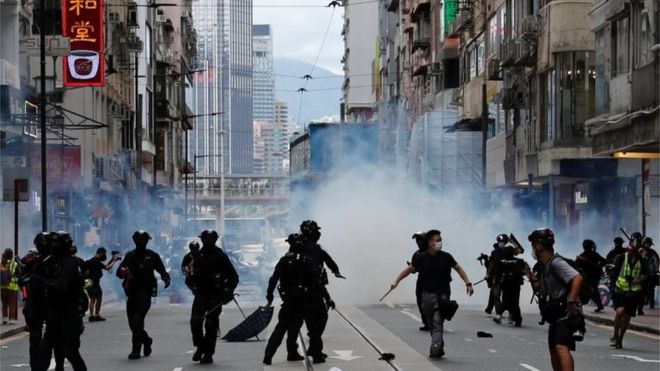
It reflects immediate concern in the government about what has been happening on the streets in that packed, throbbing territory.
But the decision was also fuelled by the legacy of British control there. This kind of citizenship was not offered, despite some calls to do so, at the time when Hong Kong was handed back to China in 1997.
Remember that handover took place on the basis that its partial democracy and market economy would be respected. But that's been eroded so visibly in recent years.
It was notable not one MP in the House of Commons spoke against the next phase of Britain and Hong Kong's story being to offer a home to islanders here. Government's decisions are still affected by choices made decades ago.
The decision also reflects a souring of the atmosphere around relations between the UK and China.
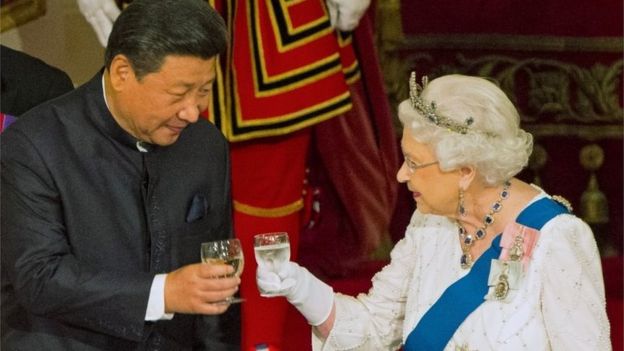
It's not that long ago that former Prime Minister David Cameron rolled out not just the red carpet, but the Queen's golden carriage to welcome the Chinese Premier.
We rarely saw the then Chancellor George Osborne happier than on visits to China extolling the virtues of trade.
The balance between the opportunities of doing business and objecting to China's human rights policy was awkward then.
Chinese President Xi Jinping with Queen Elizabeth IIImage copyrightREUTERS
Image captionChinese President Xi Jinping with Queen Elizabeth II at a state banquet at Buckingham Palace in 2015
But the dilemma is more acute, not least because a group of Tory MPs, including some up and coming key figures on the backbenches, have joined forces with some of the more traditional 'awkward squad' to oppose close links with China regularly and loudly.
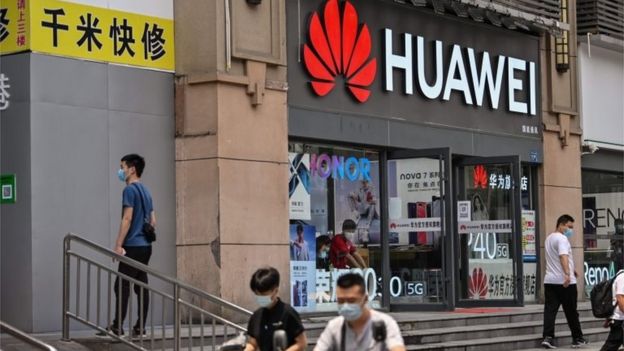
Most prominently they have been concerned about whether the UK government should allow the Chinese telecoms giant Huawei a place in building the 5G phone network.
Several of those involved in trying to change the government's minds are increasingly confident that Number 10 will soon find a way of rolling back the firm's participation in the project.
As a group they have organised, and they have some strength in numbers, as a previous rebellion suggested.
One of those involved in the manoeuvrings suggested the government had to be pushed to act on Hong Kong.
China is a vast economic power that can't be ignored. There are areas, such as trade and climate where ministers are keen to cooperate.
And the prime minister, asked just yesterday about it, said that: "The position is very, very simple: I'm not going to get drawn into Sinophobia because I'm not a Sinophobe."
But the characteristics of the relationship between the two countries have definitely changed.
In the words of one government source today, the UK approach has not hardened, but "China's more aggressive preferences have been revealed."
Huawei storeImage copyrightAFP/ GETTY IMAGES
Image captionA group of Conservative MPs have put pressure on the UK government about allowing the Chinese telecoms giant Huawei a place in building the 5G phone network
The government's promise to Hong Kongers comes at a junction in our immigration policy.
It was only yesterday that MPs backed the Immigration Bill that ends freedom of movement - the product of a referendum that was fought on the concept of controlling immigration which, for many voters meant getting the numbers down.
Isn't it a contradiction therefore that the government has sent out this message to potentially several million to come to our shores?
A clash for many perhaps, depending how and when people from Hong Kong arrive here.
But for ministers, the decision is a testament of the principle that the UK out of the EU can make its own decisions about who arrives and who leaves.


https://www.bbc.com/news/uk-politics-53258403


Top Stories

US passes HK sanctions as nations condemn new law
The US House Speaker said the law was a "brutal, sweeping crackdown" against Hong Kong's people.
50 minutes ago
UK makes citizenship offer to Hong Kong residents
1 July 2020

Features


More on this story


Friday, 5 June 2020

Post-Brexit Britain supports freedom - we are welcoming Hong Kong refugees

The government is offering safe haven to millions of people in Hong Kong, showing that the UK is leading the world in democracy


Monday, 1st June 2020, 5:46 pm
Updated

Protestors hold umbrellas in Hong Kong in 2019 (Photo: MANAN VATSYAYANA/AFP via Getty Images)
It is no surprise that China has chosen the middle of a global pandemic to undertake the wholesale hijack of Hong Kong. Taking advantage of a crisis and a distracted world in order to fulfil aggressive, expansionist objectives is a classic element of the totalitarian playbook.
Beijing has spent years testing the water; the supposed international standard bearers of liberty and democracy turned out to be paper tigers on each of the previous occasions when Hong Kong’s freedom was infringed. Other, even more egregious, human rights abuses by China – such as the wholesale oppression of the country’s Uighur Muslims – were also allowed to pass almost unremarked.
The world’s democracies should have realised long ago that tyrannies are dedicated opportunists. If you give an inch, then regimes like China’s will take a mile – literally, in the case of numerous territory grabs. Then they will take some more. That lesson is forgotten at least as often as it is painfully relearned.
More should have been done, far sooner, to try to prevent the crushing of Hong Kong. It is an everlasting shame that a flourishing society, with so many achievements and so much potential, could simply be surrendered to the mercies of such a regime. The city’s young people were left using umbrellas to fight for their liberty and their lives, against the rubber bullets and steely greed of a totalitarian bully.
A vigil for protesters who were injured during police arrests on 31st May. (Photo: ISAAC LAWRENCE/AFP via Getty Images)
The craven failure of the free world even to criticise Beijing’s numerous crimes in recent years was interpreted as tacit permission to continue along the same path. If we weren’t going to push back when times were relatively good, then China understandably bet that we won’t do so if it accelerated its plan while the world wrestled with Covid-19.
The turning of world opinion against a regime that facilitated the spread of the virus by seeking to cover up the outbreak has likely also accelerated the urge to seize final control of Hong Kong – grab what you can, when you can.So while it is depressing to see this happen, is it not surprising.
What does seem to have surprised many people, however, is the decision of the UK to make a dramatic offer of safe refuge to millions of Hongkongers.
The Foreign Office extended the rights of an estimated 350,000 holders of British National (Overseas) [BNO] passports to include 12-month renewable UK visas, and a path to British citizenship, which is welcome. Even better, they made clear those rights apply to all those eligible for a BNO passport – a far wider pool of up to three million people.
It’s a snub to China, which claims a supposedly sole and inviolable right to control every aspect of Hongkongers’ lives, with no contest or rebuke from any other state. It’s also a justified signal that we won’t be deterred by farcical denunciations about the supposed imperialism of protecting people’s rights – particularly when they’re issued by a 21st Century imperialist power which is itself on the rampage.
Just as importantly, it’s a lifeline to people in Hong Kong who feel they need to leave their home in order to stay safe. Nobody should have to make such a decision, but we are right to help to offer refuge to those who do. Hopefully other democratic countries will do so, too. There’s a strong moral and principled logic for the decision. So why, then, does it surprise some observers?
The answer lies in a misunderstanding of the UK and the Conservative Party. If you believed all the rhetoric about Brexit “cutting us off from the world” and “Fortress Britain” supposedly “pulling up the drawbridge”, then of course you’ll be surprised to see a post-Brexit UK leading the world in welcoming people from Hong Kong who need safe harbour. Because that rhetoric was mere propaganda all along.
Hong Kong protesters rally against China's national security law (Photo: Getty)
Listen again to those Brexiteers who talked of a reassertion of democratic self-determination, however, and this policy is completely consistent. A UK that found the EU an excessive infringement on its rights understandably opposes a far more gross assault on the rights of Hong Kong by China.
A UK that sought to speak for itself on the world stage is now doing so. Eighty-five per cent of Conservative Party members agree with the policy. (By contrast, it must be said, the EU has gone a bit quiet about its much-vaunted commitment to fundamental values.)
It’s no coincidence that two of the Brexiteers who made the case for democratic self-determination are at the very heart of this decision. Priti Patel and Dominic Raab, as Home Secretary and Foreign Secretary, have delivered a policy that defies their opponents’ crude caricatures of their politics.
Perhaps their critics forget that both Patel and Raab are the children of people who sought refuge in this country and were granted it. They know first-hand that the right decision in Westminster can make the difference between freedom and oppression, life and death.
The UK’s history on such decisions over the years has, frankly, been patchy; on Hong Kong, at least, this Government has got it right.
https://inews.co.uk/opinion/columnists/post-brexit-britain-supports-freedom-welcoming-hong-kong-refugees-2871253