Showing posts with label Schengen. Show all posts

Saturday, 14 March 2020

The Real Crisis Starts Now in Europe

I think it’s safe to say the new crisis just killed the Schengen Treaty. That ridiculous document which guaranteed freedom of movement across the European Union finally hit something it couldn’t bully, COVID-19.
Regardless of whether you believe the pandemic is real or not, the reaction to it is real and is having real consequence far beyond the latest print of the Dow Jones Industrial Average.
The lockdown of Italy isn’t a temporary thing. Oh, the suspension of free movement is temporary, but it portends something far bigger.
It’s the beginning of the real political balkanization that’s coming to the European Union over the next few years. Old enmities and prejudices have not been stamped out under the boot heel of oppressive legislation coming from a bunch of disconnected technocrats in Brussels.
They have only been suppressed.
Because when there are existential threats there’s no time or desire to virtue signal about how we’re all one big happy dysfunctional family.
For decades Germany refused to lighten up on its fiscal inflexibility believing, rightly, that it shouldn’t subsidize profligacy in places like Italy, Spain and Greece if it didn’t want to.
At the same time, however, Germany transmitted those rules to the single currency regime of the euro. That was the price they forced on the rest of Europe.
This ensured that eventually they would have to do exactly that, subsidize or bailout debts, as the mispricing of labor and capital efficiency inherent in the any single currency applied over multiple economies drove capital to Germany and out from those countries.
Now Germans face the existential threat of COVID-19 imported into Europe mostly through Wuhan textiles workers in Milan’s leather shops/ Their leaders will force them to accept looser spending rules.
And do you think this will engender an outpouring of love and affection towards Italians?
If you do you might be delusional or an open-borders libertarian… but I repeat myself.
Chancellor Angela Merkel has signaled for months she would spend more to satisfy the rising Greens on Germany’s political left.
Her finance minister, Olaf Scholz, unleashed the full force of Germany’s sovereign wealth fund to offer unlimited support to German businesses facing troubles because of this virus.
This is as good a cover story for the gargantuan holes in the balance sheets of zombie German banks as they were likely ever going to get folks.
ECB President Christine Lagarde was brought in to ram through the political changes needed to loosen Germany’s tie. She knew the only way the EU would survive the growing crisis within its non-functional sovereign debt market was to print money to the high heavens.
Or allow the union to break up. But, there is no Door #2 in Europe. All doors lead to Brussels.
Germany stood in the way of that while at the same time Merkel ruthlessly enforced Schengen. She weakened the political center in Germany and inflamed memories of a Germany which rampaged across Europe militarily in the 20th century through enforced austerity hollowing out less-efficient euro-zone economies.
So in the midst of this mess comes COVID-19 and the uncoordinated and inept response to it from the political center of Europe to date. Only now are they coming to the conclusion they need to restrict travel, after sitting on their hands for a few weeks while Italians died by the hundreds.
And do you think that’s engendering waves of love and affection among Italians towards Germans?
If you do then you don’t know Italians… at all.
And this is your signal that this is the beginning of the real crisis. Because while COVID-19 may have been the catalyst for the breakdown of capital markets, capital markets were simply waiting for that spark to occur.
Any other type of spark, a bank failure from a run of bad loans, could have been handled and absorbed. There was no Credit Anstalt the central planners weren’t prepared for.
They’ve been able to keep Deutsche Bank operational for the past few years, for pity’s sake, they could have handled any other single bank failure.
But with COVID-19 being the ultimate form of exogenous shock to the global economy there is no containing the financial contagion. And that’s why we saw a strong unwind of U.S. equities and a sharp rise in both the Japanese yen and the euro when this thing began.
Part of what had been pushing U.S. equities higher was the capital flow from Europe and Japan into the U.S. That reversed for short time as the eurodollar markets seized up and the demand for cash locally rose sharply.
It’s no different than what is happening here.
I went to my bank yesterday to grab some cash and finish our self-quarantine prep (we’d bought extra toilet paper weeks ago). The teller told me she’d moved out a lot more cash than normal and it wasn’t even the end of lunch hour.
Then I told her the bank run on corporate credit began earlier in the week as companies like Boeing maxed their credit revolvers to front run the bank pulling it.
That got her attention.
The same thing on a larger scale was happening in Europe until Lagarde told the world that she wasn’t done blackmailing Germany to loosening its stance on fiscal rules at her presser on Thursday.
And the rally in the euro, which was already sick, died.
Annnnd…. it’s gone!
What we saw to end this week was an epic reversal of that capital outflow as the USDX and U.S. equities rallied while the euro crashed back to $1.11. And now that it’s started I don’t expect it to stop.
The Fed fired major blanks at the dollar-funding crisis in the credit markets this week. What is the ECB going to do to stop rates from rising in Europe as money flees their incompetence?
Fairy dust springs to mind, honestly. But, more likely there will be a very quick move to close the banks and cancel the use of cash while new rules are adopted and Lagarde turns to the IMF to bailout the ECB which can very easily go bankrupt here.
The weakest banking system in Europe serves a country on lockdown over this virus.
So, it doesn’t matter now that Germany has acquiesced, pledging its own savings and lifting fiscal restraints of euro-zone members. All the printing will does is feed the vortex of unpayable debt that is far bigger than their prodigious piggy bank.
The next stage of the crisis is here with the focus finally turning to Europe. The U.S., for all of its faults, is one nation with a unified debt market and an executive who can and has exercise powers necessary to keep the wheels from completely falling off the U.S. economy.
Will Trump spend money he doesn’t actually have? Yes. So what?
That money will go into a logistical pipeline that far outstrips Europe’s to combat a disease over a smaller population spread across larger distances. That limits the damage to the U.S. It ensures political stability that the EU cannot hope to compete with for the trust of spooked capital.
Add the global economy grinding to a halt. We’ll see the crisis emerge in Europe to feed a widening gyre of debt servicing that will look like a global bank run on dollar liquidity.
It will force fundamental reform of the euro and the ECB. They are necessary for the EU to survive this crisis in anything close to its current form.
I’m not laying odds that will work. Instead I expect Schengen’s suspension to hold and more countries go the way of the Brits by exiting the EU itself.
While this crisis is tailor-made to shove the federalization of Europe down the throats of what’s left of the German middle class, I don’t think it succeeds.
Until Germany is willing to bail out Italian banks, there is no solution to this.
And while I think Merkel is willing to fall on her sword to get this done, It may still not work.
How convenient it is that Merkel’s CDU just cancelled their April 22nd leadership vote because of this crisis. This forestalls any possibility of Merkel losing control of her party until after Germany begins its EU Commission Presidency.
Whatever she has planned she has to do soon. Her political capital is just about spent.
There will be no change of leadership during a crisis like this. She’s almost done completing the sell out of Germany to the EU begun by Helmut Kohl.
Just in time for the whole experiment to come crashing down.
Join my Patreon if think the EU is toast


Sunday, 24 November 2019

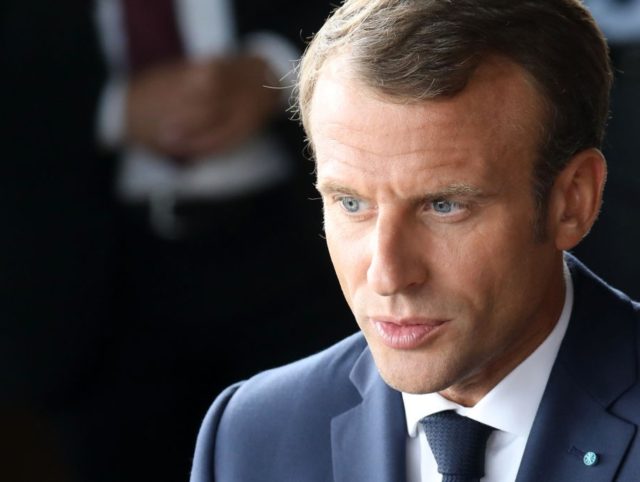
Macron Vows Punishment for States Refusing Third World Migration

Emmanuel Macron has said funding should be withdrawn from pro-sovereignty nations reluctant to hand more power over to Brussels, and that countries which refuse to welcome third world migrants must be thrown out of the Schengen area.

VIRGINIA HALE
Macron
“Europe is not a menu à la carte, it’s a political project,” the French president declared, speaking at the end of an EU mini-summit on migration in Salzburg Thursday evening.
At a press conference following the meeting of European leaders, Macron acknowledged there was “a crisis and tensions” over the topic but, crying out, “Who generates them?” the former investment banker launched a broadside at nations which reject asylum seekers and those which “refuse to let boats dock on its ports”.
Taking aim at the ex-communist Visegrad states, which are reluctant to follow the West down the road of globalist multiculturalism, he lashed out at “the leaders who tell me… ‘[I] love Europe when it gives me money, when it makes my people prosperous, when it allows my workers to make better a living in neighbouring countries,’ but at home, will not take a single migrant, not a single refugee.”
“Countries that do not want more Frontex or solidarity [in housing and feeding third world migrants] will leave Schengen. Countries that don’t want more Europe will no longer [get access to] structural funds,” he told journalists.
Turning the topic to EU Parliament elections, the banking protegé said next year’s vote would be “an historic fight [and] an election like no other”, as it would determine whether “the political project led by the founding fathers [of the union] … will prevail”.
Macron has previously summarised next year’s vote as a battle between pro-sovereignty conservatives and a “progressive” bloc which would impose his vision of a globalist, socially liberal EU superstate, which revolves around “values” and secular “human rights”, on the entire continent.
While most of the French leader’s ire at Salzburg was aimed at populists, his attack on countries “that do not want more Frontex” encompassed a much larger group at the summit, where Sebastian Kurz told reporters that southern states at the frontline of mass migration to Europe were “reluctant” over plans to massively increase the size and scope of the EU border agency.
The Austrian leader explained that in countries including Greece, Spain and Italy, there is “concern” that handing more power over to Brussels would make it “harder to wave migrants through” to other, richer EU countries.
In an interview on national radio last week, he said: “Because they were unable to persuade Hungary to let migrants in, the plan now is that they will take border protection rights away from us.
“They want no less than to send their mercenaries from Brussels to replace our Hungarians who are defending the border, and working as police and soldiers, whose homeland is important.”
Speaking at Salzburg, the populist leader told journalists that the expansion of Frontex was a “nice idea”, but said the agency had “never successfully protected a single metre of a border, while we have protected hundreds of kilometres”.
“There’s no need for them to protect the Hungarian border in our place, not to mention the questions of principle concerning the issue of sovereignty,” he said, adding that he had presented at the summit his own proposal which would “resolve this problem” to Austria, which is currently chairing the EU presidency.
Noting that the Hungarian proposal, which would see money marked for Frontex instead sent to help individual nations invest in protecting and strengthening their own external borders, had already been presented to Bulgaria, Orbán said “there are more of us who oppose” the EU plans than for, adding: “The status quo is on our side for now”.
This view was also expressed by Slovak prime minister Peter Pellegrini and his Czech counterpart Andrej Babiš, the latter of whom said on the subject: “Malta, Italy, Greece, Spain need to be told that they will get more money. They each have their own coast guard, they don’t need any Frontex.”
https://www.breitbart.com/europe/2018/09/21/macron-punish-refuse-migration-brussels/

Tuesday, 12 February 2019

Are there alternatives to the Irish backstop in the Brexit plan?

Given the fights there have been over the backstop, are there no conceivable alternatives to it? 
Georges Baur, Catherine Barnard

The hunt for such alternatives inevitably leads to examples of other borders and it is usually only a matter of time before someone volunteers the Switzerland-France border as a model.

Switzerland is in Schengen (so no need for passport checks) and regulations on goods are broadly aligned with those of the EU.

Switzerland is not in the EU’s customs union nor its VAT regime, and that means border checks are required. Its watches and cuckoo clocks literally run like clockwork, so, the argument goes, must its borders.
But it’s not as simple as that. As the Swiss Federal Customs Administration makes clear, even though they have the latest technology and much paperwork is done away from the border, there is still some physical infrastructure and delays of up to four hours if a lorry is searched.
In 2018 Switzerland launched a new IT-based customs transformation programme. This programme aims to simplify, harmonise and fully digitise customs tax and duty collection processes. It should be in place by 2026.
However, this programme will not make controls at the border redundant. Quite the opposite. Because routine administrative work and bureaucratic procedures will be replaced by IT-based solutions, personnel will be freed up. These people will be used to strengthen security, especially for control functions and reinforcement of criminal prosecution. Some of these functions will continue to apply at the border. Hence, even with a highly technologically advanced customs management system, controls at the border will not become obsolete and nor will customs infrastructure vanish.
What about another favoured example, the Norway-Sweden border? Norway is not in the customs union either, so the origin of goods must be checked. Again, Norwegian Customs make clear what is required. Although it is technologically advanced, there is still a delay.
The average time from when a lorry arrives at the border to when it leaves is about 20 minutes. This includes roughly ten minutes waiting time, three to six minutes of handling time, and the time spent coming off the road to complete the customs process.
And there’s physical infrastructure too. All this despite existing agreements on customs facilitation, transit and rules of origin between the EU and the European Free Trade Association states, of which Norway is one.
Less often talked about are Andorra and San Marino. Both are small European nations that are in a customs union with the EU. Although Andorra’s treaty only covers goods, its borders with Spain and France are strictly controlled. This is due to the fact that Andorra has no VAT (yet) and is known as low tax territory. Thus, smuggling has always been a concern of the neighbouring countries. The customs union with San Marino covers all goods except coal and steel. It has traditionally kept an open border without checks at its frontier with Italy. However, it levies an import tax, at 17 per cent.
The Bulgaria-Turkey border is worse. Turkey is in a customs union with the EU, which removes tariffs and quantitative restrictions in bilateral trade between EU member states and Turkey for the goods covered. It also sets a single external tariff for both the EU and Turkey, so they charge the same duties on imports from non-EU countries.
Unlike the customs union covering EU member states, the EU-Turkey agreement is incomplete. It covers industrial goods but not agricultural products (except certain processed agricultural products), coal and steel products, or public procurement.
Finally, the border between Turkey and the EU is bureaucratic and lengthy. Lorry drivers need an export declaration, a customs permit, invoices for the products they are transporting, insurance certificates and a transport permit for each EU nation they will drive through. The queues at the border can be up to 17 kilometres long and the wait as much as 30 hours. While Turkey has invested significantly in modernising its border, with checks taking place an hour inland, Bulgarian officials check the paperwork for every truck and x-ray all refrigerated lorries.
Which brings us to the US-Canada border. Again, much resource has been put into streamlining this border but there are still delays - the length can be seen online. All of this indicates that regardless of the technological capabilities of the EU’s neighbouring countries, there will be checks and the borders and this means infrastructure.
By Professor Catherine Barnard, senior fellow The UK in a Changing Europe and Dr Georges Baur. This piece is from the report Brexit and Backstop: everything you need to know
https://uk.finance.yahoo.com/news/alternatives-irish-backstop-brexit-plan-162900584.html

Friday, 21 September 2018

Macron Vows Punishment for States Refusing Third World Migration

Emmanuel Macron has said funding should be withdrawn from pro-sovereignty nations reluctant to hand more power over to Brussels, and that countries which refuse to welcome third world migrants must be thrown out of the Schengen area.

VIRGINIA HALE
Macron
“Europe is not a menu à la carte, it’s a political project,” the French president declared, speaking at the end of an EU mini-summit on migration in Salzburg Thursday evening.
At a press conference following the meeting of European leaders, Macron acknowledged there was “a crisis and tensions” over the topic but, crying out, “Who generates them?” the former investment banker launched a broadside at nations which reject asylum seekers and those which “refuse to let boats dock on its ports”.
Taking aim at the ex-communist Visegrad states, which are reluctant to follow the West down the road of globalist multiculturalism, he lashed out at “the leaders who tell me… ‘[I] love Europe when it gives me money, when it makes my people prosperous, when it allows my workers to make better a living in neighbouring countries,’ but at home, will not take a single migrant, not a single refugee.”
“Countries that do not want more Frontex or solidarity [in housing and feeding third world migrants] will leave Schengen. Countries that don’t want more Europe will no longer [get access to] structural funds,” he told journalists.
Turning the topic to EU Parliament elections, the banking protegé said next year’s vote would be “an historic fight [and] an election like no other”, as it would determine whether “the political project led by the founding fathers [of the union] … will prevail”.
Macron has previously summarised next year’s vote as a battle between pro-sovereignty conservatives and a “progressive” bloc which would impose his vision of a globalist, socially liberal EU superstate, which revolves around “values” and secular “human rights”, on the entire continent.
While most of the French leader’s ire at Salzburg was aimed at populists, his attack on countries “that do not want more Frontex” encompassed a much larger group at the summit, where Sebastian Kurz told reporters that southern states at the frontline of mass migration to Europe were “reluctant” over plans to massively increase the size and scope of the EU border agency.
The Austrian leader explained that in countries including Greece, Spain and Italy, there is “concern” that handing more power over to Brussels would make it “harder to wave migrants through” to other, richer EU countries.
In an interview on national radio last week, he said: “Because they were unable to persuade Hungary to let migrants in, the plan now is that they will take border protection rights away from us.
“They want no less than to send their mercenaries from Brussels to replace our Hungarians who are defending the border, and working as police and soldiers, whose homeland is important.”
Speaking at Salzburg, the populist leader told journalists that the expansion of Frontex was a “nice idea”, but said the agency had “never successfully protected a single metre of a border, while we have protected hundreds of kilometres”.
“There’s no need for them to protect the Hungarian border in our place, not to mention the questions of principle concerning the issue of sovereignty,” he said, adding that he had presented at the summit his own proposal which would “resolve this problem” to Austria, which is currently chairing the EU presidency.
Noting that the Hungarian proposal, which would see money marked for Frontex instead sent to help individual nations invest in protecting and strengthening their own external borders, had already been presented to Bulgaria, Orbán said “there are more of us who oppose” the EU plans than for, adding: “The status quo is on our side for now”.
This view was also expressed by Slovak prime minister Peter Pellegrini and his Czech counterpart Andrej Babiš, the latter of whom said on the subject: “Malta, Italy, Greece, Spain need to be told that they will get more money. They each have their own coast guard, they don’t need any Frontex.”
https://www.breitbart.com/europe/2018/09/21/macron-punish-refuse-migration-brussels/