Showing posts with label Remoaner. Show all posts

Friday, 7 February 2020

Brexit Is a Suicide Attack on the UK Itself

Brexit has revealed just how beneficial EU membership is — and also the exorbitant cost of divorce.
John Feffer • Feb 07, 2020

(An article from the other side of the divide)

Brexit news, Brexit transition period, Boris Johnson news, UK after Brexit, Scottish independence news, Ireland Brexit news, Northern Ireland Brexit vote, will UK fall apart after Brexit, Brexit costs, UK Brexit news

If I were the European Union, I’d be wiping my hands, sighing in relief and slamming the door after the United Kingdom’s long-delayed departure. Britain had been a noisy, pushy house guest for 47 years, and it was only growing ruder. It spent the last three years hanging out in the foyer, braying and temporizing. Even as it steps out the door, it’s trying to negotiate the most generous visitation terms: all rights with no responsibilities.
Good riddance to guests who overstay their welcome.
The UK was always demanding special exceptions to the rules. It was always attempting to smuggle its ridiculous laissez-faire ideas into continental practices. It was always boasting of its extramarital affairs with America. And, mon dieu, could it drone on at dinner about the “good old days” when the sun never set on its imperialist expanse. John Bull, indeed!

Unwelcome Guests

There’s no better example of this British bull than Nigel Farage, the man who practically engineered Brexit. What do you suppose he was doing for a living for the last two decades? Managing a Union Jack flag factory? Running a fish-and-chips shop in London? Growing turnips somewhere in the British countryside? No, the man who made a career of hating the EU served in the European Parliament non-stop since 1999.
He was pulling down £100,000 ($130,000) a year for doing the work of a termite, eating away the foundations of the house into which he’d been invited. Part of his time was also spent misspending funds, which forced the EU to dock his pay. At least when he complained of EU corruption, he could present one indisputable case to prove his point.
Farage’s departure from the European Parliament was of a piece with his undistinguished tenure as parliamentarian. “I’m hoping this begins the end of this project,” he crowed on his last day in the body as he waved his little Union Jack. “It’s a bad project, it isn’t just undemocratic, it’s anti-democratic.” Seems to me that the European Parliament was overly democratic by letting someone so obnoxious bite the hand that had fed him, year after year, for two decades.

What Will Be Left of Great Britain?


As for the speechifying and flag-waving, the Parliament’s vice president, Mairead McGuinness, was having none of it. “If you disobey the rules, you get cut off,” she said to the misbehaving Farage. “Please sit down, resume your seats, put your flags away — you’re leaving — and take them with you.”
It’s too bad no one ever said something like that to Boris Johnson, the erstwhile prime minister of what will soon be the incredibly shrinking United Kingdom. Johnson joined Farage in misleading the British public into cutting off their own noses to spite the EU’s face. Johnson is wittier than Farage, more willing to make fun of himself and his pomposities. But he’s still a prat. In the end, the pair have turned out to be the glycerol and nitric acid of Brexit — harmless by themselves but recklessly explosive in combination.
The nitroglycerin blast won’t reach across the Channel. The European Union will survive Brexit, thank you very much. No, Brexit will turn out to be a suicide attack on the UK itself.

Goodbye Scotland?

The hardy people of Scotland didn’t want to leave the European Union. By a margin of 62% to 38%, they voted “remain” in the 2016 referendum. It was unanimous across all 32 council areas.
In the last UK election in December, meanwhile, the Scottish National Party (SNP) practically swept the results, gaining 13 more seats to hold a commanding 48 of 59 Scottish seats in the British Parliament (it currently holds a majority in the Scottish Parliament as well). Labor, having failed to clearly support “remain,” dropped to a single seat.
The head of the SNP, Nicola Sturgeon, is angling to hold another referendum on Scottish independence. The Johnson government is saying no, and that the 2014 referendum — which supported remaining in the UK by a margin of 55% to 45% — was a “once in a generation” opportunity. Sturgeon could very well retort that, because of Brexit, the UK has aged a generation in the last three years.
Support for independence today in Scotland is as close as Brexit was in 2016. The latest polls put it at around 51%. But that will likely increase as the economic impact of Brexit begins to hit. Of course, Scottish independence would also be a step toward rejoining the European Union. According to the outgoing president of the European Council, Donald Tusk, there’s enthusiasm in the EU about an independent Scotland applying for admission.
The enthusiasm goes both ways, since the Scottish economy depends a great deal on Europe. In 2018, Scottish exports to the EU grew by 4.5% to reach £16 billion. That’s less than a third of what goes to the rest of the UK, but it’s still a significant amount. Moreover, because of a growing labor deficit, Scotland has relied on EU nationals to staff the tourism and service sectors. As a sign of their europhilia, the Scots voted last week to keep the EU flag flying outside their devolved parliament in Edinburgh. Take that, Nigel Farage!

Goodbye Northern Ireland?

Northern Ireland also wanted to stay in the EU — not quite so much as Scotland, but still by a significant margin of 56% to 44% in the 2016 referendum.
Brexit could have the most calamitous impact on the peace that has held between unionists and republicans in Northern Ireland. The Good Friday Agreement that effectively ended the war between these two communities also softened the border between the two parts of Ireland through demilitarization and increased cross-border exchanges.
Ever since, it’s been a delicate balance between the north and the south, and between Northern Ireland and the UK. But at least everyone was part of the EU. Not anymore. Since the Republic of Ireland remains part of the EU, a special arrangement has been made to keep Northern Ireland part of Europe’s customs union. But that will push the boundary between the UK and Ireland into the sea and also require all sorts of paperwork for the trade that passes between the two.
The unionists are upset that their link to the UK has been weakened. The republicans are angry that they’re no longer part of the EU alongside the Republic of Ireland. The various paramilitaries associated with these communities are still around, though it’s unlikely that Brexit by itself will reignite the conflict.
But the long-held dream of republicans in Northern Ireland — unification with the south — is now back on the table. And that might push the unionists up against the wall. Many are furious at Boris Johnson’s betrayal of Northern Ireland at the EU negotiating table and might probably view unification with the south as a detour back into the EU. But other unionists might be willing to go to any length to prevent that scenario.
As Nick Laird writes in The New York Review of Books: “The old binary national and religious distinctions would be complicated with economic questions, and questions about whether the Northern Irish want to be yoked to insular self-defeating Little Englanders who couldn’t care less about them, or to the largest single market in the world, which, for whatever its faults, was founded on the postwar ideals of peace and fraternity and prosperity.”
Of course, the longer Northern Ireland debates this question, the more the question might answer itself. “The demographics of Northern Ireland have been steadily shifting,” writes James Angelos in The New York Times. “Within the decade, a majority of its people will be Catholic, making the prospect of a united Ireland seem almost inevitable.”

Goodbye Prosperity?

First off, even though the UK is now officially out of the EU as of January 31, no one knows what the economic impact will be because of the one-year grace period before any of the consequences of withdrawal begin to kick in.
The UK has dodged the bullet of a no-deal exit, which would have been truly catastrophic. But during this transition period, it now faces a second bullet. Johnson is threatening a no- free-trade exit as part of his negotiations with the EU, refusing to accept European rules and regulations in exchange for privileged access to the EU market.
Even if the two sides narrow their differences, the UK will be hard hit by losing the benefits of membership. The Brexiteers have been counting on a trade deal with the United States to take up the slack. Given how vindictive and unpredictable Donald Trump can be on trade issues, that’s an especially poor horse to bet on.
According to researchers at the London School of Economics, Britons can expect a drop of 6.4% in per capita income. Whatever the UK saves in its payments to the EU — about £9 billion overall in 2018 — will be more than offset by the cost of divorce, which will be £33 billion. The UK will lose out not only on the import and export side. UK businesses won’t be able to bid on public contracts in EU member states. The UK will have to forgo R&D resources from Brussels. Young Britons won’t be able to find work so easily on the continent.
Brexit optimists point to a couple of strong indicators in the current British economy, such as low unemployment, low inflation and accelerated wage growth. See, they say, the gloom-and-doomers are wrong. But this last year has been the worst non-recession growth year in the UK since World War II.
The economic shock delivered by the initial Brexit vote in 2016 already took £1,600 out of the British pockets that they might have ordinarily had if the vote had gone in the “remain” direction. Financial services and other businesses have already moved a $1 trillion in assets to other European cities. Foreign investors who might have set up factories in England as a way to access the European market, like Honda and Nissan, are looking elsewhere. Last year, the rate of investment into the UK dropped to the lowest in six years.
Johnson is hoping that he can remake England into a low-wage, low-regulation alternative to the European Union, a “Singapore on the Thames.” Singapore? Hah, the UK should be so lucky. It will be more like Louisiana, which has also pursued a “low road” approach to competing for investment. Despite being a haven for oil and chemical companies, Louisiana is one of the two poorest states in the country and comes in dead last in the rankings of most environmentally friendly states.

The Holy Grail

The Holy Grail of the Brexiteers is not just leaving the EU but also destroying the institution, as Farage so indelicately put it. Even here, though Brexit has proven self-defeating.
The British experience of withdrawal has served as smelling salts to the rest of Europe. No other exits are on the horizon. Brexit has revealed just how beneficial EU membership is — and also the exorbitant cost of divorce.
The far right remains euroskeptical. It has also grown more powerful politically since 2016 and has more representation in the European Parliament. This access, however, has changed the political calculus. Now the euroskeptics are looking at how to change the EU from within, which is frankly a more dangerous prospect.
But that’s a European debate, which no longer will include the British. The UK is pursuing a different Holy Grail: success outside the European Union. And how likely is that prospect?
To understand the UK’s current predicament, let’s go back to the scene involving the Black Knight in “Monty Python and the Holy Grail.”
The Black Knight stands before a bridge to block King Arthur from crossing. Undeterred, Arthur promptly cuts off the Black Knight’s left arm.
“’Tis but a scratch,” the Black Knight says, brandishing the sword with his other arm.
Arthur promptly cuts off this arm as well.
“It’s just a flesh wound,” says the Black Knight.
Arthur cuts off first one leg and then the other.
“All right,” says what remains of the Black Knight, “let’s call it a draw.”
That’s England, limbless after its battle with the EU. Goodbye Scotland, Northern Ireland and general prosperity. Brexit has left the UK with barely a leg to stand on. Nigel Farage and Boris Johnson might call that a victory. Other Brexiteers might gamely declare it a draw. Everyone else will see it much more clearly: as a veritable rout.
*[This article was originally published by Foreign Policy in Focus.]
https://www.fairobserver.com/region/europe/uk-after-brexit-northern-ireland-scotland-eu-news-15431/

Monday, 3 February 2020

The Remainer elites are the true bigots of Brexit Britain

On Brexit Day on Friday we witnessed just how much Remainers loathe ordinary people.


Brendan O'Neill


BRENDAN O'NEILL
EDITOR


The Remainer elites are the true bigots of Brexit Britain


Everyone from Sadiq Khan to Remoaner newspaper columnists spent last week fretting that there would be an outburst of hatred and chauvinism on Brexit Day on Friday. And they were right, there was. But it didn’t come from Leavers, the vast majority of whom celebrated our leaving of the European Union in good, lively spirits. No, it came from bitter middle-class Remainers. Anti-Brexit people in the worlds of culture and commentary unleashed some of the vilest hatred of recent times on Friday night. Their masks fell and we saw what many of us suspected to be the case – that behind the Remoaner facade of cosmopolitanism and tolerance there lurks an extreme, Victorian-level contempt for ordinary people and their stupid voting habits.


The tone was set by Tom Peck, political sketch writer at the Independent. He resuscitated the pre-democratic fashion for depicting the lower orders as animal-like savages, as not fully evolved, by describing the pro-Brexit gathering in Parliament Square as ‘a knuckle-dragging carnival of the irredeemably stupid’.
Knuckle-dragging. We all know what that means. Ape-like. Lacking in true sentience. Not properly human. Isn’t it striking that Alastair Stewart can lose his job merely for mentioning the word ape, in an entirely non-targeted, non-racist way, in a Twitterspat with a black gentleman, while Peck is cheered and celebrated by his fellow Remoaners for implying that a vast gathering of largely working-class people had the demeanour of apes. This is because the one group of people you are perfectly at liberty to hate in our woke era is the white working classes: thick, knuckle-dragging scum.
Indeed, the word ‘thick’ was trending on Twitter in the hours after the Brexit Day celebrations as armies of hateful Remoaners took to the web to express their disgust with the lower orders. They feverishly shared videos of mostly older working-class people being interviewed by news channels and not being as articulate as they might have been. Absolutely no consideration was given to the fact that many of these people – unlike the luvvies laughing at them and mocking them – are not used to the pressures of TV lights and cameras. No, they all had to be denounced as ‘thick as mince’ (to quote the editor of the Canary) plebs who sum up the bovine stupidity of the hordes who backed Brexit.
Across the Twittersphere these ordinary voters were ridiculed. Actor John Hannah insulted the ‘peasants and pensioners’ and other ‘idiots and racists’ who backed Brexit. He said: ‘I hope you choke on your crap cheapshit meat and extortionate US drugs.’ Peasants? God almighty. Hannah’s violent fantasies of the poor dying from choking was a low point of this orgy of Remoaner hatred.
Others contented themselves with the elitist sport of insulting the Brexit Day interviewees. They jeered at the men and women who lack their own clipped tones and thesaurus-standard command of the English language. They called them ‘thick as fuck’, dumb, a sorry image for this once great country. They look and sound like people who have had ‘Nigel Farage’s wet dreams piped directly into their fucking brains’, pushing out ‘all capacity for rational thought and normal human speech patterns’, as one online proponent of this nasty class hatred put it.
Lacking ‘normal speech patterns’? What they mean is that these people – with their working-class London and northern accents – don’t sound like us. They don’t look like us, either. In his hateful sketch of the working-class crowds in Parliament Square, Tom Peck expressed his horror at seeing men without their shirts (nothing horrifies the middle classes more than shirtless working men – see also their disgust with the kind of people who attend football matches). He also revelled in telling us that they virtually couldn’t read – even when the lyrics of ‘Rule Britannia’ flashed up on the big screen, it was all ‘infinitely beyond them’, he sneered.
Luvvies were out in force spreading hatred, too. All they could see in London and elsewhere were swarms of racist scum. Kathy Burke, in a flagrant insult to the working classes from which she and I come, titillated her fawning middle-class followers by saying: ‘Have a lovely day you stupid racist wankers.’ Eton-educated poet Musa Okwonga bemoaned the ‘growing nastiness’ of British society (funnily enough, he wasn’t referring to the class hatred unleashed by his fellow Remainers). Irvine Welsh, having for years provided the London literary set with the underclass moral pornography of his novel Trainspotting, gave them another thrill by sharing a video of working-class people in Warrrington celebrating Brexit and saying ‘it’s like we have regressed 80 years + already’. His followers took the bait. The ‘average cultural experience’ of these people is a ‘donkey ride on the Blackpool seafront’, one said.
Everywhere one looked on Friday night, on Brexit Day, there was hatred all right. Remoaner hatred. Hatred for the masses. Hatred for the not perfectly articulate working classes. Hatred for northerners. And of course, as many of us know, this hatred has been brewing for a long time. Indeed, the man who has done perhaps more than any other Remoaner to paint Brexit voters as thick, radio presenter James O’Brien, chided his fellow Brexitphobes for being shocked at the ‘ignorance’ on display on Brexit Day. ‘This shouldn’t be a surprise’, said the privately educated broadcaster who makes his living from mocking the state-educated people who phone his show.
What happened on Friday is this: the pretence of Remainer tolerance fell apart. There had been cracks in it for a long time. Many of us could see the anti-democratic, anti-masses impulse that fuelled hardcore Remainer activism. We saw it in Matthew Parris chastising the political class for ‘lick[ing] the boots of the mob’. We saw it in Paul Mason’s hateful commentary on ex-miners ‘sitting in the corner of the pub calling migrants cockroaches’. We saw it in the ceaseless commentary about ‘low-information’ voters and thick old people who should hurry up and die, and in the petitions and marches designed to overthrow the largest democratic vote in UK history. By its definition, Remainerism – as a post-referendum ideology and cultural identity – was intolerant: intolerant of democracy, intolerant of voters, intolerant of the uneducated. But on Friday night that became clear. Perhaps the reality of Brexit finally demolished Remoaners’ ‘liberal’ posturing, revealing the stark, ugly reality of their contempt for the crowd.
There are two important lessons to take from this extraordinary display of chauvinistic intolerance towards working-class people. The first is that Remainerism is far more intolerant than the movement to leave the EU. Indeed, a recent poll found that on various issues – from climate change to gay marriage to immigration – Remainers are less tolerant of people who disagree with them than Leavers are. Given that bigotry fundamentally means intolerance towards those whose beliefs differ to one’s own, it is clear that bigotry is more pronounced in Remain camps than in Leave camps. And the second sobering lesson to take from Friday’s orgy of Remoaner hatred is that Brexit – as a phenomenon, as a battle over values – is not over. Not by a long shot.
All those calling for the nation to come together now that Brexit is done (kind of) are kidding themselves. It isn’t going to happen and it shouldn’t happen. The divide is too deep, the chasm in values too wide. On one side we have vast numbers of people who have a deep moral attachment to the ideals of nationhood and solidarity, and on the other we have the narcissistic individualism and tendency towards intolerance of the out-of-touch cultural and intellectual elites. This is what Brexit exposed. And its exposure is a very positive thing. We now know how divided this country is. We now know how much the elites loathe ordinary people. We now know that being pro-EU was largely a cover for being uncomfortable with democracy and horrified by the masses. It’s good that we know this. And it’s important that we realise that such vast, clashing views of politics, life and the world will not be mended for years. Perhaps decades. The battle for Brexit is largely won; the battle for the future of Britain has only just begun. Those of us who hate intolerance and love democracy have our work cut out for us.
Brendan O’Neill is editor of spiked and host of the spiked podcast, The Brendan O’Neill Show. Subscribe to the podcast here. And find Brendan on Instagram: @burntoakboy
https://www.spiked-online.com/2020/02/03/the-remainer-elites-are-the-true-bigots-of-brexit-britain/


SEE ALSO:

A glorious victory for democracy

Sunday, 2 February 2020

Delingpole: My 48 Hours of Hell with the Brexit ‘Knuckledraggers’

If you haven’t read the Independent’s hilariously bitter account of the Brexit Day celebrations you absolutely must! It captures, I think, better than any article I have ever read why it was that the Remoaners lost and why the Brexiteers (eventually) won.

JAMES DELINGPOLE


There’s a big clue in the fantastically snobbish phrases that the author, Tom Peck, uses to describe the celebrations in London’s Parliament Square when Britain regained her independence. (How odd that a newspaper — well, ex-newspaper — called the Independent should be so appalled by this.)
“A knuckle dragging carnival of the irredeemably stupid.”
“Not quite midnight’s children but 11 o’clock’s toddlers.”
“Roaring its pissy breath into the night air in phoney celebration of regaining an independence it had never lost”.
This is the authentic voice of the liberal elite pouring scorn on the ordinary people it has never understood and never tried to understand.
It’s a variant on the “deplorables” speech with which Hillary Clinton effectively handed the U.S presidential election to Donald Trump.
The people didn’t vote the way they did because they have minds of their own, apparently. No, they voted the wrong way because they are stupid, ill-educated, primitive, racist, small-minded, childish, ignorant brutes. Knuckledraggers, no less.
Well, I was there among those “knuckledraggers” in Parliament Square on Brexit Day and I have to say, you couldn’t have met a nicer, friendlier, happier bunch of people.
Sure, one or two of them may not have had the benefit of an undergraduate education studying something important like Gender, Racism or Environmental Guilt at university. But they were decent, honest, cheerful, sensible people — and a lot more representative of real Britain, I suspect, than the politically correct metropolitan minority who voted Remain.
The atmosphere in Parliament Square as Nigel Farage made his victory speech and as Dominic Frisby performed his magnificent, sweary and very funny Brexit anthem 17 Million F**k Offs was joyous and celebratory but not remotely aggressive.
In his hissy-fit essay, Peck makes a great deal of how much swearing went on – and goes to great lengths not to be amused by Frisby’s song, which lists all the various members of the liberal-left Establishment who sought to prevent Brexit.
The list of people “the British told to f*** off” was long indeed.
“The IMF, the treasury, Tony Blair, John Major, Femi Weirdo, Jess Philips, George Osborne.” It went on and on and on. By the time it got to the end, the 17 million f*** offs may even have found themselves outnumbered. Whether, in fact the IMF, the Treasury, Tony Blair and absolutely everybody else will, in the end, turn out to have been right, and this lot wrong, is as close to a certainty as anything in politics can possibly be.
But first, it completely ignores the fact that Britain — real Britain — is a very sweary place where f-words and c-words are as often a sign of merriment as they are of rage.
Second, it completely ignores — as the humourless, narrative-obsessed left so often does — the tone of the occasion in general, and Frisby’s song in particular: it’s music hall, it’s folk balladry, it’s about pantomime villains who have now happily been defeated. (Which is, by the way, one of the huge differences between the left and right these days: the left seriously means its violence and yearns for more of it; on the right, it is almost exclusively braggadocio, without malice).
Third, it contrives deliberately to overlook the fact that for a time, all those villains mentioned in Frisby’s song really were a genuine threat to British democracy. They tried to pull every trick in the book to prevent the 2016 EU Referendum from being honoured. So it would seem entirely reasonable that on Brexit Day of all days the majority who voted Brexit should take the opportunity to wish them a final good riddance.
For me, the Parliament Square celebrations were the culmination of 48 hours of partying and thoroughly justified self-congratulation by some of the people who had fought for Brexit — often at considerable personal cost.
On Brexit Eve I went to a dinner thrown for some of the journalists and writers who campaigned for Brexit. All of us had had similar experiences: mocked and marginalised and dismissed as swivel-eyed loons; losing friends.
Quite a few of them you’ll see in this video I made with my colleague Kurt Zindulka.
It’s an all-star cast and, though I say it myself, I think it captures better than almost any other footage I’ve seen the spirit of the Brexit celebrations: not just the joy and excitement and relief at our regained independence — note how the word “freedom” crops up again and again — but also the wit and the sense of humour and puckishness.
Let’s be honest: given the choice who would you rather have next to you in a trench? Sir Tim Rice, Rod Liddle and Julia Hartley-Brewer? Or Tony Blair, George Osborne, and Femi Weirdo?
The left can’t meme, they say — and there’s a reason for that: the spirit of the modern left is humourless, authoritarian, disapproving, devoid of lightness, self-deprecation or wit.
And the same goes I think for those on the Remoaner side of the argument. Sure they had the Establishment on their side – everything from the Bank of England to the IMF to the City of London to BBC. But we had all the best characters, the best arguments, and the best jokes.
We Brexiteers were more honest, more authentic and frankly, more British.
That’s why we won. And why we deserved to win!
https://www.breitbart.com/europe/2020/02/02/delingpole-my-48-hours-of-hell-with-the-brexit-knuckledraggers/

Tuesday, 5 November 2019

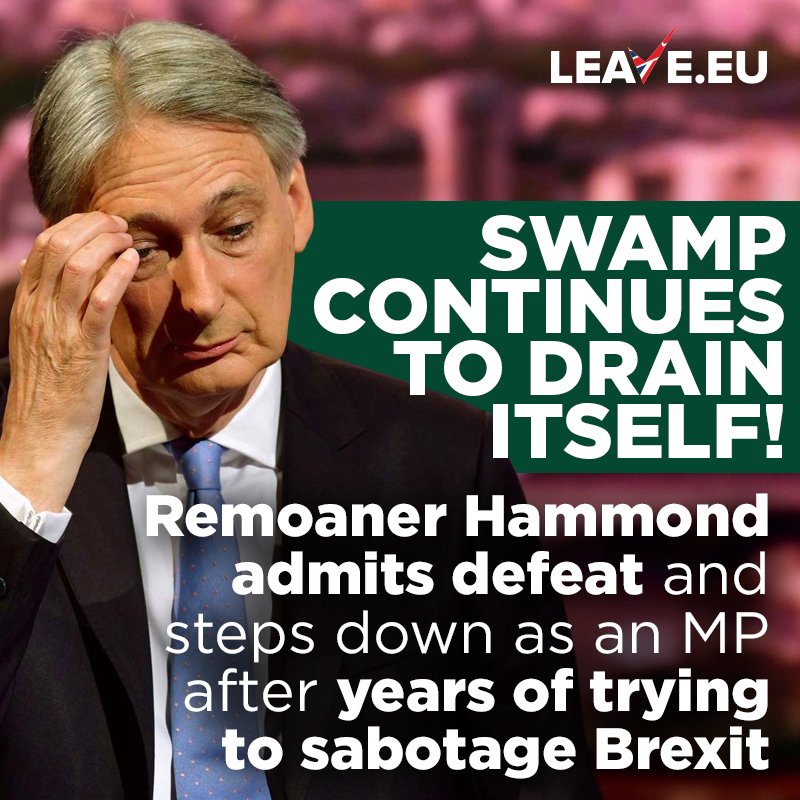
Hammond throws in the towel !

The Westminster Swamp is draining itself at an incredible rate, with Remoaner Hammond being the latest to throw in the towel and step down. 

5 NOVEMBER 2019

Goodbye Phil - the good people of Runnymede and Weybridge can't wait to see the back of you!

https://twitter.com/LeaveEUOfficial/status/1191777860102623232

Friday, 11 October 2019

Brexit is far from the finishing line

Whatever comes of these talks, democracy will still be in peril.


TOM SLATER
DEPUTY EDITOR


11th October 2019


So, at the time of writing, we’re not in the ‘tunnel’, but by the time you read this, we might be. It was announced earlier today that negotiations on Britain’s EU exit would recommence, following a ‘positive’ meeting between Irish Taoiseach Leo Varadkar and UK PM Boris Johnson yesterday, which cleared a ‘pathway’ to a deal. But the European Union was keen to make clear we were not quite entering said tunnel – the Brussels jargon for the secretive, buckle-down stage of talks.


If you’re finding the metaphors and fine distinctions baffling, you’re not the only one. What will come of these talks is really anyone’s guess. The Irish press has been briefed that the UK has moved significantly on the issue of customs, perhaps to something resembling the Northern Ireland-only backstop, which would keep Northern Ireland in the Customs Union. But for now No10, for whom this outrageous land-grab was supposedly a red line, remain tight-lipped.

The secrecy and the accompanying chin-stroking speculation is a reminder of how the EU does business – behind closed doors, beyond the prying eyes of the people. But it is also a reminder of how shut out the British public has been throughout the Brexit process, as much domestically as in the Brussels talks. Over the past three-and-a-half years we’ve all looked on, spectators, if that, as politicians and campaigners, most of whom want Brexit to fail, cut deals between one another.

So now it falls to Johnson, the late-in-the-day Leaver, to have one last shot at securing a meaningful Brexit by 31 October. But even if he gets what he wants, it’s worth remembering that the Northern Irish backstop has seemingly consumed No10 to the exclusion of all other issues with Theresa May’s Withdrawal Agreement and the accompanying Political Declaration – not least the role set out for the ECJ. The backstop is just the start of what’s wrong with that deal.

Meanwhile, our Remainer Parliament has made a No Deal Brexit effectively impossible. If no agreement is passed by 19 October, the Benn (aka Surrender) Act will kick in, forcing the PM to request an extension and giving Brussels the right to dictate how long we stay in limbo. MPs claim this was about avoiding the ‘calamity’ of No Deal, but the way they have acted recently has made it all the more clear that this was about stopping Brexit and pushing the public out of the process.

They claim there is no mandate for the No Deal Johnson was allegedly hurtling towards, and yet they blocked an election before 31 October. Now MPs are mulling over holding a second referendum – a non-choice between a version of May’s deal and Remain – before a General Election, lest the plebs elect a parliament willing to take us out. That would take months. Even if Johnson pulled off the impossible in Brussels, this is what he would be returning to.

So we have a European Union that seemingly won’t allow a meaningful Brexit for the entire United Kingdom. We have a parliament that won’t allow No Deal, and won’t allow us to vote them out. And in the middle is a government, with a negative majority, in office but not in power, but kept in place because it suits the agenda of the Remoaner opposition. Any avenue through which the public might genuinely shape events has been closed off. This is what we’re up against.

Amid the infernal swirl of jargon and speculation that is going to continue these next few days, it is important that we don’t let the seriousness of all this escape us. If Brexit is thwarted, it will leave British democracy itself in peril. We would be in a European Union we cannot leave, and lumbered with a political class more emboldened than ever to use the power we lend them to overrule our wishes. There may be light at the end of the tunnel, but for now it feels much more like an oncoming train.

Tom Slater is deputy editor at spiked. Follow him on Twitter: @Tom_Slater_

https://www.spiked-online.com/2019/10/11/brexit-is-far-from-the-finishing-line/

Monday, 16 September 2019

At least the Lib Dems are being honest

Remoaners need to stop feigning outrage at the Revoke pledge.


TOM SLATER
DEPUTY EDITOR


At least the Lib Dems are being honest

In the past 24 hours, the British chattering classes seem to have woken up to the fact that the Liberal Democrats are not actually in favour of democracy. What a clever, perceptive bunch they are.

This comes in response to the news from the Lib Dem party conference that if – and this is a huge if – Jo Swinson’s party wins a majority at the next election it will revoke Article 50. That is, it would cancel Brexit by fiat.

This is never going to happen, of course. The Lib Dems currently have a mighty 18 MPs, a third of whom are defectors from other parties. In the likely event that they fail to score another 300+ seats, the Lib Dems will continue to call for a second referendum, as they have done more or less since the first one.

Still, the policy has succeeded at least in flaunting to pure-bred Remainers that this is the political home for them, and reminding the rest of us what a hilariously misnamed outfit the Liberal Democrats is. The Lib Dems and others have always said a ‘People’s Vote’ was the ‘democratic’ way to stop Brexit – but this has always been, to use their favourite swear word, bollocks.

Another vote on EU membership further down the line, a good while after we’ve actually left, would be perfectly democratic. But we haven’t left yet. Yes, democracies can change their minds. But it’s a funny kind of democracy in which public votes are only ever implemented if the elite agrees with them.

So most of us didn’t need this Revoke announcement to work out that the Lib Dems are not big fans of democracy. But apparently many in the political and media sphere are not so quick on the uptake.

Labour MP Stephen Kinnock, who is pushing for a variation on Theresa May’s ‘Brexit’ deal, slammed the Revoke policy as ‘undemocratic’. ‘How can any Lib Dem politician look their constituents in the eye’ and ‘refer to themselves as a “democrat”?’, he thunders in the Guardian, seemingly unaware that that ship sailed long ago.

Similarly, anti-extremism campaigner Brendan Cox tweets that it is ‘totally legitimate to push for a second referendum’, but revoking Article 50 ‘cannot be justified’. This was also the line of attack when Swinson was grilled on the Today programme this morning – that a second Brexit referendum is one thing, but revoke is quite another.

This is right, to a degree. Revocation would certainly be a more audacious denial of the 17.4million who voted Brexit. But a second referendum isn’t ‘legitimate’: again, we haven’t left yet, plus those pushing for it have made it clear that it would be rigged against Leave – providing a choice between Remain and a May-style Remain By Another Name.

When it comes down to it, much of this discussion about the ‘legitimate’ way to stop Brexit is really a discussion about the most easily spun way to stop Brexit. The problem with Revoke is that it leaves no one in any doubt. This is about optics, not principle.

Just look at some of the people feigning outrage at the Lib Dem announcement. Remoaner Corbynista Paul Mason called it an ‘insult’ to Leave voters. That’s the same Paul Mason who has spent a good chunk of the past few years insulting Leave voters, insisting that Brexit is a ‘project of the racist and xenophobic right’.

Then there’s Green MP Caroline Lucas, who says ‘you can’t pretend the result didn’t happen’ and that in backing Revoke the ‘Lib Dems are doing just that’. Not only is Lucas a prominent backer of a second referendum, she also recently admitted that she would ignore the result of a second referendum if the result was Leave again, echoing comments made by Swinson just days earlier.

These people are either buying their own bullshit or lying. I’m not sure which is worse. Either way, we can’t let them get away with this. The petulant extremes of the Lib Dems shouldn’t be used to whitewash the anti-democratic antics of everyone else on the elite-Remain side.

At least the Lib Dems are being honest. Their newfound Remoaner critics certainly are not.

Tom Slater is deputy editor at spiked. Follow him on Twitter: @Tom_Slater_

Picture by: Getty.

Wednesday, 13 March 2019

The emasculation of Brexit

In voting against No Deal, MPs have devastated the 2016 vote for greater democratic control.

Brendan O'Neill
13th March 2019

The emasculation of Brexit

It isn’t surprising that, this evening, MPs voted down the possibility of a No Deal Brexit, twice, first by embracing the Spelman amendment against No Deal and then by voting against Theresa May’s bizarre whipped attempt to keep No Deal in the mix — they rejected that by 321 to 278 votes. But it is nonetheless shocking.

It isn’t surprising because the vast bulk of the political class has been whipping up panic about No Deal for months, hysterically talking about it as a 21st-century apocalypse that will plunge Britain into a Cormac McCarthy-style dystopian nightmare in which cheese will run out, the whole country will be criss-crossed by traffic jams, and there will be a devastating outbreak of ‘super-gonorrhoea’ (Evening Standard). But it is still shocking because it is just so craven. It represents the political elite’s fullest effort yet to emasculate the Brexit process and to lay themselves – and by extension the UK – at the mercy of the Brussels bureaucracy. It is their clearest snub yet, among many snubs, to the spirit of the vote for Brexit – the desire to take back democratic control.
The vote against No Deal may have been smaller than expected. But right now, nothing better captures the aloofness and hollowness of the British establishment than their hissy-fitting over No Deal. They talk about No Deal in the way politicos used to talk about MAD (mutually assured destruction) in the Cold War 1980s. Indeed, the film about nuclear war that us 80s kids watched at school – The Day After – could easily be refashioned into Remoaner propaganda about ‘the day after’ No Deal. It’s all there: disease, hunger, the descent into communal savagery. Sadly for the Project Fear machine, many of us remember unhinged panics from the past and that has built up our immunity to this blackmail style of politics that essentially says: ‘Do as we say or you will suffer terribly.’ And yet, exactly as the establishment loses its head over No Deal, the public warms to it. A ComRes poll at the weekend found that 44 per cent of the public favours leaving with no deal if Brussels makes no further concessions. That’s a six-point rise from January. Deltapoll has found that the things voters believe are ‘needed to honour the referendum’ amount to what the political class refers to as a ‘Hard Brexit’.
It is so striking: ‘Hard Brexit’ and ‘No Deal’ are bogey-words within elite political circles – including, in fact especially, among Corbynista cliques – and yet these are seen as decent, even desirable political positions by significant sections of the public. Say No Deal in Islington and watch people wail and boo; say it in Stoke and you’ll have a lot of people saying: ‘Yes, let’s do that.’ The No Deal divide captures the Two Britains phenomenon: on one side the Britain of the well-connected and right-on, who see life outside of Brussels’ purview as virtually impossible, and on the other the Britain of ordinary people who consider that democracy is the greatest guard against abuse by either foreign technocrats or domestic lawmakers. But as well as speaking to the gaping moral and political chasm between Them and Us, today’s vote against No Deal is a form of political suicide, a crystal-clear indicator that our political class has utterly given up on even negotiating with the EU, never mind being faithful to the vote of June 2016.
Taking No Deal off the table is the end of the Brexit negotiations. For the simple reason that you cannot negotiate in a serious, grown-up, meaningful way if you do not reserve the option of walking away – or ‘crashing out’, to use another phrase that strikes fear into the heart of the establishment and a nod of approval from much of the public. The establishment is making itself subservient to the EU. That is the signal sent by this. No Deal may have been turned into a political swearword in recent months, but in truth it was always an incredibly honourable position. It was the UK saying to the EU: ‘We value the vote of June 2016 so much that we are willing to walk away if the thing you offer us doesn’t measure up to it.’ Now, with the obliteration of No Deal, many MPs have made clear what we all knew to be the case – that they do not value the vote of June 2016. These anti-No Dealers have now signalled, openly and frankly, their disdain for the thing that we the people want: democratic control over political negotiations, over treaties, over trade, over our borders. This is the divide that will define Britain for decades – that between an establishment that despises the burdens of democratic governance, and ordinary people who know that democratic governance is a people’s best protection against tyranny and abuse.

Monday, 20 August 2018

The Bosses’ Vote

A second Brexit referendum, brought to you by exploited Indian labour.

TOM SLATER
DEPUTY EDITOR
20 AUGUST 2018

The Bosses̢۪ Vote

The People’s Vote campaign, which is calling for a second Brexit referendum in the hopes of overturning that other (presumably sub-people’s) vote we had in 2016, isn’t even trying to hide its elitism any more.
Just look at its latest posterboy, co-founder of Superdry Julian Dunkerton. Over the weekend he announced he was donating £1million to the campaign. He says Superdry, the fashion brand he launched in 1985, would never have been a success were it not for the EU Single Market.
But it took people on Twitter all of 30 seconds of Googling to work out that it also might not have been a success if it weren’t for the 28p-an-hour wages his company paid Indian workers to produce Superdry clothes. A People’s Vote, part-funded by Indians’ exploited labour.
Dunkerton joins a rogues’ gallery of capitalists – including Virgin boss Richard Branson and the Pimlico Plumbers guy / bad Rod Stewart lookalike, Charlie Mullins– who have been demanding a People’s Vote. Alongside them, the likes of Airbus more subtly try to scupper Brexit by preaching fire and brimstone about a No Deal Brexit.
(Meanwhile, a poll last week suggests a plurality of voters think we should Leave without a second referendum and with or without a deal.)
It’s hard to work out whether the People’s Vote crew realise they have picked spokespeople who couldn’t be more unpalatable to the British masses or just don’t care. I mean, the capitalists aside, look at who else they’ve got on their side: Tony Blair, Alastair Campbell, the bald one from Mock the Week. This is terrible, terrible optics, to use a fittingly Blairite term.
But none of this should surprise us. The People’s Vote campaign has always been an Orwellian enterprise. The aim here is not to change people’s minds, but to beat Leave voters into submission. They hope the combined hysteria of MPs, bosses and luvvies will be enough to scare Leave voters or make them check out of the process entirely, safe in the knowledge that the elites don’t care what they think.
The second referendum these people want is not a People’s Vote – it is a Bosses’ Vote, a chance for the economic and political elites who run Britain to have another crack at browbeating us into doing what they want.
Lucky for those of us committed to defending Brexit, it is a strategy that will only remind Leave voters of the contempt in which the elite holds them, and why they decided to wipe the smirks off their faces last time around.
Tom Slater is deputy editor at spiked. Follow him on Twitter: @Tom_Slater_
Picture by: Getty