Showing posts with label Propaganda. Show all posts

Wednesday, 17 August 2022

Russia-Ukraine Disinformation Tracking Center: 258 Websites Spreading War Disinformation And The Top Myths They Publish

NewsGuard has identified 258 Russia-Ukraine disinformation sites and is tracking the top false narratives that they are publishing about the war in Ukraine

By Madeline Roache, Sophia Tewa, Alex Cadier, Chine Labbe, Virginia Padovese, Roberta Schmid, Edward O’Reilly, Marie Richter, Karin König, McKenzie Sadeghi, Chiara Vercellone, Zack Fishman, Natalie Adams, Valerie Pavilonis, Shayeza Walid, Kelsey Griffin, Coalter Palmer and Andie Slomka.

Last updated: Aug. 17, 2022

Russia-Ukraine Disinformation Tracking Center - NewsGuard (newsguardtech.com)


Months before Russian forces invaded Ukraine on Feb. 24, 2022, false narratives about Ukraine and its allies, many promoted by the Kremlin’s disinformation apparatus, were already proliferating online. From false claims of Ukrainian genocide directed at Russian-speaking Ukrainians, to assertions that Nazi ideology is driving Ukraine’s political leadership, these claims were used to justify Russia’s full-scale invasion of Ukraine.

As support for the Ukrainian government rose, Kyiv has made use of social media platforms and messaging apps to push back against the Kremlin’s disinformation machine. However, a growing stream of anti-Russia misinformation has also spread online. Some pro-Ukrainian sites and scores of social media users have shared false posts about the war, ranging from manipulated images of the mythical Ghost of Kyiv to misleading footage of alleged Russian attacks.

Tracking 258 Top Russia-Ukraine Disinformation Sites

English-language websites: 119

French-language websites: 42

German-language websites: 22

Italian-language websites: 28

Other: 47

To date, NewsGuard’s team has identified and is tracking 258 domains some with a history of publishing false, pro-Russia propaganda and disinformation — that have promoted false claims about the Russian-Ukraine conflict. These websites include official Russian state media sources of the kind that some of the digital platforms have temporarily sanctioned since the onset of the Russian invasion. But many websites that are not official propaganda arms of the Russian government and are not being sanctioned by the platforms also promote false claims supporting the government of Vladimir Putin. These sources include anonymous websites, foundations, and research websites with uncertain funding—at least some of which may have undisclosed links to the Russian government.

 The three most influential among websites known to be funded and operated by the Russian government are the state media sources RT, TASS, and Sputnik News. Below are links to NewsGuard’s Nutrition Labels for these three sources:

RT Nutrition Label

SputnikNews Nutrition Label

TASS Nutrition Label

NewsGuard’s team is monitoring these and the dozens of other sites that we have identified as those that spread Russia-Ukraine disinformation narratives, including the top myths cited in this report. As noted above, as new myths and disinformation sources are identified, we will update this report accordingly.

Russia employs a multi-layered strategy to introduce, amplify, and spread false and distorted narratives across the world — relying on a mix of official state media sources, anonymous websites and accounts, and other methods to distribute propaganda that advances the Kremlin’s interests and undermines its adversaries. Its government-funded and operated websites use digital platforms such as YouTube, Facebook, Twitter and TikTok to launch and promote false narratives. NewsGuard has been tracking these sources and methods since 2018. and licenses its data about Russian propaganda efforts to the U.S. Department of State, U.S. Cyber Command, and other government and defense entities.

In 2020, the U.S. Department of State’s Global Engagement Center, citing NewsGuard’s reporting and data, outlined key components of these efforts in its report, “Pillars of Russia’s Disinformation and Propaganda Ecosystem.”

While Russia’s disinformation firepower has meant that pro-Russia disinformation remains dominant, anti-Russia or pro-Ukraine disinformation, occasionally shared by Ukrainian authorities, has also started to emerge. These narratives tend to paint a triumphant picture of Ukrainian armed forces while making unsubstantiated anti-Russia claims.

For example, videos of the “Ghost of Kyiv”, a Ukrainian fighter pilot alleged to have shot down six Russia military jets, were spread to millions on TikTok and other platforms. Days later, it emerged that the footage originated from a video game and that there is no evidence to support the existence of the “Ghost of Kyiv”.

Researchers, platforms, advertisers, government agencies, or other institutions interested in accessing the full list of domains can contact us here: Request domain list.

Top Russia-Ukraine war myths:

These myths are listed in the order in which NewsGuard’s analysts disproved them, with newest entries at the top.

Please refer to this link for the following articles:

MYTH: Ukrainian anti-war protestors obstructed traffic in Italy, causing major backups

MYTH: A video shows Ukrainian farmers in a field set on fire by the Russian military during the Russia-Ukraine war

MYTH: Video shows a Russian missile destroying a Ukrainian weapons depot

MYTH: Dashcam footage shows that Russia deployed nuclear missiles to its border with Finland

MYTH: Vladimir Putin plans to reveal the West’s plans to “depopulate” the world

MYTH: Russia is not stealing grain from Ukraine or blocking shipments, as the West has charged

MYTH: To mark the anniversary of the Nazi invasion of the Soviet Union, Ukrainian activists put anti-Russian stickers on walls and fences at the Auschwitz concentration camp

MYTH: NATO is establishing a military base at the Severodonetsk airport in Ukraine

MYTH: A video shows the Russian warship Moskva exploding

MYTH: Deutsche Welle reported that German police arrested a Ukrainian refugee for blackmailing women 

MYTH: The Ukrainian Orthodox Church canonized nationalist leader Stepan Bandera

MYTH: The Red Cross in Ukraine is involved in children’s organ trafficking

MYTH: A Russian strike on a munitions depot led to a fire at a defunct mall in Kremenchuk, Ukraine

MYTH: The Ukrainian army seized a United Nations office in Kramatorsk, Ukraine

MYTH: Ukraine asked Poland to deport Ukrainian men of military age for them to join the frontlines

MYTH: A video showed a Ukrainian girl injured by a Russian missile singing the national anthem

MYTH: Ukraine’s Azov Battalion used explosives to blow up the Mariupol Drama Theater

MYTH: Zelensky used a green screen to fake appearances in Ukraine

MYTH: Ukraine is requiring women to register for military service 

MYTH: Ukrainian refugees burned down a house in Germany where they were staying while attempting to burn the Russian flag

MYTH: Hunter Biden helped finance a bioweapons research program in Ukraine

MYTH: A French man who was killed in Ukraine’s Donbas region was not a journalist, but a mercenary

MYTH: Kateryna Prokopenko, the wife of Ukraine’s Azov Regiment commander, is a neo-Nazi.

MYTH: Ukrainian President Volodymyr Zelensky is Russian and therefore is an illegitimate president

MYTH: The U.S. is recruiting ISIS mercenaries to fight in Ukraine.

MYTH: Residents of the city of Tampere, Finland, filmed a Finnish train transporting hundreds of tanks and military equipment to its eastern border with Russia in May 2022, following the country’s move toward NATO membership.

MYTH: Putin used a green screen to record a fake TV appearance.

MYTH: Poland is preparing to invade Western Ukraine.

MYTH: Ukraine is selling surplus weapons to African countries.

MYTH: Ukrainian President Volodymyr Zelensky has an estimated net worth of $850 million. He accumulated his wealth after he was elected.

MYTH: Google Maps revealed uncensored satellite images of Russian military sites in April 2022 during the Russia-Ukraine war, which were previously blurred. The change was meant to help Russia’s enemies better assess the Russian military’s capabilities and advances.

MYTH: Ukrainian President Volodymyr Zelensky urged Ukrainians to surrender.

MYTH: NATO military advisors are hiding out in a subterranean NATO bioweapons laboratory called PIT-404, which is financed by Metabiota, a company affiliated with Hunter Biden. The lab is located underneath the Azovstal Iron and Steel Works in Mariupol, Ukraine.

MYTH: A secret document called the “Chancellor’s File” proves that NATO planned a war against Russia decades ago.

MYTH: Russia does not use the type of missile that was employed to attack the Kramatorsk train station.

MYTH: The International Committee of the Red Cross (ICRC) helped carry out forced evacuations of Ukrainians to Russia.

MYTH: Classified documents show Ukraine was preparing an offensive operation against the Donbas.

MYTH: The massacre of civilians in Bucha, Ukraine, was staged.

MYTH: The U.S. is developing bioweapons designed to target ethnic Russians.

MYTH: Photos show Ukrainian president Volodymyr Zelensky fighting in combat after Russia invaded Ukraine.

MYTH: Videos show the “Ghost of Kyiv” shooting down Russian planes.

MYTH: Ukraine threatened Russia with invasion.

MYTH: U.S. paratroopers landed in Ukraine.

MYTH: Russian missiles hit a nuclear waste facility in Kyiv.

MYTH: Ukrainian “nationalists” seized about 20 OSCE vehicles in eastern Ukraine.

MYTH: Ukraine staged the attack on the hospital in Mariupol.

MYTH: European universities are expelling Russian students.

MYTH: A man named “Bernie Gores” was the first American casualty of the Ukraine crisis.

MYTH: Ukraine is training child soldiers.

MYTH: The war in Ukraine is a hoax.

MYTH: The U.S. has a network of bioweapons labs in Eastern Europe.

MYTH: Russia was not using cluster munitions during its military operation in Ukraine.

MYTH: NATO has a military base in Odessa.

MYTH: Russia did not target civilian infrastructure in Ukraine.

MYTH: Modern Ukraine was entirely created by communist Russia.

MYTH: Crimea joined Russia legally.

MYTH: Polish-speaking saboteurs attempted to bomb a chlorine plant in Donbas.

MYTH: Ukrainian forces bombed a kindergarten in Lugansk on Feb. 17, 2022.

MYTH: The U.S. and U.K. sent outdated and obsolete weapons to Ukraine.

MYTH: Nazism is rampant in Ukrainian politics and society, supported by the authorities in Kyiv.

MYTH: The West staged a coup to overthrow the pro-Russia Ukrainian government in 2014.

MYTH: Russian-speaking residents in Donbas have been subjected to genocide.

Correction: An earlier version of this tracker inaccurately referred to Mimikama as a German fact-checking organization. In fact, Mimikama is Austrian. NewsGuard apologizes for the error.

Russia-Ukraine Disinformation Tracking Center - NewsGuard (newsguardtech.com)

Monday, 20 September 2021

Op-ed: Will China's President Xi’s big bet pay off?

 Chinese President Xi Jinping is making the most audacious geopolitical bet of the 21st century.

  • For China, that bet has many faces: a rapid rollback of economic liberalization, a crackdown on individual freedoms, an escalation of global influence efforts and military buildup.
  • At the same time, President Xi has launched a push to share the virtues and successes of the Chinese authoritarian model with the rest of the world.

20 Sep 2021  Frederick Kempe  15 hrs ago   CNBC

© Provided by CNBC China's President Xi Jinping speaks during a bilateral meeting with U.S. President Donald Trump at Trump's Mar-a-Lago estate in Palm Beach, Florida, April 7, 2017.


Chinese President Xi Jinping is making the most audacious geopolitical bet of the 21st century.

A head-spinning series of seemingly disparate moves over recent months add up to nothing less than a generational wager that Xi can produce the world's dominant power for the foreseeable future by doubling down on his state-controlled economy, party-disciplined society, nationalistic propaganda, and far-reaching global influence campaigns.

With each week, Xi raises the stakes further, from narrowing seemingly mundane personal freedoms like karaoke bars or a teenager's permitted time for online gaming to three hours weekly to the multimillion U.S. dollar investor hit from his increased controls on China's biggest technology companies and their foreign listings.  

It is only in the context of Xi's increased repressions at home and expanded ambitions abroad that one can fully understand Australian Prime Minister Scott Morrison's decision this week to enter a new defense pact, which he called "a forever agreement," with the United States and the United Kingdom.

Much of the news focus was either on the eight nuclear-powered submarines that Australia would deploy or the spiraling French outrage that their own deal to sell diesel submarines to Australia was undermined by what French officials called a "betrayal" and a "stab in the back" from close allies. France went so far as to recall its ambassador to the United States for the first time in the history of the NATO alliance.

All that noise should not distract from the more significant message of the ground-breaking agreement. Prime Minister Morrison saw more strategic advantage and military capability from the U.S.-U.K. alignment in a rapidly shifting Indo-Pacific atmosphere, replacing his previous stance of trying to balance U.S. and Chinese interests.

"The relatively benign environment we've enjoyed for many decades in our region is behind us," Morrison said on Thursday. "We have entered a new era with challenges for Australia and our partners."

For China, that new era has many faces: a rapid rollback of economic liberalization, a crackdown on individual freedoms, an escalation of global influence efforts and military buildup, all in advance of the 20th national party congress in October 2022, where Xi hopes to seal his place in history and his continued rule.

Former Australian Prime Minister Kevin Rudd, one of the world's leading China experts, points to Xi's "bewildering array" of economic policy decisions in a recent speech as president of the Asia Society.

They started last October with the shocking suspension of Alibaba financial affiliate Ant Group's planned initial public offering in Hong Kong and Shanghai, clearly aimed at Alibaba co-founder Jack Ma. Then in April, Chinese regulators imposed a $3 billion fine on Alibaba for "monopolistic behavior."

In July, China's cyber regulator removed ride-hailing giant Didi from app stores, while an investigative unit launched an examination of the company's compliance with Chinese data-security laws.

Then this month, China's Transport Ministry regulators summoned senior executives from Didi, Meituan and nine other ride-hailing companies, ordering them to "rectify" their digital misconduct. The Chinese state then took an equity stake in ByteDance, the owner of TikTok, and in Weibo, the micro-blogging platform.

Xi was ready to accept the estimated $1.1 trillion cost in shareholder value wiped from China's top six technology stocks alone between February and August. That doesn't factor in further losses among the education, transportation, food delivery, entertainment and video gaming industries.

Less noticed have been a dizzying array of regulatory actions and policy moves whose sum purpose appears to be strengthening state control over, well, just about everything. 

"The best way to summarize it," says Rudd, "is that Xi Jinping has decided that, in the overall balance between the roles of the state and the market in China, it is in the interests of the Party to pivot toward the state." Xi is determined to transform modern China into a global great power, "but a great power in which the Chinese Communist Party nonetheless retains complete control."

That means growing controls as well over the freedoms of its 1.4 billion citizens.

Xi has acted, for example, to restrict the video gaming of school-aged children to three hours a week, and he has banned private tutoring. Chinese regulators have ordered broadcasters to encourage masculinity and remove "sissy men," or niang pao, from the airwaves. Regulators banned "American Idol"-style competitions and removed from the internet any mention of one of China's wealthiest actresses, Zhao Wei.

"The orders have been sudden, dramatic and often baffling," wrote Lily Kuo in the Washington Post. Jude Blanchette of the Center for Strategic and International Studies says, "This is not a sector-by-sector rectification; this is an entire economic, industry and structural rectification."

At the same time, President Xi has launched a push to share the virtues and successes of the Chinese authoritarian model with the rest of the world. 

"Beijing seeks less to impose a Marxist-Leninist ideology on foreign societies than to legitimate and promote its own authoritarian system," Charles Edel and David Shullman, the recently appointed director of the Atlantic Council's new China Global Hub, wrote in "Foreign Affairs." "The CCP doesn't seek ideological conformity but rather power, security, and global influence for China and for itself."

The authors detail China's global efforts to not remake the world in its image, but rather "to make the world friendlier to its interests — and more welcoming to the rise of authoritarianism in general."

Those measures include "spreading propaganda, expanding information operations, consolidating economic influence, and meddling in foreign political systems" with the ultimate goal of "hollowing out democratic institutions and norms within and between countries," Edel and Shullman write.

Within President Xi's bold bet lie two opportunities for the U.S. and its allies.

The first is that Xi, by overreaching in his controls at home, will undo just the sorts of economic and societal liberalization China needs to succeed. At the same time, the world's democracies, like Australia, are growing more willing to seek a common cause to address Beijing.

In the end, however, Xi's concerted moves require an equally concerted response from the world's democracies. The French-U.S. crisis following the Australian defense deal this week provides just one example of how difficult that will be to achieve and sustain.

82 Comments

b Sirius37m
If you’re more concerned about China’s domestic affairs than your own country’s aggressive foreign policy toward China it’s because you’ve been propagandized. Change your media consumption habits accordingly.

Glen Gard4h
Sorry to say they can't be trusted at all.  My opinion they are biting the hands that feed them. Back in the 70's they were a third country. Our Western/Capitalism Ideals saved this country from ruin. What they have done i.e. stolen technology while our Govt's / Wall Street Execs have ignored because of GREED will be the downfall of the free world. 


harry forrester6h
Welcome to the Communist way of life

eon flores9h
Remember how Japan and Germany started world wars ½ for economic power building up strong military.


https://www.msn.com/en-us/money/markets/op-ed-will-china-s-president-xi-s-big-bet-pay-off/ar-AAOBybw

Wednesday, 1 September 2021

The disinformation tactics used by China

The Chinese embassy in London has criticised the BBC following a documentary about Chinese disinformation campaigns.

By Krassi Twigg and Kerry Allen
BBC Monitoring

Published

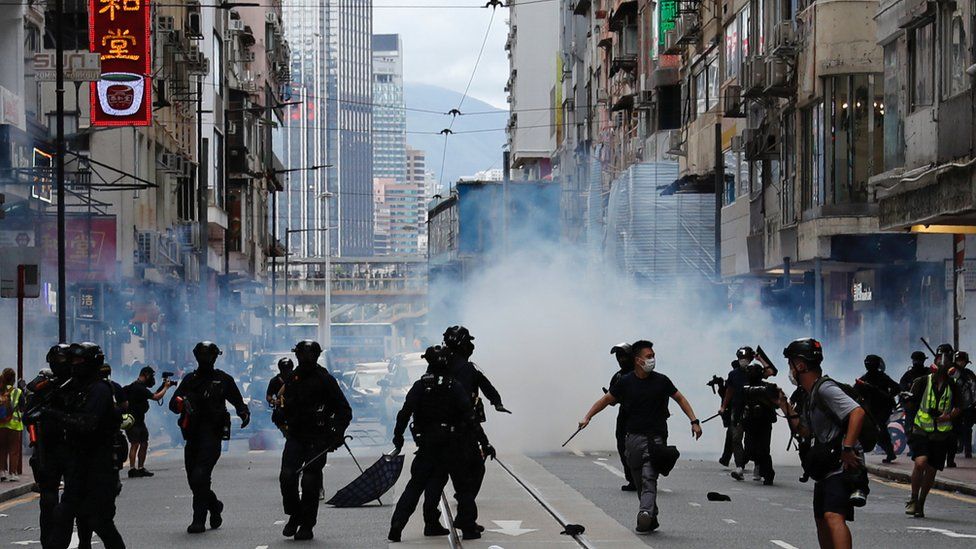
Street view of riot police and protesters in Hong KongIMAGE SOURCEREUTERS
image captionFacebook and Twitter removed accounts linked to China during unrest in Hong Kong in 2019

The Chinese embassy in London has criticised the BBC following a documentary about Chinese disinformation campaigns.

There have also recently been a series of denials from Beijing over reports into forced imprisonment of its minority Uighur population - these have included baseless accusations against media and human rights organisations.

In the latest attack, an official falsely claimed a Uighur interviewee on a BBC programme was an actress.

So what tactics does China use in the spread of misleading and false information?

Increasing anti-BBC coverage

There have been almost daily anti-BBC articles in Chinese state media since mid-February.

It follows a decision by the UK broadcasting regulator Ofcom to revoke the licence for China's state-run overseas broadcaster, CGTN.

For years, China has broadly criticised Western outlets for reports on affairs in Xinjiang and elsewhere in China, saying they should not intervene in China's "internal affairs".

But these latest attacks on Western media are a clear escalation.

Chinese domestic media outlets have praised their government for banning the BBC's World News channel, although it was only available in some international hotels and residential compounds where foreigners live.

Reports from leading outlets like China's Global Times have criticised the "Cold War" mentality when it comes to China - on topics ranging from Hong Kong, the Uighur population of Xinjiang and the Covid-19 pandemic.

When China was facing a backlash over its handling of early stages of the pandemic last year, and some US officials were floating the theory that the virus could have escaped from a Wuhan lab, CGTN started to push its own conspiracy theory.

Despite a complete lack of evidence, the station suggested the virus originated at a military base in Maryland in the US and was brought to China by American soldiers during an athletics competition.

Presentational grey line

Find out more

Finger pointing at mobile phone screenIMAGE SOURCEGETTY IMAGES
Presentational grey line

'Wolf warriors' on social media

In recent months, China experts have noticed dozens of new and highly active official social media accounts representing Chinese embassies and leading diplomats.

This has become known as "wolf warrior" diplomacy. The best-known account belongs to Zhao Lijian from the Chinese foreign ministry.

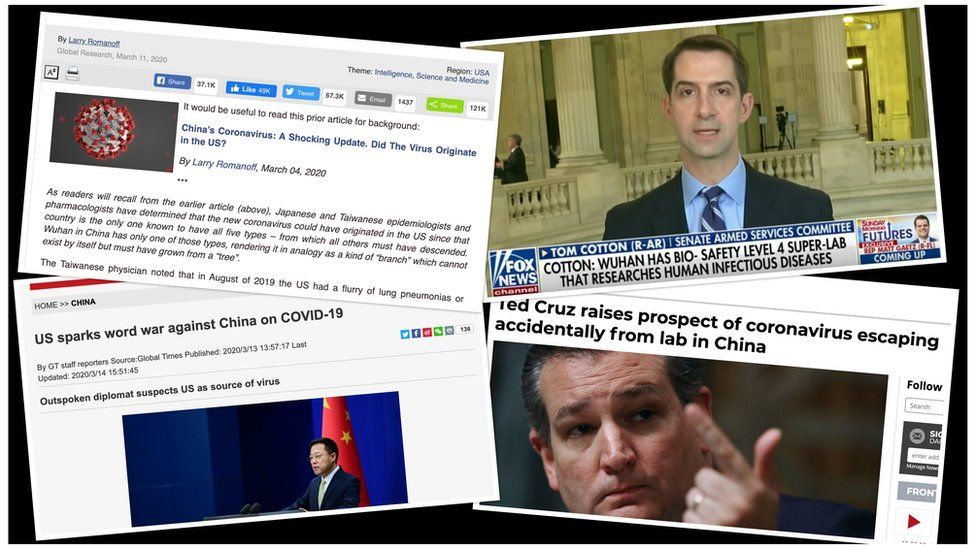
He caused controversy in March after tweeting articles suggesting that coronavirus originated in the United States.

Composite picture of websites
image captionThe US and China traded unverified theories about the origins of coronavirus

Those tweets have been shared more than 40,000 times and referenced in 54 different languages, according to research from the Digital Forensic Research Lab, part of the Atlantic Council think tank.

Popular hashtags referencing the posts have made waves at home too - they've been viewed by users of Chinese social network Weibo more than 300 million times.

In December, Zhao Lijian was widely criticised for sharing a fake image of an Australian soldier killing an Afghan child, for which China refused to apologise.

'Keyboard army'

China draws on millions of citizens to monitor the internet and influence public opinion on a massive scale online. These recruits are known as the "50 cent army" - so named because of reports that they were paid 0.5 yuan per post.

This "keyboard army" has long been active on Chinese social media platforms. Its aim has been to aggressively defend and protect China's image overseas.

When tweeting in English, the messages are aimed at a Western audience, much like troll farms in Russia that sow discord.

To the unsuspecting reader, they might appear as patriotic citizens acting independently, but frequently they are taking directions from Chinese authorities.

One example is the way in which video footage of violent protests in Hong Kong in 2019 was promoted on social media via this keyboard army using terms such as "terrorism", while coverage of peaceful protests was censored.

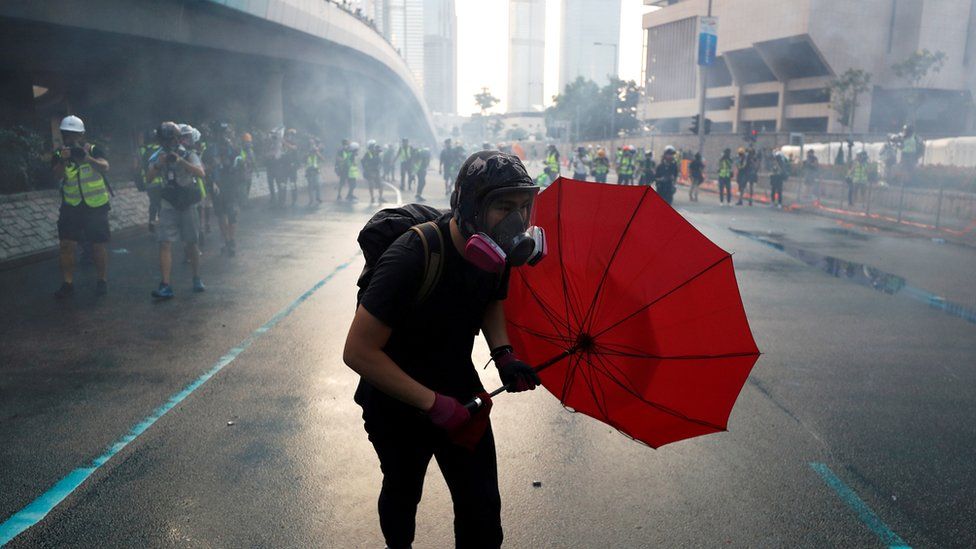
A Hong Kong protesterIMAGE SOURCEREUTERS

In August 2019, Facebook and Twitter announced they had removed accounts linked to a state-backed information campaign.

Facebook said: "Although the people behind this activity attempted to conceal their identities, our investigation found links to individuals associated with the Chinese government."

Twitter identified more than 900 accounts from China. But these were only the most active components of the campaign, which the company said involved some 200,000 accounts.

Fake social media accounts

A BBC investigation in May 2020 found hundreds of fake or hijacked social media accounts promoting pro-China messages on Facebook, Twitter and YouTube. Some 1,200 accounts targeted people critical of how Beijing was handling the pandemic.

There was no definitive evidence tying these accounts to the Chinese government, but it did display similar characteristics to the state-backed network removed by Facebook and Twitter in 2019.

It also resembled another network dubbed "Spamouflage Dragon", which pumped out pro-China posts and attacked critics with spam, which was uncovered by the social analytics firm Graphika.

Subsequently Twitter said it had removed more than 23,000 accounts linked to China involved in a range of "manipulative and co-ordinated activities".

In response to comments made by Yang Xiaoguang, from the Chinese Embassy in the UK on the BBC Today programme, a BBC spokesman said: "We completely reject these claims and stand by our journalism. BBC News reporting in Xinjiang has been accurate and impartial - we did not use any false images and the interviewee who appeared on the BBC was not an 'actress' as claimed."

Additional reporting by Jack Goodman


https://www.bbc.com/news/56364952