Showing posts with label Simon Jenkins. Show all posts

Thursday, 24 October 2019

An election would liberate Boris Johnson. But first he must get his deal through

The prime minister has targeted 12 December. Yet if he wants to ‘get Brexit done’, he’ll have to compromise on the withdrawal bill

Thu 24 Oct 2019 18.24 BST
Last modified on Thu 24 Oct 2019 18.50 BST
Simon Jenkins
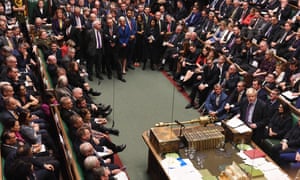

Boris Johnson addresses MPs on Tuesday 22 October
 Boris Johnson addresses MPs on Tuesday 22 October, the day his Brexit bill was granted a second reading. Photograph: Jessica Taylor/UK Parliament/AFP via Getty Images

The remainers have screwed up. After three years of dithering since the 2016 referendum, this last gasp of Britain’s liberal establishment, once so confident and unassailable, has become a drawn-out howl of anguish. Ever since one of its former members, Boris Johnson, turned Caliban, he has roamed the political landscape, taunting his old associates at every turn. He threatens them with no-deal Brexits and general elections, and they shudder. He may be the weakest prime minister in recent history. But remainers have no idea how to respond.

The prime minister now faces almost certain defeat over his rock-solid pledge, “no ifs, no buts”, to leave the EU by 31 October. Assuming Brussels allows him to postpone Brexit to give him time to pass his withdrawal bill through parliament, he has two options. He can press ahead with that bill and risk delays and hostile amendments, or he can “pause” it and attempt instead to get a pre-Christmas general election, which should give him more room for manoeuvre. For that, under the Fixed-term Parliaments Act, he needs Labour cooperation.

In a bold bid to square the circle, Johnson has offered more time in parliament in return for Labour’s agreement to an election date of 12 December. Labour must decide if it wants to be tied down in that way. In particular, will Johnson accept amendments to his bill over the next month that he might not like. He has one asset in hand: that the House of Commons has already voted on a second reading to pass his Brexit bill. He therefore needs only to survive the amendments stage. But his opponents would surely be wise to await the outcome of their amendments before agreeing to go to the country.

Johnson should have every incentive to be extremely collaborative on such amendments. They might not suit some of his wilder backbenchers but they would get him from his present bind to where he wants to be, on the sunny uplands of an election campaign, where he is sure he can win a signal victory. Every tactical consideration should impel him towards a compromise on the bill – even if it might embrace a confirmatory referendum down the line. Just get it out of the way.

Labour would be well advised to collaborate. Jeremy Corbyn and his disjointed band of remainers, half-leavers, soft-Brexiters and second-coming referendum-ers, have been wrongfooted at every turn. They should now concentrate on one thing, minimising the cost of Brexit to the economy. Their task should be to soften its impact. Now to stand in its way would see them massacred at the polls.

Those eager to keep Britain as close as possible to Europe have more parliamentary power at this moment probably than ever since 2016, if only because they have what Johnson most wants, the key to an election. In return they must keep open the negotiating option in the transition period and with it the possibility of a customs union, a Norwegian option, the resolution of the Irish border nonsense, and the avoidance of chaos in the labour market. Johnson has no need to concede these red rags to his fundamentalist bulls, just the possibility of them emerging from the eventual negotiation.

How far the terms of the negotiation need to be written into the withdrawal bill is moot. Clearly, with trust in Johnson’s intentions at a low ebb, flexibility is all. The opposition needs only seek a transitional negotiation that leaves open “a” customs union, if not “the” one. Johnson has, after all, conceded one for Northern Ireland.

Everything will then be to play for next year. As the BBC’s Europe editor, Katya Adler, never ceases to remind us, the big battles are yet to come, in 2020. Those close to the Brussels negotiations have found parliament’s obsession with the terms of withdrawal baffling and infuriating. It is the UK’s future relationship with the EU that should matter, and that is yet to be settled. It is not withdrawal that may need “postponing”, but the UK’s place in Europe’s overall trading community. We are not yet done with border checks, alignments, quotas and tariffs. Those horrors lie ahead.

Johnson is understandably frustrated by Downing Street’s lack of control over events. He should be reminded, daily, that this crisis is his doing. He knows that an election could liberate him from the bondage of a hung parliament. But that is why he has everything to gain from getting his bill, however bastardised, through the present Commons. References to future trade deals are really neither here nor there. Like all Johnson’s Don Giovanni promises, they are words suited to passing circumstance.

For their part, remainers must see a residual interest in passing Johnson’s bill. The nocturnal litany of “why no” simply has to shift to “how yes”. This requires not reason but the art of politics. That art has long been seen as the genius of the British constitution. It has guided parliament through crisis after crisis, from the Glorious Revolution of 1688 to the Great Reform Act of 1832 and the Parliament Act of 1911. Britain’s parliament at no point lost control of events, whether to the crown, the judges or the streets.

An election is clearly needed. A government must be able to govern, a prime minister to lead. A new parliament should allow tempers to cool and some concept of a national interest to revive. Perhaps the remainers can yet redeem themselves. They can eliminate Corbyn’s “risk of a no-deal crash-out” by agreeing Johnson’s bill. They can try to keep open the option of a customs union and single market. They can soften Brexit as best they can. But that is for next year. For now, just pass the bill.


Thursday, 17 October 2019

Guardian: Boris Johnson has a deal. Now MPs must end the agony and vote it through

The DUP is again proving the fly in the Brexit ointment, but it should not be allowed to decide who rules Britain

Thu 17 Oct 2019 18.52 BST
Last modified on Thu 17 Oct 2019 21.48 BST
Simon Jenkins

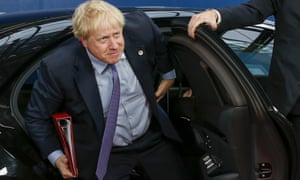
Boris Johnson
 ‘Boris Johnson has choked on a dozen promises, but he has eliminated the notorious backstop.’ Photograph: Julien Warnand/AP

Here we go again. The bloody torso that is Brexit will this weekend dump itself in the torture chamber of the House of Commons. MPs will be asked to approve – in some fashion or other – the Brexit deal reached by Boris Johnson in Brussels. It is now surely clear that the deal comes as close as is feasible to a workable withdrawal from the EU, given the limitations set by the Commons since 2016. It also sets a framework for something quite separate, Britain’s long-term relationship with the EU, which is yet to be negotiated in detail.

Johnson won the Tory leadership by creating a problem for which there was by definition no solution. He would not just leave the EU but would replace its customs union with a “frictionless” border in Ireland. There could be no such border, and Britain had no economic interest in having one. All the current chaos ensues from that. Despite his bluster, he has tried to avoid the greater lunacy of no deal. Faced with the impossibility of customs barriers, he has conceded a virtual border down the Irish Sea, regulatory alignment and a crazily bureaucratic scheme of tariff rebates. He is rumoured to have made concessions to die-hard unionists on abortion and subsidies. He has choked on a dozen promises, but he has eliminated the notorious backstop. In return, he has granted Belfast a veto on future trade deals.

Johnson has deployed all his political charm to win over Ireland’s Leo Varadkar and his own last-ditchers. The result is something of a coup. His deal is not permanent. It covers a withdrawal and a “standstill” transition, but it must surely be last call for the UK’s orderly departure from the EU, give or take some weeks of tidying up. A deal is done and on offer.

And yet. At the last minute, the Democratic Unionist party has punched Johnson in the stomach. It is refusing to accept the deal, thus possibly denying him a Commons majority. This is despite opinion in the region strongly supporting continued trade links with the Republic. It means the DUP is on the brink of doing what Sinn Féin never achieved: turning majority opinion in the region in favour of reunification. The party is now demanding a specific unionists’ veto in the Belfast assembly – not just an overall majority – on any new cross-border customs arrangement.


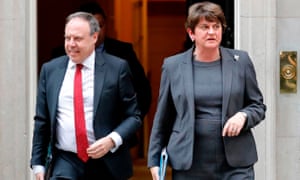
FacebookTwitterPinterest The DUP’s Arlene Foster and Nigel Dodds: ‘The party is now demanding a specific Unionists’ veto in the Belfast assembly.’ Photograph: Tolga Akmen/AFP via Getty Images

It beggars belief that the United Kingdom parliament can allow itself to be held to ransom by such absurdities. The way forward is for MPs from all other parties to back the deal, but it also beggars belief that elected politicians appear ready to reject it. These politicians voted for the Brexit referendum and voted to activate article 50. Yet Jeremy Corbyn has declared that Labour intends to support the DUP’s rejectionism. His claim that the deal “endangers the rights and protections of British workers” is hooey. He just wants to embarrass Johnson.

If the DUP is right, and the deal risks Northern Ireland being drawn ever closer to the Republic, that is surely something Labour should welcome, not impede. Corbyn’s reluctant backing for another referendum is more opaque. Whether the government might accept such an amendment in return for getting Labour votes on Saturday is unknown, though the gamble could be worth it. Polls show that the public is so fed up with Brexit it would probably vote in a second referendum for any deal, rather than no deal or remain. Otherwise Labour’s position, as set out last night by Keir Starmer, is all over the shop. It mostly consists of objections to the political statement, which is for future negotiation and remains all to play for. Either way, Corbyn should see electoral advantage in allowing Johnson his moment of glory, clearing the decks of Brexit and aiming for an early general election.

The Liberal Democrats’ opposition to the deal is equally bizarre. Rejecting it would let Johnson present himself as the only “orderly” Brexiter in sight, the only one who sought to honour the will of the people. The Lib Dems would surrender their best opportunity in a generation of supplanting Labour as the responsible party of the left. The same goes for the Scottish Nationalists. Brexit has led to a surge in support for independence, but the SNP needs to solidify support at the polls, not stay party to this interminable squabble south of the border. Everyone needs Brexit off the table.

Johnson has made manifold errors. Alienating 21 Tory MPs was crass. They should be helping him get MPs from across the parties behind the deal, freeing him from the DUP. Nor should he have fixated on the customs union, but rather relegated it to the transition period. It left the Northern Irish trap gaping to catch him, as it did Theresa May. The region’s sectarianism returns time and again to haunt British politics. On the back of Brexit, it may yet complete the break-up of a no longer “united” kingdom.

The DUP should not decide who rules Britain. MPs should vote for Johnson’s deal, and those who dislike its details should save their fight for the transition. Exit now would at last draw the Brexit poison from daily politics. It would lift the threat of no deal, and hopefully open the door to a calmer negotiation of Britain’s European future. It is time, surely, to end this agony.


• Simon Jenkins is a Guardian columnist

https://www.theguardian.com/commentisfree/2019/oct/17/boris-johnson-deal-mps-dup-brexit-britain

Wednesday, 31 August 2016

It’s a hard sell, but in post-Brexit Britain optimism must become a strategy

Now Project Fear has been shown to be exaggerated, Brexiters must tone down their pessimistic rhetoric too. It’s time to focus on the facts

Wednesday 31 August 2016 
Simon Jenkins

If I had my way, the new year would start tomorrow. After the purgatory of August as the nation’s holiday, autumnal September is when we return to work, supposedly regenerated. Plans, budgets, accounts and the statistical year should begin then. September, not cheerless January, should be the month of new resolutions.
September is my month for optimism. Last summer I enjoyed reading Yuval Noah Harari’s rollercoaster panoptic on the rise of the planet’s superheroes, Sapiens. This summer I did not enjoy his gloomy follow-up, Homo Deus. It is a classic of worst-case futurology. The digital revolution is so sexy and potent, Harari predicts, that we simply cannot resist its downside. Gene science and robotics will lead to subservience to the “techno-religions” of Silicon Valley, with different classes of humans and the brain of most ordinary humans reduced to obsolescence. To Harari we are doomed – pending more research.
Any fool can extrapolate the present. As the headline writer knows, anything “could” happen. But I doubt this one. The school subject that should be compulsory is not maths but history. During the 1840s railway boom, alarmists said 600 projected railways would invade every village in the land in a mania of steam. From Mary Shelley’s Frankenstein through Arnold Toynbee, HG Wells and Aldous Huxley, each human advance is accompanied by forecasts of disaster. In the 1960s, Paul Ehrlich shatteringly declared “the population bomb” would lead to mass starvation by the end of the 1970s. He was supported by Barry Commoner and his thesis of an imminent “closing circle” of ecological suicide.
As recently as 10 years ago, James Lovelock, scientism’s revivalist preacher, warned of “the revenge of Gaia” against our worship of combustion. “It could now be our auto da fé, and the cause of our extinction,” he declared. All these books make much use of the word “could”. They also add that it is “not too late” – usually pending their next bestseller.
More appealing was my other summer reading, Johan Norberg’s Progress. It looks not at what “could” happen but at what “has” happened. Norberg is a prophet of anti-pessimism. He is shocked by a 2015 YouGov poll that found 71% of Britons convinced “the world is getting worse”, against just 5% who said it was getting better. More than half thought world poverty was rising, against 10% who thought it falling. It was the same in the US.

Norberg points out that every index of global improvement – measuring starvation, poverty, child mortality, literacy, women’s education, democracy, violence, death in war – shows a steady upward graph. It is easy to retort, “But what about Syria and the Congo?” When an argument is general, the objection must be general.
What exercises Norberg is that progress deniers risk generating what he calls “nativist backlash”. To him, “When we don’t see the progress we have made, we begin to search for scapegoats for the problems that remain.” Misinformed about the improving state of the world, people wander about under a cloud of superstition and fear. They soon accept the authoritarian “curtailment of the freedom and openness that progress depends on”. They vote for Ukip and Trump.
The politics of fear has become the default mode of democratic politics. The desensitising word crisis is applied to any and every problem. The chairman of the US joint chiefs of staff can “personally attest … that the world is more dangerous than it has ever been”. He had no evidence, just a budget to defend. Most of us belong to a tribe, with tribal interests at stake. The left seizes on evidence of inequality, ignoring absolute prosperity. The right seizes on moral degeneracy, with the philosopher John Gray warning of “the approaching end of civilisation”.
Cue the latest chase. Brexit was a triumph for the pessimist tendency. Its theme was that Britain was doomed if immigration were not controlled and the country released from bondage to Brussels. Now that the remainers’ Project Fear has been shown to be exaggerated, Brexit must tone down its own gloom. It must see some virtue in European co-operation, and build a new relationship of continental trust. Given the recent past, this will be a hard sell, but sold it must be. Optimism must become a strategy.
A running theme of Norberg’s book is the dependence of such political argument on the media. He is right. Almost the entire Brexit debate – one of the most passionate and intriguing in modern British politics – was conducted as a contest of competing menaces. This was no surprise. The media depends on bad news “to sell newspapers”, but newspapers are veritable libraries of congress compared with internet news sites, drenched in polarisation. I still think the internet has contributed to the diversity of public debate, but even an optimist finds this a close call.
Journalists customarily defend themselves from the charge of distortion by claiming their job is to report deviations from the norm of progress. Good news is rarely news. We report plane crashes and divorces, not take-offs and happy marriages.
This does not excuse such scaremongering as the claim that the 2014 Ebola outbreak could infect “1.4 million people by 2015”. Similar fear-inducing pessimism about bird flu, Aids, terrorism and climate change deaden us to real risks. Apologists claim to be raising awareness and stimulating “something to be done”. But governments are easily terrorised into doing the wrong thing. In the case of bird flu, the diversion of medical resources was said to have caused more deaths than the epidemic itself.
By far the most positive sign of humanity’s advance is the decline in global violence, on a state and personal level. The cognitive scientistSteven Pinker attributes this to historical evolutions. These include nations becoming inherently more “pacifist”, the “feminising” of politics, the growing power of reason and “the expanding circle of sympathy”. He, like Norberg, is puzzled by the potency of pessimism.
My optimistic future sees the post-digital age as putting live experience back at the centre of human activity. Machines will serve humans ever more efficiently, but not enslave us, as Harari miserably predicts. But that is the future. Optimism’s trump card is the past and present. It is facts. These too can lie, but those who say so must prove it.
https://www.theguardian.com/commentisfree/2016/aug/31/brexit-britain-optimism-project-fear-crisis

Friday, 24 June 2016

The biggest threat of Brexit is not to the UK but to the rest of Europe


First thoughts

Although Britain has given itself an almighty shock, the visionary outcome of this leave vote ought to start a grand debate across the continent

Friday 24 June 2016 
Simon Jenkins


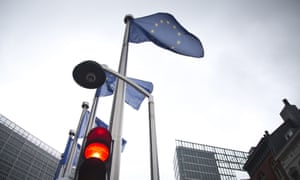
EU flags in Brussels
'Every muscle must be strained for a new relationship with Europe. Other leaders
of the EU must know they all have a vested interest in minimising the damage.’
Photograph: Virginia Mayo/AP

Asilly question was asked and a silly answer was given. That is democracy. But so is leadership. As the good ship Tory government smashes on to rocks of its own devising, David Cameron cannot desert the bridge. He has made a massive misjudgment, but it was one in which almost the entire British establishment has colluded.
They must all now perform a U-turn. They must behave as if Project Fear was overstated. Every muscle must be strained for a new relationship with Europe. Other leaders of the EU, fearing similar disintegrating pressures, must know they all have a vested interest in minimising the damage. The idea of “punishing” Britain will merely compound the stupidity and risk to European stability.
The immediate job is not to reflect on causes but to get down to work. The referendum is consultative. Procedures must be followed. For the time being, Britain remains a member of the European Union, but parliament must honour the government’s commitment to the British people to adhere to their decision. Officially that takes two years, though in Europe anything can happen. The French government in 2005 contrived to disregard a popular rejection of the Lisbon treaty.
As some advocates of leave claimed, leave can mean many things. No one has an interest in exaggerating the harm. Britain will have to reach a deal, on trade and other things, that will be novel and peculiar whatever the cost. It is Cameron’s parting duty to negotiate it. No one can have the slightest interest in his past threats of closed borders, collapsing trade and punishment budgets. The slate is wiped clean.
The biggest threat from this referendum is, in truth, not to Britain but to the rest of Europe, which is why the EU should think carefully about how to respond. It has been judged by this referendum and found wanting. Britain will not be the last to tell it so. Polls have shown between a quarter and third of people across Europe are now deeply hostile to the European project. The economies of southern Europe are in a Germany-induced lockdown. Brussels, and its German paymasters, are in trouble.
Britain should have been party to helping Europe out of this trouble. It should now take the initiative and be party to helping from the outside. The visionary outcome of a leave vote ought to be a grand debate across the continent, a search for a new confederacy of nation states. What is needed is a new Europe for the 21st century, to replace the ramshackle corporatism erected in response to the 1945 settlement, a confederacy in which Britain should be proud to participate. That vision may yet be far off, but so once was the EU.
As for Britain, it has given itself an almighty shock. Scotland may well be impelled to even faster independence, whatever that may mean in the context of whatever is negotiated with the EU. A bigger casualty has been London, which voted overwhelmingly for remain. It is revealed as a city statelet out of touch with its hinterland. Its morale and even its wealth have taken a severe knock, which to many outsiders will be no bad thing.
A half-century of metropolitan arrogance and centralism, to which all governments and all cultural institutions have subscribed, has gone suddenly rotten. Future British governments can no longer pretend at devolution. The capital has grown too big, too fat and too rich. Brexit will take it down a peg – or three.
How this is to happen is this morning impossible to envisage. Cameron and his amanuensis, George Osborne, clearly did not expect their gamble to fail. Cameron should have copied Harold Wilson in 1975 and stayed above the fray, guiding his country through a decision he asked it to decide for him. He is now the agent of a popular decision which he is charged with honouring. But the onus is on his leave colleagues now to prove their case, that leave would not harm Britain but benefit it. They may be cock-a-hoop, but it is they who are now on trial. If Boris Johnson and Michael Gove are really to be in some reconstructed government, they deserve to feel the heat.
https://www.theguardian.com/commentisfree/2016/jun/24/brexit-threat-europe-visionary-outcome-debate