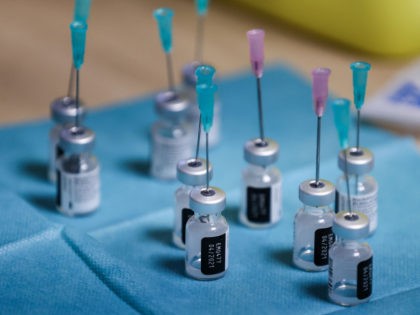
A new poll has revealed that two-in-three Britons think Brexit helped the UK’s vaccine rollout and that support for leaving the EU has risen in the wake of a row over vaccines.
A poll by JL Partners/Bloomberg today showed 67 per cent of Britons thought the EU had acted in a “hostile” way during the vaccines dispute, while only 13 per cent said the bloc acted like an “ally and a friend”.
Sixty-two per cent of respondents said Brexit had helped the UK’s vaccine rollout as it was not attached to the EU’s procurement process.
The poll also revealed that almost one-in-five people who voted remain in the 2016 referendum would now vote to leave due to the EU’s actions.
It comes after the EU has levelled a number of threats to block shipments of vaccines to the UK this year, with many pundits accusing the bloc’s leaders of vaccine nationalism.
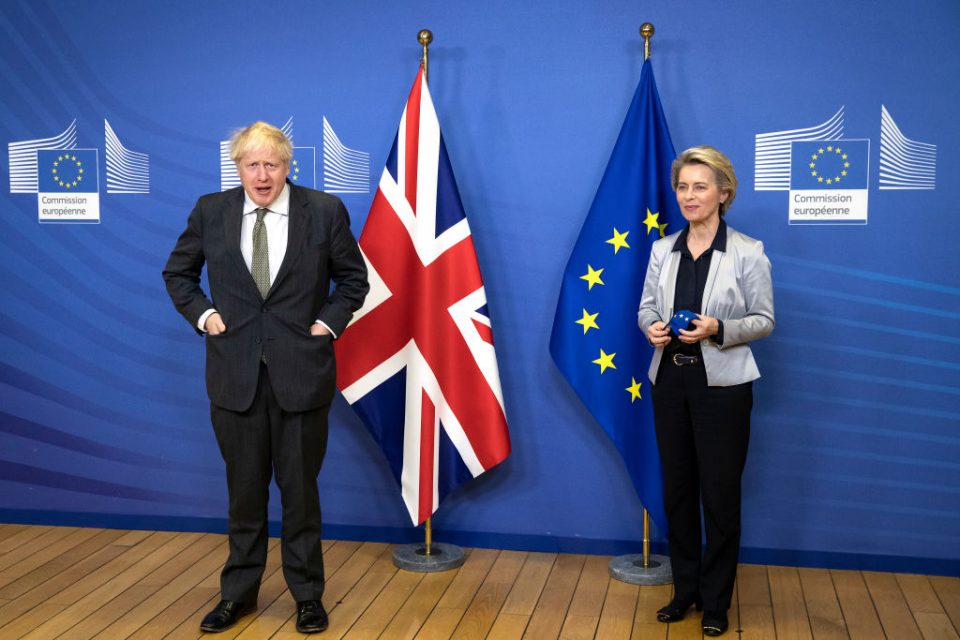
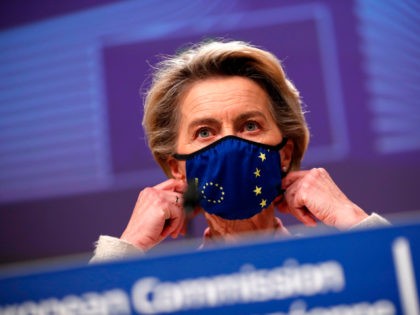
European Commission President Ursula von der Leyen first made the threat in January as the bloc’s vaccine rollout faced early supply problems.
It led to a quickly reversed decision by the EU to breach the Brexit Withdrawal Agreement, which was met by outrage across the globe.
Just last month, the EU once again threatened to block vaccines as it was angry that AstraZeneca/Oxford University jabs being produced in the Netherlands were due to be sent to the UK.
EU leaders also talked down the UK-founded AstraZeneca vaccine over the past few months, with French President Emmanuel Macron falsely saying it was “quasi-ineffective” in over 65s.
Vaccine rollouts have been slow across the continent, with countries like France, Germany and Spain only administering doses to around 20 per cent of their populations so far.
The UK, meanwhile, has given at least one jab to about 55 per cent of its population.
Commentary: How COVID-19 vaccines are being weaponised as countries jostle for influence
08 Apr 2021
A new hybrid Cold War is underway, with US, China and pivotal states engaging in a power play, says NUS Business School’s Alex Capri.
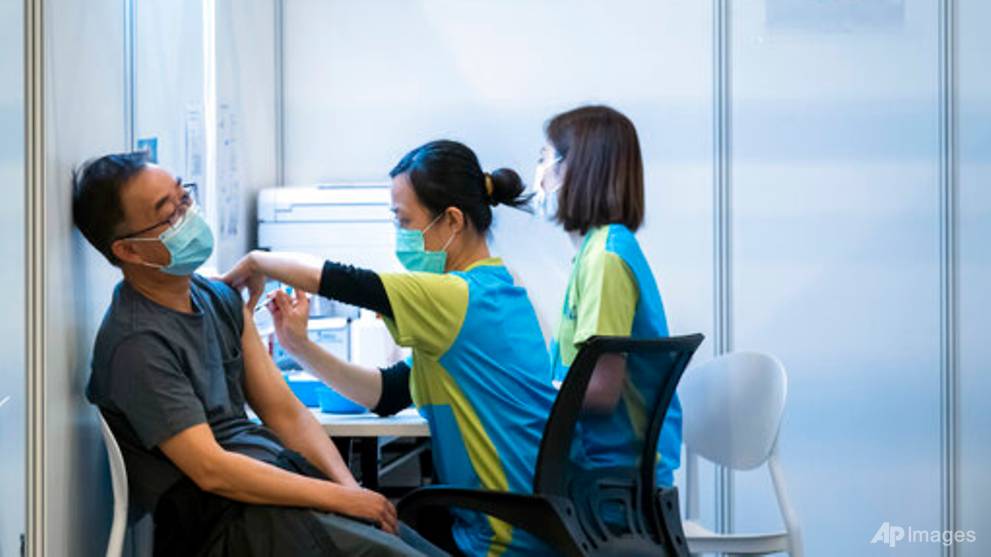
A man receives a dose of the Sinovac Biotech COVID-19 vaccine at a community vaccination centre in Hong Kong, Feb 23, 2021. (File photo: Paul Yeung/Pool via AP)
SINGAPORE: Mario Draghi, the Prime Minister of Italy, recently blocked the export of 250,000 AstraZeneca vaccine doses from his country to Australia.
To many in the international community, this was an act of “vaccine nationalism”. In fact, Mr Draghi’s decision reflected different variants of nationalistic behaviour, spurred on by geopolitical forces and compounded by COVID-19.
At the outbreak of the pandemic in early 2020, for example, China, the US, the EU, India and the UK all imposed export restrictions on personal protective equipment (PPE). Shipments of ventilators and antiseptic chemicals were also blocked as national health services competed for scarce supplies.
This behaviour contradicted the norms of international commerce, science and social exchange, which, for decades, have benefitted from a highly interconnected and interdependent global system.
Worse, vaccine nationalism may be the precursor to “vaccine diplomacy,” a form of realpolitik that compels nations to leverage their nation’s vaccine capabilities for geopolitical gain.
Boxes containing Sinovac's COVID-19 vaccines arrive at Phnom Penh International Airport, in Phnom Penh, Cambodia, Friday on Mar 26, 2021. (Photo: AP/Heng Sinith)
But vaccine diplomacy has shed light on an even more fundamental truth: A hybrid cold war is underway, involving the US, China and other pivotal states.
Its by-product is hybrid warfare, a mix of diplomatic, economic, cyber and information-related actions, all of which fall below the threshold of armed conflict but are, nonetheless, disruptive to the workings of the international system.
There will be no returning to the kind of globalisation the world experienced over the past four decades. Consequently, state and non-state actors must adapt.
VACCINE DIPLOMACY
Consider what has been playing out on the world stage.
Beijing recently eased restrictions on travel into China for international travellers, on the condition they show proof of vaccination with China-made brands such as Sinovac and Sinopharm - despite lack of complete final stage clinical trial data over the actual efficacy of Chinese vaccines.
When Russia became the first nation to authorize a vaccine (the Sputnik V, which now has a reported efficacy rate of 92 per cent) American, British and other Western diplomats stationed in Moscow rejected offers from the Putin government for free vaccinations, despite not having access to alternative vaccines at the time.
Although Phase 3 data wasn’t yet available at the time, the optics of British or American diplomats receiving a Russian vaccine would have been a propaganda coup for Moscow.diplomacy in a very tangible way.
In March, a surge in COVID-19 cases threatened to wreak havoc across the nation, which prompted the Rodrigo Duterte government to turn to China for more vaccines - even though both countries were locked in an escalating confrontation over disputed territory in the South China Sea.
More than two hundred ships were first spotted on Mar 7, 2021, at Whitsun Reef, about 320km west of Palawan Island in the South China Sea. (File photo: AFP/Handout)
As Beijing was supplying its vaccines to Manila, some 200 Chinese vessels were moving to occupy Whitsun reef, an atoll claimed by both China and the Philippines.
The timing of Beijing’s South China Sea gambit was no coincidence: Manila’s dependence on Chinese vaccines meant the Duterte regime had essentially agreed to forfeit its challenge to Beijing’s power play.
Beijing’s move in the Philippines sparked a reaction from the US and its allies. Even as Chinese vessels were dropping anchor at Whitsun reef, US Secretary of State Antony Blinken was conducting meetings with his counterparts from Japan, Australia and India - all members of the Indo-Pacific Quad security forum - to begin preparations for a multilateral vaccine diplomacy campaign.
One country with a lot to gain from vaccine diplomacy is India. The Serum Institute of India (SII) is the world’s largest manufacturer of vaccines, making approximately 1.5 billion doses per year under license from, among others, companies such as AstraZeneca.
In January, India launched the Vaccine Friendship initiative, which aims to supply made-in-India vaccines, gratis, to developing countries around the world - a direct challenge to China’s vaccine diplomacy. New Delhi has already reached out to Manila and will provide the Philippines with a steady supply.
India, which views China’s rise as a strategic threat, has been looking to capitalise on its growing importance to Washington in the broader context of a US-China hybrid cold war.
Its vaccine manufacturing capabilities are a major asset, particularly as New Delhi hopes to promote Make-in-India initiatives to attract strategic supply chains as they decouple from China. Having Washington’s endorsement provides New Delhi with a historic opportunity.
THE BATTLE IN CYBERSPACE
Vaccine nationalism has been linked to state-backed disinformation, propaganda and cyber intrusions - all key elements of hybrid warfare.
A man holds a laptop computer as cyber code is projected on him in this illustration picture taken on May 13, 2017. (Photo: REUTERS/Kacper Pempel/Illustration)
On the information front, for example, Russia, allegedly engaged in digital disinformation operations to undermine confidence in Pfizer’s and other vaccines produced in the US and Europe. This was done not only to promote its own vaccine, the Sputnik V, but to sow confusion and mistrust among citizenry of other countries.
In cyber-space, vaccine nationalism has been linked to a surge in cyber-intrusions and the theft of data at pharmaceutical companies, NGOs and government agencies.
In the early days of the pandemic, for example, in 2020, Pfizer, an American company, and its German partner, BioNTech, reported that sensitive documents had been hacked in a cyberattack on the European Medicine Agency (EMA). Like other regulatory agencies, the EMA regulates and approves medicines and has extensive information on trial drugs.
(Listen to the behind-the-scenes considerations and discussions going into what might be Singapore’s biggest vaccination programme ever on CNA's Heart of the Matter podcast:)
ECONOMIC AND TECH NATIONALISM
Early on, COVID-19 wreaked havoc with decentralised, pluralistic governments in the US and Europe, leaving them conspicuously absent from the world stage.
As Western governments turned inward to cope with COVID-19, China’s “wolf-warrior” diplomats used social media to paint American and European pharmaceutical companies as greedy opportunists peddling unsafe vaccines while depicting their governments as self-serving and callous. This narrative has resonated on both social media and traditional media in many of the world’s poorer countries.
China moved quickly to launch a global vaccine diplomacy campaign, promoting itself as the provider of a sorely needed public good.
Beijing has announced it will supply its Sinopharm and Sinovac vaccines in more than 60 nations, targeting its neighbours as well as strategically important states in Africa, Southeast Asia and the Middle East. It has made early inroads with its vaccine offers in Latin America and the Caribbean, as well as in Eastern and Central Europe.
China’s vaccines are to be distributed as limited “donations” or as “samples” for larger purchases in the future. In other instances, the vaccines will be offered with credit guarantees from Chinese State-owned banks, a familiar practice used to push Chinese telecommunications technology and other infrastructure into countries along its Belt and Road initiative (BRI).
Here, an economic-diplomatic-technology feedback loop becomes apparent as Beijing-administered vaccines are linked to other essential services and products provided by Chinese companies.
For example, as telemedicine and medical technologies become ubiquitous, an ocean of private data will become accessible through a worldwide vaccination campaign administered by state-backed entities.
Chinese state-funded company BGI, for example, which already provides COVID-19 testing and DNA sequencing services for 80 countries, offers a compelling example of the kind of scale, depth and power of vaccine diplomacy.
It obtains DNA samples from billions of people around the world, which has triggered fears of digital dystopia on a massive scale.
The US and its allies are mobilising. A report from the non-profit ONE Campaign found that five nations, along with the European Union, are on track to have over 1 billion surplus doses after vaccinating their populations. Many of these will be donated to countries around the world, under the banner of vaccine diplomacy.
A box with China's SINOVAC vaccines against COVID-19 is seen during the mass vaccination program for the elderly people at Movistar Arena in Bogota, Colombia on Mar 9, 2021. (Photo: REUTERS/Luisa Gonzalez)
CONTRADICTIONS: STATES, FIRMS AND MARKETS
While governments pursue self-serving realpolitik, the scientific, medical and corporate communities, to a large extent, remain country-agnostic.
This was on display during the initial race for a vaccine, as researchers, health professionals and other stakeholders shared data and collaborated using open-sourced genome sequencing software on the internet.
Scientific data was available throughout the digital global commons. Open-sourced artificial intelligence and powerful machine learning helped produce effective vaccines in less than a year - an absolute wonder of science and technology.
Hybrid cold war has produced contradictions between governments, markets and non-state actors, therefore, which will extend beyond vaccines. Affected parties must learn how to navigate through these contradictions.
Just weeks after the Draghi proclamation, police in Italy discovered another 29 million doses of AstraZeneca vaccines, stashed away in a warehouse in Anagni, Italy.
It was not surprising, then, that AstraZeneca’s official response was that the company was trying to keep out of the political fray while it awaited the outcome of highly charged negotiations between the UK and the EU, and which countries would win the right to receive its COVID-19 vaccines.
Alex Capri is Research Fellow, Hinrich Foundation and Visiting Senior Fellow, NUS Business School. His new book Techno-Nationalism: How its Reshaping Trade, Geopolitics and Society” (Wiley) is due in stores in September.
The UK will tell the EU next week that it must consider the millions of pounds British taxpayers spent on the creation of the Oxford University/AstraZeneca jab as the two sides look to resolve an ongoing row over vaccine exports.
The UK and EU are set to resume talks from tomorrow over Brussels' threats to block the export of AstraZeneca vaccines manufactured at a Halix plant in the Netherlands. (Getty Images)
The UK will tell the EU next week that it must consider the millions of pounds British taxpayers spent on the creation of the Oxford University/AstraZeneca jab as the two sides look to resolve an ongoing row over vaccine exports.
The UK and EU are set to resume talks from tomorrow over Brussels’ threats to block the export of AstraZeneca vaccines manufactured at a Halix plant in the Netherlands.
European Commission President Ursula von der Leyen has publicly threatened to block shipments of vaccines from the plant destined for the UK, unless the company gives more units of the jab to EU countries.
AstraZeneca has fallen behind on its scheduled delivery of vaccines to the EU, with the pharma giant blaming production and supply chain issues for the delays.
The UK government made orders of the vaccine, created in Britain, earlier and on a larger scale than the EU, meaning that units manufactured in the bloc are being sent to the UK.
Von der Leyen has called for “reciprocity”, after 21m vaccine units have been sent from EU plants to the UK with none coming the other way.
The Sunday Telegraph reports that British officials will tell the EU in negotiations that it was £84m of UK government funding that helped create the jab and that without this cash no vaccine would exist.
The UK will push for overall investment into vaccines to be counted into the EU’s calculations during negotiations next week, with Boris Johnson’s government spending more than £6bn to develop and procure vaccines.
Culture secretary Oliver Dowden told Sky News today: “Our position is very clear, that the EU should not be engaging in blocking exports and that they should honour the pledge that Ursula Von De Leyen gave to Prime Minister Boris Johnson a short while ago, whereby they agreed that any contracts should be honoured, so that is to say that if vaccines have been provided in honouring of the contracts, that should be honoured by the EU and we expect them to abide by that.”
The European Union, which exploited the border between British Northern Ireland and the EU’s Republic of Ireland as an all-important bargaining chip in the Brexit talks, ditched the deal it demanded for the province and announced a hard border in an attempt to remedy its vaccine failures, before backing off.
Northern Ireland, despite being an integral part of the United Kingdom of Great Britain and Northern Ireland, as the name would suggest, has been virtually economically annexed by the EU, with even the British military required to fill in forms and alert NATO before moving assets there from the British mainland, because Brussels insisted this was the only way to avoid a “hard border” with the Republic of Ireland.
Many Brexit supporters suggested that the EU, which claimed its demands that Northern Ireland obey EU rules and be subjected to an EU-monitored trade border with the rest of the United Kingdom were made in the interests of Irish peace, never really cared about the island, and merely found it convenient leverage against the British government.
For some, those accusations were proven true when Brussels announced that it would itself be introducing a hard border between the Republic of Ireland and Northern Ireland so it could keep hold of UK-bound vaccines, which it is trying to seize to make up for its own failure to secure an adequate number of jabs for EU citizens.
Reports indicate Brussels took this action, which the First Minister of Northern Ireland, Arlene Foster, described as an “incredible act of hostility”, without even bothering to consult EU Ireland, with Irish government ministers scrambling to assure people they were trying to address the situation on social media before the bloc ultimately abandoned its plans in the face of a growing public relations disaster.
“The European Union has once again shown it is prepared to use Northern Ireland when it suits their interests but in the most despicable manner — over the provision of a vaccine which is designed to save lives,” First Minister Foster, who supports Brexit and Northern Ireland’s place in the United Kingdom, but opposed the terms of Boris Johnson’s deal with the EU, had said.
“At the first opportunity the EU has placed a hard border between Northern Ireland and the Republic of Ireland over the supply chain of the coronavirus vaccine,” she added.
The Republic of Ireland’s political leaders, meanwhile, had expressed “shock” and “concern” at the EU’s announcement of a hard border to block vaccine movements, and relief when the Brussels backed down.
Britain’s decision not to join in with the EU on vaccine procurement early on in the pandemic was widely condemned by British anti-Brexiteers and supposed health experts, many of whom essentially accused the Boris Johnson administration of making a call which would kill people in the name of narrow nationalism.
It ultimately proved to be the correct call, however, with the United Kingdom managing to approve vaccines, place orders, and begin mass inoculation programmes long before the EU.
Brussels, meanwhile, finds itself in a growing spat with AstraZeneca over the jab it devised with Oxford University, as EU-based plants face issues with production at scale. The bloc has been demanding UK-made vaccines intended for UK citizens be diverted to make up the shortfall, and is looking to block the export of UK-purchased Pfizer/BioNTech vaccines made in the EU to the wider UK if it does not get its way, even if the Northern Ireland border remains open..
Many EU governments have begun ordering vaccines at the national level in response to the fiasco, including from Russia, as critics accuse Brussels of “acting like the drunk guy in McDonald’s at 2:30 a.m. getting angry because everyone who placed their order before him got served before him.”
The British military has to fill in forms and alert NATO when moving forces from one part of the United Kingdom to another under the Northern Ireland protocol of Boris Johnson’s deals with the European Union, it has been revealed.
Brussels has postponed the inaugural meeting between Britain’s mission to the bloc and European Union officials, in apparent retaliation for the UK refusing to give the EU’s envoys the diplomatic status afforded to those representing sovereign states.
The EU ordered a raid of a vaccine plant in Belgium because it did not believe AstraZeneca’s explanation for the delay in vaccine production, as the bloc continues to look for others to blame for its failures in rolling out a vaccination programme.
Major German newspaper Die Zeit has labelled the European Union’s failure to approve vaccines and secure their delivery as “the best advertisement for Brexit”.
Brexit leader Nigel Farage has criticised the “nasty, vindictive” EU for threatening to block the export of vaccines purchased by Britain because Brussels is falling behind in its own vaccine programme.
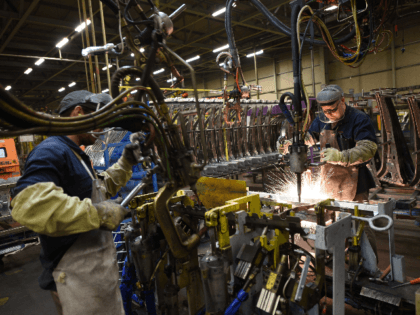
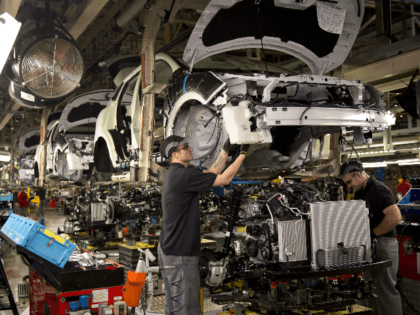
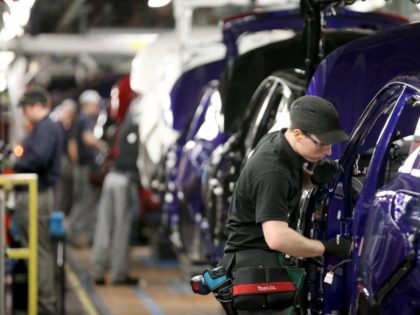
Brexit Britain has enjoyed a slew of good news stories in manufacturing, on top of Nissan’s high-profile commitment to expanding operations in the country.
Nissan’s chief operating officer has said that Brexit “is a positive” for the carmaker, and that it will be moving battery production from Japan to Britain.
Brexit Britain is reportedly refusing to grant the European Union the rank of a sovereign state, by denying its ambassador to the UK full diplomatic rights and privileges.
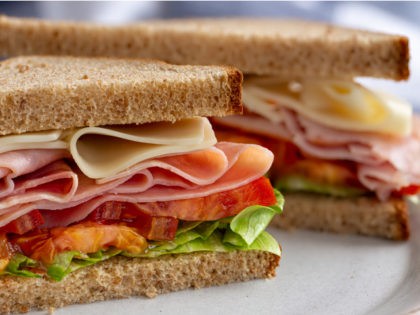
A Conservative MP has branded as “pathetic” a Dutch customs agent confiscating ham sandwiches from a lorry driver who had just arrived from the UK, with the officer telling the driver: “Welcome to Brexit.”
The UK’s managing director of Nissan, Andrew Humberstone, has said that he is “satisfied” with the UK-EU trade deal agreed last month, and doubled down on the Japanese company’s commitment to building cars in Britain, even despite the lockdown.
Leading European Union parliamentarian Guy Verhofstadt says Britons backed Brexit to demonstrate their right to be stupid, and that the country’s youth will take it back into the EU.
With no reliable majority for May’s administration in the House of Commons, and both the Commons and the Lords dominated by politicians who never wanted to leave the EU in the first place, the country was quite literally ungovernable…
Britain left the European Union in name in January 2020, but remained subject to the EU, its judges, and its migration regime through a so-called “transition” period. It left in a real sense on at 11 pm on December 31st — according to supporters of Prime Minister Boris Johnson’s exit deal, at least. But how did the country get here?