Showing posts with label Chancellor. Show all posts

Thursday, 13 February 2020

The Guardian view on the reshuffle: Johnson’s cabinet of courtiers

It was billed as a low-key and traditional ministerial shakeout. It has turned out to be a defining seizure of power by No 10


Britain’s Prime Minister Boris Johnson

 ‘Mr Johnson has strengthened his already strong grip on government.’ Photograph: Toby Melville/Reuters

When the Conservatives won the election in December, the spring reshuffle was soon touted as a strategic reshaping event for Whitehall. Around Christmas, the word on the street was that some departments would be closed and others forcibly merged, while new ministries that better reflected the government’s domestic priorities would be created. More recently, however, No 10 seemed to cool on such a grand governmental restructuring. On the eve of Thursday’s reshuffle, expectations of significant changes were low.
Little did we know what awaited. The reshuffle turned out to be a very major event, but not for the reasons that had once been trailed. Instead, No 10 went straight into battle with by far the most powerful department in Whitehall, the Treasury. Mr Johnson and his advisers clearly planned this confrontation. He told the chancellor, Sajid Javid, that he wanted much closer control of Treasury decisions, with a new set of Treasury ministerial advisers answerable to No 10, not the chancellor in No 11. Mr Javid put up a fight for his department’s autonomy – and lost. Just before midday he resigned, making him the shortest-serving chancellor in 50 years.
It is one of the axioms of British government that the relationship between the prime minister and the chancellor is the axis on which an administration is built. Think Thatcher-Howe and later Thatcher-Lawson. Think Blair-Brown or, more recently, Cameron-Osborne. For that axis to be smashed within two months of an election victory and less than a month before what is now being billed as the defining budget statement of the new parliament on 11 March is an act of either recklessness or desperation. Either way, it shows that something was badly rotten at the heart of the Conservative government.
The question left by the departure of Mr Javid is where the rot lay. One obvious reading is that No 10 under Mr Johnson and his chief adviser, Dominic Cummings, are demanding total control of the government, and that Mr Javid, who had rowed with No 10 over HS2 and other spending issues, was too independent. By forcing him out, and replacing him with Rishi Sunak, No 10 now has a less experienced chancellor under its thumb, rather than a rival departmental baron.
Another possibility, however, is that No 10 wants the spending taps turned on in the budget. It may be that Mr Javid, a protege of George Osborne, was too wedded to fiscal orthodoxy and austerity to permit it. The truth probably lies in a mix of the two readings – centralist control and a difference over spending. But it may be premature to see Thursday’s dramatic events as nothing more than a Johnson-Cummings power grab. If next month’s budget, to be delivered by Mr Sunak, a Cummings favourite, in fact marks a clear turn away from austerity, it would be significant. It might imply that this reshuffle was a power grab with an emblematic purpose for the new post-austerity Conservatism that Mr Johnson claims to embody.
Whatever his broader strategic purpose – if he actually has one – Mr Johnson has strengthened his already strong grip on the government. The sacking of Julian Smith, the first genuinely effective Northern Ireland secretary since the Labour years, was a particularly petty and destructive act, especially at such a delicate time in British-Irish relations. A clutch of relatively untested ministers have retained cabinet posts, while the new cabinet appointments mostly reward middle-ranking ministers who owe their advancement solely to Mr Johnson’s patronage. One potentially dire consequence is that a task as important as chairing the vital Cop26 UN climate change conference in Glasgow falls to the inexperienced new business secretary, Alok Sharma.
This is the sixth different Tory-led government since 2010. It marks a break with all the others. The days when David Cameron or Theresa May struggled to balance the factions of their party around the cabinet table are gone. This is a government beholden to one man, Mr Johnson, and to his grey eminence, Mr Cummings. There are no factions now. This prime minister is not the first among equals, as holders of his office were once said to be. He is the sole source of authority within a cabinet that is no longer made up of ministers and now consists of mere courtiers.
https://www.theguardian.com/commentisfree/2020/feb/13/the-guardian-view-on-the-reshuffle-johnsons-cabinet-of-courtiers
Rishi Sunak has won the Treasury, but its long-fabled power is now broken

With Sajid Javid out, the chancellor will be Dominic Cummings’ deputy – and economic strategy may take a radical turn

  Thu 13 Feb 2020 


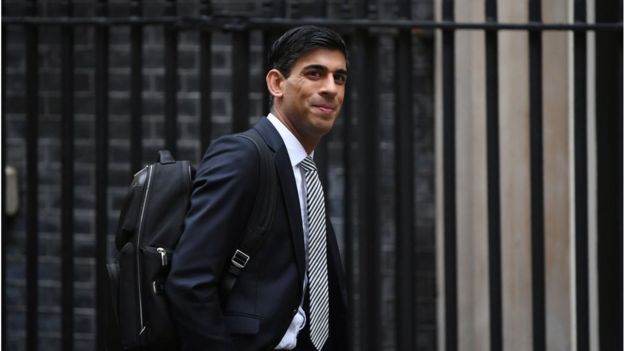
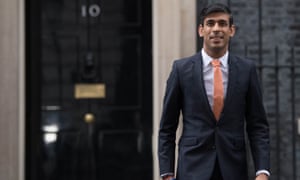
The new chancellor, Rishi Sunak, leaving 10 Downing Street, February 2020
‘The golden boy of the new government.’ The new chancellor, Rishi Sunak, leaving
10 Downing Street, February 2020. Photograph: Stefan Rousseau/PA


There’s a handy rule of thumb in British politics that applies to almost every premier: “Every prime minister is his own chancellor or foreign secretary.” The departure today of Sajid Javid confirms that No 10 is determined to be in control of economic policy.


Some have praised Javid’s resignation as honourable, but in truth, the former chancellor had no alternative. Had Javid stayed in office, he would have been diminished to chancellor-in-name-only. Boris Johnson’s demand that he replace his own advisers with those handpicked by Dominic Cummings was an offer that the former chancellor could only refuse. It is all the more extraordinary given the brevity of Javid’s tenure (just 204 days), and the timing: a budget is set to be delivered in just 27 days.
Many Westminster watchers will view this through the prism of personality politics; a typical tussle for power in which Cummings, the prime minister’s top adviser, has emerged victorious. But there is more to it than that. Javid was a weak chancellor who lacked either a sense of strategy or vision. He couldn’t decide whether he was continuing austerity or ending it; aligning with the EU or diverging from it; pursuing a more interventionist state or rolling back its frontiers. He deserved to be sacked.
The removal of Javid is the latest illustration of Johnson’s political primacy. As was evident at the time of the Tory leadership contest, nearly four years of Brexit-induced turmoil left him as the last Conservative standing. Those who had their reservations about his character threw their lot in with Johnson because they thought he could win. So it proved, and it leaves the prime minister virtually unassailable.
Javid’s replacement as chancellor, Rishi Sunak, was marked for promotion during the general election, standing in for the prime minister at debates that Johnson shied away from. Just like his predecessor, Sunak is a former City banker. Educated at Winchester and wedded to the daughter of an Indian billionaire, his backstory is far from the son of a bus driver and self-made millionaire Javid.
As the golden boy of the new government – and mindful of the fate of his immediate predecessor – Sunak is unlikely to cause Downing Street much trouble. He owes his ascent in a large part to his loyalty and obedience. But in some respects, Sunak may be in a stronger position than first appears. To lose one chancellor might be considered unfortunate; to lose two would be seen as reckless. But Johnson has repeatedly shown that the old political rules don’t seem to apply to him, so this notion shouldn’t be overstated. Sunak will know that.
Sunak’s main policy contribution has been “free ports”, an idea whose main merit appears to be its evocative name. It is the notion that Britain can establish special economic zones around its ports where taxes and tariffs are nonexistent and the government can merrily provide state aid. This ignores the reality of fixed-capital investments that already exist (manufacturing plants can’t simply be ripped up and relocated) and the requirements of an EU trade deal that won’t allow such a tilted playing field if Britain is to trade freely with its neighbours.
The reality, however, is that Sunak is now merely Cummings’ deputy. With the most powerful economic policymaker now an unelected adviser, this could be the turning point for both economic strategy and for the long-fabled power of the Treasury. Unlike many in the Tory party, Cummings has no fetish for eliminating the deficit. He is not bound by the ideological straitjacket of Treasury thinking. And he cannot be criticised for lacking vision.
The government now talks of nationalisation, significant increases in public investment in research and development and infrastructure, and the introduction of wealth taxes. Margaret Thatcher famously described Tony Blair as her greatest legacy. If this new “national conservative” agenda succeeds, perhaps in time John McDonnell will say the same of Cummings.
https://www.theguardian.com/commentisfree/2020/feb/13/rishi-sunak-treasury-sajid-javid-chancellor-dominic-cummings

Sajid Javid's exit leaves Boris Johnson in control of Treasury

Javid had shown willing over PM’s tax and spending plans, but perhaps not quite enough

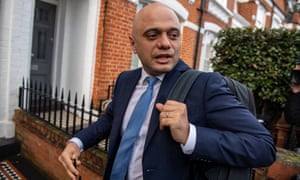
Sajid Javid arrives home after quitting as chancellor.
Sajid Javid arrives home after quitting as chancellor. Photograph: Chris J Ratcliffe/Getty Images
“The wiring of power in Downing Street is systemically dysfunctional,” Dominic Cummings wrote in a furious 2018 blogpost about the failure of Theresa May’s government to make Brexit happen.
Thursday’s ruthless reshuffle made clear that he and Boris Johnson are determined to subject the top of government to a radical rewiring, and never mind the risk of shocks.
Most visibly, with less than a month to go before the budget that is meant to draw a line under a decade of austerity and “unleash Britain’s potential”, Johnson has taken back control of the Treasury.
 Sajid Javid: 'Any self-respecting minister' would reject PM's demands – video
No 10 could not have been sure how Johnson’s former leadership rival, Sajid Javid, would have responded to the demand that he sack his key policy advisers and instead accept guidance from the prime minister’s team. But they knew there was a strong possibility he would choose to walk: and they had a ready-made, super-loyal successor on hand just in case, in the form of Rishi Sunak, already chief secretary to the Treasury.
Whatever the disruption involved, they appear to have been determined to enable Johnson and his key aides to exert much more direct control over economic and fiscal policy, which will have to be at the heart of the prime minister’s plan to “level up” the UK.
Cummings’ influence can of course be overstated - and other key advisers including Lee Cain and Munira Mirza, both central to Johnson’s project, will also celebrate the assertion of No 10’s authority.
But there is little doubt that Cummings places loyalty and the ruthless removal of any impediments to the prime minister’s authority at the centre of his approach.
Across departments, the changes smacked of a determination to reward loyalty and enforce unity.
The secretary for Northern Ireland, Julian Smith, who had been critical of some aspects of Brexit policy, was chucked out despite his success in resurrecting Stormont. By comparison, the Brexit true-believer Suella Braverman, who backed the prorogation of parliament which was found to be illegal by the supreme court, moves up to replace the sonorous Geoffrey Cox as attorney general. Amanda Milling, one of the four MPs who holed up with Johnson in his Oxfordshire home in 2016 as he plotted his first, short-lived tilt at the leadership, joins the cabinet.
At least in her early days, Theresa May treated reshuffles as a perilous political balancing act; making Johnson her foreign secretary, for example, despite being unconvinced by either his Brexit stance or his ability.
But her cabinet ended up being, as the then chief whip Smith put it, the “worst example of ill-discipline in cabinet in British political history”.
With an 80-seat majority, Johnson has no need of such niceties, and he and Cummings are impatient to get on with their “levelling up” plans.
Downing Street described the proposal that was put to Javid, of a joint No 10-No 11 team of advisers – from which almost all of his current team would be left out – as a way of ensuring chancellor and prime minister “rise and fall together”. But it would also have been read as a humiliation for a man who had already been described in hostile briefings as “chino”: chancellor in name only.
Clashes between Javid and Cummings – and between Javid’s advisers and No 10 officials - had been whispered about at Westminster for weeks.
Allies had insisted the two men themselves got on well “at a personal level”, and Javid also has close links to the prime minister’s influential partner, Carrie Symonds, who once worked for him.
But Johnson and his team were irked at a series of briefings about Javid’s role in big decisions – including pre-empting the announcement on HS2 by revealing the Treasury would back it. And there have been some policy differences, too, though No 10 insist these formed no part of the conversation on Thursday morning.
Johnson wants to take advantage of his chunky majority and a full parliamentary term to make some potentially controversial decisions, including on tax and spending, and Javid’s instincts, insiders say, were more “small-c” conservative.
The chancellor had made clear his willingness to be considerably more flexible in sanctioning big-ticket spending than his predecessor, “Spreadsheet Phil” Hammond.
In his one set-piece speech during the election campaign, he set out something similar to Gordon Brown’s “golden rule”, allowing long-term investment spending – including the prime minister’s beloved infrastructure projects – to be funded by borrowing. That in itself is a revolution in Conservative thinking.
But Javid also stressed that he was determined to balance the current budget, as it is known – funding day-to-day spending through tax receipts. And that would constrain how much Johnson has available for upfront spending pledges, unless the government is willing to raise more tax.
Radical plans have been floated in recent weeks, including a “mansion tax” on the most expensive homes, and, possibly more likely, a review of council tax bands to ensure the wealthier pay a higher rate.
But perhaps remembering George Osborne’s pasty tax “omnishambles” budget – and more recently, Hammond being forced to ditch a modest increase in national insurance after a backbench backlash – Javid, close sources say, was more cautious.
Sunak is likely to have no such scruples – nor the independent power-base to act as a counterweight to No 10. Which, of course, is the point. Cummings watched the months-long tussle between May and Hammond with scorn.
Next month’s budget is likely to mark a dramatic break with the past 10 years. And judging by Thursday’s events, sceptics – inside and outside government – face being swatted aside, even if they happen to be the chancellor of the exchequer.
That 2018 Cummings piece, which mused on the threat posed by Jeremy Corbyn’s Labour party if the Tories did not get their act together, concluded: “If revolution there is to be, better to undertake it than undergo it”.
https://www.theguardian.com/politics/2020/feb/13/sajid-javids-exit-leaves-boris-johnson-in-control-of-treasury

Who is the new chancellor Rishi Sunak?

Following the shock resignation of Chancellor Sajid Javid, a new chancellor has been appointed.
  • 13 February 2020
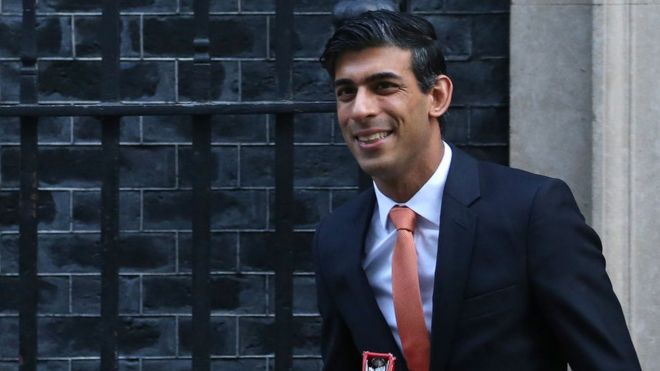
Rishi Sunak
With just four weeks to go until the Budget, one of the main events in the calendar for the UK Treasury, Mr Javid has been replaced by 39-year-old Chancellor Rishi Sunak.
So who is Mr Sunak, and what is his background?
Mr Sunak has been the Conservative MP for Richmond in Yorkshire since 2015. He lives in Kirby Sigston, just outside the town of Northallerton.
His father was a GP, and his mother was a pharmacist. His parents - who are of Indian origin - came to the UK from east Africa.
He was born in 1980 in Southampton in Hampshire, and studied at the exclusive private school Winchester College.
Mr Sunak then went on to Oxford University to read Philosophy, Politics and Economics, a tried and trusted route for aspiring Westminster politicians. He also studied for an MBA at Stanford University.
Before entering politics he worked for investment bank Goldman Sachs and a hedge fund, then co-founded an investment firm.
His wife - Akshata Murthy - is the daughter of Indian billionaire and co-founder of IT services giant Infosys Narayana Murthy.
The couple have two daughters.

'The force is strong'

Mr Sunak campaigned for Leave in the EU referendum, and his constituency voted 55% Leave.
He voted for Theresa May's Brexit deal on all three occasions, and was an early supporter of Boris Johnson, making a number of media appearances in his support.
In July 2019 Mr Sunak was picked by Mr Johnson to be chief secretary to the Treasury, after being parliamentary under-secretary in the Ministry of Housing, Communities and Local Government from January 2018 to July 2019.
Sajid JavidImage copyrightSAJD JAVID
Mr Sunak is seen as a rising star in the Conservatives, with endorsements from people including former Conservative Party leader Lord Hague of Richmond, who has described Mr Sunak as an "exceptional individual".
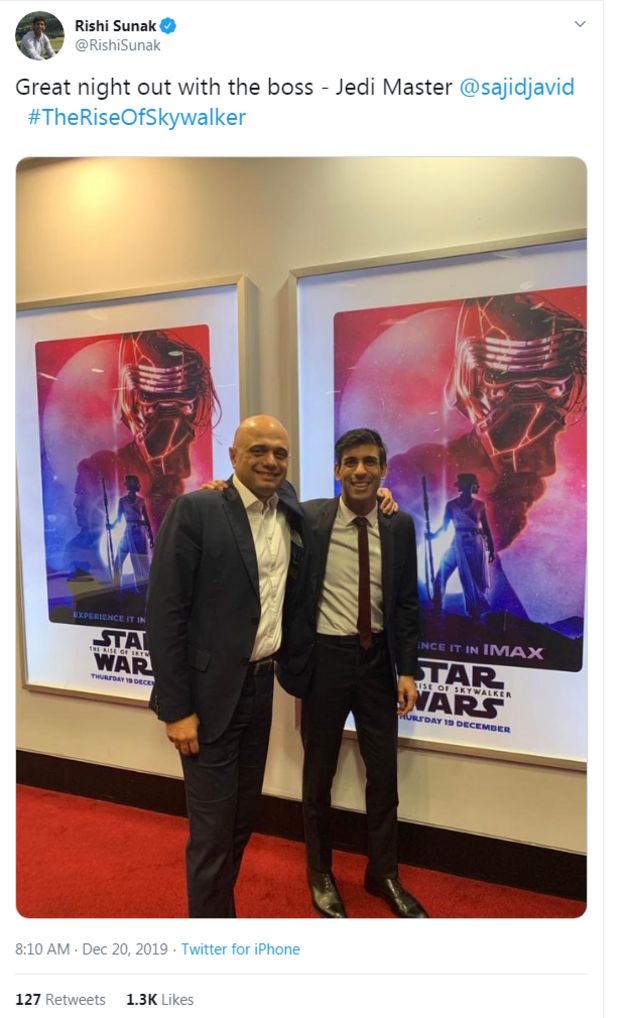
He was also endorsed by Mr Javid, who in a recent tweet said "The force is strong with young Sunak" in reference to a phrase from Disney's Star Wars franchise.
His hobbies include keeping fit, cricket, football and watching films, according to his website.
One of his childhood heroes was Southampton football player Matt Le Tissier.
"One of my prized possessions is an 18th birthday card signed by the entire Saints team, but Matt in the middle there, which I've still got," Mr Sunak told the BBC in an October 2019 interview.

'First generation immigrant'

Mr Sunak has said his Asian identity matters to him.
"I'm a first generation immigrant. My parents emigrated here, so you've got this generation of people who are born here, their parents were not born here, and they've come to this country to make a life," he said.
"In terms of cultural upbringing, I'd be at the temple at the weekend - I'm a Hindu - but I'd also be at the Saints game as well on a Saturday - you do everything, you do both."
Rishi SunakImage copyrightGETTY IMAGES
In the interview he said he had been "fortunate" not to have to endure much racism growing up, but he said there was "one incident that sticks in my head".
"I was just out with my younger brother and younger sister, and I think, probably pretty young, I was probably a mid-teenager, and we were out at a fast food restaurant and I was just looking after them. There were people sitting nearby, it was the first time I'd experienced it, just saying some very unpleasant things. The 'P' word."
"And it stung. I still remember it. It seared in my memory. You can be insulted in many different ways, certainly in this job, but that stings in a way that is hard to explain."
However, he said he "can't conceive of that happening today" in the UK.

Wednesday, 24 July 2019

Delingpole: Boris’s Brexit Cabinet Is the Soundest Since Margaret Thatcher

Boris Johnson has passed his first test as prime minister with flying colours. He has appointed the most robustly conservative (and pro-Brexit) cabinet since the Thatcher era.


JAMES DELINGPOLE
25 Jul 2019
Boris Johnson Close
Like his joyously uplifting speech on the steps of 10 Downing Street yesterday, Boris’s appointments augur extremely well not just for the delivery of Brexit by October 31 but also for Britain’s future as a thriving economy and beacon of freedom and prosperity in the years beyond.
At a stroke, the chances of Britain now falling for the alternative of an anti-Semitic, pro-terrorist, Marxist regime led by Jeremy Corbyn have been reduced to almost zero.
In financier-speak Britain has been oversold for too long. Now it is most definitely a BUY.
My favourite appointment is that of Priti Patel to Home Secretary. Patel is probably the closest thing we’ve got to being the heir to Margaret Thatcher: feisty, sparky, incredibly sound and, let’s be honest, not a little sexy.
It’s being spun as a victory for “diversity” and ethnic minorities. Yeah, right. Patel – who loathes tokenism and PC in all its manifestations – got the job because not because she’s Ugandan Asian or female but because she’s easily the best white man available. One of this government’s most pressing tasks is to reform and bolster the police and to reduce the knife crime which has grown rife, especially in Sadiq Khan’s failing London. Patel won’t take prisoners. I don’t much fancy Khan’s chances.
Dominic Raab is a great pick as Foreign Secretary. For those of us on the Brexit right, he was leadership candidate we would have most preferred to win if Boris hadn’t made the final cut. Apart from being sound — obvs — he’s famously brusque and intolerant. Well, good: having read some of those leaked memos from our ex-Washington ambassador Sir Kim Darroch, it sounds like our Foreign Office could do with a bit of a kick up the arse from Dom.
Of the big three appointments, the one that most concerns me is Sajid Javid as Chancellor of the Exchequer. OK he has a City background but that proves little: how do we know he wasn’t promoted because he was just a safe pair of hands or because he pushed the right diversity button? Sure, I see that it’s good optics to have Britain’s first Muslim Chancellor (not that he’s exactly a devout Muslim) but what’s far more important – imperative, indeed – is that Britain’s economy is run by a ruthlessly pro-markets, supply-side, Laffer-curve-worshipping, cost-slashing Austrian school zealot. Is “The Saj” one of those? We’ll have to wait and see…
Almost more important than any of the above, though, is the man I mentioned yesterday: Dominic Cummings.
As a master strategist and tactician, Cummings prefers to fly below the radar, but you’ll know how he operates if you saw last years’ Channel 4 drama Brexit: The Uncivil War where he was played by Benedict Cumberbatch. He doesn’t suffer fools and he makes things happen. Without him – and this is certainly not to downplay the fine work done by everyone from Nigel Farage and Dan Hannan to Kate Hoey and Gisela Stuart – the Brexiteers would probably have lost the Referendum.
This cabinet is being described in some quarters as ‘Dominic Cummings’s cabinet.’ It wouldn’t at all surprise me if he were indeed the Machiavellian genius behind it all.
There’s a big clue in what is, superficially, Boris’s most surprising appointment: that of Michael Gove to Chancellor of the Duchy of Lancaster (a Cabinet-ranking, minister without portfolio role roughly equivalent to Deputy Prime Minister).
Gove, of course, was the traitor who infamously knifed Boris the last time he tried to become prime minister – in the immediate aftermath of their EU Referendum victory leading the Vote Leave campaign.
This led to the disastrous Theresa May premiership – and three painful years of Brexit not being delivered – so, in theory, Boris ought not to be a Gove fan.
But Boris is no fool. He sees that Gove – as probably the most effective minister of the last decade, especially during his stint at Education – is far too talented to be left out of any worthwhile cabinet. Also, clearly, he is capable of great magnanimity.
There’s more to it than that though. It wouldn’t remotely surprise me if Cummings had stipulated that, as part of his new job as Boris’s senior advisor, he would have to work with Michael Gove in a senior role.
This was always the plan in the aftermath of the referendum: Gove and Cummings were going to get on with the vital business of dismantling or at least defanging the Deep State which had done so much to thwart Brexit and Conservative policy generally. Boris was going to get on with the business of being Boris.
What has happened here, in other words, is that the band has reformed – and its comeback tour is going to be better ever before.
There are one or two other Easter eggs buried in this particular Cabinet which I’ll talk about later.
My immediate take though is that this Cabinet is everything any red-meat conservative and Brexiteers could possibly have hoped for.
And if you’re still in any doubt of how good it is, just sit back and enjoy the delicious taste of these salty Remainer tears…
https://www.breitbart.com/europe/2019/07/25/boriss-brexit-cabinet-is-achingly-sound/