Showing posts with label Singapore. Show all posts

Sunday, 21 June 2020

The problem with toppling statues

Instead of pushing historical figures off their pedestals, consider what Singapore did during its bicentennial year to deal with Stamford Raffles’ place in its history.

  • 21 Jun 2020
  • The Star Malaysia
  • By JONATHAN EYAL

THEY were once feted as pioneers, leaders who created empires and powerful nations, worthy characters of worship by their successors. Some of their statues stood on their pedestals for centuries in city squares and other central locations, seen by millions of passers-by and pointed to reverentially by parents and teachers of successive generations of schoolchildren.
a worker painting over graffiti on the base of a statue of James Cook in a Sydney suburb that had been vandalised by australians objecting to problematic historical figures. — Reuters/aaP
Now, however, the statues are being toppled.
And this is not just the fate of a relatively unknown individual such as Edward Colston, a wealthy 17th-century trader whose statue stood for 125 years in the heart of the English city of Bristol, only to be ripped out now by demonstrators objecting to his role in the slave trade.
And it is not just a single episode in a corner of England. Neither Italian explorer Christopher Columbus in the United States nor his British counterpart James Cook in Australia is spared as demonstrators and activists around the world agitate for statues to be removed.
Even Winston Churchill, Britain’s venerated wartime leader, rated in every national poll as the greatest Briton to have ever lived, is now endangered – his statue opposite Big Ben in the heart of London was defaced with obscenities.
According to promoters of this wave of destruction, the age of colonialism, racial oppression and war which many of these people – invariably men, of course – stood for should not be merely condemned, but erased; their statues must not be allowed to stand, for merely having them upright is an insult to the memory of their victims. Most of the activists promoting this destruction are not hooligans; they genuinely find the statues offensive.
But sincerely held opinions can still be dead wrong. For the reality remains that the mass destruction of statues and images – whether because they represented gods no longer acceptable or were deemed pagan or religious – is a recurring theme in history on every continent. And such destructive movements never produce any good.
Besides, there are better ways of dealing with such emotions. Singapore handles thorny historic questions without violence while not compromising on moral principles.
There is no doubt that if you are a black person in the United States walking down famed Monument Avenue in Richmond, Virginia, lined with statues of Confederate leaders who started a civil war to defend their “right” to own slaves, you would not only be deeply hurt but you’d also be wondering why such people are still standing on plinths in the 21st century.
The same applies to British black people going past statues of those who created the empire, monuments still adorned with praising captions such as a “The Conqueror of Natal” or the “Victor of Magdala”.
And what is one to say to Belgian citizens of African origins passing daily by the statue of King Leopold II who not merely colonised the Congo but also used the colony as his private property, sanctioning the murder and mutilation of millions? Why is he still standing astride his huge horse, still supposedly revered as “King of the Belgians”?

Symbol of change
Undoubtedly, the act of toppling statues has a huge symbolic effect – it is a visible sign of radical change, of not only the collapse of a slab of marble or bronze but also of a political system.
The first thing revolutionaries in France did after toppling King Louis XVI in 1792 was to topple or melt down statues of his ancestors. American revolutionaries did the same with statues of the British king. So did the people of Eastern Europe, after they shook off communism in the late 1980s; the first to go were the statues of communist dictators. And the most iconic image of the US-led invasion of Iraq in 2003 remains, of course, the sight of Saddam Hussein’s statue collapsing.
On every occasion, the message was unmistakable: a decisive, sudden and irrevocable break with the past.
Still, those currently pushing for the destruction of monuments are operating in a very different political environment, one in which the decision to remove a statue can be made through the normal political process rather than through violence. And although the current demonstrators claim to represent a new and refreshing mood of change, the truth is that controversial monuments have already been subjected to political debates for a long period of time.
Take Colston, the English slave owner whose statue was first toppled in this current wave of violence. Over the past two years, Bristol’s local authorities have been discussing the possibility of adding to Colston’s statue an explanation about his involvement in slavery, one which would present Colston in a different light and would have replaced the existing plaque which praises him as “virtuous and wise”.

Toppling the Colston statue saved the council a hefty removal fee ...
Toppling the Colston statue

However, the local authorities could not agree on what the plaque should say, and Mayor Marvin Rees decided he had more important matters to deal with.
“I could have expended a lot of political capital on a statue, entering into a symbolic act. But that would not have actually fed, clothed, or paid any bills for people in Bristol,” said Rees.
Perhaps his decision was wrong. But that does not give a few hundred demonstrators the right to impose their own decision by force, especially since nobody could accuse Bristol’s local leader of being unaware of race sensitivities. For Rees is Britain’s first directly elected black mayor. In effect, therefore, those who toppled the statue in Bristol decided their views mattered more and should be imposed on others.

Complex figures
The movement to destroy monuments also tends to promote a single view of past personalities, a – no pun intended – black-and-white perspective in which people are either wholly good or entirely bad, and therefore should be remembered or expunged from history.
And that’s simply nonsense, for most historic figures have their achievements and warts, and the question is one of balance.
It is a fact, for instance, that Churchill had a dim view of some “natives” in the colonies; he referred to Mahatma Gandhi, for instance, as a “half-naked fakir”.
Churchill was also behind the carpet bombing of rebellious Iraqi tribes in the 1920s and German cities in the 1940s and, of course, a horrible famine in India.
Incidentally, the British leader is not much loved in Eastern Europe either, for his part in consigning the eastern part of the continent to Soviet domination.
Yet none of this should obscure the fact that Churchill’s leadership defeated a much bigger evil, a Nazi monster for whom the extermination of people as a race was an article of faith. It is interesting to note that neither Indians nor Germans nor East Europeans are among those seeking to deface Churchill’s statue in London, and some of those who did engage in vandalism had little idea of who Churchill really was: “I have not met Churchill personally,” explained a young demonstrator at the site, seemingly oblivious to the fact that Churchill died in 1965.
The same applies to the campaigns against Cook in Australia or Columbus in the United States. Undoubtedly, their so-called “discovery” of Australia and the Americas heralded the start of horrible colonial episodes. But it also transformed the world, expanding knowledge and economic progress.
Furthermore, their failings – and the crimes committed by the colonialists who came after them – are now widely acknowledged and documented. The celebration of Columbus Day in the United States is now increasingly challenged, while the Latin Americans have long marked Oct 12, the day of Columbus’ landing in the Americas, as the “Day of the Race”, the seminal event where different races were forced to mingle. So what purpose is achieved by pulling their statues down, when their significance and their historic context are already being reinterpreted?
Besides, where does one stop in the quest to settle scores? Those who consider Churchill a monster because of the way he treated India may be interested to know that a petition is now making the rounds in Britain to remove a statue of Gandhi from the English city of Leicester. More than 5,000 have signed the petition accusing one of the world’s greatest humanitarians of “well-documented anti-black racism” – a reference to his comments about Africans during his early years in South Africa.
Is there a way of satisfying the real sense of historic injustice which some people feel about past historic figures without descending into wanton vandalism? There certainly is, as Singapore has shown.

Recasting history
Sir Stamford Raffles was neither a democrat nor a believer in a multiracial society. So upon Singapore’s independence, the easiest thing would have been to have him removed; that is what many former British colonies did to statues of their old founders or rulers.
But instead, he was set into a new context, recast for a new Singapore and, last year, as part of the Singapore Bicentennial, Raffles’ statue was joined by those of four other historic leaders of local communities: Sang Nila Utama, Tan Tock Seng, Munshi Abdullah and Naraina Pillai.
A similar approach was taken to the Victoria Theatre and Concert Hall, which had its British coat of arms removed from the facade to be replaced by Singapore’s, but recently had the old British crown restored to its roof.
None of these suggest for one moment either a nostalgia for empire or an inability to deal with past historic wrongs. Indeed, it is precisely the opposite: They suggest a confidence in a nation’s ability to take a critical look at its history and recast it for today’s generations.
And the same should be done in the United States and Europe: reinterpreting the significance of old monuments or augmenting them with new ones, rather than simply trying to destroy them in an effort to erase the past.
Barack Obama, the former US president and the first AfricanAmerican to break through what was considered an insurmountable barrier, recently warned those who sought to make change by being “as judgmental as possible about other people” and by assuming that that’s enough. “If all you’re doing is casting stones,” said Obama, “you’re probably not going to get that far”. – The Straits Times/Asia News Network

Toppling the Colston statue saved the council a hefty removal fee ...
Toppling the Colston statue saved the ...
independent.co.uk

https://www.thestar.com.my/opinion/columnists/asian-editors-circle/2020/06/21/the-problem-with-toppling-statues


Wednesday, 11 September 2019

GUARDIAN: Merkel warns of danger to EU of Singapore-style UK on its border

UK poses threat if it fails to match regulation standards of bloc, says German chancellor


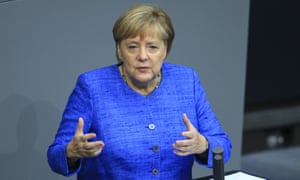
Angela Merkel
Angela Merkel said an orderly Brexit was still possible but the German government is prepared for a disorderly withdrawal. Photograph: Anadolu Agency/Getty Images

Angela Merkel has highlighted the economic danger posed by Britain if it is allowed to become a Singapore-on-Thames as Boris Johnson’s Brexit envoy outlined a plan to ditch the UK’s commitments to stay aligned to the EU’s social and environmental standards.
In talks with European commission officials, the prime minister’s negotiator, David Frost, insisted that the UK is seeking a “clean break” from an array of the bloc’s regulations, a policy choice from the new British government that has caused alarm in other EU capitals.
As the UK’s new vision was laid out in Brussels, the German chancellor, speaking in the Bundestag, said she was determined to strike a deal with Johnson but that a no-deal Brexit could not be ruled out.
Merkel also warned of the economic threat that the UK could pose. Johnson had privately told EU diplomats during his time as foreign secretary of his desire to build a “buccaneering” Britain, which has been seen as an indication of his plan to recast the UK as a low-tax and low-regulation state.

Merkel’s comments indicate the difficulty that the British government will face in striking what it has described as a “best in class” free trade deal if it fails to match EU standards on goods, workers’ rights, tax and the environment, among others.
EU sources have said that the UK will need to sign up to more onerous, level playing-field obligations than Canada due to the UK’s proximity and the size of its economy.
Diplomats in Brussels said that the British government would be presented with a “Canada minus minus”, potentially including tariffs on some goods, if it seeks to strike a free trade deal without the full array of commitments currently contained in the political declaration on the future relationship agreed with Theresa May.
Merkel told German parliamentarians: “We still have every chance of getting an orderly [Brexit] and the German government will do everything it can to make that possible – right up to the last day. But I also say we are prepared for a disorderly Brexit.
“But the fact remains that after the withdrawal of Britain, we have an economic competitor at our door, even if we want to keep close economic, foreign and security cooperation and friendly relations.
“On the one hand, as Europeans we are weaker with Britain’s exit – that has to be said – but on the other hand, this is the moment to develop new strengths.”
She added: “No country in the world can solve its problems alone and if we all work against each other we will not win. I believe in win-win situations, if we work together.”
A UK government spokesman said: “The UK is seeking to agree a free trade agreement. The EU have always said this is available. Any level playing-field provisions will need to reflect this end state.”
The intervention from Berlin came as France’s minister for Europe, Amélie de Montchalin, accused the UK of breaking “the spirit” of the negotiations by trying to strike “mini-deals” with individual EU member states.
“We see that in the bilateral meetings the British try to get with their opposite numbers that they are trying to organise a managed no deal,” she told a news conference after meeting the 26 ambassadors to France of the EU’s members. The British ambassador was excluded. “And what the British want is to ensure that the different relationships that they have with each EU member state are recreated before the moment of separation, thanks to these mini deals. It is completely contrary to the spirit in which we’ve been negotiating. When [Stephen] Barclay [the UK Brexit secretary] or others try this in France, we say: ‘We hear you. Go and talk to Michel Barnier to see what can be done at the European level.’”
De Montchalin said a no deal was now “highly possible”. She added that a Brexit extension request by the UK would not be accepted under the “current conditions” and the the EU27 would deal with the UK prime minister and not parliament.
She said: “We first have to receive a formal ask. Governments talk to the commission, that’s the way it works. There is no such thing, for example, as parliament asking for an extension. Those who have the legitimacy to represent a country are those who sit at the table of the European council.

“If – and that’s a big if, it seems … we try to follow what’s happening in the UK – but if there is such an ask, we have always said that ‘time for time’ is not an option. So if there is a change in the political scene – a new government, the announcement of elections, something that makes us think the landscape of the discussions is changing – then we will consider an extension.

“I cannot tell you now what might be decided now in such a situation on a night in Brussels in October,” the French minister added. “As we have said, under current circumstances, the answer is no: if nothing changes, we have always said time alone is not a sufficient reason [for another extension]. We cannot commit today, because we have no concrete scenarios yet.”


https://www.theguardian.com/world/2019/sep/11/angela-merkel-stresses-danger-of-britain-becoming-singapore-on-thames-no-deal

Monday, 9 September 2019

Could We Unleash the UK Economy’s Potential With a Singapore Brexit?

A a so-called ‘Singapore-Style Brexit’ will turn the UK into a ‘bargain bucket economy of low taxes ...

By 


In recent times, we are told by many throughout British politics, Westminster and media columnists aplenty, that a so-called ‘Singapore-Style Brexit’ will turn the UK into a ‘bargain bucket economy of low taxes and a race to the bottom.’ However, the constant slating of Singapore’s successful and vibrant economy by those same politicians and commentators, tends to come not from a desire for the UK economy to succeed, but from a hatred of all things Capitalistic and Free Market.
With regards to Brexit and the European Union (EU), the UK is, in many regards shackled, with the economy’s huge potential and dynamic nature held back. For example, the increase in VAT in the UK, as required by the EU in 2011 has meant that goods and in particular services in the UK, which comprise the vast majority of our economic growth, success and future potential are more expensive. From the EU’s point of view, the playing field is levelled out.
It is also no secret amongst EU leaders and bureaucrats that if the true potential of the UK economy is unleashed post Brexit it is the EU, not the UK who will need to up their game, with the UK economy able to thrive and drive itself forward like no other.
eu-brexit-flag
Brexit offers many economic opportunities, not just challenges

The Singaporean Economic Powerhouse

In 1965 Singapore broke away from Malaysia, or the Malaysian Federation as it was then known. Singapore was predicted to fail and it was said by many economists and commentators that the Singaporean economy simply would not be able to make a success of this break away. However, the reality couldn’t be further apart from these naysayer’s predictions.
As things stand, Singapore has all but everything we could want in a successful economy; no foreign debt, it is very stable, the government has huge spending power for projects and public services and they have a positive budget surplus on a consistent basis. Simply put, the Singaporean economy is an example of what a dynamic, free-market, lower tax economy and society can do, and it is nothing short of fabulous.
Currently in the UK, we have an outdated tax system, an overtaxed population, a productivity problem and there is an emerging culture that profit and success are not good things. Rather, they are the basis for greed rather than ambition and wastefulness rather than innovation and productivity at every level.

Singapore’s GDP per Capita growth (source: tradingeconomics.com)

How Do the UK’s Current Tax Laws Hold the Economy Back?

At present, tax laws and regulations in the UK are fundamentally based on changes made way back in the 1970s and 1980s and during the Thatcher era. However, since then, very little in practice has actually changed. The main taxes in the UK (Income Tax, National Insurance, Corporate Taxes and Capital Gains) all need reforming and overwhelmingly, reducing.

Income Taxes in the UK Vs Singapore

The UK’s Income Tax works in a progressive manner, with tax bands, meaning that as workers and earners move from one band to the next, they progressively pay more tax on earnings above the bracket threshold amount. The Income Tax bands are currently set as:
  • 0% on income up to £12,500 (this is known as the ‘Personal Allowance’)
  • 20% on all income up to £50,000 (Basic Rate Band)
  • 40% on all income over £50,000 (Higher Rate Band)
  • 45% on all income over £150,000 (Additional Rate)
Hence, if someone in the UK earns £150,000 per annum (roughly what the Prime Minister gets paid), taking Income Tax and National Insurance into account, they will pay a total of £59,464 in income-related taxes, leaving take home pay of £90,536, or a mere 60% of true earnings.
In Singapore, for someone earning the same £150,000, their total tax obligations amount to £14,748, or 9.8% of total earnings. Although Singapore also have a progressive taxation system with tax bands, the Singaporean top tax band is just 22%, which in practice means that Singaporean employees and workers can expect to be much better rewarded for the work they perform, with reward and recognition, proven to increase productivity and happiness at work.
uk-income-tax-bands
The tax bands for UK taxpayers can become very expensive (source: The Express)

Corporate Taxes in the UK Vs Singapore

We have all heard numerous stories of business people and companies moving to Singapore, including James Dyson in recent times. The question must be asked, why do they choose Singapore? IS it because of Brexit, or is it more likely due to the much more favourable and success encouraging Corporate Tax laws of this South East Asian economic powerhouse?
Messiers Corbyn and McDonnell would have you believe that their proposed rises in Corporation Tax will only affect Amazon and Starbucks. However, the reality is that every single limited company will be affected by their ‘small’ rise in Corporation Tax to more than 25%. Businesses from your local corner shop to small online retailers will see their profits eroded by this punitive tax measure proposed by the currently Marx and Mao-inspired Labour Party.
In the UK, Corporation Tax is currently set at 18%, which must be paid on all business profits earned by UK companies. Singapore’s Corporate Tax rate is a flat rate of 17%. However, where the UK falls behind in a big way is when you take a look at company dividends, or the rewards paid to shareholders upon a business’ success. For those running limited companies in the UK of all sizes, this is very pertinent.

Punishing Success with Taxes

For example, for a UK company that makes £250,000 in profit with a director drawing out £150,000 in dividends, a total of £123,450 will need to be paid in Corporation and Dividend taxes (£39,225 in dividend taxes and £84,225 in Corporation Tax.) Dividend tax bands in the UK work in a progressive manner and according to the same income amounts as income tax.
  • 5% Basic Rate
  • 5% Higher Rate
  • 1% Additional Rate
Coupling these dividend taxes with Corporation Tax, it can mean that a business owner will pay up to 55.1% tax on business and personal profits, something that is expected to rise quite starkly with any Corbyn-McDonnell led government.
Singaporean tax laws on the other hand are very clear that tax needs only be paid once on corporate income and profits. This translates into 0% tax on all dividend payments, allowing companies and shareholders to flourish and enjoy their hard-earned success. In the case of the same business making £250,000, with the director drawing out £150,000 of his or her company’s profits in Singapore, they would pay a total of £42,500 in total, otherwise known as much less than what they would pay in the UK.

VAT in the UK Vs Singapore

In the UK, until 2011, VAT (Value Added Tax) was set at 17.5% but rose to 20%. However, under EU Competition Rules, the UK is not allowed to lower VAT to lower than 15% as this would fall foul of the EU’s Competition Rules and Regulations. VAT is added on almost every single good and service provided by UK companies, startups and businesses. If it were reduced, goods, products and services could all become much cheaper and after Brexit, this is surely one of the first taxes that the UK Chancellor should consider reforming and reducing.
Lower VAT will allow for services offered by UK companies, which are a huge portion of the UK’s Economy and growth to become much cheaper and therefore much more competitive, something companies in Singapore are reaping the major benefits of and something journalists, broadcasters and policy makers in Westminster should surely take notice of.
VAT in Singapore is set at 7%, which if implemented in the UK could well mean that goods in the ships and services offered by UK companies could be more than 10% cheaper than at present. When it comes to trade and investment, it would therefore be a no brainer for a foreign company looking to sell goods to on-shore in the UK. Coupled with lower corporate tax rates, UK-based companies would see rapid and sustained growth.

How Can the UK Benefit from Lower Taxes Post-Brexit?

Having left the EU, the UK will no longer be bound by inward looking competition rules set by the EU. We will no longer need to keep our VAT at a rate of 15% or higher and we will no longer be required to maintain current tax levels. Furthermore, by reducing income, corporation and dividend-related taxes, the UK, an already popular and attractive destination for businesses and investors will become much more favourable.
Lower Corporation Taxes will make the UK much more attractive for companies and businesses looking to onshore somewhere that encourages their success, with EU countries such as France charging as high as 34.1% for businesses and corporations, stifling success and profit.
Much like Singapore, by reducing the amount of tax UK workers pay, the current productivity crisis can become a thing of the past, with workers and employees able to enjoy the fruits of their labour. Corbyn and McDonnell talk about a ‘race to the bottom,’ however, by reducing the tax burden on UK workers and citizens, more people will be taken out of poverty, the incentive to work will be greater and the results of one’s hard graft will be better rewarded as it should be.

Promoting Business and Enterprise

With regards to businesses and private enterprise, something else the current Labour Party stands opposed to, reducing corporate taxes will not only bring in greater revenue for the exchequer (as is proven year after year with corporation tax cuts) to spend on public services and local investment, but will also provide much greater incentive for businesses in the UK to flourish, succeed and prosper, much like the case in Singapore, where huge growth and innovation is demonstrated year after year after year.
We often hear of how good Singapore’s public services and healthcare are and this is in no small part due to their encouraging of success and innovation as part of their dynamic and modern economy.
Reforming the UK Economy to be more like Singapore should not be seen as a hinderance or a negative thing. Rather, it should be seen for what it is; a great opportunity to break away from the shackles of the protectionist EU and bring the UK Economy into the future. our economy can be much more competitive, much more dynamic and much more ambitious. We should think about rewarding success, embracing what Capitalism has to offer, much like Singapore does and we can be more ambitious, productive and prosperous. Bring on a Singapore Brexit…
https://techround.co.uk/business/unleash-uk-economys-potential-singapore-brexit/

Tuesday, 13 August 2019

Beyond Brexit, the EU and Britain will face the same challenges

No Deal would be a bad outcome for both sides, but the status quo is worse still. The EU is now in its third psychological phase of Brexit. Boris Johnson and Emmanuel Macron do agree about one thing

13 August 2019

By Nicolas Bouzou

Beyond Brexit, the EU and Britain will face the same challenges
Photo: Rui Vieira - WPA Pool/Getty Images
For the European Union, Boris Johnson’s arrival in Downing Street is seen as part of the rising tide of populism. It might shock the new Prime Minister’s supporters to learn that European governments put him in the same bracket as Matteo Salvini, but it is the case.
That said, Johnson’s arrival is by no means seen as entirely negative. In particular, his willingness to get the UK out by October 31 has the merit of clarifying the Brexit timetable.
It’s at least one area where the British government is in agreement with President Macron, who also wants the UK out by Halloween. The French president is ready to risk No Deal. Chancellor Merkel, on the other hand, would prefer a deal even if meant stretching out negotiations even further.
In any case, both sides now know that after that date negotiations will be over. That prospect seems credible and even, from a certain point of view, desirable.
The EU has gone through three psychological phases since the 2016 referendum.
The first was one of amazement and sadness. The UK has been a member state since 1973 and its values were very much those of the rest of the bloc – an attachment to parliamentary democracy and the free market, and opposition to protectionism. Unlike the United States, the UK opposed the death penalty and had a well-established welfare state.
The second phase was one of optimism. It was time to take advantage of Brexit to get on with new initiatives in areas such as technological innovation and defence which the UK had always hindered. At the same time, the overwhelming feeling in the EU was that Michel Barnier had done an excellent job of negotiating Brexit. He had clearly respected the choice of a majority of British voters while being equally clear on issues such as the ‘divorce bill’ and the conditions for participating in the single market.
The third and most recent phase has been one of irritation, particularly towards the end of Theresa May’s premiership. British domestic politics threw the Withdrawal Agreement up in the air at a time when the EU had other more pressing issues to deal with, such as the migration crisis, the rise of populism and Europe’s failure to keep up with the American and Chinese tech giants. The view in Brussels was that Brexit was beginning to take up too much time and energy.
At the moment the prevailing sentiment is more circumspect. The likelihood of No Deal increases with every passing day. Clearly, it would be a bad outcome for the EU. Some French fishermen could go out of business. Most of our businesses are not ready, given that six months ago the odds of No Deal looked close to zero.
In GDP terms, however, it would be significantly worse for the UK than the continent, where the impact would be largely sectoral. For the UK the impact would be more widespread, especially given that last week’s second quarter GDP figures showed the British economy is already in trouble.
Boris Johnson believes No Deal could end up being a kind of investment, following which the UK could eventually become a kind of European version of Singapore. The short-term cost of Brexit in terms of reduced growth would be more than compensated for in the longer term.
It’s a questionable argument. For one thing, Singapore is a city that was run like a business by Lee Kwuan Yew, a despot of rare intelligence. It’s not a democracy of 66 million people. Its success is not only down to fiscal prudence, but also an extremely effective education system, a well-conceived housing policy, very high levels of security and effective, well-compensated public servants. Mr Johnson has recently announced that he wants to attract more foreign scientists. It’s a perfectly legitimate policy, but all the studies suggest that Brexit – particularly of the No Deal variety – will be a hindrance to international academic cooperation.
A macroeconomic analysis of the UK shows that long-term growth is suffering above all from weak productivity. The challenge is therefore to invest in the technologies of the Fourth Industrial Revolution (digital, AI and robots) and training to make both business and government more effective.
The UK also has the same problem as the rest of Europe when it comes to keeping up with the US and Chinese tech giants; Amazon, Apple, Facebook, Tencent and AliBaba are neither European nor British. To start catching up we need a European version of Nasdaq, coupled with the completion of the digital single market, so our start-ups can ply their wares in a huge European market. Both the EU and the UK have an interest in Britain’s involvement in this new single market.
Be it in tech innovation, fighting climate change, tackling terrorism and combating geopolitical threats, the EU and the UK need to work together. These days, the only way to be effective is through international co-operation.
Nationalism has always been a losing strategy.  As we prepare to enter the Fourth Industrial Revolution, especially with China on the rise, it is a suicidal strategy. No Deal would be a bad outcome for both sides, but the status quo is worse still. Whatever may happen from here on in, after October 31 the EU and the UK must do their utmost to work together as closely as possible.
CapX depends on the generosity of its readers. If you value what we do, please consider making a donation.
https://capx.co/beyond-brexit-the-eu-and-britain-will-face-the-same-challenges/

Thursday, 28 September 2017

US economist: Britain's post-Brexit path to prosperity

The EU is terrified that Britain will become a low tax, business friendly haven after Brexit. But that is exactly what Britain can now become, and it will ensure a stellar future outside the confines of the failing Brussels behemoth

Big_ben
Big Ben knows when it's time to leave
28afeec47808a46741242eeecfe39bbc94ff3741
Daniel J. Mitchell
On 28 September 2017 10:30
Since I’m in London for a couple of speeches, I’ve taken advantage of this opportunity to make sure I’m up to speed on Brexit.
Regular readers may recall that I supported the U.K.’s decision to leave the European Union. Simply stated, the European Union is a slowly sinking ship. Getting in a lifeboat doesn’t guarantee a good outcome, I noted, but at least there’s hope.
"The European Union’s governmental manifestations…are – on net – a force for statism rather than liberalization. Combined with Europe’s grim demographic outlook, a decision to remain would guarantee a slow, gradual decline. A vote to leave, by contrast, would create uncertainty and anxiety in some quarters, but the United Kingdom would then have the ability to make decisions that will produce a more prosperous future.
"Leaving the EU would be like refinancing a mortgage when interest rates decline. In the first year or two, it might be more expensive because of one-time expenses. In the long run, though, it’s a wise decision."
Others reached the same conclusion.
“Black Swan” author Nassim Nicholas Taleb…told CNBC’s “Power Lunch” the EU has become a “metastatic and rather incompetent bureaucracy” that is too intrusive. “The way they’ve been building it top down from Brussels is doomed to fail. This is 2016. They are still thinking 1950 economics,” said Taleb, who is also the author of “Antifragile” and is an advisor to Universa Investments. Taleb has warned about an EU breakup for some time, calling it a horrible, stupid project back in 2012.
That being said, there is a lot of angst in the U.K. about what will happen during the divorce process, in part because of the less-than-stellar performance of the Tory leadership.
There are three things, however, that British politicians need to remember.
First, the EU bureaucrats are terrified at the prospect of losing $10 billion of annual payments from the U.K., which is why they are desperately trying to convince politicians in London to cough up a big pile of money as part of a “divorce” settlement.
And “desperately” is probably an understatement, as James Hannam remarks:
"The UK…contributions to the EU do come to over €10 billion a year. That is a substantial fiscal hole for the European Commission to plug… The Commission would prefer not to reduce expenditure since the structural funds and agricultural subsidies it distributes help to justify the EU’s existence. …it is not surprising that the Brexit divorce bill has become a sticking point in the negotiations. If the amount is big enough, it could tide the EU over for a few years.
"In Brussels, a problem kicked down the road is treated as a problem solved. This gives the British some leverage because it is most unlikely that the Commission will have lined up any new sources of funding, or agreed what it can cut, before March 29, 2019, when negotiations have to be completed. With no deal, the EU might end up with nothing at all."
Second, European politicians are terrified that the U.K., which already has the world’s 10th-freest economy, will slash tax rates and become even more competitive in a post-Brexit world.
If you don’t believe me, maybe you’ll believe European officials who say the same thing.
"European leaders will insist that the UK rules out tax dumping as part of any trade deal struck during Brexit negotiations… Matthias Machnig, the German deputy economy minister, called for a “reasonable framework” in tax and regulation, and is warning “a race to the bottom in tax and regulation matters would make trade relations difficult”. Donald Tusk, the European Council president, also warned this morning that a deal must “…encompass safeguards against unfair competitive advantages through, inter alia, fiscal, social and environmental dumping”. The fear is that unless the trade deal which binds the UK into the European standards on tax, competition and state aid the UK will lead a regulatory “race to the bottom”."
Third, failure to reach a deal (also known as a “hard Brexit”) isn’t the end of the world. It’s not even a bad outcome. A hard Brexit simply means that the U.K. trades with Europe under the default rules of the World Trade Organization. That’s not complete, unfettered free trade, but it means only modest trade barriers.
And since Britain trades quite successfully with the rest of the world under those rules, there’s no reason to fear a collapse of trade with Europe.
Moreover, don’t forget that many industries in Europe will pressure their politicians to continue free trade because they benefit from sales to U.K. consumers.
"Around one in seven German cars is exported to the UK. Around 950,000 newly registered vehicles in the UK last year were made in Germany. As many as 60,000 automotive jobs in Germany are dependent on exports to the UK. Deloitte have explored the potential effect of a “tariff war” on the industry.
"…German politicians are realising this. The Bavarian Minister for Economic Affairs, Ilse Aigner, has said that “Great Britain is one of the most important trading partners in Bavaria. We must do everything we can to eliminate the uncertainties that have arisen.” …The Minister is correct. …A comprehensive free trade agreement is not only vital, but should be easy to achieve. In other words, spiteful protectionism from the Commission would accomplish nothing but impoverishing all sides."
The bottom line is that the U.K. has plenty of negotiating power to get a good outcome.
So what does this mean? How should British politicians handle negotiations, considering that they would like free trade with Europe?
Part of the answer is diplomatic skill. British officials should quietly inform their counterparts that they understand a hard Brexit isn’t a bad outcome. And they should gently remind EU officials that a hard Brexit almost certainly guarantees a more aggressive agenda of tax cuts and deregulation.
But remember that it’s in the interest of U.K. policymakers to adopt good policy regardless of what deal (if any) is made with the European bureaucrats.
The first thing that should happen is for British politicians to adopt a low-tax model based on Singapore. Some experts in the U.K. are explicitly advocating this approach.
"I call this the Singapore effect. When Singapore separated from the Malaysian Federation in 1965, it apparently faced a grim future. But the realisation that no one was going to do it any favours acted as a spur to effective government – with spectacular results. We could do the same. We need a strategy that lays out the path to reductions in corporation tax, lower personal tax."
Marian Tupy of the Cato Institute explains why copying Singapore would be a very good idea.
"Why Singapore? Let’s look at a couple of statistics. In 1950, GDP per capita adjusted for inflation and purchasing power parity was $5,689.91 in Singapore. It was $11,920.58 in the U.K. Average income in Singapore, in other words, amounted to 48 percent of that in the U.K. In 2016, income in Singapore was $82,168.33 and $42,287.17 in the U.K. Put differently, Singaporeans earned 94 percent more than the British. During the intervening years, Singaporean incomes rose by 1,344 percent, while British incomes rose by 256 percent.
'…the “threat” of Singaporean tax rates and regulatory framework ought not to be a mere negotiating strategy for the British government vis-a-vis the EU. It ought to be a goal of the British decision makers—regardless of what the EU decides!"
Here’s a chart from Marian’s article.
Or the U.K. could copy Hong Kong, as a Telegraph columnist suggests.
"Our political leaders still seem to lack a vision of what Britain can achieve outside the EU… Perhaps they are lacking in inspiration. If so, …Hong Kong…is now one of the richest places in the world, with income per capita 40 per cent higher than Britain’s."
And much of the credit belongs to John Cowperthwaite, who unleashed great prosperity in Hong Kong by limiting the role of government.
"Faced with…the approach being taken in much of the West: deficit financing, industrial planning, state ownership of industry, universal welfare and higher taxation. How much of this did the British civil servant think worth transposing to Hong Kong? Virtually nothing. He had a simple alternative: government spending depended on government revenues, and this in turn was determined by the strength of the economy. Therefore, the vital task for government was to facilitate growth.
"…He believed in the freest possible flow of goods and capital. He kept taxes low in order that savings could be reinvested in businesses to boost growth. …Cowperthwaite’s view was that higher government spending today destroys the growth of tomorrow. Indeed, over the last 70 years Hong Kong has limited the size of the state to below 20 per cent of GDP (in Britain it is over 40 per cent) and growth has been substantially faster than in the UK. He made a moral case for limiting the size of government, too."
In other words, the United Kingdom should seek comprehensive reforms to reduce the burden of government.
That includes obvious choices like lower tax rates and less red tape. And it also means taking advantage of Brexit to implement other pro-market reforms.
One example is that the U.K. will now be able to assert control over territorial waters. That should be immediately followed by the enactment of a property rights-based system for fisheries. It appears that Scottish fishermen already are agitating for this outcome.
"The Scottish Fishermen’s Federation says the UK’s exit from the European Union will boost jobs in the sector, reports The Guardian. It’s chief executive Bertie Armstrong said the exit will give them “the ability to recover proper, sustainable, rational stewardship through our own exclusive economic zone for fisheries”."
Let’s close with some Brexit-related humor.
I already shared some examples last year, and we can augment that collection with this video. It’s more about USexit, but there’s some Brexit material as well.
And here’s some more satire, albeit unintentional.
The President of the European Commission is so irked by Trump’s support for Brexit that he is threatening to campaign for secession in the United States.
"In an extraordinary speech the EU Commission president said he would push for Ohio and Texas to split from the rest of America if the Republican president does not change his tune and become more supportive of the EU. …A spokesman for the bloc later said that the remarks were not meant to be taken literally, but also tellingly did not try to pass them off as humorous and insisted the EU chief was making a serious comparison."
I have no idea why Juncker picked Ohio and Texas, but I can state with full certainty that zero people in either state will care what a European bureaucrat thinks.
And speaking of accidental satire, this tweet captures the mindset of the critics who wanted to pretend that nativism was the only reason people were supporting Brexit.
"The EU is an economic catastrophe unfolding in slow motion at huge scale!" "The only reason anyone wants to leave the EU is racism!"— Marc Andreessen (@pmarca) July 3, 2016
Last but not least, we have another example of unintentional humor. The pro-tax bureaucrats at the OECD are trying to convince U.K. lawmakers that tax cuts are a bad idea.
"The head of tax at the Organization for Economic Co-operation and Development, which advises developed nations on policy, said the UK could use its freedom from EU rules to slash corporate tax but the political price would be high. …”A further step in that direction would really turn the UK into a tax haven type of economy,” he said, adding that there were practical and domestic political barriers to doing this. …The UK is already in the process of cutting its corporate tax rate to 17 percent."
Though maybe I shouldn’t list this as unintentional humor. Maybe some British politicians will be deterred simply because some tax-free bureaucrats in Paris expressed disapproval. If so, the joke will be on British workers who get lower wages as a result of foregone investment.
By the way, here’s a reminder, by Diana Furchtgott-Roth in the Washington Examiner, of why Brexit was the right choice.
"As we celebrate Independence Day on July 4, we can send a cheer across the pond to the British, who declared independence from the European Union on June 23. For the British, that means no more tax and regulatory harmonization without representation. Laws passed by Parliament will no longer have to be EU-compatible.
"It even means they will be able to keep their high-efficiency kettles, toasters, hair dryers and vacuum cleaners. As just one example of the absurdity of EU regulation, vacuum cleaners with over 1600 watts were banned by Brussels in 2014, and those over 900 watts are scheduled to be phased out in 2017. Brussels bureaucrats say that these vacuum cleaners use too much energy.
"No matter that the additional energy cost of a 2300-watt vacuum cleaner compared with a 1600-watt model is less than $20 a year, that it takes more time to vacuum with a low-energy model, and, most important, people should be able to choose for themselves how they want to spend their time and money. I, for one, prefer less time housecleaning."
Amen. As much as I despise the busybodies in Washington for subjecting me to inferior light bulbs, substandard toilets, second-rate dishwashers, weak-flow showerheads, and inadequate washing machines, I would be far more upset if those nanny-state policies were being imposed by some unaccountable international bureaucracy.
Daniel J. Mitchell, a long standing contributor to The Commentator, is a Senior Fellow at the Cato Institute, the free-market, Washington D.C. think tank. His articles are cross-posted on his blog by agreement