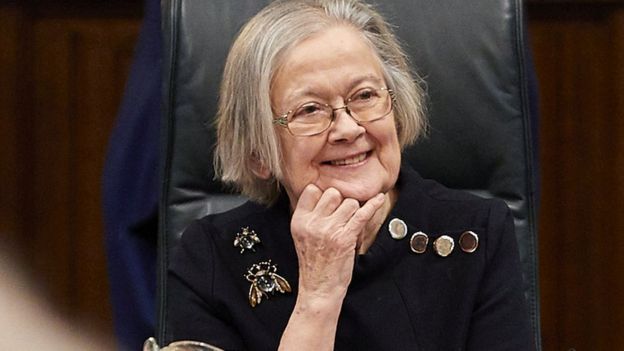
On Friday, outgoing Supreme Court President Lady Hale insisted judges were not "politically motivated".
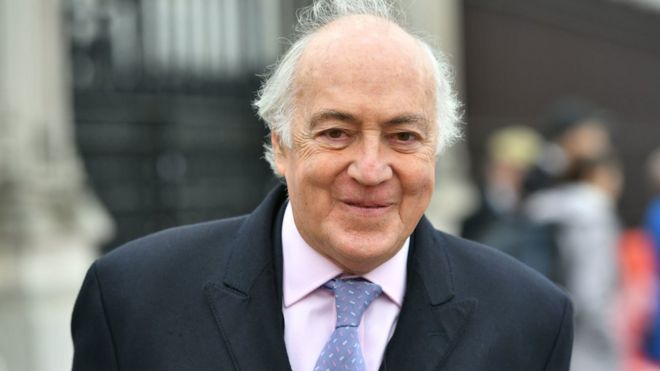
But Lord Howard questioned whether unelected judges should make the law.
The Conservative manifesto pledged to review the "relationship between the government, Parliament and the courts" and the Queen's Speech included plans for a "constitution, democracy and rights commission".
In an interview with BBC Radio 4's Today programme, Lord Howard said there had been "a significant increase in the power of the judges at the expense of Parliament and indeed government".
He said this was partly because of the expansion of judicial review - where a judge reviews the lawfulness of a decision made by a government or other public body.
It was also because "they were invited by Parliament, under the Human Rights Act, to enter the political arena by considering, for example, whether the measures that Parliament had taken to deal with a particular problem were proportionate to the objectives they wanted to achieve", he said.
"Sometimes in order to reach the result they want to achieve, they... distort the meaning of the Act of Parliament of which they are interpreting," he added.
Lord Howard also criticised the Supreme Court ruling, delivered by Lady Hale, that Mr Johnson's decision to prorogue Parliament for five weeks was unlawful because it prevented MPs from carrying out its duties without reasonable justification.
Asked if he felt the ruling was a political act, he replied: "I think that judges have increasingly substituted their own view of what is right for the view of Parliament and of ministers."
Image copyrightSUPREME COURTImage captionLady Hale will officially retire from her post next month
The government has refused to rule out changes to the way judges in the court are appointed.
The prime minister has previously hinted at US-style confirmation hearings for Supreme Court justices, suggesting they should be subject to "some form of accountability".
UK Supreme Court judges are appointed on legal experts' advice, whereas in the US the President can nominate them.
Lady Hale has warned against any attempt to "politicise" the judiciary.
"We don't want to be politicised, we don't decide political questions, we decide legal questions. In any event, Parliament always has the last word," she told the Today programme on Friday.
"I hope very much that we never get to a situation where the politics of the judge - if he or she has any politics - come into whether or not they merit appointment as a judge at any level of the system."
"We are not politically motivated. I do not know the political opinions of my colleagues and they do not know mine, and long may it remain so," she added.
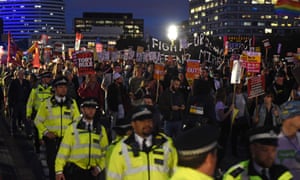
The Brexit storm resurged in August, embroiling the Queen, the courts, and Winston Churchill’s grandson Fri 13 Sep 2019 05.00 BST by Jon Henley Europe correspondent Boris Johnson’s decision to suspend parliament for five weeks triggered angry protests across the UK. Photograph: Oli Scarff/AFP/Getty Images
It was a quiet summer, albeit punctuated by the repeated pledges of Boris Johnson to take Britain out of the EU “do or die” – deal or no deal – on 31 October. Then quite suddenly, Britain’s long-running Brexit drama turned into a crisis.
The new prime minister found himself cornered: shorn of a Commons majority, obliged by furious MPs to beg for a Brexit extension he has sworn never to request, and prevented from calling the snap election he urgently wanted.
Parliament, meanwhile, was – perhaps unlawfully – suspended until 14 October, preventing MPs from discussing all this until three days before the crunch EU summit at which Brexit’s fate could be decided and a fortnight before the current exit date.
How did all this play out, what does it mean and where might it go from here? If you’re blindsided or even just bewildered by the latest unlikely plot twists in the interminable saga of Britain’s efforts to leave the EU, this is for you.
Having decided – narrowly – in June 2016 that Britain should depart the EU, voters had offered no guidance as to the destination: a soft Brexit, remaining close to the EU; a hard Brexit, distancing itself from the bloc; or no deal at all.
Theresa May’s government thought it knew what voters wanted, and negotiated with the EU27 the only exit deal possible given a series of red lines she had already laid down. Parliament, however, had other ideas, refusing to endorse the deal and forcing the UK to delay its planned departure.
After MPs rejected the withdrawal agreement in three successive votes but proved unable, over many months, to decide on any alternative course of action, May gave up. And in came Johnson.
The problem, said the new prime minister, was that the Brexit deal contained the infamous Irish backstop, the mechanism to avoid a return to a hard border between Northern Ireland and the Republic of Ireland. It was “undemocratic”, he said, and had to go.
The UK would, of course, far prefer to leave with a deal, but it would not hesitate to leave without one – and no amount of Commons votes, or even an election campaign, would change its mind. It was up to “our friends and partners” in the EU to budge.
But after spending nearly two painstaking years negotiating the 577 pages of Theresa May’s deal and having always said it could not be reopened, the EU did not believe Johnson wanted a deal. His “central scenario”, European diplomats were told, was to crash out.
Advertisement
And that is where things stood – a fraught standoff in an essentially phoney war – on 28 August, when the prime minister suddenly announced he had asked the Queen to suspend parliament for five weeks, from early September to mid-October.
And it all, for want of a better term, kicked off.
An unprecedented 10 days
Suspension, or prorogation, is normal in between governments; it usually lasts a couple of weeks. It is not normal for five weeks, little more than 50 days before arguably the most momentous event in the country’s history since the second world war.
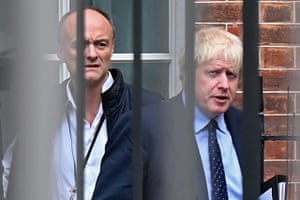
Boris Johnson and his special advisor Dominic Cummings leave from the rear of Downing Street before heading to the Houses of Parliament on 3 September. Photograph: Daniel Leal-Olivas/AFP/Getty Images
Unless steps were taken beforehand, on 31 October the UK would, with enormous consequences, crash out of the EU without a deal. Opposition and rebel Tory MPs assumed Johnson wanted to stop parliament stop him doing what he wanted. They were outraged.
With a window of barely a week before prorogation kicked in, Labour, the Liberal Democrats, the Scottish National party, Plaid Cymru and the Greens joined forces with 21 doughty Tory objectors, including two former chancellors and Winston Churchill’s grandson.
Amid nationwide public protests, Johnson and his cabinet tried to head them off, refusing to rule out simply ignoring any anti no-deal law, and threatening to expel from the Conservative party any rebels who dared vote for one. It didn’t stop them. His opponents declared parliamentary war.
Advertisement
Together, they voted to seize control of the parliamentary agenda on the first full day after the summer recess and, then in a series of remarkable votes, rammed through a bill forcing Johnson to ask the EU for another extension – he said he would rather “die in a ditch” – if there was still no agreed Brexit deal by mid-October.
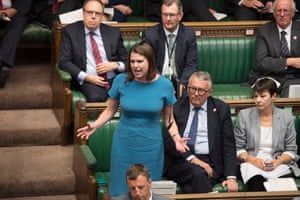
Liberal Democrat leader Jo Swinson during Prime Minister’s Questions in the House of Commons on 4 September Photograph: Jessica Taylor/UK Parliament
Many of the Conservative rebels said their resolve had been strengthened rather than shaken by the prime minister’s bullying. Their subsequent sackings – by text message– enraged moderate Conservatives who lamented what they called the transformation of their previously broad-church party into a narrow, extremist Brexit sect.
Within a week of parliament’s return, Johnson had suffered an unprecedented six consecutive parliamentary defeats, including two on motions of his own demanding an early election: perhaps not surprisingly, his rebel purge having left him with a majority of minus 41, he failed to get the required two-thirds of MPs’ votes.
Rebel and opposition MPs alike by now had so little trust in Johnson that they refused to allow any fresh elections until they were sure an extension had been secured and a no-deal Brexit on 31 October ruled out. Even his own brother, Jo, quit the cabinet, citing a conflict between “family loyalty and the national interest”.
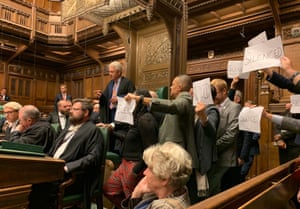
MPs protest in the House of Commons as parliament is suspended. Photograph: Clive Lewis/Parliament
Amid unprecedented scenes in parliament, the prime minister on Monday went ahead with his decision to suspend parliament until 14 October. But there was one more twist: sensationally, Scottish judges declared his move was aimed at silencing parliament and was therefore unlawful. The supreme court will rule next week.
So what happens now?
Not for the first time in the Brexit saga, that is the £350m-a-week question. Britain is certainly – again not for the first time – an international laughing stock. But where we go from here is still not much clearer than it was before that long, quiet summer. Commentators see four main options.
First, Johnson could still get a deal, perhaps by agreeing to the EU’s original proposal to resolve the Ireland problem: creating a border in the Irish sea. Winning parliamentary approval would be very hard, but perhaps possible – Labour MPs in leave-voting constituencies want to deliver, and Tory hardliners may see this as their last chance.
Second, he could break his promise, request an extension and then immediately demand an election, counting on a fiercely anti-EU, people-versus-parliament campaign to see him through. This could, however, leave him vulnerable to a squeeze from both the Brexit party and (possibly) a coordinated opposition promising a second referendum.
Third, he could go full no deal on 31 October as he promised, ignoring the law (or at least testing it to its limits in the courts). He could then call an early election after the UK leaves the EU, trusting that with Brexit delivered, the Brexit party will be no more – and hoping that no deal is not so catastrophic that the country does not give him a kicking.
Finally, he could be pushed out by a no-confidence vote or step down of his own accord. Rather than the divisive Jeremy Corbyn, a more neutral figure (Ken Clarke?) might then head up a temporary government whose sole purpose would be to ask the EU for an extension. Elections would then follow which, if he campaigned for no deal, Johnson could conceivably win.
Will the EU27 play ball? They are, certainly, rapidly running out of patience. Most now would really like the UK just to go as soon as possible. They will never throw Ireland under the bus by ditching the backstop - but if no deal could still be avoided, they would be pleased.
A good reason (elections, a new government) would be needed, but it is hard to see even Emmanuel Macron refusing a request for an extension intended to avoid no deal.
No one wants to be seen to be actively helping the UK over the cliff edge.
BELFAST (Reuters) - Belfast’s High Court dismissed on Thursday a case arguing that a British exit from the European Union without a withdrawal agreement would contravene Northern Ireland’s 1998 peace accord, saying the issue was political and not for the courts. SEPTEMBER 12, 2019 / 6:32 PM / UPDATED 10 HOURS AGO Amanda Ferguson FILE PHOTO: A woman wearing an Irish flag and a man wearing an EU flag demonstrate in front of the parliament at Westminster, in London, Britain, September 4, 2019. REUTERS/Hannah McKay/File Photo
The case is one of a series across the United Kingdom challenging Prime Minister’s Boris Johnson’s Brexit strategy. Johnson has said Britain must leave the EU on Oct. 31, whether or not it secures a deal on an orderly exit.
Scotland’s highest court of appeal ruled on Wednesday that Johnson’s decision to prorogue, or suspend, parliament for five weeks was unlawful and should be annulled, a verdict that will be appealed at the UK’s Supreme Court next week.
Rights campaigner Raymond McCord, one of three people backing the Northern Ireland case, said he would seek to join the other challenges before the UK’s highest court, including on the issue of prorogation.
Lawyers for McCord had argued that a no-deal Brexit would breach the 1998 Good Friday Agreement that brought peace to the British-run province, but Judge Bernard McCloskey said the case “trespassed upon the prohibited domain of the non-justiciable”.
“I consider the characterisation of the subject matter of these proceedings as inherently and unmistakably political to be beyond plausible dispute,” McCloskey said in a 68-page written judgement.
“Virtually all of the assembled evidence belongs to the world of politics, both national and supra-national.”
Parliament was prorogued on Monday until Oct. 14, a move opponents argued was designed to allow the prime minister to push through a no-deal exit from the European Union on Oct. 31 with little scrutiny.
Belfast’s Court of Appeal, the next step in the province’s justice system, had agreed to hear brief arguments from McCord’s lawyers on prorogation on Friday as well as the no-deal case challenge on Monday.
However, McCord said on Thursday that he was hoping to go straight to the UK Supreme Court on prorogation while continuing with the no-deal appeal, which he hoped will ultimately will also end up being referred to London along with other cases.
“This will hopefully ensure my case is heard and Northern Ireland has a voice and representation alongside the rest of the UK in the Supreme Court,” McCord told Reuters by email.
McCord’s son was murdered by pro-British militants in 1997, just before the peace deal, which largely ended three decades of violence between Irish nationalists seeking a united Ireland and pro-British unionists. Some 3,600 people died in the conflict.
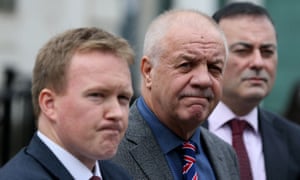
Victims’ campaigner Raymond McCord (C) and solicitors Ciaran O’Hare (L) and Paul Farrell outside court after the judge dismissed their case. Photograph: Brian Lawless/PA
The high court in Belfast has dismissed claims that a no-deal Brexit and the imposition of a hard border would damage the Northern Ireland peace process.
Lord Justice Bernard McCloskey said the applications were a matter of politics and that was not an area in which courts should intervene.
His decision follows the reasoning of the high court in London, which concluded that Boris Johnson’s advice to the Queen to prorogue parliament for five weeks was lawful. By contrast the Scottish appeal court on Wednesday ruled that the prime minister acted illegally in proroguing parliament in order to stifle debate in the Commons.
Delivering the judgment, McCloskey said: “Virtually all of the assembled evidence belongs to the world of politics, both national and supra-national.
“Within the world of politics, the well-recognised phenomena of claim and counter-claim, assertion and counter-assertion, allegation and denial, blow and counter-blow, alteration and modification of government policy, public statements, unpublished deliberations, posturing, strategy and tactics are the very essence of what is both countenanced and permitted in a democratic society.”
The judge did not deal directly with prorogation since he said it had been been the “centrepiece” of the English and Scottish cases.
The Belfast hearing, involving three cases, turned on different legal issues to those heard in London and Edinburgh.
Lawyers for the applicants in Belfast argued that by creating a hard border on the island of Ireland, a no-deal Brexit on 31 October would undermine the Good Friday agreement and other agreements that underpin cross-border cooperation between the UK and Ireland.
One of the applicants was a high-profile victims’ campaigner, Raymond McCord, whose son was murdered by loyalist paramilitaries in 1997.
Another victims’ campaigner, Jamie Waring, brought a case. He was represented by the Belfast-based civil rights organisation the Committee on the Administration of Justice (CAJ).
Northern Ireland’s appeal court will hear appeals against the decision on Friday. The Northern Ireland cases will eventually reach the supreme court in London next week when claims from London, Edinburgh and Belfast will be joined together in a three-day hearing.
This article replaces an earlier version that incorrectly claimed the judge had ruled on prorogation.
Scottish appeal court judges have declared Boris Johnson’s decision to suspend parliament in the run-up to the October Brexit deadline is unlawful.
The three judges, chaired by Lord Carloway, Scotland’s most senior judge, overturned an earlier ruling that the courts did not have the power to interfere in the prime minister’s political decision to prorogue parliament.
Lawyers acting for 75 opposition MPs and peers argued Johnson’s decision to suspend parliament for five weeks was illegal and in breach of the constitution, as it was designed to stifle parliamentary debate and action on Brexit.
The judges failed to issue an interdict, or injunction, ordering the UK government to reconvene parliament, prompting a row over whether the decision meant MPs could go back to the House of Commons.
The court issued an official summary of its decision declaring the prorogation order was “null and of no effect”, but Carloway said the judges were deferring a final decision on an interdict to the UK supreme court, which will hold a three-day hearing next week.
Jolyon Maugham QC, the legal campaigner whose Good Law Project funded the legal action, said he and Aidan O’Neill QC, the group’s lawyer, believed this meant prorogation was suspended with immediate effect unless the UK government won a court order reinstating it.
The UK government will appeal at the UK supreme court against the latest ruling, which also contradicts a decision in Johnson’s favour by senior English judges last week.
The UK supreme court has already scheduled an emergency hearing on both the Scottish and English cases for 17 September, alongside a third challenge brought in the courts in Belfast.
The three Scottish judges, who will issue their reasonings in full on Friday, said unanimously the prorogation was unlawful “because it had the purpose of stymying parliament”.
Carloway, the lord president of the court of session – the supreme civil court of Scotland – said parliamentary scrutiny of the executive was “a central pillar of the good governance principle enshrined in the constitution”.
Lord Brodie said that attempting to frustrate parliament in this way was “an egregious case of a clear failure to comply with generally accepted standards of behaviour of public authorities”.
The court’s summary concluded that Johnson’s prorogation request to the Queen and her decision to accept it “was unlawful and is thus null and of no effect”.
Maugham said: “Our understanding is that unless the supreme court grants an order in the meantime, parliament is unsuspended with immediate effect.
“I’m relieved that my understanding of the functioning of our democracy – that allows parliament to exercise its vital constitutional role – has been vindicated by Scotland’s highest court.
“This is an incredibly important point of principle. The prime minister mustn’t treat parliament as an inconvenience.”
Joanna Cherry QC, the Scottish National party MP who was the lead applicant in the case, called for prorogation to be halted. “The court agreed it is unlawful to suspend the UK parliament for the specific purpose of preventing parliament from scrutinising the Brexit process and holding this shambolic Tory government’s extreme Brexit plans to account,” she said.
“This ruling takes us one step closer to ensuring the UK government cancels their shameful prorogation and blatant plot to force through an extreme Brexit. Boris Johnson cannot be allowed to break the law with impunity.”
A UK government spokesperson said: “We are disappointed by today’s decision and will appeal to the UK supreme court. The UK government needs to bring forward a strong domestic legislative agenda. Proroguing parliament is the legal and necessary way of delivering this.”
No 10 sources said the government noted that last week the high court in London did not rule that prorogation was unlawful, which suggests ministers may try to hold back from recalling parliament until an appeal ruling.
A spokeswoman for John Bercow, the Speaker, and the House of Commons authorities said it would be up to Johnson to recall parliament during prorogation. “Any decision to accelerate the meeting of parliament during prorogation is a matter for the government,” she said.
However, calls quickly grew among opposition parties for Johnson to act now to restore sitting for the House of Commons and Lords.
Nicola Sturgeon, Scotland’s first minister, said: “Today’s court of session judgment is of huge constitutional significance – but the immediate political implications are clear. Court says prorogation was unlawful and null and void – so parliament must be recalled immediately to allow the essential work of scrutiny to continue.”
Keir Starmer, the shadow Brexit secretary, said: “I welcome the court’s judgment. No one in their right mind believed Boris Johnson’s reason for shutting down parliament.
“I urge the prime minister to immediately recall parliament so we can debate this judgment and decide what happens next.”
Shami Chakrabarti, the shadow attorney general, added: “This ruling shows that, despite what Boris Johnson has spent his privileged life thinking, he is not above the law. Labour will not allow his elitist shutdown of parliament to enable him to dodge scrutiny and force through a disastrous no-deal Brexit.”
The Liberal Democrat leader, Jo Swinson, tweeted: “Scottish judges have found in favour of 75 MPs (including me and other Liberal Democrats). We argued that Boris Johnson’s parliament shutdown is illegal, and designed to stifle parliamentary debate and action on Brexit.”
Last night, the House of Commons put on one of the most nauseating displays in its history. From the self-congratulation of the obsessively anti-Brexit, anti-democratic Speaker John Bercow to the last-minute pushing through of an archaic Humble Address motion to force government advisers to hand over their private WhatsApp messages, this was parliament at its worst. At its most aloof, its most decadent, and its most illiberal.
But perhaps the most grotesque sight of all, the sight that confirmed that this parliament is truly and irreparably exhausted, was Remainer MPs holding up signs declaring that they have been ‘silenced’ by Boris Johnson’s prorogation. This takes gall and arrogance to dizzying new heights.
Parliament is prorogued as of last night. It will not sit until 14 October. Whatever one thinks of this prorogation – spiked sees it as a cynical and unnecessary step – for Remainer MPs to complain about it is just too much to stomach. As prorogation began, with the arrival of Black Rod late in the evening, Remainer MPs booed, chanted ‘shame’, tried to prevent Bercow – the hero of their anti-Brexit, anti-democratic efforts – from leaving his chair, and held up signs saying ‘SILENCED’.
Silenced? Is this some kind of joke? Just a couple of hours before this ridiculous orgy of self-pity these same MPs had actually, legally silenced us, the people, by once again voting against the holding of a General Election. They pose as victims of ‘silencing’ when in truth they are the silencers. They are silencing the public voice, the very source of their democratic authority, and in the process bringing about a constitutional crisis unprecedented in modern times.
It is perverse for MPs to claim to be silenced. They have had more than three years to enact Brexit. They have been part of the longest parliamentary session since the English Civil War of 1642-1651. It reached that landmark on 7 May this year. By that point, the current parliamentary session had been running for 298 sitting days, or 2,657 hours and 56 minutes.
And what did they do for these hours and hours and days and days? They gabbed and blathered. They delayed and blocked and stalled Brexit. They made excuse after excuse for their failure to deliver Brexit. They preened and posed and made pseudo-fiery speeches about the evils of Brexit that impressed the Twitterati but literally no one else in the country. They filled the Commons with excuses and noise and bluster, all designed to distract attention from their staggering failure to respect the will of the people.
For these people now to present themselves as ‘silenced’, as being gagged on the Brexit issue, is mad. Indeed, their claim that ‘Brexit chaos’ is destroying parliament is utterly unconvincing. If Brexit has become chaotic, it is because of them. It is because of MPs’ backtracking on their own manifesto promise to respect the result of the EU referendum and because of their post-manifesto, post-democratic determination to destroy Brexit instead. We shouldn’t let them get away with blaming Brexit for the alleged chaos enveloping the political realm, because in truth it is their cynicism and lies and continual blocking of Brexit that has withered democracy in this country and reduced politics to a joke.
Even worse, they now prevent us, the public, from having a say on their behaviour and, in particular, on their legal block against a No Deal Brexit and their determination to secure yet another extension to the Article 50 process. Last night, MPs voted for a second time against holding a General Election. They do not want an election until they have effectively banned No Deal and kept us in the EU until at least January next year. They are going against the express will of the people and, at the same time, insulating themselves from the people’s judgement. They are usurping our democratic wishes while preventing us from having any say about this whatsoever. It is an outrage against democracy. They are silencing the masses.
This parliament doesn’t only feel morally and politically exhausted – it feels increasingly illegitimate. It feels like the least representative parliament in living memory. This is a parliament in which the vast majority of members were elected on manifestos that promised to deliver Brexit and yet it has spent much of the past three years trying to thwart Brexit. This is a parliament in which numerous MPs are now representatives of different parties to the ones they were elected for in 2017. This is a parliament that voted in favour of the EU referendum, voted in favour of triggering Article 50, and which continually said the people’s voice must be respected, and yet it now flat-out refuses to make Brexit a reality and in fact has essentially outlawed it via the Benn Bill.
They have to go. They have no idea how much contempt the public feels for them. Or perhaps they do, which would explain why they are so desperate to put off a General Election until they have completed their latest anti-Brexit, anti-democratic machinations. The public is biting at the bit to pass judgement – stinging, unforgiving judgement – on these political unrepresentatives. Parliament derives its authority entirely from the people, and yet right now it stands in opposition to the people. The people will not forget this when, finally, these charlatans and elitists allow us to exercise our democratic right to vote.
 SUPREME COURT