A think tank has said that Boris Johnson should rip up the EU-approved withdrawal agreement, as it would still leave the European Union with too much control.
The withdrawal agreement, signed in January 2020, leaves Brussels with having too much say over issues including state aid and British laws, according to the Centre for Brexit Policy, which campaigns for a “real” Brexit, where the UK regains full control of her laws, courts, borders, and trade policy without condition.
The think tank is reportedly backed by several key lawmakers across the political spectrum. Its director-general John Longworth said in comments reported by Reuters: “Deeply embedded in the Withdrawal Agreement are sweeping powers for the EU over much of our commercial and national life.”
“The prospect of the European Court of Justice and the European Commission continuing to issue orders to the UK and endless legal wrangling truly means we face a nightmare on Brexit street unless we break free from their clutches at the 11th hour,” Mr Longworth added.
Brexit Party leader Nigel Farage had also advised Prime Minister Johnson to drop the withdrawal agreement. He said before the document was even signed that it “is not Brexit” and “will never free us completely from the European Court of Justice”.
London and Brussels are set to enter the final stage of talks on Tuesday. The Telegraphreported that the UK’s chief negotiator Lord David Frost said that discussions had been “relatively positive”, hinting at progress between the two parties, and suggested that the bloc had reversed some of its earlier “unrealistic ambitions”.
State aid — rules regarding the state’s ability to support British businesses in a manner which could distort competition — and access to British territorial fishing waters have been two red lines that neither the UK nor EU had wanted to cross. However, sources speaking to The Sunsaid that the EU had given ground on its fishing demands.
But Lord Frost had also maintained that the EU still needs to be more “realistic” in some areas of debate.
Frost said, according to The Sunday Times: “An agreement is still very much possible, but equally very far from certain. The last two weeks of informal talks have been relatively positive, but there remains much to be done and time is short.
“We have been saying from the beginning of this process that we simply want a standard free trade agreement like Canada’s. Sadly the EU’s position has not been so straightforward and we continue to be asked to accept provisions which do not reflect the reality of the change which our exit from the EU brings.
“If the gaps in these areas are to be bridged, the EU still needs to scale back more of its unrealistic ambitions and work on more realistic policy positions. I hope this will be possible this coming week and I and my team are ready to work as hard as necessary to move things forward.”
The UK officially left the EU on January 31st, 2020, but remains in a transition period — still tied to EU rules — until December 31st, 2020. The prime minister has recently pledged that he will withdraw from negotiations with the bloc and prepare for a clean break if a deal is not agreed on by October 15th.
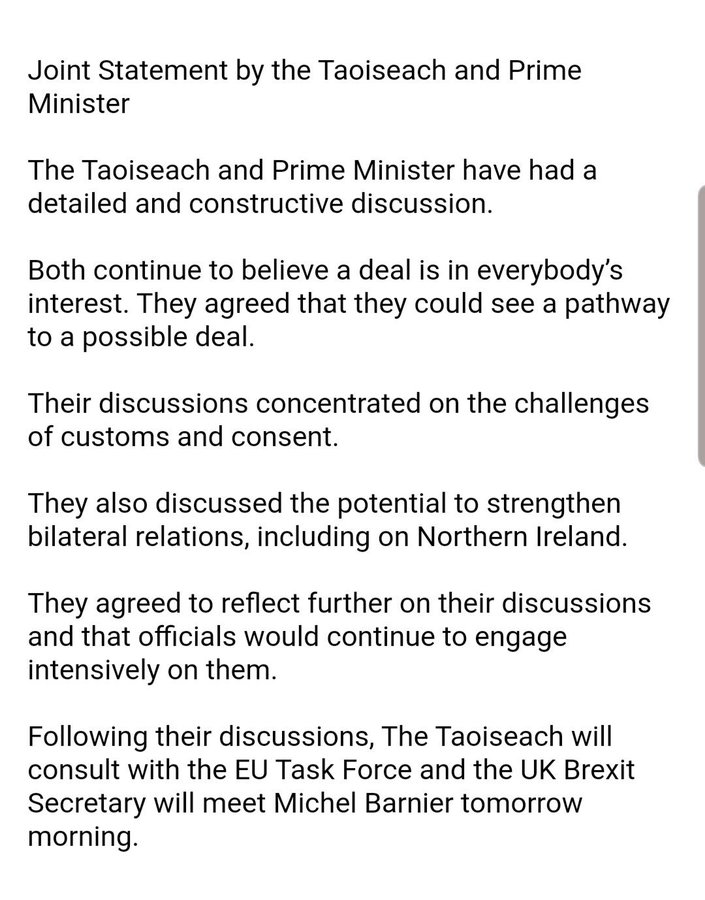
LAST Thursday’s summit between Messrs Johnson and Varadkar took place away from the eyes of the press and was followed by a joint statement saying they could ‘see a pathway to a possible deal,’ writes Paul Wood.
This was surprising and promising. Did they mean it, or is each trying to look as if a breakdown in talks is not his fault? Few people were there and so we know little about what was said.
A piece in The Times said they looked at proposals ‘that would have had Northern Ireland staying in both the UK’s customs union and the EU customs union’.
The Irish Times said it would amount to a scaled-down version of the customs partnership’ proposed by Theresa May (which sounded like the customs union under a different name), but applied only to Northern Ireland.
It would mean the UK levying customs rules on goods going from Great Britain to Northern Ireland, but people in Northern Ireland who received those goods getting the money they had paid back, since they are in the UK. That would mean the entire UK leaving the customs union, as promised by Boris, but with an administrative customs border in the Irish Sea.
The DUP, which represents most of the Ulster Protestant Unionists, would be very stupid indeed not to agree, as it will help the Northern Irish economy in general and Protestant farmers in particular. Boris is keeping very close to the DUP.
If they don’t agree, Boris no longer needs them as much as Theresa May did, as he no longer has a majority in the House of Commons even with them. If they oppose the deal, some in the European Reform Group, the hardcore Brexiteer Tory MPs, may find it hard to support it, but I think they will. For them there will not be a better chance.
Michel Barnier has now agreed, after meeting Stephen Barclay on Friday morning, that the negotiations can move to the ‘tunnel’ (intensive secret negotiations). That means this might work but time is very short indeed.
If it fails, what next? Boris will remain in office but not in power until eventually an election or referendum is called. If it is an election, he must campaign with a proposal and, as an alternative, leaving with no deal.
The Tory Party obviously cannot win an election saying, ‘We want to leave the EU but will not countenance no-deal’. Clearly a deal is impossible unless leaving with no deal is on the cards. If the Tories win, leaving with no deal will be likely, but that is only a stop on the path to a deal.
Remaining in a customs union with the EU as Philip Hammond suggests, with the right for the UK to leave this customs union by giving one year’s notice, in some ways makes sense at least temporarily. It would take us out of the EU and let an election decide whether we should stay in the customs union. But Nigel Farage would unfairly call it Brexit In Name Only and this might well sink the Tories, leading to a Corbyn (Trotskyite, hard Left) government backed by the Scottish Nationalists in return for a promise of another referendum on Scottish independence.
But my feeling is that the new proposal may work. I hope so and so do most people, apart from those, like Tony Blair and Sir John Major, who are determined that the UK remains in the EU.
Bluff
BUT bluff by whom, and targeted at whom? Those, maybe, are the real questions, because this drama has multiple actors, all of whom have interests and agendas that may be colouring their reactions, writes Michael St George.
Though Boris has, since last Thursday remained fairly tight-lipped about the details, some kind of, in effect, double customs union, involving keeping Northern Ireland in a de facto, if not de jure, customs union with the Republic, appears to be the basis for this tentative rapprochement.
But when 85 per cent of Northern Ireland’s exports are to the UK, with only 5 per cent and 3 per cent to the Republic and the EU respectively, it’s hard to see why Northern Ireland would burden itself with onerous EU costs and regulations for such a small proportion of its trade, and risk disruption to the flow of the major part of it.
Which might explain why, as early as last Friday, the DUP’s Nigel Dodds had already rejected the double customs union as ‘unrealistic’, asserting that the province staying in a full customs union with the UK was non-negotiable, and that for the ongoing ‘tunnel’ talks in Brussels to disregard this precondition would be counter-productive.
The technical assessments of Johnson’s proposals are not especially favourable. Anand Menon, of The UK in a Changing Europe initiative, reckons the long-term economic impacts are negative, and potentially more damaging than the deal negotiated by Theresa May, but the chart below appears to acknowledge that they do give the UK more independence and flexibility. TCW readers are recommended to visit the UKinCE website for themselves and make their own judgment of its pro or anti Brexit stance.
Theresa May’s former Europe Adviser, Raoul Ruparel of Open Europe, however, is more sanguine. There are some concerns, he says, but they can be managed. TCW readers should visit OE’s website and make their own judgment about its pro or anti Brexit stance, too.
As former Northern Ireland Secretary Owen Paterson points out, a double customs union would also potentially be a breach of the Belfast (Good Friday) Agreement, and a violation of the Principle of Consent which was enshrined within it.
We also know, because former Secretary-General to the EU Commission Martin Selmayr was indiscreetly frank about it, that it has long been the EU’s position that relinquishing its sovereignty of Northern Ireland is the price the UK must be made to pay for leaving the EU. It would be unwise to assume that the reactions of both Brussels and Irish Taoiseach Varadkar, who has shown himself regrettably ready to pander to nationalist Republican revanchism, scrupulously disregard this.
Bluffing about seeing a way forward would certainly be in Boris’s interest, and that of the Conservative Party. The almost exclusive focus of politicians, media and public on the Northern Ireland backstop serves to obscure the suspicion that, ultimately, he will try to get what otherwise is essentially Theresa May’s (non)-‘Withdrawal’ Agreement through the Commons. The flaws in it remain as serious as ever they were.
But Boris knows that, if he fails to achieve Brexit by 31st October, the chances of both his own survival and that of his government, are damaged. The votes which, because of May’s defenestration and Boris’s ascendancy to Number Ten on a Brexit do-or-die ticket, have come back to the Tories from the Brexit Party after its resounding victory in the European elections, could once again vanish.
So he has every incentive to play up the chances of a deal after all, and exaggerate its significance, if it can be presented as something which warrants getting a soft Brexit over the line. The recriminations can come afterwards.
Brussels and Dublin equally have an incentive, to understate the significance. The EU will be calculating that, by playing hardball, it increases the chances of a Remainer Parliament, which has already passed the Benn Surrender Act, forcing Boris, failing a 31st October Brexit, to seek an Article 50 extension on humiliating terms, probably involving conceding a second referendum.
In short, almost none of the actors in this drama has an incentive to be 100 per cent genuine. Safer, perhaps, to assume that none of them are?
Iain Dale presents the evening show on LBC Radio and is a commentator for CNN.
Well what a day that was. I normally write this column on a Thursday morning, and when I started to type this yesterday I had woken up to the fact that the DUP were refusing to go along with Boris Johnson’s compromise plan with the EU over the Irish border. A few hours later there was white smoke, albeit not from the DUP. Hmmm. Perhaps mention of white smoke and the DUP might cause my old acquaintance Ian Paisley to spin in his grave. Apologies for that. No, the white smoke came from the Berlaymont building in Brussels.
To be honest, I think we were all taken a bit by surprise. But there it was, the deal that no one thought Boris could either get, or frankly ever intended to get. We all have short memories, but I remember during the leadership contest when he would constantly say he intended to reopen the Withdrawal Agreement and abolish the Backstop.
The Withdrawal Agreement, the EU said, could not be reopened. It was.
The Backstop could never be touched or abolished, said the EU. It was.
Regulatory alignment could never be watered down, they said. It has been.
This was a diplomatic and negotiating triumph for a prime minister who has only been in office for 85 days. I doff my cap. I never thought it was achievable, but it was. OK, there are many aspects of the deal which I could criticise, but in this sort of situation you never get all you want. And most sensible people recognise that.
The next crunch time comes tomorrow when the House of Commons meets to decide whether to pass the deal. I keep coming back to the point that if opposition MPs are so fearful of No Deal, why are they still so reluctant to support an actual deal? I know why. It’s because it’s got nothing to do with a deal. It’s all to do with thwarting Brexit. And the general public can smell that a mile off.
The next deadline is Saturday evening when, if the deal hasn’t passed, the Prime Minister is supposed to send a letter to Brussels requesting an extension to Article 50. Hints continue to be dropped by Number 10 that there is some way around this, but we’ll have to wait and see.
If the letter is sent, and a No Deal Brexit really is avoided then the next test must surely come on Monday when Boris Johnson will surely again challenge the opposition parties to agree to an election. They may well try to delay that until 31st October just in case the Prime Minister tried to pull a last minute fast one. There is also much talk of Labour moving towards a position, first articulated by Tom Watson before the Labour conference, whereby there would have to be a confirmatory referendum in advance of an election. This would also mean keeping Boris Johnson in power for another nine months. Is it really a credible position for Labour to describe Boris Johnson and his government in evil terms and yet be the prime movers of keeping him in power for nine months longer than absolutely necessary? As Alastair Campbell might say, this is all tactics and no strategy.
– – – – – – – – – –
Sky News have seemingly trolled themselves by opening up a new channel which won’t have any Brexit news on it whatsoever. But it only operates Monday to Friday 5pm-10pm. Utterly baffling. You can just imagine the meeting where some bright spark came up with the idea and no one was prepared to tell the bright spark he or she was talking utter bollocks. It has been glorious to see Adam Boulton treat the idea with the contempt it deserves.
– – – – – – – – – –
The race to succeed John Bercow as Speaker of the House of Commons hasn’t really caught light yet and it’s not easy to predict the winner. There are nine candidates but none of them have really pulled ahead of the others. Lindsay Hoyle and Harriet Harman are said to be the two favourites, but it wouldn’t at all surprise me to see Chris Bryant come up on the rails. Lindsay Hoyle’s problem seems to be that while he is very popular among Tories, Labour MPs aren’t flocking to him. It’s a sort of reverse Bercow situation. Harriet Harman, meanwhile, is struggling to attract any Tories at all. Among the Tory candidates, Eleanor Laing would appear to be the frontrunner, but in the LBC hustings last week it was Shailesh Vara who impressed most. Everyone assumes he’s running because he really wants to be a deputy speaker, but in the right circumstances maybe he might come through the middle. Stranger things have happened.
– – – – – – – – – –
The fact that Dame Louise Ellman has quit the Labour Party has sent reverberations through what’s left of the right of the party. It’s been a long time coming, but it had a certain inevitability about it. The reaction on the hard left has been predictably disgusting, and if she had any doubts about leaving after 55 years, the comments on Twitter threads will have dispelled them. I just hope she never read them. The question now is what the more moderate voices in the Labour Party do now. The answer is probably nothing. Why? Because they hope that after an election the long nightmare of the Corbyn leadership will be over and things will get back to normal. They won’t, though. The hard left have a vice-like grip on the party machine now, and in any leadership election following Corbyn’s departure, it is almost inevitable that the most hard left candidate would win. Everyone is talking about Angela Rayner, Rebecca Long-Bailey, Laura Pidcock and Emily Thornberry duking it out. Just imagine, though, if Diane Abbott threw her hat into the ring…
The new agreement updates the Northern Ireland protocol of Theresa May’s Withdrawal Agreement and the Political Declaration, which deals with the future relationship. But while the rest of the deal appears to be unchanged, Boris has succeeded in winning some key concessions from the EU.
Here are five reasons why Boris’s deal is better than May’s:
1. The backstop is gone
Firstly, the backstop that Theresa May negotiated with the EU has been replaced by a new Northern Ireland Protocol and the UK-wide Customs Union in the backstop has been removed completely. Northern Ireland will remain in the UK’s customs territory, which means its people will be able to benefit from any trade deals brokered by the UK after the transition period ends. The territorial sovereignty of the UK is kept intact and the country will have one common external tariff with the rest of the world (although goods coming into NI destined for the EU will pay the EU’s external tariff).
The downside for Northern Ireland is that the region will have to remain, as before, inside the EU’s regulatory orbit for goods, to allow its border with the Republic of Ireland to remain open. Northern Ireland will remain aligned with the EU, and some checks may take place for goods travelling between Northern Ireland and Great Britain.
But…
2. Northern Ireland can leave if it wants
In Theresa May’s Withdrawal Agreement, the UK and Northern Ireland could only break away from the backstop as long as the EU agreed on alternative arrangements. As the EU would have no incentive to do this, May’s agreement essentially meant that the UK and NI would either have to remain inside the Single Market and Customs Union, or risk being trapped in the backstop forever.
In Boris Johnson’s deal, if Northern Ireland wants to leave the arrangement set out above, it can do so with a vote in the Stormont Assembly held every four years. The future of Northern Ireland will now be decided in Belfast, not Brussels. The DUP would not have a veto over this process, which explains its disappointment at the deal.
3. Free trade deals can start on New Year’s Day 2021
Under Boris Johnson’s agreement, the UK will be able to formally begin negotiating trade deals with the rest of the world as soon as the agreement is ratified by parliament. Until now, the uncertainty of the UK’s exit date from the EU has made genuine negotiations with most countries impossible.
But once Boris Johnson’s Withdrawal Agreement is passed, the UK will formally be able to conclude trade talks with the rest of the world. If the UK begins negotiating with the United States in earnest, a Free Trade Deal could be completed as soon as 1 January 2021, when the transition period of the deal ends.
4. Goodbye to the ‘level-playing field’ commitments
Binding commitments for the whole UK to maintain “minimum standards” in the areas of social and environmental policy, tax, competition and state aid have been removed from the withdrawal agreement This is the so-called ‘level playing field,’ a phrase the EU uses to extend its regulatory power over nation states. Whether the UK has to obey these rules or not will instead be decided in the next stage of Brexit talks (negotiations on the “future relationship”), giving the UK greater leverage in the next stage of the talks. This will not, of course, mean a lowering of any standards: the Tory agenda now is about raising standards higher still: new UK laws can replace the old EU ones to underline this point.
5. The UK still takes control of its money, borders and laws
The UK will have left the EU by 31 October 2019. And as soon as the transition period ends, the country will take control of its money, borders and laws. Yes, there’s £33 billion of divorce payments – but we will take back control of the £13 billion a year that we send to the EU, saving at least £70 billion net over the next decade. The UK will have the ability to control its own borders, and if it wishes, end the free movement of people with the European Union, and replace it with its own immigration policy that prioritises and encourages high-skilled people to come and live and work in the UK. This would happen in January 2021.
Now that the backstop has been removed, it also appears that ECJ’s jurisdiction has been massively reduced. The ECJ will still have jurisdiction over EU citizen’s rights for a time-limited period, and over disputes that relate to an interpretation of EU law in the WA. Northern Ireland will also be subject to some ECJ jurisdiction as long as it remains aligned to the EU. But once we leave, the UK will be free to set its own laws, in its own parliament, with its own elected representatives voting on legislation.
LABOUR has given up on plans to get a new Brexit deal and would back a version of Theresa May’s hated Withdrawal Agreement, John McDonnell has dramatically revealed.
McDonnell said Labour would hold a second referendum on one of the deals already discussed by Parliament – such as May’s or the Norway option.
Labour has given up on plans to get a new Brexit deal, John McDonnell dramatically revealed Credit: BBC
The latter would see Britain out of the EU but remaining in the single market, meaning goods, services and people could continue to enjoy free movement.
Jeremy Corbyn has repeatedly promised to go back to Brussels to thrash out a new “jobs first” Brexit if he seizes power - vowing to protect Britain's industry and boost the economy.
JEZ GIVE UP
But in a sign of yet more Labour Brexit chaos, his close ally and shadow chancellor waved the white flag of defeat.
McDonnell told Andrew Marr: “We’ve got to get to a situation now where we accept what the offer is.
“I think it’s a matter of confirming what the offer would be – then it has to go back to the people again.
We’ve got to get to a situation now where we accept what the offer is. I think it’s a matter of confirming what the offer would be – then it has to go back to the people again.
John McDonnell
“I was in negotiations for six weeks with the Conservatives and there were a whole range of issues there that were addressed - and from the indications that we were getting from the European Union - that we might be able to get some shift on.
“So you can see an offer consolidating that would then go back to the people – we believe the people should have the final decision. “There were a range of positions that the EU was sympathetic to.
“It’s a matter of saying, ‘this is what the offer is that is the reality of the EU is willing to agree to’.
Boris Johnson has repeatedly stated his desire for a new agreement with Brussels chiefs, but warned we will be leaving the EU “do or die” by October 31.
Last week a law was passed demanding the PM go begging to the bloc for a Brexit extension – but Boris said he would rather be “dead in a ditch” than do so.
But McDonnell said Labour and other parties cannot trust the PM to stick to his word by holding the new vote before Britain is due to leave the EU at the end of the month.
He said: “Until we've ruled a no deal off the agenda, I can't risk, with Boris Johnson being in power, that he wouldn't somehow impose that on the country.
"So we can get no deal off the agenda, then I'd like a general election and part of that would be saying let's have a referendum."
McDonnell revealed Labour's Brexit plan to Andrew Marr todayCredit: BBC
In the weeks leading up to his formal confirmation as Prime Minister some commentators of note suggested that this most mercurial of politicians was almost bound to renege on this promise. He was uniquely untrustworthy they said. But with the appointment of Dominic Cummings as his senior aide his intent could not have been clearer. If we don’t leave by Halloween Boris is toast. Johnson had painted not so much a red, as a crimson line. Nothing that has happened since has hinted at any deviation from this position.
His opponents in parliament have certainly taken him at his word and have rallied to defy him but are still shorn of a viable plan. Meanwhile Boris has drawn another crimson line. He has insisted that any new deal is wholly dependent on the EU jettisoning the so-called Irish backstop.
The backstop is an ingenious concept, one that has had bestowed upon it a special reverence during these negotiations. It was included in the doomed Withdrawal Agreement to safeguard an open border between Northern Ireland and the Republic of Ireland should the UK and the EU not reach an acceptable trade arrangement after an agreed transition period. It was conceived in December 2017 and almost immediately became an immutable symbol of good faith for both sides, constantly invoked by countries who had never previously much concerned themselves with the Good Friday Agreement and its aftermath.
However the adoption of backstop had a vulnerability built into its birth. It required and was dependent on receiving the consent of the UK parliament. Without this and with the Article 50 clock ticking – albeit with sporadic enforced stops – the very event that it was designed to prevent in the medium term would suddenly unavoidably appear in the headlights. So it has come to pass. I am not sure even the Germans have invented a name for this calamitous turn of events. The Withdrawal Agreement with the backstop baked in was defeated three times in the Commons and now our new PM has declared the Withdrawal Agreement a dead duck unless the Irish backstop is jettisoned.
Which is were our friend Dom Cummings comes in.
During the 2010 General Election campaign I recall a conversation with a veteran former Tory MP who had stood at every such election since before I was born. He couldn’t remember a single campaign in 50 odd years when Labour had not devoted a day to “the Tories are going to destroy the NHS” pitch to voters. Six years later Vote Leave painted a red bus with a £350 million a week for the NHS message emblazoned on its side and had it move around from one solid Labour constituency to another. The chutzpah behind this was gob smacking but its impact was devastating and ultimately decisive. Cummings had intuited the lessons of 50 years of general election campaigns and in an act worthy of Sun Tzu deployed the strengths of his opponents against them. Indeed it worked so well that we are likely to be leaving the EU before we turn the clocks back.
For the NHS in 2016 read the backstop in 2019. If the EU27 fail to move on the backstop designed to stop a “hard border” in two years they will need to erect one in two months.
Once again it seems Dom Cummings may have sensed the solemnity and steadfastness of his foe’s position and deployed it against them.
No one knows if there is an acceptable alternative solution to the problem that the backstop was supposed to sort – and the consequences of not finding one are truly unsettling – but we are about to find out both whether those who said they could never countenance a hard border in Ireland really meant it and if Dom Cummings has exposed the EU Achilles heel.
LONDON (Reuters) - Britain is “ready and willing” to do a deal to leave the European Union if Brussels renegotiates the agreement, a senior government source said on Tuesday, denying that a no-deal Brexit was Prime Minister Boris Johnson’s central plan. AUGUST 6, 2019 / 5:54 PM
FILE PHOTO: The British union flag and the EU flag are seen flying near the Houses of Parliament, in London, Britain, March 18, 2019. REUTERS/Toby Melville
Johnson, who took over as prime minister two weeks ago, has taken a hard line with the EU, demanding that it show willingness to change the deal it agreed with his predecessor before negotiations can restart to secure Britain’s smooth departure from the bloc.
His insistence that Britain is boosting preparations to leave without a divorce agreement if Brussels refuses to renegotiate has spooked markets, sent the pound tumbling and prompted some lawmakers to suspect a no-deal Brexit is his ultimate goal.
A report in The Guardian newspaper cited EU diplomats as saying they believed a no-deal Brexit was the “UK government’s central scenario”.
The government source said this was not the case, but the EU had to understand that Johnson could not again bring forward the deal that was rejected by Britain’s parliament three times, leading to the resignation of his predecessor Theresa May.
“We want a deal. It’s sad that they don’t want to negotiate with us,” the source said, on condition of anonymity.
“The fact that the Withdrawal Agreement has been rejected by large margins by the House of Commons on three occasions means that, if there’s going to be a deal, they have to be prepared to renegotiate. We’re ready and willing to do so.”
Johnson has said Britain will leave the EU on Oct. 31 with or without a deal.
His government says the only way to secure a deal would be to ditch the Irish backstop - an insurance policy designed to prevent the return of border controls between EU-member Ireland and Britain’s province of Northern Ireland that were ended by the 1998 Good Friday peace agreement.
The Withdrawal Agreement May struck in November with the EU says the United Kingdom will remain in a customs union “unless and until” alternative arrangements are found to avoid a hard border. Many British lawmakers oppose being bound to EU rules and customs duties post-Brexit.
The EU has repeatedly ruled out renegotiating the Withdrawal Agreement, and The Guardian cited a senior EU diplomat as saying Britain “does not have another plan”.
“No intention to negotiate, which would require a plan,” the newspaper quoted the diplomat as saying after meeting David Frost, the British government’s new chief Europe adviser. “A no-deal now appears to be the UK government’s central scenario.”
An EU official briefed on the meeting on July 31 described it as “introductory” when Frost said little more than what Johnson has said publicly.
Boris Johnson has been confirmed as the new Conservative leader and soon-to-be prime minister and will now begin the task of trying to deliver Brexit.
By Reality Check teamBBC News23 July 2019 15:05
The former foreign secretary has pledged the UK will leave the EU on 31 October, "do or die", accepting that a no-deal Brexit will happen if an agreement cannot be reached by then.
He has called the withdrawal agreement "dead" but says he will "take the bits that are serviceable and get them done" - such as guaranteeing the rights of 3.2 million EU citizens in the UK.
The withdrawal agreement (WA) is the deal negotiated by the UK government and the European Union (EU) to settle the basis on which the UK will leave. As part of it, the UK agreed to pay the EU a "divorce bill" (estimated to be £39bn), guarantee EU citizens' rights and sign up to the Irish backstop - an insurance policy designed to avoid a hard border in Ireland.
The deal allowed for a transition period after Brexit, during which things like UK-EU trade would stay the same, while both sides worked out their future relationship. But the withdrawal agreement was rejected three times by MPs - leading to Theresa May's downfall.
Irish border
PA Media
Solve the problems of the Irish border where they properly belong, in the context of the free trade agreement, that we will do after we come out on 31 October. Boris Johnson
After Brexit, Northern Ireland and the Republic of Ireland could be in different customs and regulatory regimes, which might mean products being checked at the border. To avoid border posts (which some believe could threaten the peace process), Mrs May and the EU agreed on the backstop. In the event that no free trade deal was agreed that avoided a hard border, this insurance policy would effectively keep the UK and EU in a customs union. This proved controversial because it would stop the UK doing some of its own trade deals.
Mr Johnson is saying the Irish border can be dealt with after the UK leaves the EU, instead of as part of the withdrawal agreement.
Obstacle: The EU has said the Irish backstop cannot be removed from the withdrawal agreement - the deal to delay the UK's exit until the end of October specifically prohibited its renegotiation. If the UK leaves with no deal and seeks a free trade agreement, the EU has said it will not begin negotiations until the issue of the Irish border is settled.
Irish backstop
Getty
There are abundant, abundant technical fixes that can be introduced to make sure that you don't have to have checks at the border. Boris Johnson
Boris Johnson wants to ditch the Irish backstop - he's called it "a prison". He has said there are "abundant, abundant technical fixes" to avoid checks at the border. He concedes there is "no single magic bullet" but points to a "wealth of solutions" instead.
Obstacle: The UK and the EU have previously looked for technological solutions to the Irish border without success. EU deputy chief negotiator Sabine Weyand said in January: "We looked at every border on this Earth, every border the EU has with a third country - there's simply no way you can do away with checks and controls." There are "alternative arrangements" which could help: trusted trader schemes (where businesses are certified to make sure they meet certain standards) and ways of making customs declarations away from the border, but they wouldn't eliminate the need for checks altogether. After Brexit, the EU would still require inspections of things like animal and plant products entering its single market, and the new entry point to that market would be at the Irish border.
£39bn
Reuters
I think that the £39bn should be kept in a state of creative ambiguity.
Boris Johnson has said he is prepared to withhold the money the UK has agreed to pay the EU and use it as a negotiating tool to get a better deal. Settling the UK's financial obligations (which include previously agreed contributions to the EU budget and funding things like EU staff pensions) was agreed by Theresa May as part of the withdrawal agreement. The figure for those obligations has been calculated at £39bn.
Obstacle: The EU has said it will not start future trade talks until the issue of money (along with citizens' rights and the Irish border) is settled. Refusing to pay would almost certainly sour relations between the two, and could lead to a legal challenge from the EU.
No deal
Reuters
It's vanishingly inexpensive if you prepare. Boris Johnson
While accepting that a "disruptive... badly handled" no-deal Brexit would be costly, Mr Johnson said it was "vanishingly inexpensive if you prepare" and added that "much of this work has been done".
Obstacle: Mr Johnson's view of the cost of a no-deal Brexit is at odds with the vast majority of economists, a significant number of his own backbenchers, and organisations such as the Office for Budget Responsibility (OBR), which calculates the government's forecasts for the economy. The OBR said no deal would push the UK economy into recession.
Zero tariffs
AFP
“There will be no tariffs, there will be no quotas, because what we want to do is get a standstill in our current arrangements under GATT24 Boris Johnson
Mr Johnson has said he would mitigate the effects of no deal on the UK economy (which he admits would cause "disruption") by relying on a piece of trade law known as Article 24. He originally said this would allow the UK and the EU to have zero tariffs (taxes on imports) on trade while the two sides negotiated a trade deal. This would, in theory, help keep trade flowing and would stop the EU imposing tariffs on goods being imported from the UK (cars, for example, are subject to a 10% import tax from non-EU countries, and on agricultural produce it's even higher).
Obstacle: Boris Johnson was wrong to say Article 24 would automatically allow for a standstill in trade relations, and indeed - when challenged in interviews - he later accepted that it would require the agreement of both sides. Also, Article 24 only covers the trade in goods (not services) and it does not cover non-tariff barriers such as regulations. The EU has ruled out signing any Article 24 agreement immediately after a no-deal Brexit.
Your guide to Brexit jargon
Use the list below or select a button
What is the timetable?
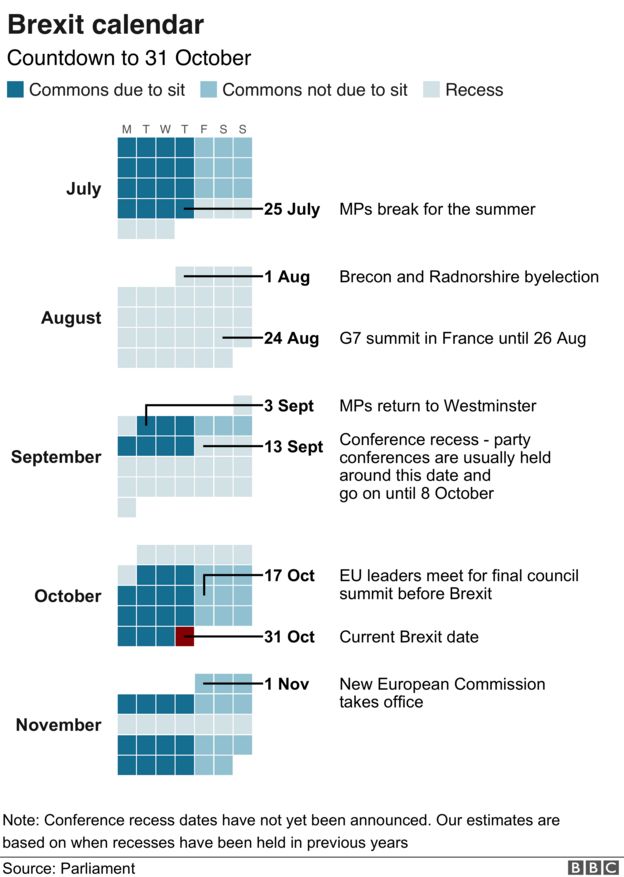
Mr Johnson has just over three months until Brexit day. He will become prime minister on 24 July and Parliament begins its summer recess the following day.
A week later there will be a by-election and the rest of August will be pretty quiet, both in Westminster and Brussels. Parliament returns at the start of September but will take another recess later in the month for party conferences.
On 17 October there will be a summit of EU leaders. Brexit is scheduled for 31 October, the day before the new European Commission takes office.




 STEVE4GOOD