Showing posts with label ONS. Show all posts

Wednesday, 24 April 2019

Government borrowing lowest for 17 years

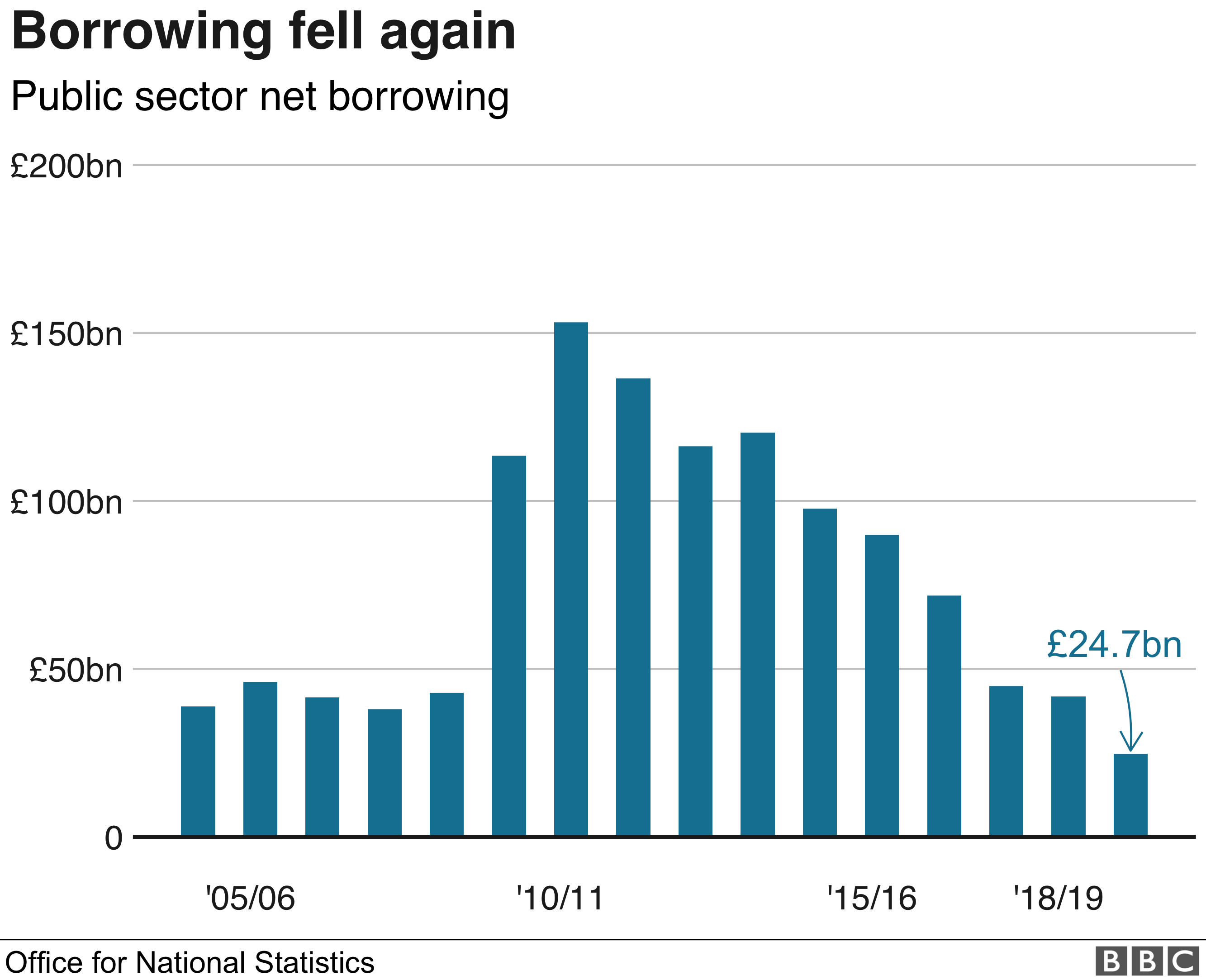
Government borrowing last year fell to its lowest annual level in 17 years, official figures show.
24 April 2019
 Money
Borrowing for the 2018-19 financial year was £24.7bn, £17.2bn less than in the previous financial year, the Office for National Statistics said.
Despite the drop, the amount was still higher than the Office for Budget Responsibility's forecast last month.
Economists believe the reduction should give the government freedom to ease the austerity measures of the last decade.
The figures showed tax receipts continued to grow strongly in March, but higher government spending accounted for the wider-than-expected deficit, mostly down to the purchases of goods and services.
The Chancellor of Exchequer, Philip Hammond wants to reduce borrowing to the equivalent of 2% of UK economic output. Borrowing last year was equivalent to 1.2%, giving the chancellor some extra spending room.

Scrap austerity?

Mr Hammond, speaking to the Treasury Select Committee on Wednesday reiterated that by the financial year 2020-21 the government would have around of £27bn to use on a range of options.
But he added: "Until we have resolved the Brexit issue I don't think it makes sense to to plump for one option or another."
Samuel Tombs, UK economist of Pantheon Macroeconomics, said: "The chancellor still should be able to scrap the further austerity measures planned for 2020-21 in the Budget later this year and meet his target."
borrowing
John McDonnell MP, Shadow Chancellor said: "So much for the deficit being eliminated - something the Tories told us they would achieve by 2015. Four years on and the Government has added another £1.7 billion to the deficit in March alone.
"Nine hard years of austerity have held down growth, and shifted deficits onto the shoulders of local councillors, NHS managers, and head teachers."


https://www.bbc.com/news/business-48036184

Friday, 22 September 2017

UK budget deficit unexpectedly narrows in boost for Hammond

The UK budget deficit unexpectedly narrowed in August as spending fell and the government recorded healthy receipts of value-added tax, stamp duty and national-insurance contributions.
FRI, SEP 22, 2017 - 11:09 AM
The shortfall was £5.7 billion (S$10.42 billion) compared with £6.9 billion a year earlier, the Office for National Statistics said Thursday. It left the deficit in the first five months of the fiscal year at £28.3 billion, down 0.7 per cent on the year.
The figures are a boost for Chancellor of the Exchequer Philip Hammond as he attempts to stick to his budget-cutting strategy in the face of demands to lift public-sector pay after years of austerity.
Special factors are expected to push up borrowing in 2017-18 as a whole but there is a growing consensus that the deficit will come in below the £58 billion predicted by the Office for Budget Responsibility in March.
Revenue rose 3.5 per cent last month, with VAT climbing 5.6 per cent to its highest level for any August on record despite the squeeze on household incomes from soaring import prices.
Stamp duty on property purchases jumped 18 per cent and NICs, a social-security levy, rose 5.8 per cent.
Self-assessed income tax receipts were adversely affected by timing issues. July 31, the deadline for so-called payments on account, fell on a Sunday in 2016, meaning revenue came in during the following month instead.
As a result, self-assessed receipts fell at an annual rate of 22 per cent last month, though combined income in July and August was the highest for the months on record at £9.4 billion.
On the spending side, day-to-day expenditure fell 0.6 per cent, helping to offset an increase in capital investment.
While debt payments fell, they are running 17 per cent higher in the fiscal year so far as result of higher inflation pushing up the cost of servicing index-linked government bonds.
The deficit has fallen from 10 per cent of GDP in the aftermath of the financial crisis to 2.3 per cent last year, and Mr Hammond is pledging to balance the books by 2025.
But any shock to the economy from Britain leaving the EU could blow his fiscal plans off course.
There are also questions over how far the government is prepared to relax its seven-year squeeze on public-sector pay.
An across-the-board easing could cost billions of pounds that the government might struggle to finance within existing budgets, forcing it to cut spending, raise taxes or borrow more.
BLOOMBERG

Friday, 22 July 2016

Britain BOOMS after EU vote: Ignore the doom-mongers…it’s good news all round

BRITAIN has been boosted by a host of positive economic reports putting paid to scaremongers who promised a financial crisis if we left the EU.

The Bank of England admitted it saw “no evidence” of a sharp economic slowdown and the pound gained in strength as a result.
Positive job figures showing unemployment falling and record numbers in work were heralded by new Prime Minister Theresa May.
Average earnings in the year to May were up 2.3per cent, official figures revealed, and mortgage brokers reported a brisk trade from foreign investors.
Economic newsGETTY
The British economy was boosted by positive economic news yesterday
The Bank of England, whose governor Mark Carney warned in May that Brexit was likely “to have a negative impact in the short term” reported that no such impact could be detected.
The Bank’s network of “regional agents” said UK firms were trying to maintain “business as usual” and the Bank said: “As yet, there was no clear evidence of a sharp general slowing in activity.”
The Bank’s agents said there had been a post-referendum dip in housing market activity but transactions had so far proved more resilient than some people had expected.
I’m delighted the IMF have climbed down and agree there will be no UK recession
Cabinet minister John Redwood
There was also “little evidence of any impact on consumer spending on services and non-durable goods” although some people were thought to be “more hesitant” about big purchases.
On Tuesday, the IMF - whose head Christine Lagarde warned in May that the consequences of Brexit would be “pretty bad to very, very bad” - forecast UK growth in 2017 to be 1.3 per cent, the fastest in Europe ahead of both France and Germany.
At home, the Office for National Statistics reported that employment reached an new record high of 74.4 per cent of the working age population, with 31.7 million people having jobs in the three months to May, 176,000 up from the previous quarter.
SterlingGETTY
The weak British pound is thought to be driving export growth
A total of 1.65 million people are unemployed, a fall of 54,000 over the quarter and 201,000 down compared with a year ago and an eight-year low, while the 4.9 per cent jobless rate was lower than any time since 2005.
Mrs May chose to open her debut Commons question time session as PM by welcoming the employment figures.
She also promised to pursue her goal of “an economy that works for everyone ... that delivers jobs and well-paid jobs in particular” while “living within our means”.
She told Labour leader Jeremy Corbyn: “I assure you that we are focused on building a country that works for everyone. That means an economy that ensures that everyone can benefit from the nation’s wealth, a society where everyone gets the opportunities they deserve and a democracy that everyone can have faith in.”
Later hailing recent aerospace deals and investments, she stressed: “Britain is open for business. I would encourage other companies to go out there and get that business.”
Work and Pensions Secretary Damian Green responded to the ‘remarkable’ employment figures: “This shows that there are more people in work than at any other point in our history, which is fantastic news as we build a Britain that works for everybody, not just the privileged few.
“We’ve entered a period of significant change, but when it comes to our jobs market we’re in a position of strength, with over 2.6 million more people in work than there were in 2010, the number of workless households cut to an all-time low, 750,000 vacancies in the economy and wages rising too.
“Our job now is to build on this success story so that everybody can benefit from the opportunities that are being created regardless of who they are or where they come from. Encouragingly, employment has risen in all regions and nations of the UK over the last year.”
Separately, estate agents reported that interest in the UK property market from overseas buyers was up 50 per cent since the Brexit vote, largely credited to the fall in the pound making such investments cheaper for foreign and expat buyers.
The reports belied predictions the referendum result would scare off foreign buyers.
John RedwoodGETTY
Cabinet Minister John Redwood was delighted with the positive news
Peter Wetherell, of upmarket London estate agents Wetherell, said: “Many potential buyers had been putting off their decision and waiting for the referendum result to see how the land lies.
“But now we have the result and a large number of buyers are back asking about properties to purchase.”
Conservative former Cabinet minister and Brexit backer John Redwood said of the IMF’s predictions: “I’m delighted the IMF have climbed down and agree there will be no UK recession. I’m delighted they now agree the UK will grow faster than France or Germany or Italy next year - though I think they’re underdoing it.
“I am increasing my forecasts for UK growth because there is a monetary loosening going on and the low value of sterling will help our exports.”
Mr Redwood hailed banking giant Wells Fargo’s decision reported this week to invest in a new £300 million London HQ as “another great vote of confidence”.
Mr Redwood went on: “I think things will be even better now when we’re making our laws and trade deals and showing we are more open for business.
“I think business people are just beginning to realise how restricted they were by all the tariffs and rules the EU imposes.”
IMFGETTY
The IMF predicted the UK economy would grow by 1.3 per cent in 2017
He expected a possible slight slowdown of activity this summer said this would be temporary and he stressed that top end property deals had already been hit by new tax rules introduced in April to tackle money laundering.
Mr Redwood added: “The good news is that people aren’t rushing for the exit in the way some people forecast because they are realising that it’s in the EU’s interests as well as in Britain’s interests to have no-tariff trade with fewer barriers between the EU and the UK. What’s not to like?”
UK Independence Party MP Douglas Carswell also hailed the retreat by economic forecasters on their pre-referendum gloom-mongering, saying: “It’s a bit like the Wizard of Oz. When you draw back the curtain you realise that those economic wizards who are supposed to have magical powers turn out to be a bunch of rather confused middle-aged men.
“Either they are incompetent and have no more idea as to what’s going to happen in the economy than random members of the public, or they connived with George Osborne to scaremonger people into voting to stay in the EU.”
Mr Carswell acknowledged there were concerns about the economy but said they did not arise from the Brexit vote: “They are because we failed to fix the banks and we ran our monetary policy as the IMF told us to.
“We need to rediscover a bit of self confidence.”