Showing posts with label Transition period. Show all posts

Wednesday, 30 December 2020

UK approves Brexit trade deal

 Prime Minister Boris Johnson says UK will become EU’s ‘best friend’ after Brexit transition ends.


The U.K. House of Commons has endorsed the Brexit trade deal | Christ J Ratcliffe/Getty Images

LONDON — The U.K.'s post-Brexit trade agreement with the European Union has passed into law after receiving royal assent in the early hours of Thursday morning.

Speaker of the House of Commons Lindsay Hoyle told MPs at 12.35 a.m. Thursday that Britain's Queen Elizabeth II had signified her royal assent for the European Union (Future Relationship) Act, after it passed through both Houses of Parliament.

MPs in the House of Commons voted 521 to 73 to pass the bill at its second reading in the Commons. It enshrines into law the 1,246-page Brexit deal struck by the EU and the U.K. on December 24. The deal covers goods and services trade, but also includes investment chapters, provisions on fish and data protection and arrangements for future cooperation on areas such as R&D and space.

Both the Conservative and Labour parties backed the legislation, despite a rebellion of a limited number of MPs from both camps. These included Tory former Northern Ireland Secretary Owen Paterson, who abstained, and former Shadow Home Secretary Dianne Abbott, who explained her decision to vote against the deal saying it falls short on policy areas such as security. The Scottish National Party, the Liberal Democrats, the Green Party, Plaid Cymru and the Democratic Unionist Party of Northern Ireland did not support the bill.

Opening the debate, Prime Minister Boris Johnson said that following the end of the Brexit process, the U.K. will “seize the moment to forge a fantastic new relationship” with the EU “based on free trade and friendly cooperation.”

“With this bill, we are going to become a friendly neighbor, the best friend and ally the EU could have, working hand-in-glove whenever our values and interests coincide with fulfilling the sovereign wish of the British people to live under their own laws, made by their own elected parliament,” Johnson said.

On the opposite benches, Labour Leader Keir Starmer faced criticism for his decision to instruct his party to back the deal in Westminster, while in the Scottish parliament Labour are expected to vote against the deal later Wednesday. Starmer defended Labour’s position saying the two votes are “completely different” and the only choice in Westminster is between a thin agreement and a no-deal outcome.

“When the default is no-deal it’s not a mark of how pro-European you are to reject implementing this treaty. It isn’t in the national interest to duck a question or to hide in the knowledge that others will save you from the consequences of your own vote,” he said.

The U.K. government in Westminster is expected to press ahead with implementing the deal regardless of whether the devolved administrations in Scotland, Wales and Northern Ireland express their consent.

Former Prime Minister Theresa May, who endorsed the agreement, lamented the very thin provisions on services and the loss of access to the Schengen Information System II security and border management intelligence database. But she expressed hope that more ambitious arrangements could be negotiated with the EU in the future. “We have a deal in trade which benefits the EU but not a deal in services which would have benefited the U.K.,” she said.

The bill concluded all its remaining stages in the Commons minutes after the second reading vote, and will now pass to the House of Lords, with peers expecting to vote it tonight. The legislation is expected to receive the royal assent it needs to become law shortly afterwards.

https://www.politico.eu/article/uk-house-of-commons-vote-brexit-trade-deal-eu/

Friday, 25 December 2020

BBC - Brexit: What you need to know about the UK leaving the EU

While you were settling in to enjoy Christmas Eve, the UK and European Union finally agreed a deal that will define their future relationship.

25 December 2020

Related Topics
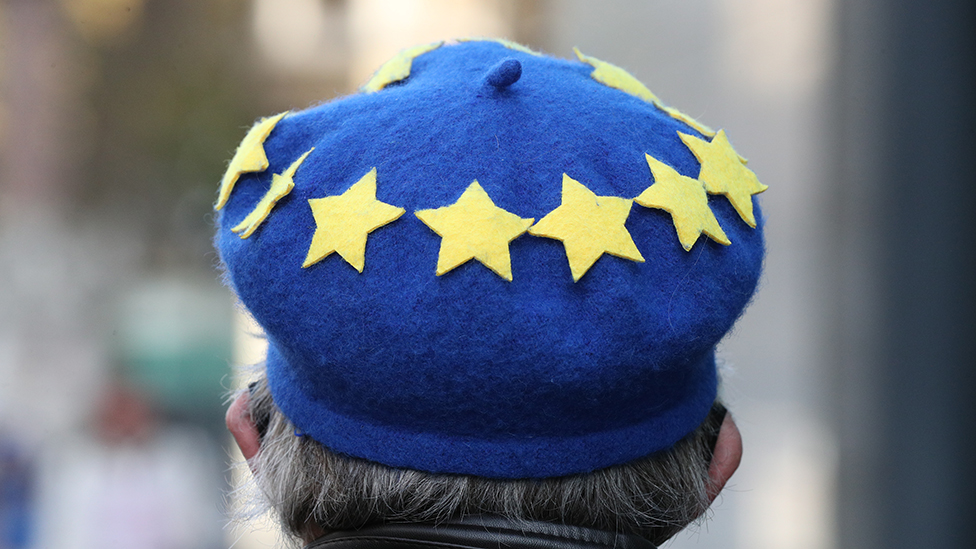
EU beanie hat, seen from behindIMAGE COPYRIGHTPA MEDIA

While you were settling in to enjoy Christmas Eve, the UK and European Union finally agreed a deal that will define their future relationship.

Ever since the UK left the the EU on 31 January, both sides have been talking about what the new rules should be.

The negotiations went to the wire, as the current arrangement ends on 31 December.

What do we know about the deal?

The deal contains new rules for how the UK and EU will live, work and trade together. But we don't know a lot of the detail yet because the full document - expected to be well over 1,000 pages long - has not been released.

What we do know is that it means:

  • No taxes on each other's goods when they cross borders (known as tariffs)
  • No limits on the amount of things which can be traded (known as quotas)

European Commission president Ursula Von der Leyen said competition rules - designed to prevent one side gaining an unfair advantage - "will be fair and remain so".

She said the UK and EU will "continue co-operating in all areas of mutual interest, including things like climate change, energy, security and transport".

We also know the UK will not be taking part in the Erasmus exchange programme for students.

Why did the deal take so long?

Because so much was at stake.

The EU is the UK's nearest and biggest trading partner, The UK government says the deal covers trade that was worth £668bn in 2019.

While the UK was in the EU, companies could buy and sell goods across EU borders without paying tariffs.

Without the deal, businesses would have had to start paying these taxes, which would have added to their costs.

No deal would have also meant even more border checks, which could have caused delays for lorries transporting products.

What happens next?

Even though the deal has been agreed, it still needs to be made law.

For that to happen it must be looked at and approved by both the UK and European parliaments.

As it's been left so late, the European Parliament won't have time to sign it off before the end of the year. That shouldn't stop the deal coming into force on 1 January, but it will take longer before it's officially rubber-stamped.

The UK government says it will summon MPs back on 30 December to vote on the deal. However, there wouldn't be time to debate and look at the details closely.

And in one sentence?

Both sides are relieved there is a deal, but people and businesses don't have much time to prepare for the changes starting on 1 January.

What are the EU and Brexit?

The EU is made up of 27 European countries.

EU citizens are free to live and work in other EU countries, and firms in those countries can buy and sell each other's goods without checks or extra taxes at borders.

The UK was the first country to leave the EU and this was known as Brexit - British exit.

Brexit happened because a public vote - or referendum - was held in June 2016, to decide whether the UK should be in the EU.

What Brexit words mean

The last few years have seen many words and phrases enter our lives. We haven't used them here, but politicians do use them. Here's what some of them mean:

Transition period: The 11-month period following the UK's exit from the EU (finishing at the end of 2020), during which time the UK has followed EU rules, to allow leaders to make a deal

Free trade agreement: This is what the EU and the UK have now agreed - a deal between countries that encourages trade by getting rid of barriers like taxes on goods

WTO rules: If countries don't have free trade agreements, they must trade according to rules set by a global body called the World Trade Organization (WTO), which can mean taxes on goods

UK map showing which parts of the country voted for and against Brexit

More on this story


https://www.bbc.com/news/uk-politics-32810887

Monday, 19 October 2020

19 Oct 20 The Church and the internal Market Bill

 Ngel Farage, the veteran Brexiteer was referring to a joint letter by leading Anglican clerics the Archbishop of York, Justin Welby, the Archbishop of York Stephen Cottrell, the Archbishop of Armagh, John McDowell, the Archbishop of Wales, John Davies, and the Primus of the Scottish Episcopal Church, Mark Strange, complaining about the Internal Market Bill which passed the House of Commons with a resounding majority and is currently before the unelected House of Lords.

JACK MONTGOMERY

Excerpt taken from the article " Farage on London Church Attack: ‘We Are a Christian Country and Our Culture Is Under Assault’ "

The bill was drawn up after government ministers became concerned that the European Union intended to abuse measures in the Brexit Withdrawal Agreement (WA) to prevent food from being imported from Great Britain to the British province of Northern Ireland if, as looks increasingly likely, the ongoing Brexit-in-name-only “transition period” expires at the end of 2020 without a formal trade UK-EU trade agreement being struck.

The WA leaves Northern Ireland partly within the EU’s regulatory ambit in the event of a “No Deal”, in order to main the supposedly all-important open border between Northern Ireland and EU member-state the Republic of Ireland — but the British government did not anticipate that the EU would interpret this in such a way as to allow them to blockade the transport of food from one part of the United Kingdom to another.

Consequently, the Internal Market Bill is intended to give British government ministers the power to “disapply” elements of the WA if it is used in this way — a move the EU and its British apologists — including the increasingly politicised Church of England — have decried as a breach of international law.


“We believe this would create a disastrous precedent,” the Anglican clerics’ letter complains.

“If carefully negotiated terms are not honoured and laws can be ‘legally’ broken, on what foundations does our democracy stand?” they add, as though allowing the EU to control trade between different parts of the United Kingdom in order to uphold the sanctity of a foreign treaty would be more democratic than allowing Britain’s duly elected representatives amend or leave that treaty to uphold the national interest.

Former Brexit minister Steve Baker MP responded to the intervention by saying that he was “extremely disappointed that the archbishops are sowing disunity and division at a time when they could instead build up much-needed harmony in our nation,” adding: “I pray that the archbishops might be blessed with better legal advice. They would then realise the hysterics of various lawyers are not justified.”

Former Conservative Party leader Sir Iain Duncan Smith MP was far more cutting, remarking acidly:  “I hope this is not a distraction from the difficulties the Church of England has been in with the inquiry into Child Abuse, which reported back last week.

“I hope this is not an attempt at distraction from the Church of England’s own internal troubles.”

Follow Jack Montgomery on Twitter: @JackBMontgomery


https://www.breitbart.com/europe/2020/10/19/farage-on-london-church-attack-we-are-a-christian-country-and-our-culture-is-under-assault/

Sunday, 23 August 2020

‘They want us to obey the rules of their club’: Michael Gove attacks EU over Brexit talks

Michael Gove has attacked the EU over its stance in the ongoing Brexit talks, saying it wants Britain to “obey the rules of their club even though we are no longer members”.
James Morris
Senior news reporter, Yahoo News UK

Gove was hauled into the House of Commons on Tuesday to answer an urgent question about the third round of negotiations on the UK and EU’s future relationship, which took place last week.
The chancellor of the Duchy of Lancaster and Cabinet Office minister told MPs it will be “difficult” to reach an agreement “while the EU maintains such an ideological approach”.
It comes after Michel Barnier, the EU’s chief negotiator, launched another blistering attack on Boris Johnson’s government on Friday, saying: “The UK will have to be more realistic… you cannot have the best of both worlds.”
Michael Gove hit back following Michel Barnier's criticism of the UK. (Parliamentlive.tv/Getty Images)
Gove told the Commons the discussions were “constructive” and that consensus exists on issues such as a free trade agreement, law enforcement and aviation.
However, he added: “There remain some areas where we have significant difference of principle, notably on fisheries, governance arrangements and the so-called level playing field [a term used by the EU as part of its calls for fair and competitive trade].
“The EU essentially wants us to obey the rules of their club – even though we are no longer members – and they want the same access to our fishing grounds as they currently enjoy, while restricting our access to their markets.
“It remains difficult to reach a mutually beneficial agreement while the EU maintains such an ideological approach.
“But we believe an agreement is possible if flexibility is shown… but success depends on the EU recognising that the UK is a sovereign equal.”
The UK, after leaving the EU on 31 January, is currently in a transition period in which the two sides have until 31 December to agree their future relationship.
During the transition period, the UK effectively remains a member of the EU. The transition period can be extended for up to two years, but Downing Street must give notice of this by 30 June.
Because of the coronavirus crisis, there have been calls for Number 10 to extend the transition period, with leaders primarily focused on the pandemic. However, the government has insisted it will not be seeking an extension.
Britain's Prime Minister Boris Johnson stands outside 10 Downing Street to look at posters drawn by children, of rainbows, being used as symbols of hope during the COVID-19 pandemic, and messages of thanks for the workers of Britain's NHS (National Health Service), in central London on May 15, 2020. (Photo by DANIEL LEAL-OLIVAS / AFP) (Photo by DANIEL LEAL-OLIVAS/AFP via Getty Images)
Boris Johnson fought the 2019 general election on a promise to "get Brexit done". (AFP via Getty Images)
If a future relationship agreement is not reached with the EU, the UK will then trade with the EU on World Trade Organization (WTO) terms – the same as what a “no-deal” Brexit would have entailed.
One more round of talks is scheduled for the week beginning 1 June, before a high-level meeting later in June to review the progress made.

Friday, 31 July 2020

Michel Barnier warns Brexit deal is ‘unlikely’ as he accuses UK of being ‘unwilling to break the deadlock’

James Morris
Senior news reporter, Yahoo News UK

Michel Barnier has said a 'future relationship' Brexit deal with the UK is 'unlikely'. (European Commission)

Michel Barnier has warned a Brexit deal is “unlikely” after he accused the UK of being “unwilling to break the deadlock”.
It follows the latest round of talks seeking to agree a “future relationship” deal between the UK and EU beyond 31 December.
Barnier, the EU’s chief Brexit negotiator, said talks remain at a stalemate: “We are still far away.”
At a press conference on Thursday, he accused Boris Johnson’s government of “not showing a willingness to break the deadlock”.
Boris Johnson and Michel Barnier pictured in October last year. (AFP via Getty Images)
He added: “Over the past few weeks the UK has not shown the same level of engagement and readiness to find solutions respecting the EU fundamental principles and interests.”
Barnier said there had been no progress on two key points: the “level playing field” to ensure fair competition between businesses, and fisheries.
“We have been saying the same thing since the very beginning of these negotiations,” he said.
“They were part and parcel of our engagement with Boris Johnson eight months ago [when the UK and EU agreed a Brexit blueprint]. We are simply asking to translate this political engagement into a legal text, nothing more.
“The time for answers is quickly running out.
"By its current refusal to commit to open and fair competition, and to a balanced agreement on fisheries, the UK makes a trade agreement – at this point – unlikely."
The UK, after leaving the EU on 31 January, is in a “transition period” in which the two sides have until 31 December to agree their future relationship.
During the transition period, the UK effectively remains a member of the EU. It could have been extended for up to two years but Michael Gove “formally confirmed” the UK wouldn’t seek an extension last month.
Barnier also warned the EU and UK have until “October at the latest” to strike a deal or risk the imposition of quotas and tariffs.
He said: “If we do not reach an agreement on our future partnership there will be far more friction.
“For instance, on trading goods – in addition to new customs formalities there will be tariffs and quotas.
“This is the truth of Brexit... and I will continue to tell the truth.

Read more: Russia report: Seven revelations from the damning document that was delayed for nine months

“If we want to avoid this additional friction we must come to an agreement in October at the latest so that our new treaty can enter into force on 1 January next year.”
David Frost, the UK’s chief Brexit negotiator, said in a statement: “Considerable gaps remain in the most difficult areas. That is the so-called level playing field and on fisheries.
“We have always been clear that our principles in these areas are not simple negotiating positions but expressions of the reality that we will be a fully independent country at the end of the transition period.”