Showing posts with label Brexit Party. Show all posts

Tuesday, 21 January 2020

Brexit Party MEP Alexandra Phillips rips into 'revolting' EU - 'It is anti-democratic!'

BREXIT PARTY MEP Alexandra Phillips unleashed a scathing attack on the European Union during an interview with talkRADIO's Mike Graham.


Ms Phillips claimed the European Union was "deliberately made to be anti-democratic", admitting she was "revolted" by the Brussels political system. The Brexit Party MEP slammed the EU for their treatment of Greece and Italy when the economic crisis happened. She also told talkRADIO's Mike Graham the entire European system was corrupt.


Brexit news
Ms Phillips labelled the EU anti-democratic (Image: TalkRADIO)

Ms Phillips said: "It is anti-democratic, not undemocratic but deliberately made to be anti-democratic.
"That is what I find revolting.
"When the massive economic crisis happened, the Eurozone crisis and everyone saw the way the EU treated countries such as Italy and Greece.
"Essentially saying to democratically elected leaders sorry because you’re probably going to want to leave the euro to devalue your currency and get back on your feet we can’t have that because it is going to threaten the project.
Brexit news
The Brexit Party MEP said the EU was corrupt (Image: TalkRADIO)
"We are going to have to remove you and impose such strident austerity.
"At one stage you had about 100,000 Greek families relying on food banks."
Mr Graham added: "The streets were burning, the streets were on fire, there were riots going on."
The Brexit Party MEP responded: "At the same time the Nobel Peace Prize was awarded to the EU.
"I can’t get my head around how corrupt this entire system is."
Brexit news
The Brexit Party MEP warned Croatia about joining the euro (Image: Getty)
Last week Alexandra Phillips slammed the European Union's future plans during a European Parliament plenary session.
She said: "The vision for the EU over the next six months a simply astonishing, open borders with two more countries Albania and Macedonia and ambitions to keep the UK shackled to EU rules.
"Why on earth would we want to do that?
"If those policies were not bonkers enough you want Croatia to also join the failing single currency.
"You would be locking your country and your people inside an economic prison."
The 2016 EU referendum result
The 2016 EU referendum result (Image: Express)
Ms Phillips continued: "The Euro is the EU poster child for weak growth, high unemployment and stagnant wages.
"Don’t do it, keep the Kuna!"
"As Brexit has shown citizens want freedom, not being dictated to by a faceless super state.
"The UK is leading the way out of this fanatical democratically bankrupt project.
"I am telling you unless the EU can show the will to reform many brave nations will follow."


Friday, 13 December 2019

The dream is dead: Johnson election triumph breaks UK "remainer" hearts

LONDON (Reuters) - After all the arguments and all the mass marches, opponents of Brexit faced a stark truth on Friday after Prime Minister Boris Johnson’s election landslide: there will be no second referendum and divorce from Europe is inevitable.

DECEMBER 13, 2019 / 11:51 AM / UPDATED 3 HOURS AGO
Andrew MacAskill
5 MIN READ


A Conservative Party rosette is seen on a jacket as ballots are tallied at a counting centre for Britain's general election in Chesterfield, Britain, December 13, 2019. REUTERS/Molly Darlington

With the Conservatives set to win their largest parliamentary majority since 1987, Johnson will be able to push his divorce deal through parliament, allowing Britain to leave the EU next month.

It will be Britain’s most significant geopolitical move since World War Two.

Some supporters of another Brexit vote blamed themselves for the crushing defeat. The main organisation campaigning for a second referendum imploded, while the leader of the main opposition Labour Party was ambivalent, pledging to stay neutral in any other vote.

“I am distraught, and like everyone else in the remain community wish we had more competent representation,” said Mike Galsworthy, an anti-Brexit campaigner, who was sipping a whisky before going to bed after seeing the exit polls come in.

The 2016 referendum on EU membership has been the most polarizing issue in recent British history, crystallising divisions between cities and towns, young and old, the winners of globalisation and those left behind.

For many pro-Europeans in Britain, another referendum represented the best chance of ending the turmoil and political paralysis. If they had united into a single political force, they may have stood a chance of overturning the result.

In addition to their own shortcomings, so-called “remainers” were outmanoeuvred.

Over the past three years, support for remaining in the EU has led in almost every opinion poll, prompting some of the largest street protests in modern British history. Parliament twice forced Brexit to be delayed.

But the main opposition parties failed to work together to forge a functional cross-party alliance, mystifying millions of Britons.

While the Conservatives consolidated the vote of those who want to leave the EU, building a coalition of pro-Brexit voters across regional and class lines, campaigners for another referendum struggled to win converts or agree on a unified plan.

DIVIDED
After his crushing election victory, Johnson said “all those miserable threats” of a second referendum were over. He told one protester - who wears a hat with the blue and gold flag of the EU and yells “stop Brexit” at politicians outside parliament - that it was time to retire.

“I say respectfully to our stentorian friend in the blue 12-star hat that’s it’s time to put a sock in the megaphone and give everybody some peace,” he said.

Key to the “Remain” camp’s defeat was Labour’s refusal to join an initiative aimed at encouraging tactical voting, whereby people back a candidate in order to block another rather than out of genuine support.

In London seats such as Kensington, Wimbledon and Chipping Barnet, the Conservatives narrowly won after Labour and the pro-European Liberal Democrats split the anti-Brexit vote.

By contrast, the newly created Brexit Party agreed not to run against Conservatives in about half of constituencies to avoid diluting the pro-Brexit vote.

Many campaigners said the fate of their movement was inextricably linked with Labour leader Jeremy Corbyn, the least popular opposition leader in living memory and a veteran opponent of Britain’s EU membership.

Other campaigners blamed strategic errors by the opposition, such as agreeing to a snap election when the prime minister was trapped in parliament, unable to pass his Brexit deal unamended.

Johnson got the election he had sought when the opposition parties’ united front against a vote broke.

The People’s Vote, the main umbrella group campaigning for a second vote on EU membership, said they will now rebrand early next year to fight for Britain to have close ties with the bloc.

The group, which has been gripped by infighting in recent weeks, will “refocus its campaign to concentrate on vital social issues that the government must urgently prioritise in its Brexit negotiations.”

Reporting by Andrew MacAskill; Editing by Guy Faulconbridge and Gareth Jones

https://uk.reuters.com/article/uk-britain-election-remain/the-dream-is-dead-johnson-election-triumph-breaks-uk-remainer-hearts

The Brexit party folded, but make no mistake: Farage won it for Johnson

Whatever Nigel Farage does next, his decision to stand aside against 317 Tories and target Labour leavers was monumental

Fri 13 Dec 2019 Last modified on Fri 13 Dec 2019 


https://www.theguardian.com/commentisfree/2019/dec/13/brexit-party-nigel-farage-boris-johnson-labour-leavers

Nigel Farage
 ‘Farage pledged to scoop up the leave vote in Labour heartlands and places people were unlikely to ever vote Tory.’ Photograph: Scott Heppell/Reuters


Until 11 November, many had assumed that Nigel Farage’s Brexit party was revving up for a general election. But that morning, Farage told an audience of supporters and journalists in Hartlepool that his Brexit party would be standing down in 317 Conservative-held seats to avoid splitting the leave vote. The audience was stunned; there was muted applause after he finished.
This election will be remembered as a resounding, crushing victory for Boris Johnson’s Conservatives. Just as has happened countless times before, Farage will be written off and ridiculed for his party not winning a single seat. But that morning of 11 November was the single most important moment of the campaign. Farage won it for Johnson.
The decision to stand down against the Tories was not an easy one. According to Ed Jankowski, who was the Brexit party’s digital strategist until the middle of November before resigning, Farage was for a long time eager to stand in every seat and not stand down – as he was being pressured to do by his erstwhile Leave.EU ally Arron Banks. Farage instead kept pushing a leave alliance that the Tories were never likely to officially agree to. But as the Brexit party started to flag in the polls, Farage lost his nerve and gave in to those not wanting to challenge Conservative seats.
In Farage’s speech, and in the weeks following, he pledged to scoop up the leave vote in Labour heartlands and places people were unlikely to ever vote Tory. As for Jankowski, he told me that he pushed hard to get a detailed data set of Labour leavers. If he had stayed on, Jankowski says he would have pushed for the Brexit party to hone its digital content so that it made a strong emotional appeal to those voters.


Alexandra Phillips
Pinterest
 ‘Nigel Farage’s close ally Alexandra Phillips said she felt ‘disenfranchised’ for not being able to vote Brexit party in her own Tory-held constituency.’ Photograph: Johnny Armstead/REX/Shutterstock

Instead of the sophisticated digital campaign Jankowski envisaged, the wheels seemed to come off the Brexit party campaign. Farage’s close ally Alexandra Phillips, who used to be his head of media at Ukip, publicly criticised the decision to stand down, saying she felt “disenfranchised” for not being able to vote Brexit party in her own Conservative-held constituency. Farage and the party chairman, Richard Tice, are also rumoured to have fallen out over strategy, with Farage no longer showing up in the seat Tice stood in Hartlepool.
Farage spent the rest of the campaign travelling predominantly to Labour leave seats, albeit to greatly diminished crowds compared to the big rallies seen earlier in the year. But while the shine had gone from the Brexit party, and it ended up winning no seats, its campaign has had a major impact on the election.
One of the early results of the election night, a Labour hold in Sunderland Central by 2,964 votes, was striking for the swing. Labour was down 13.4%, Conservatives up slightly by 2%, while the Brexit party had a swing of 11.6% from a standing start. When the first 10 seats were in, in mostly northern and Midlands seats, there was nearly a 10% drop for Labour, while the Conservatives were only up 2.1% and the Brexit party was scooping up a 6% swing.
In some places the Conservatives gained seats from Labour on modest swings, while the Brexit party got swings of more than 10%. In Don Valley, Caroline Flint’s 2017 majority of 5,169 appears to have been swallowed up by the Brexit party – which won 6,247 votes as the Tories took the seat. A similar dynamic appears to have taken place in Tony Blair’s former seat of Sedgefield.
Farage, whatever you think of him, was right. Many Labour leavers, who couldn’t bring themselves to vote Tory, did vote for the Brexit party. This wasn’t the case everywhere. In the much-watched seat of Workington, the Brexit party won little more than 1,749 votes to the Conservatives’ 20,488.
It’s not clear what happens to the Brexit party now, with a Conservative majority set to secure an exit from the EU. Farage has already registered the name of the Reform party. As this general election campaign wore on, Farage increasingly focused on radical reform – more direct democracy, scrapping of the House of Lords, a reformed electoral system. When I spoke to the Brexit party’s Claire Fox in October, she saw Brexit as the gateway to a kind of bloodless revolution for British democratic institutions. Fox is part of a core of former Revolutionary Communist party figures who have flocked to the Brexit party and remained loyal to Farage, who ended up convening around Spiked, the rightwing media outlet.
With Brexit a done deal, Farage himself is rumoured to be heading for the US to cash in via the lucrative speaker circuit. Farage basically admitted to Andrew Neil on election night that he would be giving stump speeches for Trump on the campaign trail for the US presidential election 2020.
Wherever he ends up, and whatever happens to the Brexit party now, this election is the culmination of a long campaign to redraw the map of British politics, starting with Farage forcing David Cameron’s hand in calling an EU referendum in the first place. Without Farage’s decision to stand down against 317 Conservatives, the election would have been very different. Without going hard after Labour leavers, the Conservatives would not have a thumping majority. Although his party hasn’t won a seat, and even if his campaign itself faltered, the untold story of this election is how Farage once again shaped events. He remains the bête noire of British politics.
• Darren Loucaides is a writer based in Barcelona and London

Nigel Farage’s project falls flat as Brexit party set to win zero seats

Farage expected to focus on supporting Donald Trump’s presidential campaign as Brexit party flounders
Lisa O'Carroll
13 Dec 2019 04:15GMT

https://www.theguardian.com/politics/2019/dec/13/nigel-farages-project-falls-flat-as-brexit-party-set-to-win-zero-seats

Brexit party chairman Richard Tice
 Richard Tice failed to win Hartlepool in north-east England on what looked set to be a disastrous night for the Brexit party. Photograph: Lee Smith/Reuters

The Brexit party is on course for a total wipeout with none of its 273 candidates expected to make the green benches of Westminster.
Nigel Farage’s party failed its first test in Peter Mandelson’s former constituency of Hartlepool in north-east England, where its chairman and most senior candidate, the property millionaire Richard Tice, was hoping to end 55 years of red rule.
Labour’s Mike Hill held on to the seat with 15,464 votes – a majority of 3,595 – seeing off Tice, who got just over 10,000 votes. But the Brexit party got 25.8% of the vote, just behind the Tories at 28.5%, suggesting the Conservative landslide would have been even greater had Farage given Boris Johnson a clear run in all seats.
Its hopes of taking another key Labour marginal, Tony’s Blair’s former seat of Sedgefield, also failed but Jeremy Corbyn’s party was left reeling nonetheless, down 17 percentage points on 2017.
Labour’s Phil Wilson, who was defending a majority of more than 6,000 votes in the seat, hit out on social media at his party’s “delusional” leadership.
Ann Widdecombe, the former Tory MP, was not expected to win for the Brexit party in Plymouth Sutton and Devonport.
Farage said his political life was not over, claiming a new party would rise from the ashes. “It will become the reform party, it will campaign, one of the reforms being getting rid of the first past the post system and giving people a choice,” he told the BBC.
The Brexit party appeared to scupper its own electoral chances in early November, announcing it would not contest the 317 seats won by the Conservatives at the 2017 general election.
Its support subsequently crashed in the polls and a further blow came when four MEPs, including Annunziata Rees-Mogg, Jacob Rees Mogg’s sister, quit the party urging voters to support the Conservatives instead, arguing it was splitting the leave vote and giving remain alliances a boost.
Their fears proved correct on the night, suggesting the Tory landslide would have been bigger had Farage stood down in all seats. In Barnsley, it took 29.2% of the vote, two points ahead of the Tories. In Gower, it was neck and neck with the Conservatives, with both parties taking 29.9%.
In Blyth Valley, a tight marginal snatched from Labour by the Conservatives, the Brexit party took 8.3% of the vote.
Following the election, Farage is expected to focus his efforts on supporting Donald Trump’s presidential campaign. “If I am asked to help I will,” he told the BBC. But he said he would stay in Britain to fight for what he believed was a proper Brexit.
Farage said: “The truth of it is, half the cabinet voted remain. Michael Gove – I was with him earlier – clearly wants the softest of all Brexits.
“Boris, whilst he is committed to leave, has never really, I don’t think, been keen on leaving on WTO terms.
“My view is a big majority means that the influence of the ERG [European Research Group], the influence of those who are committed Eurosceptics, becomes a lot weaker and I would expect, I’ll predict, by 1 July we will be extending the transition period out until 2022.”

Monday, 9 December 2019

The 2019 UK elections, explained - vOX

The UK is voting on Thursday. It’s (mostly) about Brexit.


Prime Minister Boris Johnson and Labour leader Jeremy Corbyn attend the State Opening of Parliament at the Palace of Westminster in London, England on October 14, 2019. 
Jack Hill - WPA Pool/Getty Images

The United Kingdom will vote on December 12, and the country’s unfinalized divorce with the European Union looms over it all.
These are the Brexit elections. Even if many wish they weren’t.
Whoever wins the election will ultimately determine whether the United Kingdom leaves the European Union early next year — and, if it does, they’ll likely be determining what that future relationship might look like.
Prime Minister Boris Johnson and his Conservative Party have vowed that if they reclaim their majority in Parliament, they will “get Brexit done” by quickly passing the prime minister’s Brexit deal and moving to negotiate a free-trade agreement with the EU by the end of 2020.
Labour, the opposition party led by Jeremy Corbyn, is instead proposing to renegotiate the Brexit deal, and then put it back to the British people for a final vote on whether they want to leave the EU on those terms — or just remain in the EU after all.

Protesters demonstrate against the EU referendum result outside the Houses of Parliament in London, England on June 28, 2016. 
Jeff J Mitchell/Getty Images

Some smaller parties are in the mix, from the new Brexit Party led by Nigel Farage, which prefers a hard Brexit, to the Liberal Democrats, led by Jo Swinson, which has promised to cancel Brexit altogether. These parties were never expected to win majorities outright, and now, as the election date nears, there are signs — especially among Brexit supporters — that their voters are moving to the two major parties that actually have a chance.
Right now, the Conservatives lead most polls, which would put them on pace to win a majority, though maybe not a huge one. That would see Johnson would return as prime minister with a Parliament finally behind him. Some recent polls have shown that lead narrowing a bit, and if continues, things may get a lot messier. A close vote could mean a hung Parliament, where no one party has a clear majority.
Much is uncertain, not least because of the weird timing of the elections: just before the holidays, and with winter approaching — not exactly an ideal time for either canvassers or voters. Then there’s the fatigue on all sides over the never-ending Brexit political fight. All of this could affect turnout.
All parties are promising that when (if) they’re in power, it won’t be all about Brexit. But none of the Brexit options parties are offering to voters can deliver a simple solution resolving the EU-UK divorce. Because there is none.
Here’s what you need to know about the UK elections on Thursday.

Why is the UK having elections now?

The UK wasn’t supposed to have elections until 2022, given that the country just voted in 2017. But in that election, the Conservatives lost their majority.
They were able to retain power through an arrangement with the conservative Democratic Unionist Party in Northern Ireland, where the DUP supported the Conservatives on key votes but wasn’t formally part of their governing coalition.
But Brexit tested that shaky majority. Then-Prime Minister Theresa May couldn’t get her Brexit deal through Parliament, thanks to the extreme Brexiteers in her party repeatedly voting it down.
When Boris Johnson took over as party leader and prime minister in July, he faced a different sort of rebellion from the more moderate or pro-EU members of his party. They joined with the opposition to pass legislation blocking a no-deal Brexit. More than 20 Conservative members got punished for defying him in September, essentially getting kicked out of the party.

British Prime Minister Theresa May holds a cabinet meeting at the Prime Minister’s country retreat Chequers to discuss department-by-department Brexit action plans in Ellesborough, England on August 31, 2016.
 Stefan Rousseau/WPA Pool/Getty Images

Normally, this would crater a government, as ruling without a majority really doesn’t work in parliamentary systems. And Johnson very much wanted to hold new elections to try to win back a secure majority. But timing and the quirks of a law known as the Fixed-Term Parliaments Act roadblocked everything.
The Fixed-Term Parliaments Act made it so that Johnson needed two-thirds of lawmakers to agree to call an election. And Labour and other opposition parties refused to agree until they could guarantee that the previous Brexit deadline of October 31 would be extended, which they saw as an insurance policy against a no-deal Brexit.
So the stalemate continued through the fall. But it worked, at least from the perspective of the opposition parties. Even though Johnson brought back a revised deal from the EU (which Parliament even backed in the first vote), the prime minister was forced to get an extension, something he didn’t want to do, and Brexit was postponed until January 31, 2020. Even though Labour, in particular, was wary about their electoral chances — Johnson did, and still does, have a lead — they had little choice but to finally agree to an election. So, at the end of October, they relented.
Elections were on.

The key players you need to know

“Wait, didn’t the UK just get a new prime minister?” you might ask. The answer is yes: Boris Johnson became prime minister in July. But Johnson got the job not by winning a general election, but by winning the Conservative leadership contest — basically an election among the lawmakers and 160,000 dues-paying members of his own party.
This time, the entire United Kingdom gets to vote on whether it wants the Conservatives, still led by Johnson, to remain in power, or if they’d rather opt for someone else, specifically Labour leader Jeremy Corbyn.
Other smaller parties definitely have the power to take votes away from the two major parties, which could immensely influence the election. But the prime minister will almost certainly come from the Conservative or Labour party.
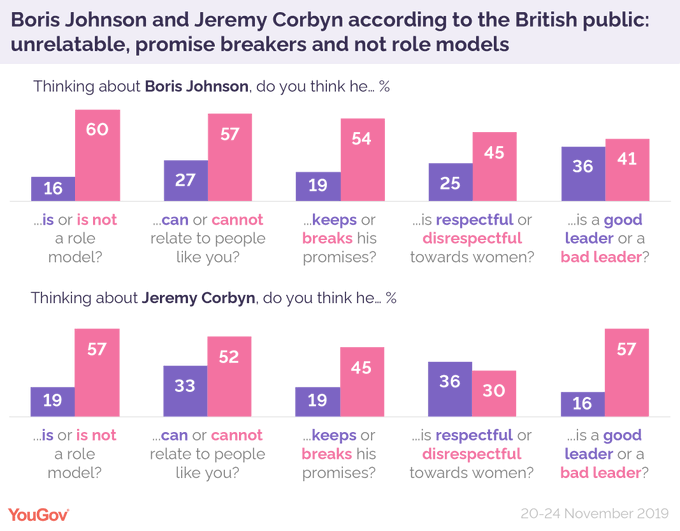
Which is too bad for voters, because neither Johnson and Corbyn are well liked or deeply trusted. Although, at least according to the polls, Johnson and the Conservatives still have the edge.
Here are the key players:

Prime Minister Boris Johnson and the Conservative Party

Johnson — whose full name is Alexander Boris de Pfeffel Johnson (yes, seriously) — is the 55-year-old former Mayor of London who was one of the main pro-Brexit campaigners.
He took over the party (and premiership) in July, promising to deliver Brexit by October 31. He failed — mostly because Parliament thwarted him.
Now, Johnson is telling voters that if they elect a Conservative majority that will back him up, he’ll “get Brexit done” and “unleash the potential of the whole UK.”
The Conservatives’ Brexit vision is extraordinarily sunny. Their manifesto (which operates like a party platform in the US, but is taken far more seriously given that a parliamentary majority should make it easy to implement that agenda) promises that Johnson will pass his Brexit agreement immediately, taking the UK out of the EU in January.
Then he’ll quickly begin negotiations with the EU on a free-trade agreement, wrapping that up by the current December 31, 2020, deadline. The Conservatives say they will not extend that deadline, meaning they’re planning to take just 11 months or so to figure out the country’s future trading relationship with the EU after the breakup alone took three years. The party also promises to have 80 percent of UK trade covered with new deals with key partners, including the United States, in the next three years.
So if you want Brexit, what Johnson and the Conservatives are selling sounds pretty darn good, even if what they’re promising is going to be a lot messier and much harder to accomplish in practice.
But Brexit is not the only issue in their platform. Conservatives are also promising more funding for the National Health Service (NHS) — which, after Brexit, is perhaps the top issue for UK voters — as well as more funding for police. The latter may be particularly salient now following a deadly stabbing terror attack near the London Bridge just two weeks ago that came amid a rise in knife crimes across the country over the past several years. On terrorism, in particular, a recent YouGov poll said voters trust Conservatives much more than Labour.
It’s an attempt to walk back some of the policies of austerity of the Conservative-led government since 2010, which have not been all that popular. Indeed, London Mayor Sadiq Khan, a Labour party member, has blamed the rise in knife crime on the Conservative-mandated cuts to police funding.
But for the most part, the Conservatives are really driving their Brexit promise hard. Boris even got a new bus for it.

Jeremy Corbyn and the Labour Party

Corbyn has been the leader of the Labour Party since 2015, and though he did better than expected in the 2017 election, things are not looking so great this time around.
Corbyn is deeply unpopular. So is Johnson to a lot of voters, but Corbyn has some extra baggage. Corbyn, a self-described socialist, is sometimes perceived as being too left-wing and he’s held some radical views, particularly on foreign policy, that some of the more moderate voters in his party reject.
He’s also facing an ongoing anti-Semitism crisis that has rocked the Labour Party for months and has only intensified during the campaign season, though legitimate concerns are sometimes mixed in with bad-faith attacks on Corbyn by political opponents.
Corbyn has been critical of Israel’s treatment of Palestinians, which is not anti-Semitic, but he has made some uncomfortable statements, including calling members of the terrorist groups Hamas and Hezbollah “friends” in 2009. He’s had to apologize for other past comments, including a 2012 Facebook message he sent to a mural artist which depicted anti-Semitic tropes.
But there have been major instances of anti-Semitism within the ranks of the Labour party since Corbyn’s rise to power (some MPs were suspended), which has led some critics to accuse him of allowing anti-Semitism to fester within the party, or at least failing to do enough to condemn it and take the very real concerns from Jewish lawmakers and others in the community seriously.
And, ahead of this election, The Jewish Chronicle used its front page in early November to call on voters to reject Corbyn, and the UK’s chief rabbi called a “mendacious fiction” that the Labour party has ended anti-Semitism within the party.
Corbyn has a long, long history as an anti-racist campaigner, and he’s condemned anti-Semitism publicly. But he has come off equivocal on the issue at times, including a November interview with a BBC reporter where he refused to apologize for anti-Semitism within the party. Corbyn has since done so, he’s repeatedly made clear that he did not accept anti-Semitism “in any form.” Either way, Corbyn has repeatedly been confronted by this controversy, and may be coloring voters’ views.
(Conservatives have been accused of Islamophobia within their ranks, but it hasn’t gotten as much attention.)
Corbyn and Labour’s somewhat muddled stance on Brexit in an election that is absolutely all about Brexit may also be a liability. Labour’s manifesto states they will renegotiate the Brexit deal in three months, seeking closer ties with the EU. Then, they’ll hold another referendum in six months, where they will ask the public whether they want to leave with the EU with Labour’s deal, or remain in the EU.

Leader of the British Labour Party Jeremy Corbyn arrives at a gathering of European Socialists prior to a summit of European Union leaders in Brussels, Belgium on October 17, 2019. 
Sean Gallup/Getty Images

That’s a tight timeline to renegotiate a deal and hold another vote, and it means delaying and prolonging Brexit well into 2020 — all of which will require buy-in from the EU. Corbyn himself has said he’ll stay “neutral” on the question of whether the EU should leave or remain, even though many lawmakers in his party want him to advocate for remaining.
Labour is in a much trickier spot than Conservatives, which have gone all-in on Brexit, and the party has followed. A huge core of Labour’s voters favor Remain, but Labour also holds seats in constituencies that voted Leave, many in traditional working-class strongholds such as in the north of England.
Labour is trying to avoid alienating the Leavers or Remainers in its party. The problem is, by “fence-sitting” Labour risks satisfying no one. Conservatives are framing a vote for Labour as essentially a vote to delay Brexit and ultimately Remain, anyway. Add that to Corbyn’s other woes, and it helps explain some of Labour’s struggles.
“In addition to all the reasons why people don’t like Corbyn, the reason why Labour is not winning is because they’re not differentiating themselves in a clear way on the key issue from Conservatives,” Abraham Newman, a professor at the Georgetown University School of Foreign Service, told me. “It’s hard to be a strategic voter when that would force you to vote for a party that’s only lukewarm on your strategic interests.”
Corbyn has tried really hard to shift the conversation away from Brexit — not just because the Labour position is a bit confusing, but because Labour’s other policies are actually quite popular with voters.
Labour’s manifesto promises free university tuition, increases in health spending and taxes on the rich, and the nationalization of some industries, including railways and internet broadband. While these policies may seem positively radical to Americans — especially something like nationalizing the railways — they enjoy support among voters in the UK.
Labour’s policies don’t seem to be the problem, then. Rightly or wrongly, the problem may be Corbyn himself.

Jo Swinson and the Liberal Democrats

The Liberal Democrats are strongly pro-Remain, and their leader, the 39-year-old Jo Swinson, has said that if her party wins the majority (it won’t) it will revoke Article 50 and stop Brexit altogether.
The Lib Dems (as they’re known for short) looked to be a serious electoral player ahead of any election: a pro-Remain party that could attract both moderate Conservatives and Labour members who supported staying in the EU, but also couldn’t quite get behind but couldn’t quite get behind Corbyn.
But it hasn’t played out that way. “The Liberal Democrats have already been substantially squeezed, as the Brits say, with their voting percentage going down pretty substantially during the campaign,” Harold Clarke, a polling expert at the University of Texas-Dallas, told me.
Liberal Democrat leader Jo Swinson addresses the audience onstage at Proud Embankment in London, England, on July 22, 2019.
 Dan Kitwood/Getty Images
Swinson has had some stumbles on the campaign trail, and hasn’t been as strong a campaigner as some thought she might be. The Lib Dems rose in popularity by supporting a second Brexit referendum, though they made it clear they favored “Remain” as an option.
But the party’s later decision to embrace an explicit “cancel Brexit” platform has made some voters queasy, as just outright canceling the results of a referendum does sound pretty undemocratic compared to holding a second referendum in which all voters would get another say.
So there probably won’t be a Liberal Democratic surge. But the party could still make a huge difference if it wins some key seats — especially if there’s a hung Parliament, as both majority parties will be trying to get its support.
Swinson has said that she won’t back either Johnson or Corbyn, but that her party’s ultimate goal is to stop Brexit; this seems to hint that Labour might be able to woo her and the party. But how influential they will be ultimately depends on Thursday’s outcome.

Nigel Farage and the Brexit Party

Farage is the former leader of the UK Independence Party (UKIP) and an ardent supporter of the campaign to leave the EU. He founded the new Brexit Party in April to ... well, you can probably figure it out from the party’s name.
The difference between the Conservatives and Farage’s Brexit Party is that the latter would be perfectly fine leaving the EU without a deal and just severing ties as bluntly as possible.
The Brexit Party surged in the European Parliamentary elections back in May, but that was when Theresa May was still prime minister and before Johnson arrived on the scene.
May was seen as too soft on Brexit, which enabled Farage to peel off some of the more hardcore Brexiteers from the Conservative Party. But Johnson emerged from the Brexiteers’ camp. And even though Johnson failed on his promise to take the EU out of the UK by October 31, he made it pretty darn clear he would have if he could have.
Nigel Farage, leader of UKIP and Vote Leave campaigner, arrives to speak to the assembled media at College Green, Westminster in London on June 24, 2016. 
Mary Turner/Getty Images
Farage originally promised to stand parliamentary candidates in all 650 districts — which rightfully made the Conservatives nervous, over fears of splitting the Brexit vote. Then, in November, Farage said that the Brexit Party wouldn’t challenge the 317 seats Conservatives won in 2017, a big boost for Johnson.
What Farage didn’t do, however, was stand down in seats Conservatives were trying to pick off from Labour, so the parties could still split the vote in critical seats that might be a bit harder to win.
Amy P. Smith, a teacher in British politics and public policy at the University of Sheffield, told me this was probably the Brexit Party’s electoral undoing.
“If you want to leave the EU and you’ve got the choice of a Conservative member of Parliament or a Brexit Party member of Parliament, you’re probably going to vote the Conservative one,” she explained, “because they’ve got a bigger chance of forming a government and you’ve got a bigger chance of seeing Brexit actually happening.”
Brexit supporters do seem to be consolidating behind the Conservatives, as voters see them as the viable and realistic option to get Brexit done. A few members of Farage’s Brexit Party even quit the party to back the Conservatives in this election. This is all good news for Boris, at least for now. Farage may not be so forgiving if Johnson is reelected and struggles on any of his Brexit plans.

The others

There are a few other smaller parties who could have some impact on the outcome such as the Greens, who favor a second referendum and remaining in the EU, and are part of a “Remain alliance” with the Lib Dems and Plaid Cymru, a Welsh party. This must means each put up whichever candidate had the best chance of winning in a particular constituency, rather than challenging them and splitting the Remain vote.
Another critical player may be the Scottish National Party (SNP), which also opposes Brexit and which many see as a possible partner for Labour if it does better than expected, for the price of another Scottish independence referendum.
There’s also Northern Ireland’s Democratic Unionist Party. Even though the DUP’s 10 MPs supported the Conservatives in 2017, that might be harder this time, as the party strongly opposes Johnson’s Brexit deal. The major nationalist party in Northern Ireland, Sinn Fein, doesn’t take its seats out of protest.

The polls say Conservatives are in the lead ... but are the polls right?

Right now, Conservatives have about a 10-point lead in the polls (43 percent in a recent YouGov poll, compared to 33 percent for Labour), though that’s fluctuated and may very well change as the UK nears election day. This would mean a Conservative majority, though maybe not a huge one — one recent estimate put it at about 38 seats.
The polls have been pretty consistent, though Labour has slightly improved its standing in recent weeks. But as Clarke, the polling expert at the University of Texas-Dallas, noted, “There’s no real indication of a strong Labour surge, like we saw from two years ago.”
There is a lot of uncertainty going into this election, and UK voters are right to be a little skittish when it comes to polling based on what happened in 2017 with May’s large lead crumbling, and the Leave upset in the 2016 Brexit referendum.

Voters attend a polling station in East London on the day of the general election on June 8, 2017.
 Kristian Buus/In Pictures via Getty Images

A lot will have to do with turnout, especially if young people vote in great numbers, which is seen as favoring Labour. More than 3 million people have registered to vote since the election was called, according to the Guardian, two-thirds of them under age 34. And again, the weird timing of the December elections — weather, holidays, travel — might factor in.
Another big unknown is tactical voting. The UK has a first-past-the-post system, so whoever gets the most votes in an individual constituency, wins. If Brexit is the big issue, voters may not vote for the candidate they like best, but the one most likely to either fulfill or stop Brexit. That means that in a tight race, even if someone is, say, all in on the Liberal Democrats, they just might suck it up and vote Labour if it means that’s one less pro-Brexit seat.
There are indications that this might happen — or at least that voters are starting to be realistic. Polls show voters are abandoning some of those smaller parties like the Liberal Democrats and the Brexit Party, and going with the two parties that can actually form a government.
“People are realizing more and more that if they want Brexit to happen, or if they want a chance to Remain, they’ve got to pick between the Conservatives or Labour,” Smith, from the University of Sheffield, said.
Smith added that this a pretty normal thing that happens in British campaigning. “The last two years, an increase in small parties is an anomaly in our system,” she said. So it all kind of makes sense, along with some missteps by the Liberal Democrats and the Brexit Party have made.
There have also been a few polls that show the Conservatives with a much narrower lead over Labour — including one showing a 6-point lead. That would make an outright Conservative majority less likely, opening up the possibility of a hung Parliament.
In that scenario, whoever won the most votes would get to try to form a government — if they can, that is. And even if a party can, as the past two years have shown, a divided, messy Parliament has made legislating difficult, especially on Brexit. This election, then, rather than clarifying the UK’s stance on Brexit, could make it knottier.
And even if the polls are right, and Johnson wins a majority, “getting Brexit done” will not be as simple as promised. Leaving the EU is actually the easy part; the next phase of negotiating the future relationship with the bloc is going to be much more complex. Johnson has promised he will not delay these negotiations past 2020, but even in the best of circumstances, it’s going to be a challenge to meet that deadline. And whatever the outcome it will reshape the UK’s economy.
“There no sigh of relief after this election,” Newman said.
“You know the expression, ‘Hold on to your hats, it’s going to be a bumpy ride’?” he added. “That’s what the UK is in for for the next decade.”
https://www.vox.com/world/2019/12/9/20993571/uk-elections-2019-brexit-johnson-corbyn