Showing posts with label Population. Show all posts

Monday, 23 October 2017

Italy's thinking on immigration


Italy is actually a great place to live, and the Italians know it. From an economic point of view they'd probably benefit from Merkel-style mass immigration. But most Italians would rather keep their own version of the dolce vita


Dolce_vita
Tuxedos at Dawn, in La Dolce Vita
Timwork
Tim Hedges
On 23 October 2017 14:24
Whisper it, but there is an air of confidence in Italy which we have not seen since the days of the Lira (still much mourned by the people). Italy’s growth rate has crept up to 1.5 percent p.a., and the country can borrow 10 year money at less than 2 percent (just as well given the size of its debt).
Perhaps to celebrate this, perhaps not, the newspaper Il Giornale (proprietor S.Berlusconi) has published a study by the government statistics unit Istat of where the country is now compared to where it was sixty years ago.
In 1957 the treaty founding the European Economic Community was signed in Rome. Italy at the time was undergoing a post war renaissance. Indeed it was making the change from simple agricultural to modern industrialised economy.
People had FIAT 500s or Vespa scooters, the films of Visconti and Fellini were on at the cinema, the bars and trattorie were full. People were not rich by international standards, but the economy was growing at 5 percent as it did throughout the 1950s and 1960s. La dolce vita - and not just the film - was known all over the world.
But it was not all it seemed in the films. In those days 15 perent of the workforce was employed in agriculture, life expectancy was one of the lowest in Europe and infant mortality was high. Now infant mortality is one of the lowest on the continent, life expectancy the highest and only 1 percent or so of the workforce is engaged in agriculture.
One of the most striking figures from the Istat study is that in 1957 the average age of the workforce was 31. Now it is 45. Only one worker in ten is under thirty; in the UK it is more than double that.
With better survival at birth and better life expectancy Italy is getting older. This is compounded by the extremely low birth rate of 8.7 per 1000, below the population replacement rate, whereas that in Britain and France is above 12, enough to keep the population expanding.
And Italy is getting less skilled. In 1957 emigration was of poor manual labourers, unable to find jobs due to automation in agriculture. Now it is of the young university educated and middle managers, who feel they have no future in Italy’s closed economy. Still, many posts are filled on ’recommendation’: who you know, not what you know.
Immigration is the most constantly discussed topic in Italy, and of course the incomers tend to be unskilled, often with no knowledge of the language. What is rarely mentioned is that immigration is fairly low. The ratio of the population born outside the country is around 8 percent, two-thirds that of Germany, Britain and France.
And this affects the birth rate. Native Italians have little confidence in their future and so either emigrate or apply for public sector jobs from which it is difficult to get fired and which have wonderful pensions. Immigrants by contrast feel a new sense of security. They start up businesses, they breed; their children are educated and the second generation become doctors and engineers and businessmen.
So would immigration be the solution to Italy’s demographic problems? I am convinced that is why Angela Merkel let in a million immigrants: Germany’s birth rate is even worse than Italy’s and soon the working population will be insufficient to pay the retired.
There is currently a vigorous debate on the merits of the ius soli and the ius sanguinis: whether nationality would be determined by whether you were born in this country or whether (as at present) you inherit it from your parents. A change would increase over the years the number of Italians; their taxes would pay for the old.
It won’t happen. The economic migrants (only a tiny proportion are refugees) want to go to Germany, Britain and Scandinavia. And whilst Italians are kindly folk, they really do not want the social upheaval caused by incomers with different lifestyle habits.
The Italians have a good thing going here and don’t want it spoiled, even though the Bel Paese will be underpopulated in a few years time and there won’t be enough workers to pay the retirement benefits of the old.
The food, the wine, the coffee, the weather, the people: it’s good here.
http://www.thecommentator.com/article/6683/italy_s_thinking_on_immigration

Wednesday, 19 July 2017

Our demographic crisis is actually a policy crisis

he much talked about demographic crisis in the Western world is real. Just look at the fertility rates in Europe. But the bigger problem is not so much that we are having too few babies as that our bloated state oriented system needs radical reform


People
Too many people, or too few?
28afeec47808a46741242eeecfe39bbc94ff3741
Daniel J. Mitchell
On 19 July 2017 04:52
I will occasionally pontificate about a demographic crisis in the developed world, but I usually feel guilty afterwards. After all, how can it be a bad thing that we’re living longer? And what gives me the right to grouse about the number of children other families decide to have?
What I should be saying instead is that demographic changes are forcing us to recognize that we have a crisis of bad public policy. To be more specific, the entitlement state has become too large.
At the risk of oversimplification, I basically stated that there are two crises in the world.
The first crisis, based in the industrialized world, is that tax-and-transfer welfare states were created back when there were lots of workers and relatively few old people, and most people assumed that demographic profile would always exist.
But now that the “population pyramid” is becoming a “population cylinder” (I was talking faster than I was thinking in the interview and reversed the two concepts at one point), there aren’t going to be enough workers to finance all the redistribution programs, particularly the ones that funnel money to the elderly.
This is a big reason why nations such as Greece and Italy already are in deep trouble and why it’s just a matter of time before the fiscal crisis spreads to France and Japan (and the United States if we don’t enact genuine entitlement reform).
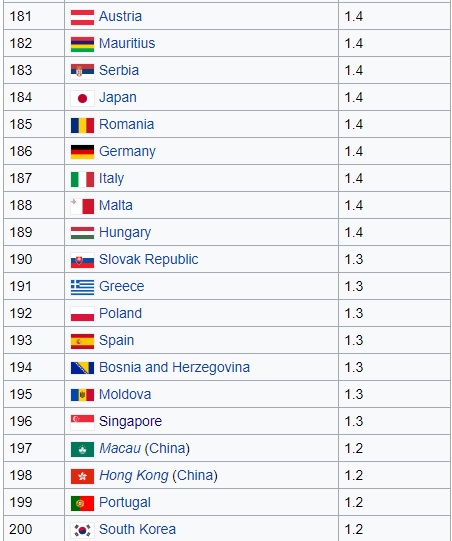
Here’s a table, based on World Bank data, showing the 20 jurisdictions with the lowest fertility rates. Which means, of course, the places with the fewest future taxpayers to finance redistribution.

The second crisis, based in the developing world, is that pervasive statism suffocates growth.
And while I largely agree with the late Julian Simon about people being a resource rather than liability, if a nation has a bloated and intrusive public sector that stifles the private sector, then a growing population can be a bad thing.
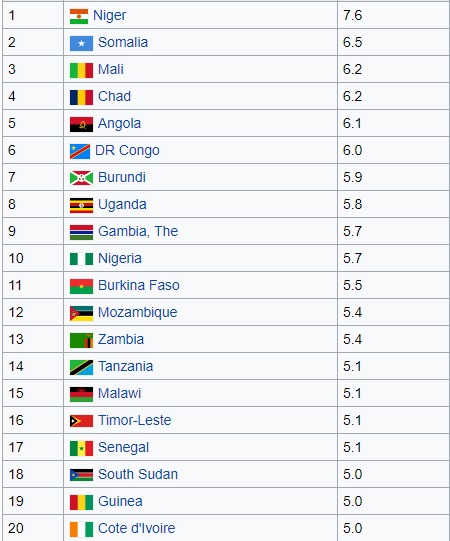
But it’s not the growing population that’s bad, it’s the statist policies. Here’s a list of the 20 counties with the highest fertility rates. The majority of them are ranked in the “least free” quartile according to Economic Freedom of the World. And none of them are in the “most free” quartile.


But the most important part of the interview, at least when thinking about problems in the industrialized world, is when I pointed out that nations such as Singapore don’t face a big problem.
Yes, Singapore has one of the lowest fertility rates in the world, but it also doesn’t have a pervasive tax-and-transfer welfare state. People are responsible for saving for their own retirement and healthcare. So the absence of future taxpayers isn’t a major challenge because the system doesn’t need to be propped up with tax revenue.
And the same thing is true in Hong Kong, another jurisdiction that is in good long-run shape even though the fertility rate is extremely low.
P.S. Given the demographic changes that are now occurring, many governments with big welfare states now recognize that they have a problem. Unfortunately, many of them think the solution is to artificially encourage more babies rather than entitlement reform.
Daniel J. Mitchell, a long standing contributor to The Commentator, is a Senior Fellow at the Cato Institute, the free-market, Washington D.C. think tank. His articles are cross-posted on his blog by agreement

http://www.thecommentator.com/article/6624/our_demographic_crisis_is_actually_a_policy_crisis


Saturday, 17 September 2016

Italy and Europe's demographic death spiral

Germany has just overtaken Japan as having the lowest long-term fertility among the world's biggest powers. But it is Italy which has shown the biggest decline in recent years. There used to be children everywhere. Europe is in a demographic death spiral


Baby
Too few babies
Timwork
Tim Hedges
On 17 September 2016 13:04
There is a little joke I have every year on 1st May. I ask an Italian what he is doing and he says ‘nothing, it is the festa del lavoro, the festival of work’.
The Festival of Work is the one day you can’t get anyone to do any work at all (though for the rest of the year Italians are harder working than their reputation suggests).
So I was a little confused when the government announced a festival of fertility and then the Minister of Health, Beatrice Lorenzin, said it was really a festival of infertility. What was an Italian supposed to do on this day (it is on 22nd September)?
Get to it, is the answer: Italy has a serious fertility problem and the government is hoping it can do something about it.
Italy is not the worst: Germany has just overtaken Japan as having the lowest long-term fertility rate among the major powers.
Levels in Portugal and Greece are even lower, but it is Italy which has shown the biggest absolute decline in recent years. There used to be children everywhere. The simplest explanation is that all animals produce fewer young when there is a lower prospect of food and shelter. Whilst this might not fully explain the problem in Germany, it is certainly the case in Italy. Everyone is worried about the economic future (not without good reason).
Italian women are, on average, having their first baby at nearly 31, the oldest in Europe.
The problem is not confined to Italy, of course. The Europe-wide figure used for fertility, known as total fertility, is 1.6 births per thousand women of childbearing age. The required level for replacement of population in an industrialised country (ie with a relatively low death rate) is 2.1.
In France the Total Fertlity rate is 2.01, Britain 1.81, Germany 1.47, Italy 1.37.
But why should we worry? Isn’t it just part of modern civilisation that women work, and that there is no pressure on them to have children if they don’t want to? Yes, but there are two problems.
The first is that with an ageing population, expensive healthcare and particularly pensions, without a continuing supply of young people there are fewer taxpayers supporting too many welfare recipients. in 1950s Italy there were ten people of working age for each pensioner. Now, there are only three to pay for them.
The second is the solution which dare not speak its name. Immigrants tend to be young, and you won’t have another crisis in 40 years’ time because they tend to produce lots of children. It will not have been far from the front of Angela Merkel’s mind, when she welcomed a million immigrants to Germany, that her country is scarcely economically viable without them. It is just that she couldn’t say that.
Concern about immigration is a leitmotif through European politics, in France, Britain, the Netherlands, Scandinavia. It was the principal feature of the recent regional elections in Germany which Merkel lost so badly, and it is a constant worry in Italy.
Giulio Meotti, Cultural Editor of Il Foglio writes that in one generation Europe will be unrecognisable.
The solution, in part, is for western countries to meet the replacement rate of their populations, and this is where Beatrice Lorenzin’s Fertility Day comes in. Unfortunately the way she has gone about it has been at best clumsy.
Adverts in the press have shown a woman clutching an hourglass and the caption ‘Beauty has no age. Fertility does.’ The website shows water dripping with the words ‘fertility is a common good’.
Some have likened the publicity to Mussolini’s attempt at growing the population. Feminists object, and there are mutterings of ‘what about the men, though?’ which doesn’t go well with the Italian man’s ‘latin lover’ image. The figures, doubtless wrongly, suggest the cold British man has a little more lead in the pencil.
But what else to do, other than this fecundity encomium? The immigrants arrive, and poor, infertile Europe has insufficient reason to turn them away. And we know where they are coming from.
As Giulio Meotti writes ‘the fatal meeting between Europe’s falling birthrate and the rise of Islam has already had significant consequences: Europe has turned into an incubator of terrorism; formed a new poisonous anti-Semitism…. Europeans are now importing young people in large numbers from the Middle East to compensate for their lifestyle choices.’
So perhaps two cheers for Beatrice Lorenzin’s Fertility Festival. At least she is doing something.
Tim Hedges, The Commentator's Italy Correspondent, had a career in corporate finance before moving to Rome where he works as a freelancewriter, novelist, and farmer. You can read more of his articles about Italy here
http://www.thecommentator.com/article/6406/italy_and_europe_s_demographic_death_spiral