Showing posts with label CityAM. Show all posts

Saturday, 18 September 2021

UK economic growth to smash official forecasts this year

The UK economy will grow faster than official forecasters expect this year and the rate of expansion will be higher in the long term, according to a new report released today.

Ratings agency Fitch says the British economy will grow 6.6 per cent this year, higher than the Office for Budget Responsibility’s four per cent forecast.

Thursday 16 September 2021 5:11 pm      CityAM

Ratings agency Fitch says the British economy will grow 6.6 per cent this year, higher than the Office for Budget Responsibility’s four per cent forecast (Photo by Peter Summers/Getty Images)

The successful vaccination programme in the UK enabled policymakers to lift economic restrictions quicker than other rich nations, providing a boost to the economy throughout the second quarter.

The relatively earlier reopening of the UK economy has dampened British consumers’ concerns about catching Covid and driven spending to similar patterns seen before the pandemic, Fitch said.

The link between rising Covid cases and weaker economic activity has been severed as consumers have acclimated to living with the virus.

The OBR does think the UK economy will grow faster in 2022. However, its 1.7 per cent growth forecast for 2023 is significantly lower than Fitch’s prediction of a 2.2 per cent expansion in output.

The UK economy is anticipated to grow faster than both the US (6.2 per cent) and Eurozone (5.2 per cent) this year.

According to the Office for National Statistics, the UK economy grew just 0.1 per cent in July.

Fitch upped its inflation forecast for the UK, hiking to reach 3.4 per cent annually by the end of this year and four per cent in early 2022. Despite both these figures being above the Bank of England’s target, the ratings agency does not expect the Old Lady to hike rates until 2023. 

According to the ONS, consumer price inflation and input inflation currently sit at 3.2 per cent and 11 per cent on an annual basis.

Ongoing worker shortages and sustained supply chain snarl ups could derail the economic recovery, Fitch noted.


Monday, 12 April 2021

Support for Brexit soars after UK-EU vaccines war, says new poll

 A new poll has revealed that two-in-three Britons think Brexit helped the UK’s vaccine rollout and that support for leaving the EU has risen in the wake of a row over vaccines.

 CITY AMMonday 12 April 2021 12:43 pm


A poll by JL Partners/Bloomberg today showed 67 per cent of Britons thought the EU had acted in a “hostile” way during the vaccines dispute, while only 13 per cent said the bloc acted like an “ally and a friend”.

Read more: China considers mixing Covid-19 vaccines to increase protection rate

Sixty-two per cent of respondents said Brexit had helped the UK’s vaccine rollout as it was not attached to the EU’s procurement process.

The poll also revealed that almost one-in-five people who voted remain in the 2016 referendum would now vote to leave due to the EU’s actions.

It comes after the EU has levelled a number of threats to block shipments of vaccines to the UK this year, with many pundits accusing the bloc’s leaders of vaccine nationalism.

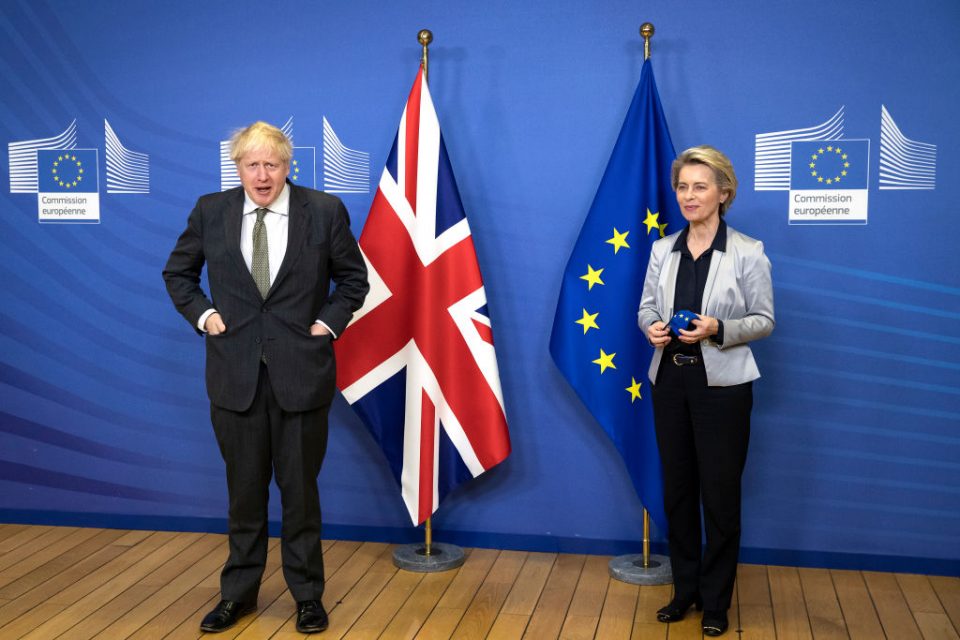
European Commission President Ursula von der Leyen first made the threat in January as the bloc’s vaccine rollout faced early supply problems.

It led to a quickly reversed decision by the EU to breach the Brexit Withdrawal Agreement, which was met by outrage across the globe.

Just last month, the EU once again threatened to block vaccines as it was angry that AstraZeneca/Oxford University jabs being produced in the Netherlands were due to be sent to the UK.

EU leaders also talked down the UK-founded AstraZeneca vaccine over the past few months, with French President Emmanuel Macron falsely saying it was “quasi-ineffective” in over 65s.

Read more: EU regulator probes possible blood clot risk with Johnson & Johnson Covid vaccine

Vaccine rollouts have been slow across the continent, with countries like France, Germany and Spain only administering doses to around 20 per cent of their populations so far.

The UK, meanwhile, has given at least one jab to about 55 per cent of its population.

https://www.cityam.com/support-for-brexit-soars-after-uk-eu-vaccines-war-says-new-poll/

Monday, 29 March 2021

29 Mar 21 British taxpayers paid for AstraZeneca vaccine

The UK will tell the EU next week that it must consider the millions of pounds British taxpayers spent on the creation of the Oxford University/AstraZeneca jab as the two sides look to resolve an ongoing row over vaccine exports.

Monday 29 March 2021 6:02 am

The UK will tell the EU next week that it must consider the millions of pounds British taxpayers spent on the creation of the Oxford University/AstraZeneca jab as the two sides look to resolve an ongoing row over vaccine exports.

The UK and EU are set to resume talks from tomorrow over Brussels’ threats to block the export of AstraZeneca vaccines manufactured at a Halix plant in the Netherlands.

Read more: UK considers giving millions of vaccines to Ireland

European Commission President Ursula von der Leyen has publicly threatened to block shipments of vaccines from the plant destined for the UK, unless the company gives more units of the jab to EU countries.

AstraZeneca has fallen behind on its scheduled delivery of vaccines to the EU, with the pharma giant blaming production and supply chain issues for the delays.

The UK government made orders of the vaccine, created in Britain, earlier and on a larger scale than the EU, meaning that units manufactured in the bloc are being sent to the UK.

Von der Leyen has called for “reciprocity”, after 21m vaccine units have been sent from EU plants to the UK with none coming the other way.

The Sunday Telegraph reports that British officials will tell the EU in negotiations that it was £84m of UK government funding that helped create the jab and that without this cash no vaccine would exist.

Read more: Government to offer free home Covid tests for businesses in back to work push

The UK will push for overall investment into vaccines to be counted into the EU’s calculations during negotiations next week, with Boris Johnson’s government spending more than £6bn to develop and procure vaccines.

Culture secretary Oliver Dowden told Sky News today: “Our position is very clear, that the EU should not be engaging in blocking exports and that they should honour the pledge that Ursula Von De Leyen gave to Prime Minister Boris Johnson a short while ago, whereby they agreed that any contracts should be honoured, so that is to say that if vaccines have been provided in honouring of the contracts, that should be honoured by the EU and we expect them to abide by that.”

https://www.cityam.com/uk-to-remind-brussels-that-british-taxpayers-paid-for-astrazeneca-vaccine/

Tuesday, 4 February 2020

Welcome to stage two of the Brexit battle: the ‘level playing field’

The battle of visions has begun. Boris Johnson views non-alignment with the major common EU rules as sacrosanct — unsurprising, since the UK has now withdrawn from the bloc.

Tuesday 4 February 2020 4:11 am


BELGIUM-EU-BREXIT
Consider the joint words by the trio of Commission president Ursula von der Leyen, European Parliament president David Sassoli, and European Council president Charles Michel (via Getty Images)

The European Commission, meanwhile, seeks an alignment of standards across a vast body of EU policy in return for a good trade deal.

The essence of Britain and Europe’s conflicting views of what the EU’s purpose is sits at the heart of our future relationship negotiations.

In Europe’s vision, the joint words by the trio of Commission president Ursula von der Leyen, European Parliament president David Sassoli, and European Council president Charles Michel convey the ideological naivety of the existing European political class, who fail to understand the realignments of democratic forces unfolding across modern European societies.

In their joint statement on the UK’s withdrawal, issued on Brexit day, the three could do nothing but caricature the EU as a global powerhouse, whose now 27 member states know that their “strength does not lie in splendid isolation but in our unique Union.”

This represents a highly unsophisticated and ideological viewpoint in which nation states have no real purpose. The EU’s top brass see Brexit as nothing but isolation, rather than Britain reaching out to a global trading community beyond a politically rigid, highly-indebted, regional protectionist club. Their misunderstanding may well remind many why Britain decided to leave the EU in the first place.

The trio’s op-ed, also published on 31 January, claims: “Without being a member, you cannot retain the benefits of membership.” This repeats the pessimism and wholescale opposition to any British economic advantage to be found in the Commission Task Force’s seminar papers, released over the first few weeks of January.

In those papers, the EU27 is cautious not to let Britain get away without reprimand or penalty for its choice to leave, nor allow it to gain any economic advantage from doing so.

All options for reform in the potential negotiated trade agreement seem truly closed off by the trio. In their words, without UK commitments to the EU “level playing field” on environment, labour, taxation and state aid, “there cannot be the highest quality access to the Single Market.”

This is reminiscent of EU leaders’ bullish warnings to David Cameron during his attempted EU renegotiation back in 2016 — when so much was then said to be “non-negotiable” — which ended up providing an impeccable pretext for the vote to Leave.

Back in the present, no sooner had Johnson set out the UK’s contrary desire to ensure no continued alignment, no jurisdiction of the European courts, and no more concessions, than the Irish Taoiseach Leo Varadkar warned him not to set “such rigid red lines” and to “tone down the kind of nationalistic rhetoric”.

Warm words indeed, given all the impossible red lines that have been set out in the past fortnight by the European Commission’s Task Force papers.

In the EU’s eyes, the requirement for non-alignment is somehow to be cast as nationalism — or, in von der Leyen’s words, “splendid isolation”.

Indeed, the Commission president’s speech in the plenary of the European Parliament as MEPs passed the Withdrawal Agreement advocates a paradox. Her request to a country that was leaving the EU was for it to “commit to uphold our standards for social protection and workers’ rights, our guarantees for the environment, and other standards and rules ensuring fair competition”, in return for “closer and better their access to the Single Market”.

Naturally, it may seem a very British question, but why were we being asked to align to the body of shackles, binding standards and rigid obligations which Britain — through its withdrawal — is seeking to cast off?
Main image credit: Getty
City A.M.'s opinion pages are a place for thought-provoking views and debate. These views are not necessarily shared by City A.M.
https://www.cityam.com/welcome-to-stage-two-of-the-brexit-battle-the-level-playing-field/

Monday, 20 January 2020

Independence is economically delusional, until Scotland’s currency puzzle is solved.

The possibility of Scottish independence is back on the political agenda once again. And one question – which currency would an independent Scotland use? – that was crucial in the 2014 referendum has still not been resolved.

Wednesday 23 October 2019 6:15 am  


The informal use of the pound is a very risky option.

To see why, the Scottish National Party (SNP) might look at the problems which Facebook is having in getting its proposed digital currency libra off the ground. Already, companies like PayPal, Visa, Mastercard and Ebay have withdrawn as potential sponsors.

While Facebook is a company and Scotland is a country, the issue is how the currencies are backed.

Facebook proposes to back the libra by its accumulated profits held in a portfolio of “low volatility assets”. But as Barry Eichengreen of the University of California points out, “anyone who lived through the 2008 global financial crisis will know that low volatility is more a state of mind than an intrinsic attribute of an asset”.

In the face of an unexpected adverse shock to the values of these assets, Eichengreen notes that these will be subject to the equivalent of a bank run. But there is no lender of last resort able to simply print money.

By simply using sterling, as many Latin American countries do with the US dollar, the Scots would have no means of printing money if their banks were attacked in a financial crisis. Taxes would have to rise massively to support the banks.

The Scots could instead apply to join the euro. An immediate problem with this would be the rule in the Stability and Growth pact that countries in the Eurozone should keep their budget deficits below three per cent of GDP.

The UK spends only 1.1 per cent of GDP more than it raises in taxes. Ironically, this would make us a shoo-in for euro membership, if Britain as a whole wanted to join.

In contrast, the latest figures produced for Government Expenditure and Revenue for Scotland show the nation running a public sector deficit of seven per cent of GDP.

This is obviously much higher than would be allowed in terms of membership of the euro. It is, in fact, the highest in the whole of Europe, the next highest being Cyprus at 4.8 per cent. So to join the euro, the Scots would have to make large cuts in public spending.

If instead they decided to set up their own currency, the markets would almost certainly force similar public spending reductions on them. After all, small countries running large public deficits tend not to be viewed kindly.

This problem has been magnified dramatically by the statement by Derek Mackay, the Scottish government finance secretary, that an SNP government in an independent Scotland would refuse to repay its share of outstanding UK debt.

A massive public sector deficit and defaulting on government debt is hardly a very sound basis on which to launch any new currency.

The desire for independence is often driven by emotion rather than rational calculation. But unless the currency question is addressed and solved, an independent Scotland would live to rue the day.
https://www.cityam.com/until-scotlands-currency-puzzle-is-solved-independence-is-economically-delusional/

Friday, 13 December 2019

Don’t ignore your opponent’s ideas — you could learn from them

UK politics is a machine for killing good ideas.It’s brutal, adversarial, and first past the post...

Friday 13 December 2019 4:15 am
Bruce Dear

https://www.cityam.com/dont-ignore-your-opponents-ideas-you-could-learn-from-them/

Jeremy Corbyn And Boris Johnson Take Part In ITV Leaders Debate

You can’t solve multi-dimensional problems with one-eyed ideology (via Getty Images)

UK politics is a machine for killing good ideas.

It’s brutal, adversarial, and first past the post. Our party-bound MPs almost never ask the only question that matters: based on the facts, what is best for the country?

Imagine that your company has a complex problem. Three of you work up ideas to solve it. But instead of reading your reports, your boss tells you all to hire cage fighters. He then stages a rumble in reception to decide whose idea wins.

Your colleagues watch, shouting “Liars”, “Get it done”, and “Stop Jenny’s report”. Then they vote for their favourite fighter, and the business adopts the idea he fought for — even if it’s the worst one. The “losing” solutions are all thrown away.

It sounds absurd, but this is basically how UK General Elections work.

We must do better. To succeed as a country, we need to learn from our political opponents’ ideas — not just try to crush and ignore them.

Take two of our biggest problems: the housing shortage and the climate crisis. If you try to solve them using just one party’s policies (be they Conservative, Labour or Liberal Democrat), you will fail. You can’t solve multi-dimensional problems with one-eyed ideology.

But if you study and combine the ideas of the main parties into sensible super-policies, then — suddenly — you have workable solutions to these intractable issues.

For example, on housing the Conservative manifesto proposed more of the same. Right to Buy stays, Help to Buy is extended to 2023, and longer-term mortgages are suggested to help the less well-off borrow to buy. But more of the same has already failed. We consistently miss our annual housebuilding target by over 100,000 homes, and over a million people are on our social housing waiting lists.

Labour’s housing policies also had massive drawbacks. Rent controls would severely damage the socially useful institutional build-to-rent market, while plans to purchase housebuilder land banks compulsorily at no-planning-gain value would undermine share values and damage new build-to-sell pipelines.

But if you put the Labour and Conservative housing policies together, dropping their worst ideas and adding in the best Lib Dem ones, you would have a policy package capable of solving the housing crisis and transforming the country.

This combined solution would see a mass council house building programme (Labour) to help those crying out for social housing. It would keep Help to Buy until 2023 to incentivise private housebuilders (Conservatives), and then refocus it on less well-off first-time buyers (Labour). Right to Buy would end (Labour), and with it the sorrowful 40-year story of fire-selling the state’s social housing stock.

Labour’s rent control and discounted compulsory purchase order ideas would be dropped. Instead, in would come the Liberal Democrats’ idea for all new homes to be zero-carbon by a fixed date and for £15bn to be invested in insulating 26m homes.

Here is a housing policy, made by learning from and uniting different ideas, which would work for the good of the whole country.

The same open-minded approach could create a policy ambitious enough to take on the climate crisis.

Let’s be honest: the free market, left to its own devices, is not going to make us carbon neutral by 2050‚ however good our “British battery makers and turbine designers” may be (to quote the Tory manifesto). The free market is primed to generate excessive consumption. Of course, it has an important role to play in tackling climate change, but it cannot do it alone.

At the other extreme, Labour’s state-led plan to reduce emissions across industries and ban the sale of new combustion vehicles by 2030 would be extremely damaging to the economy.

So again, we must learn from each other. The best climate crisis solution demands a mixed-economy and cross-party approach: the free market working with regulation and state action.

We should unleash an unrestricted dash for solar and wind power and achieve 80 per cent renewable electricity by 2030 (Lib Dems). The Paris Climate Accord targets should be enforced by law across the private and public sector (Lib Dems). We should set up a Green Transformation Fund to invest billions in advanced green technologies, including tidal power, energy and smart grids (Labour and the Lib Dems).

Vitally, we should also give the free market space to create climate crisis solutions and make sustainable profits from them (Conservatives).

The UK’s problems now involve vast global trends and pan-dimensional issues, spanning hundreds of expert areas. Old adversarial politics and single-ideology parties do not have the bandwidth to solve them. We must escape this hideous Victorian strait-jacket of one-party thinking.

Most of the votes from this election have now been counted, and at least 40 per cent of us will have woken up to our own particular idea of a nightmare.

But, whether that’s a majority Conservative government, a Labour administration, or another hung parliament, we still urgently need to rethink the way we do politics. We can only save ourselves by uniting the best policies from each party, and by listening to experts.

It’s time we stopped insulting our political opponents, and started learning from them.


Main image credit: Getty


City A.M.'s opinion pages are a place for thought-provoking views and debate. These views are not necessarily shared by City A.M.

https://www.cityam.com/dont-ignore-your-opponents-ideas-you-could-learn-from-them/

Thursday, 12 December 2019

The chaos of Brexit is nothing compared to the risk of Jeremy Corbyn

Every election is important, but some elections are indisputably more important than others. In the British context, the clearest examples of the past century have been 1945 and 1979.

Thursday 12 December 2019 6:14 am

https://www.cityam.com/the-risk-of-jeremy-corbyn/

Jeremy Corbyn
In both cases, the electorate decisively rejected the pre-election consensus that had held sway for an entire epoch. 
In 1945, Labour’s New Jerusalem and capture of the commanding heights of the economy caught British imaginations. In 1979, the then “sick man of Europe” decided that only the dramatic rupture of the economic norms offered by the Conservatives could save the country from financial ruin. 
What was similar in these two elections was that one major party advocated seismic change, while the other offered essentially continuation with what had gone before. Those content with society as it had hitherto been construed knew who to vote for, as did the discontented who yearned for a new direction.
Today’s election is an entirely different proposition. The outcome will provoke a policy shift of the magnitude of 1945 and 1979, but neither of the two main parties is offering the status quo. 
The Conservatives are promising Brexit and a break with 46 years of British membership of the European Union, to complete the work of the 2016 referendum. Labour is advocating a tax, spend and nationalisation manifesto, red in tooth and claw, the likes of which would take us back half a century.
Just as with elections themselves, some policy changes are more definitive than others. 
With all due respect to minor parties — none of whom will furnish the Prime Minister come tomorrow — there is a straight choice to be made between Boris Johnson and Jeremy Corbyn in this regard. One will deliver transformation of a nature yet to be determined, the other of a kind only too obvious. 
Much has been written about the potential financial impact of Brexit, but economics remains the only field of study where a practitioner can be more wrong than right in pronouncements and yet still be considered an expert. Businesses and individuals do not stand still in the face of change, but adapt their economic behaviour to suit new circumstances, while broader global trends can disrupt the most finely honed local predictions. 
Whether Brexit will be a drag or a boon on the UK economy is therefore unknown, particularly as what might first appear damaging could prove to be our longer-term salvation, given the economic decline of Europe and rise in importance of other markets open to trade deals. 
The same cannot be said of Labour’s offering. The UK has been down the road of high tax, high spend, and a controlled economy before. It ended with stagflation, mass industrial strife, and the country begging for an IMF bailout.  
There has never been a successful socialist economy in the world that has lasted the test of time. The fundamental failure of theoretical socialist principles to survive contact with practical reality is not a script yet to be written, as Brexit is, but something that has already been tested to destruction worldwide. 
That said, Corbyn’s economic policies will at least be reversible by a future government. But there is a more sinister part of his political agenda that will be harder to unwind. 
Corbyn’s past embrace of Islamist extremists, terrorists of many stripes, and authoritarian regimes across the world have led to his being labelled a threat by not just the security policy community, but even by members of his own party. Jew hatred has flourished on his watch, with the party of equality descending into institutional antisemitism with its appalling response to the seemingly endless cases exposed. 
In his attitudes to these issues, he represents an approach that is fundamentally at odds with the tolerant country Britain has always been. 
Johnson may not be universally popular, but he can be located as a John Bull figure in the British political continuum. In contrast, there is something peculiar — and, dare it be said, un-British — about Corbyn’s obsession with turning society on its head, while consorting with those with contempt for our liberal democratic values.   
British Prime Ministers do not need majorities to enact change. Foreign policy can be revised by prime ministerial fiat, state grants doled out at a flick of the pen, and government qangocracy transformed unilaterally. As evidence for the latter, Labour has already threatened to “reform” the Equalities and Human Rights Commission after the election, a body due to rule on the party’s problem with antisemitism next year.
There is no doubt that Brexit will cause transient change. But we will still be the same country after it, even if shorn of our European trappings. Corbyn’s programme promises an entirely different outcome, with the organs of civil society facing the brunt of the assault.   
The UK therefore faces a clear choice today. Perhaps it is in the mood to gamble that the certainty of Corbyn is preferable to the uncertainty of Brexit. 
But if it does, let it be aware what it is signing up to. For there will be no turning back, or half measures, should the revolution Corbyn has spent his entire political life campaigning for come to pass.
The views expressed here are Alan Mendoza’s personally.
Main image credit: Getty
City A.M.'s opinion pages are a place for thought-provoking views and debate. These views are not necessarily shared by City A.M.

https://www.cityam.com/the-risk-of-jeremy-corbyn/

George Freeman: We can't afford Corbyn

Today voters will decide the future of our country not just for the next five years but for generations to come. The nightmare prospect of another hung parliament on Friday 13th that can only deliver more confusion, squabbling and delay is perilously close.

Thursday 12 December 2019 12:01 am


https://www.cityam.com/george-freeman-we-cant-afford-corbyn/


The outcome of this election is too close to call — a few votes will be decisive. The worst result of all would be a hung parliament led by a weak Jeremy Corbyn government, propped up by Nicola Sturgeon and the SNP.

Jeremy Corbyn — a lifelong friend of the IRA and enemy to our police and armed forces — is danger to our security and defence, but the economic threat he poses is just as alarming.

His hard left prospectus would have a devastating effect on small businesses, startups and innovators up and down our country. Every entrepreneur, or anyone concerned with UK economic prosperity, should be worried.

Yet many young people under 40 in London are apparently tempted by Corbyn’s radical agenda.

Here are my 10 economic reasons to urge them to think again.


Fiscal policy

The party is fiscally irresponsible. It has committed to an additional spending splurge of £1.2 trillion over the next five years. That’s an extra £650m a day.

Who will pay? We will. You will. Labour says it will fund this through tax on the wealthy (those who earn over £80,000) and on businesses, but the Institute for Fiscal Studies (IFS) says this isn’t credible.

Jobs creation

Our “workfare” reforms are working to reduce unemployment. Labour has always left unemployment higher than it has found it. Under the last Labour government, unemployment rose by nearly half a million.

Even after an economic boom, Labour left office in May 2010 with welfare and unemployment up by 23 per cent. The public finances were broken — we were borrowing £1 in every £4 government spent.


A four-day-week

Corbyn’s proposal would cost the public sector £85bn over five years — paid for by taxpayers. It would cost the NHS £6.1bn a year, taking precious resources away from patients.

It is unfeasible and would have a devastating effect on huge numbers of small businesses who would have to pay less money to more staff just to keep afloat.


Tax

Labour’s taxes would be the highest in peace time history. As the IFS itself says, Labour’s policies would lead to “higher prices, lower wages or less valuable investments”. And higher interest rates risking a negative equity housing crisis for millions of low income buyers.

Marxism

Yes, actually. The shadow chancellor himself is genuinely an avowed Marxist who says his main aim in life is “the overthrow of capitalism”.


He made clear that he thinks private enterprises are “the real enemy”. This is the man who could be chancellor tomorrow.


Deja vu

Labour’s economic plans are so radical that we are seriously back in the realms of a run on the pound and capital flight.

The last major run on the pound was during the Winter of Discontent under a previous Labour government. We can’t let history repeat itself.

The Bank of England

Labour would imperil the independence of the Bank of England.

It is flirting with the idea of installing a hard-left governor of the Bank of England who is in tune with its Marxist ideas. Threadneedle Street’s independence has worked. We can’t possibly put that at risk.

Nationalisation

In the words of John McDonnell: “We’re going to bring back into public ownership rail, water, energy and mail. We will get this legislation through in the first Queen’s Speech — we want to hit the deck running,” he said.

Experts have warned this could cost £196bn and cripple our hard-won reputation as a business-friendly country.

Business

Labour has planned a draconian tax grab of £300bn, taking control of 10 per cent of a company’s shares in order to create an “inclusive ownership fund”.

Pension holders would be hit hard with millions wiped off the value of their hard-earned retirement pots. The Institute of Directors called it draconian, and the British Chambers of Commerce described it as a tax grab.

Rising debt

Finally, under Labour’s new fiscal rules, debt will rise and could continue to rise indefinitely and uncontrollably. This is grossly irresponsible.

Jeremy Corbyn’s neo-Marxist economic vision would destroy the enterprise, innovation and dynamism that this great newspaper celebrates. He has no plan for Brexit, so he would spend the next year miring the country in the chaos of two more costly and divisive referendums, one on Brexit and another on breaking up the union with Scotland.

Only a majority Conservative government can break the deadlock in parliament, get Brexit done and focus on unleashing the country’s potential.

To all City A.M. readers, I have one plea: please, don’t give us a hung parliament which would see the Marxists get the keys to Downing Street.

George Freeman is founder of the 2020 Conservative Group, author of its recent Britain Beyond Brexit report, and minister of state for the future of transport


Main image: Getty

City A.M.'s opinion pages are a place for thought-provoking views and debate. These views are not necessarily shared by City A.M.

https://www.cityam.com/george-freeman-we-cant-afford-corbyn/

Wednesday, 11 December 2019

Michael Heseltine: Hung parliament better than Conservative majority under 'flexible' Boris Johnson

If this election has proved anything, it’s that political allegiances aren’t what they used to be – not least when it comes to those normally found sitting in parliament.

Wednesday 11 December 2019 9:57 am

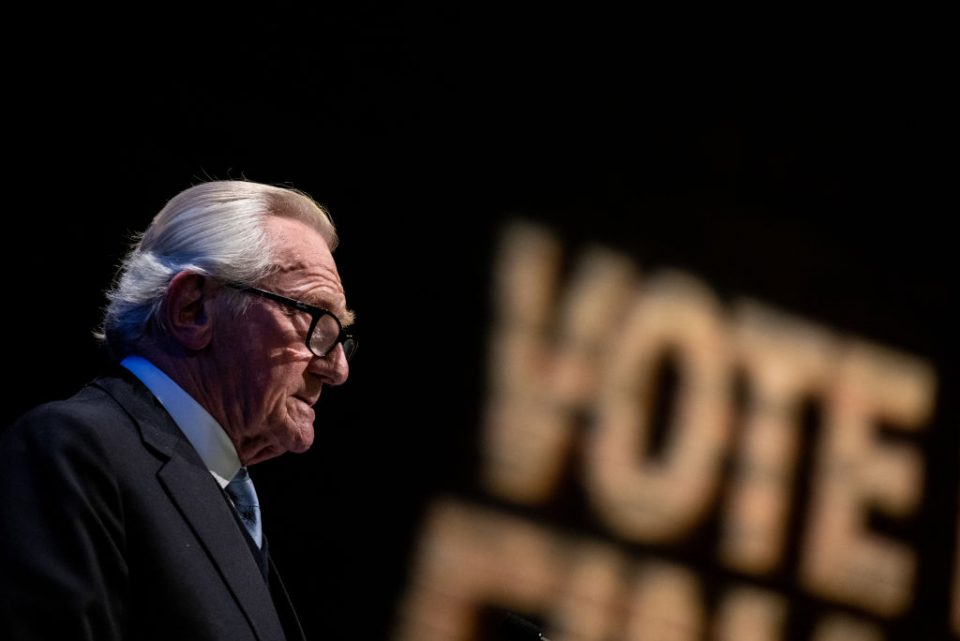
Tory grandee Michael Heseltine wants a hung parliament in this election
Tory grandee Michael Heseltine wants a hung parliament in this election (via Getty Images)

Which is why I find myself speaking to Tory grandee, former frontbencher and Conservative peer Michael Heseltine about his decision to back the Liberal Democrats over the biggest issue he still thinks the country faces since the 1940s.

Read more: ‘It was very personal, very hurtful,’ says ex-rebel Stephen Hammond

Heseltine is endorsing Monica Harding, the Lib Dem candidate for Esher and Walton, against foreign secretary Dominic Raab. Although the incumbent is sitting on one of the healthiest majorities in the country, Harding is snapping at his heels and Heseltine’s endorsement could tip more votes in her favour. But how can he be sitting in the Lords for one party while actively backing another?

“I would never leave the Conservative party. That doesn’t mean to say every word, every speech, every member I agree with,” he says.

“The difficulty in this issue of loyalty is this – what happens if you have said something all your life politically, and every leader in that party has said something similar, what happens if your party shifts? I can’t follow them. I can’t accept that we make this country poorer, less powerful, less influential.”

Read more: From Cities and Kensington to East Devon and Esher – these are the seats where almost anything could happen

Although Heseltine shies away from outright calling his friend and one-time colleague Boris Johnson a liar, he comes close to it by arguing “people were deceived” by the Vote Leave campaign.

“All those claims about millions of Turks coming here, about the piles of money for the health service. These were deliberate deceptions,” he says.

Heseltine dodges broader questions about the Prime Minister’s character in light of the ongoing hospital row, as well as his trustworthiness. But he insists Johnson is ultimately a liberal Tory who made a “calamitous” decision to back Brexit.

“It was a career choice, a bad one in my view, but I am not prepared to get into the business of slagging someone off – although I will say he is one of the most ‘flexible’ politicians I’ve known.”

Read more: Nickie Aiken – Change is coming to Two Cities

Another question Heseltine would rather avoid is the threat Labour poses, particularly with several former Tories either standing as Lib Dems or independents, most of whom now look likely to lose their seats.

“Don’t let’s spend even a minute discussing Corbyn’s programme, which would be a monumental disaster, but for its one great asset – that it’s not going to happen”.

Heseltine believes there is “no chance” of a Labour government. “All the ‘reds under the beds’ warnings reveal is how worried [the Tories] are about their own side of the argument,” says the former frontbencher.

“He’s no risk at all because he’s not going to win. It’s a diversion – an attempt to scare people into making the wrong decision. Any commentator who is looking at the polls knows Mr Corbyn is not going to be Prime Minister.”

Read more: Greg Hands – Vote Lib Dem, get Labour

But the polls are suggesting there could be a late Labour surge just as the Lib Dems start to fall away. What does the man with 35 years’ experience in the Commons think about Jo Swinson and her team’s campaign?

“They were probably unwise to put revoke at the forefront,” he admits. “The only way they could have done that, given they were never going to get a majority, was through a second referendum.”

Far from a Lib Dem majority, the most likely options now are either a slim Conservative majority or another hung parliament. Would that really be a good idea, after the stasis of the last three years?

“It’s a much better outcome than a majority for Brexit because it would lead to a second referendum,” Heseltine says. It would “remove uncertainty far faster than the Brexit deal Boris has negotiated” because of the “very wide body of options” that comes with the UK’s future relationship with the EU.

Debating this deal will bring “a year of total unpredictability as all the details are explored” whereas a second referendum could be concluded within that time. “Then you can go for parliamentary scrutiny,” he says.

But surely I ask, after all this time, it’s right that progress is made? Heseltine disagrees.

“If you are standing at the edge of a cliff, it’s quite a lonely, dangerous place to be. But if you jump over the edge it’s a damn sight more dangerous – with certain predictable consequences.”

Monday, 9 December 2019

The Lib Dems deserve a bad night at the polls

Conducting a post-mortem on an election campaign before the results come in is risky business. But if the polls have got it all wrong (again) and if Jeremy Corbyn concocts a way into Downing Street over the coming weekend, then analysing the state of the Liberal Democrats will be the last thing on anyone’s mind.

Monday 9 December 2019 6:00 am
Christian May

https://www.cityam.com/the-lib-dems-deserve-a-bad-night-at-the-polls/


So ahead of Thursday’s election, let’s look back and assess Jo Swinson’s party. The Lib Dems won just over seven per cent of the vote in the 2017 election.

As the electorate coalesced around the two main parties they were squeezed to the margins. Alarmingly, for Swinson, a YouGov poll published yesterday suggests that 23 per cent of those who backed the Lib Dems at the last election are still undecided.

In contrast, just 11 per cent of those who voted Tory or Labour in 2017 say they’re undecided today. The Brexit Party remains an irritant to the Tories in a few seats, but the threat from them has been almost entirely dealt with.

History appears to be repeating itself, with the Tories and Labour set to hoover up the vast majority of votes. Swinson now leads a party languishing on around 12 per cent with just a few days until the vote.

She hasn’t even convinced nearly a quarter of those who voted for her party last time to stick with them on Thursday.

She will certainly pick up some pro-Remain support but she has misread the country, choosing to lead a pressure group rather than a political party – and that was a mistake.

Her failure to break through has been blamed on her own dismal poll ratings. The more people see of her, the less they like her.

This is harsh but true. It is also insufficient to explain her party’s poor showing. After all, Jeremy Corbyn is the least popular leader of the opposition in history and Labour is miles ahead of the Lib Dems.

No, the cause of their looming “also ran” status must be their cynical, illiberal, anti-democratic and absurd campaign to revoke Article 50 and cancel Brexit. Here’s the thing: not all Remain-voters cried when Leave won.

Indeed, not all Leave-voters punched the air. The tears of despair and the shouts of joy were reserved for the fringes of the electorate — and just as the Brexit Party tried (and failed) to launch a national campaign on the backs of a small number of ardent “no-dealers” so the Lib Dems will fail to win big by relying on the votes of those who wave the EU flag and attend anti-Brexit marches.

Swinson’s central policy of cancelling Brexit without even a second referendum is extreme and offensive to many. Recognising this, she has tried to row back, but this should be seen by voters as too little, too late.

City A.M.'s opinion pages are a place for thought-provoking views and debate. These views are not necessarily shared by City A.M.

https://www.cityam.com/the-lib-dems-deserve-a-bad-night-at-the-polls/

Friday, 6 December 2019

General Election: Boris Johnson accuses Jeremy Corbyn of trying to 'fiddle' with second Brexit referendum

Prime Minister Boris Johnson has launched an attack against Labour leader Jeremy Corbyn’s plans for a second EU referendum ahead of the pair’s final TV debate before the General Election.

Friday 6 December 2019 7:30 am
https://www.cityam.com/general-election-boris-johnson-accuses-jeremy-corbyn-of-trying-to-fiddle-with-second-brexit-referendum/


Jeremy Corbyn and Boris Johnson take part in an ITV leaders' debate
Jeremy Corbyn and Boris Johnson take part in an ITV leaders' debate (via Getty Images)

Prime Minister Boris Johnson has launched an attack against Labour leader Jeremy Corbyn’s plans for a second EU referendum ahead of the pair’s final TV debate before the General Election.
Johnson claimed Corbyn would give 2m EU nationals a vote alongside resident Brits, saying it was an attempt to “fiddle” with the vote to ensure Leave cannot win.
It follows a similar allegation from Johnson’s chief adviser, Dominic Cummings, last week, suggesting the Vote Leave mastermind is also behind this latest strategy.
“Your policy is to cancel the result of the last referendum and to hold another one,” Johnson wrote in a letter to Corbyn.
“You have made clear that you oppose an Australian-style points system and you will not only continue ‘free movement’ with the EU but your policy is extend it to the entire world.”
“Even worse, your manifesto sets out plans to fiddle your second referendum on Brexit. You want to give 2m EU nationals the vote in your referendum,” Johnson added in a letter seen by Sky News.
“This is a sly attempt to undermine the result of the 2016 referendum, and is profoundly undemocratic. No true democrat, even the most ardent supporter of Remain, could support your attempt to undermine the result of a democratically expressed vote.
“Your policy of giving millions of foreign citizens the vote in order to overturn the referendum would create incredible bitterness that might take decades to repair,” Johnson continued.
He urged Corbyn to reconsider the policy before next Thursday’s election.
“Imagine how people will feel if the biggest democratic exercise in our history is overturned because you gave 2m EU citizens the power to reverse Brexit. It would alienate millions who already feel disenfranchised and ignored by our political system,” Johnson said.
The Tory ploy came as BBC presenter Andrew Neil chastised the Prime Minister again for failing to appear for an interview with him, as other leaders including Corbyn and the Liberal Democrats’ Jo Swinson have.
“We’ve always proceeded in good faith that the leaders would participate,” Neil told Sky.
“And in every election they have. All of them. Until this one. It is not too late. We have the interview prepared. Oven-ready, as Mr Johnson likes to say.”
https://www.cityam.com/general-election-boris-johnson-accuses-jeremy-corbyn-of-trying-to-fiddle-with-second-brexit-referendum/

Wednesday, 27 November 2019

Boris Johnson apologises to Muslim community

Boris Johnson has apologised to the Muslim community for instances of Islamophobia within the Tory party.

Wednesday 27 November 2019 5:12 pm
https://www.cityam.com/boris-johnson-apologises-to-muslim-community/

Boris Johnson
Boris Johnson has apologised for instances of Islamophobia in his party (via Getty Images)

Johnson has previously been criticised for comparing women wearing niqabs as looking like letter boxes and bank robbers, and the party has said it would soon launch an inquiry into discrimination of all kinds within the party.

Read more: Jeremy Corbyn refuses to apologise to chief rabbi

The Prime Minister was asked in Cornwall this morning if he would apologise for examples of anti-Muslim sentiment in his party.

“Of course, and for all the hurt and offence that has been caused – of course we do,” he said.

“And all that is intolerable and it’s so important as a country that we don’t allow that kind of thing and that’s why we’re going to have the independent inquiry.”

The statement is just one day after Labour leader Jeremy Corbyn refused to apologise for instances of antisemitism within his party.

On Monday, the UK’s chief rabbi said Corbyn was “complicit in prejudice” against Jews and unfit to be prime minister.

Corbyn once again refused to apologise to the Jewish community or the chief rabbi at a press conference this morning.

After being asked if he would like to apologise to the Jewish community, Corbyn said: “I’ve made clear antisemitism is a complete poison in our society.

“I acknowledge what the chief rabbi said yesterday, but I’ll also point out there’s very large amount of other people in the Jewish community who have made it very clear they do support Labour.

“That they do recognise my absolute commitment that every community in our country will be safe in a Labour government.”

The Equality and Human Rights Commission is currently investigating whether Labour is institutionally antisemitic.

A group of 11 Labour MPs also left the party earlier this year partly due to the party’s handling of antisemitism allegations.

UK chief rabbi Ephraim Mirvis said claims by the Labour leadership that they would “tackle the scourge of anti-Jewish racism” were a “mendacious fiction”.

Writing in the Times, he said: “How complicit in prejudice would a leader of Her Majesty’s opposition have to be in order to be considered unfit for high office?

Read more: Tom Watson and Sadiq Khan decry Labour ‘antisemitism’ after Panorama probe

“Would associations with those who have openly incited hatred against Jews be enough?

“Would support for a racist mural, depicting powerful hook-nosed Jews supposedly getting rich at the expense of the weak and downtrodden be enough?”

Monday, 29 July 2019

The Treasury has it entirely wrong: The British economy would gain from Brexit

The Treasury has produced its 200-page report about the effects of Brexit on the economy. Predictably, it is highly negative. It is sad that the Treasury, for which I once worked for a few years, has become so politicised that it is reduced to rationalising the views of George Osborne.
Tuesday 19 April 2016 4:59 am

Tom Welsh is City A.M.'s business features editor.
An EU flag flying in front of the Houses of Parliament in London
The modelling methods it has used to do Osborne’s bidding are the ones anyone would employ to rubbish Brexit. They involve estimating relationships over the past between such things as trade with the EU or Foreign Direct Investment, or tariffs and GDP. Unfortunately, as I pointed out in my book on the UK and the EU, these estimated relationships are highly unreliable when it comes to considering a whole new world of trading rules, which is what Britain would face after leaving the EU.
The basic point you have to ask is how the whole economy would react to the main alternative to our current regional EU rules, which is global trading rules under the World Trade Organisation (WTO). For this you need the sort of model I used in my book, a global world trade model. The results from such a model are perfectly intelligible to anyone and, what is more, they tally with what we all understand about free trade: that the wider the freedom we have to trade, the better the result.
Now consider what the EU arrangements we have actually are. The EU is a protectionist organisation known as a “Customs Union”; this raises barriers through tariffs and other non-tariff means against every country outside it. These barriers raise the price of goods sold inside the EU by the protectionist margin; so prices are higher for everything bought from anywhere that is protected against in this way. This is because, to sell into the EU, you must pay the tariff and also the extra costs of the non-tariff barriers.
The gainers from this Customs Union are the EU producers inside the protective wall: like children in a walled garden, they enjoy a cosseted life. EU producers sell their products inside the EU at inflated prices.
But the losers are the consumers who pay these inflated prices. It is a matter of some irony that our chancellor praises this Customs Union as a wonderful “free trade arrangement”! It takes your breath away that he should dare say this to UK voters and consumers. But of course they are blown away by his confident rhetoric, and who are they to argue?
When we measure the extent of the EU protective wall, we find that it is rather high, quite contrary to this rhetoric. Food prices are nearly 20 per cent higher on average, and average manufactured prices a bit more than 20 per cent higher. Even assuming, as I did in my book, that there is some reduction in this protection over time, to say 10 per cent on each, the overall effect of the EU on the consumer shopping basket is to raise it by 8 per cent – around £40 a week for the average consumer.
By leaving the EU, we move to global free trade; goods come in here from all over the world at world prices, without the EU add-on. Our consumers benefit. Our producers have to earn their way in the world at the true world prices of their products: the industries that do best will be our best industries, not our most protected ones.
But even the protected ones will not fare so badly: they will face world competition at home and they can still sell to the EU and pay the external tariff, which is only about 4 per cent on average. Under WTO rules, the EU would be unable to inflict the non-tariff barriers on them because our producers do not “dump” and they completely adhere to EU regulations already.
People ask: can we rely on the WTO to police these rules? Yes we can: the WTO is an active and powerful system of international courts that all members highly respect. Since all countries, including the US and the EU, use it repeatedly against others, they obey its judgements when they go against them. It enforces non-discrimination, the “most favoured nation” principle: that is all we need outside the EU because it means we sell our goods on a world market where no-one can arbitrarily discriminate against us, including the EU.
By leaving the EU, we go to global free trade and we rid ourselves of the intrusive EU regulation that bears down most heavily on our smaller firms who cannot afford huge HR and compliance departments. The gains to our economy from this are huge, as anyone would readily expect. The trade gain amounts to 4 per cent of national income, directly enjoyed by our voters even after spending some of it helping out those affected producers, including our farmers. The gain from getting out of the heavy-handed regulation of our whole economy by the EU is more again, and a boost to our growth rate. The Treasury report gets it precisely the wrong way round.
Patrick Minford is professor of applied economics at Cardiff Business School and author, with Sakshi Gupta, Mai Le, Vidya Mahambare and Yongdeng Xu of “Should Britain leave the EU?” (Edward Elgar, second edition, 2015).
City A.M.'s opinion pages are a place for thought-provoking views and debate. These views are not necessarily shared by City A.M.

https://www.cityam.com/the-treasury-has-it-entirely-wrong-the-british-economy-would-gain-from-brexit/

How the Treasury cooked the books in calculating the impact of Brexit

Three weeks ago, the Treasury released its report into the long-term implications of Brexit, predicting widespread economic destruction.
Wednesday 11 May 2016 4:59 am  
There will soon be a sequel, analysing what the short-term impacts of leaving the EU might be. One doubts you’ll need the foresight of those who successfully predicted a Leicester City Premier League victory to guess what this will conclude.
Yet the economic methodology of the Treasury’s work really does need to be questioned. Due to the rapid response nature of modern media, it was impossible for those favouring Brexit to offer up a thorough critique of the first report quickly. One could only show it was riddled with bizarre assumptions. Not least, it assumed away by construction any benefit of Brexit in terms of signing third-party trade deals or deregulating the economy.
For those on the Remain side, of course, it sufficed to merely herald the Treasury’s results as reflecting the “economic consensus”. Surely if anything has been proven in the economic history of post-war Britain, it is that economic consensuses are a weak appeal to authority.
To fill the void of analysis on the Treasury study comes the second publication by the new group Economists for Brexit. In this report, professor Patrick Minford provides an accessible history of trade theory before critically evaluating the Treasury’s work.
Minford explains that the way the Treasury models Brexit is to focus on “openness”, the sum of imports and exports relative to GDP, and foreign direct investment (FDI). These two factors are each assumed to follow a so-called gravity model – where openness is related to things such as distance – estimated from multi-country data. The degree of openness and FDI are then assumed to determine productivity – the ultimate driver of living standards, estimated from industrial data. Finally, this productivity effect is added into a macro model to find the general effects on investment, GDP etc.
The broad story the Treasury tells is thus this: Brexit will make the UK less open and less attractive for FDI. This will lead to lower productivity and therefore less investment and lower living standards.
There are several major problems with this method. The first relates to identifying the effect of EU membership per se. In order to find this, large regressions over time and across countries are run to isolate the “EU effect”. But this is estimated using a binary assessment of whether a country is in or out. This throws up all sorts of potential biases because it calculates the EU effect across periods with many other different policies. Many of these factors may be related simultaneously to a country’s openness or FDI and its decision to be an EU member.
The second problem is that the Treasury modelling assumes that openness and trade drive improved productivity. While intuitive and in many cases true, this need not be the direction of causation. In fact, it might be that an industrial shock can cause increased trade, FDI and productivity simultaneously. In other words, the UK may receive FDI precisely because an industry becomes more productive. To assess how Brexit would affect this, you’d need to do far more extensive work on industries and causal testing than the Treasury attempts.
Finally, the Treasury comes to vastly different conclusions to Minford’s previous Economists for Brexit modelling (which suggests that we would be better off out of the EU) primarily because it assumes that, if we leave and do not sign a trade deal or remain in the Single Market, Britain will maintain EU-style tariffs on EU partners and non-EU trading partners who have EU trade agreements. These assumptions therefore generate large effects on openness and on FDI – and hence living standards.
In fact, if instead Britain were to adopt unilateral free trade (abolishing all tariffs), exiting the EU’s protected customs union would lead to UK consumers enjoying lower prices and would shift the structure of production towards non-protected sectors, enabling us to focus on real areas of comparative advantage and raising productivity. We would, of course, have full control over regulation too.
The need for a smoothed transition may prevent this “big bang” disruptive approach. As Roland Smith of the Adam Smith Institute pointed out this week, the government and Parliament that will negotiate our exit settlement will be overwhelmingly pro-Remain and may well choose the least disruptive short-term path: remaining in the Single Market in the European Economic Area. But the largest long-term gains from Brexit require an independent, free-trading Britain.
City A.M.'s opinion pages are a place for thought-provoking views and debate. These views are not necessarily shared by City A.M.