Showing posts with label Popularism. Show all posts

Wednesday, 30 May 2018

George Soros: 'drastic' action needed for eurozone to survive

The eurozone risks lurching towards another major financial crisis triggered by austerity and populist political parties intent on blowing apart the EU, the billionaire investor George Soros has warned.
The Guardian
Richard Partington 30 May 2018
Sounding the alarm as financial markets fell into turmoil on Tuesday amid a deepening political crisis in Italy, Soros said the EU had lost its way since the 2008 banking crash and required radical transformation in order to survive.
“The EU is in an existential crisis. Everything that could go wrong has gone wrong,” he said in a speech in Paris.
Having recorded the strongest period of economic growth in a decade towards the end of 2017, Europe appears to be heading for a fresh summer of political unrest for the first time in several years. Investors fear the turmoil could ultimately lead to the demise of the euro, plunging the region into chaos.
The renowned investor's amazing life story: Against all the odds, legendary Hungarian-American investor and mega-philanthropist George Soros escaped Nazi and communist oppression, and went on to create the world's most successful hedge fund. We take a look at the lucky billionaire's incredible life story.The incredible story of the penniless Nazi refugee who broke the Bank of England
Italian bonds dropped sharply on Tuesday, pushing the country’s borrowing costs to the highest levels in more than four years as concerns grew that the EU’s third-largest economy could exit the single currency.
The crisis comes after Sergio Mattarella, the country’s president, vetoed the appointment of a controversial Eurosceptic as finance minister over the weekend, laying the ground for fresh elections later this year.
In Spain, the prime minister Mariano Rajoy faces a vote of confidence on Friday that could further plunge southern Europe into political turmoil.
© Getty composite
While the fresh unrest is likely to embolden eurosceptics who believe the EU is ultimately doomed, including prominent Brexiters in the UK pushing for Theresa May to take a tougher stance against Brussels, Soros said reforms could help save the bloc.
The Hungarian-born investor said an “addiction to austerity” at the heart of Europe was harming economic development, which had in turn been exploited by populist politicians to stoke anti-EU support.
“As a result [of austerity], many young people today regard the EU as an enemy that has deprived them of jobs and a secure and promising future,” he said.
Soros, a prominent supporter of the Remain campaign, said there were still steps that could be taken to make the EU more appealing to ordinary voters, who had been let down by Brussels since 2008.
Calling for an EU-funded Marshall plan for Africa worth about €30bn (£26bn) per year, he said migratory pressures across Europe could be relieved by helping developing nations. He also called for the EU to abandon rules requiring member states to join the euro single currency, lest they eventually combine with other EU rules to “destroy” the project altogether.
Echoing a call made by David Cameron ahead of the Brexit vote, he argued for the EU to allow member states to pursue “multi-track” relations with the bloc, rather than “ever closer union”. That would enable countries to work together in certain areas and diverge in others, helping to address issues of sovereignty.
“Europe needs to do something drastic in order to survive its existential crisis. Simply put, the EU needs to reinvent itself,” he said.
QUICK GUIDE: What are the Brexit options now? Four scenarios
Staying in the single market and customs union
The UK could sign up to all the EU’s rules and regulations, staying in the single market – which provides free movement of goods, services and people – and the customs union, in which EU members agree tariffs on external states. Freedom of movement would continue and the UK would keep paying into the Brussels pot. We would continue to have unfettered access to EU trade, but the pledge to “take back control” of laws, borders and money would not have been fulfilled. This is an unlikely outcome and one that may be possible only by reversing the Brexit decision, after a second referendum or election.
The Norway model
Britain could follow Norway, which is in the single market, is subject to freedom of movement rules and pays a fee to Brussels – but is outside the customs union. That combination would tie Britain to EU regulations but allow it to sign trade deals of its own. A “Norway-minus” deal is more likely. That would see the UK leave the single market and customs union and end free movement of people. But Britain would align its rules and regulations with Brussels, hoping this would allow a greater degree of market access. The UK would still be subject to EU rules.
The Canada deal
A comprehensive trade deal like the one handed to Canada would help British traders, as it would lower or eliminate tariffs. But there would be little on offer for the UK services industry. It is a bad outcome for financial services. Such a deal would leave Britain free to diverge from EU rules and regulations but that in turn would lead to border checks and the rise of other “non-tariff barriers” to trade. It would leave Britain free to forge new trade deals with other nations. Many in Brussels see this as a likely outcome, based on Theresa May’s direction so far.
No deal
Britain leaves with no trade deal, meaning that all trade is governed by World Trade Organization rules. Tariffs would be high, queues at the border long and the Irish border issue severe. In the short term, British aircraft might be unable to fly to some European destinations. The UK would quickly need to establish bilateral agreements to deal with the consequences, but the country would be free to take whatever future direction it wishes. It may need to deregulate to attract international business – a very different future and a lot of disruption.
https://www.msn.com/en-gb/money/news/george-soros-drastic-action-needed-for-eurozone-to-survive/


EU fears an Italian 'referendum"

Italy’s Uncertainty Pushes Euro to Fore, the Last Place Europe Wants It

LISBON — Through more than two months of tough negotiations to form a government in Italy after inconclusive March elections, global financial markets remained relatively calm. Italy’s uncertainties seemed contained to Italy, and Europe’s economy kept growing.
The New York Times
30 May 2018
By STEVEN ERLANGER
That changed this week when Italy’s president, Sergio Mattarella, effectively blocked two populist parties from forming a government. He judged that a crucial member of their proposed cabinet was intent on having Italy abandon the euro, though they had not explicitly campaigned on that issue.
In doing so, Mr. Mattarella may have laid the groundwork for a new election, one that amounts to a referendum on the euro. The European Union and financial markets reacted with dread. On Tuesday, the Dow plunged almost 400 points, the value of the euro plummeted and the cost of borrowing for Italy shot up.
For the European Union, another Italian election would be terrifically bad timing.
Chancellor Angela Merkel of Germany, a linchpin of the bloc, is weakened; she needed six months to form a government after a rough election of her own last year that was marked by a far-right, populist surge. Spain’s government could face a no-confidence vote as early as this week and possible new elections as well.
However unlikely an Italian withdrawal from the eurozone may be, the mere prospect is more dangerous to the future of the European Union than the bailout of Greece, whose economy is dwarfed by Italy’s; Britain's vote to leave the bloc; or the squabbles over the rule of law with Hungary and Poland.
Italy is a founding member of both the European Union and the euro and the bloc’s fourth-largest economy, and psychology counts.
After all, it was Brussels that warned Greece in 2011 that a proposed referendum on its bailout and the euro would actually be a referendum on membership in the European Union itself. That was enough to cause Greece to back down. It did so again four years later.
a group of people sitting in chairs in front of a crowd: Chancellor Angela Merkel of Germany, left, remains weakened after needing six months to form a government.© Tobias Schwarz/Agence France-Presse — Getty Images Chancellor Angela Merkel of Germany, left, remains weakened after needing six months to form a government.But the common currency is not without its problems. The European Union plunged into the euro without having either the economic institutions to fully manage it or full political integration. Member states gave up their authority over monetary policy, often to deleterious effect at home.
Today, not only will the issue of sovereignty not go away, it keeps roaring back with a vengeance, just when populism in Europe’s core countries seemed to have been kept at bay.
After the shock of Britain’s vote in 2016 to leave the European Union, the bloc seemed unexpectedly steady. Italy had a pro-Europe government for several years. Spain and Portugal were growing again. France’s anti-Europe presidential candidate, Marine Le Pen, was defeated. Even the populist Prime Minister Alexis Tsipras in Greece was grudgingly holding the line on spending in order to stay in the eurozone.
But the turmoil in Italy makes clear that anti-European populism has not gone away, and that the euro is in the cross hairs.
Mr. Mattarella has turned to a former International Monetary Fund official to be a caretaker prime minister and form a government. But even he seemed to have hit a wall late Tuesday evening, making the prospect of another election — as early as July or September — more likely.
Matteo Salvini, the fiery leader of the League, the populist party that is strong in Italy’s north, has made opposition to Brussels, and occasionally the euro, a standard in his campaign speeches.
His putative coalition partner, Luigi Di Maio, leader of the populist Five Star Movement, has been sharply critical of Brussels, but has lately rejected a referendum on the euro, despite having previously floated the idea.
a group of people on a city street: Pensioners demonstrating in Athens last month. In 2011 Brussels warned Greece that a referendum on its bailout and the euro would amount to a vote on E.U. membership. Greece backed down.© Angelos Tzortzinis/Agence France-Presse — Getty Images Pensioners demonstrating in Athens last month. In 2011 Brussels warned Greece that a referendum on its bailout and the euro would amount to a vote on E.U. membership. Greece backed down.Mr. Mattarella, moderate and pro-Europe, was clearly skeptical of their intentions, and he vetoed Mr. Salvini’s pick of an economy minister with openly anti-euro views, in the name of economic stability.
In doing so, Mr. Mattarella has given Italians, exceptionally, the same option built into the French election system — two rounds of voting — the first to vote your heart, and the second to vote your head. In France, Ms. Le Pen did well in the first round of presidential voting last year; she was soundly defeated in the final round.
Mr. Mattarella is gambling that Italians may do the same, if the populist parties can be made to surrender their ambiguity on the euro — an issue they skirted through the Italian campaign.
As of November, a poll by the European Commission, the bloc’s bureaucracy, showed that nearly 59 percent of Italians preferred European economic and monetary union with a single currency, the euro, while 30 percent were opposed.
The risks of leaving the euro have always been a reason Italy has stayed in. But the country has not done well with the euro, by some measures, and so the question now is whether a public frustrated by two decades of stagnation is ready to take a gamble of its own and bolt.
As demonstrated by the Brexit vote, which numerous analyses showed would not be good for Britain’s health, economic logic does not always prevail.
Like Ms. Le Pen, Mr. Salvini may discover after a public debate that despite anger at Brussels over migration and the problems of the euro, Italians, like the French and the Greeks, are afraid to leave it.
a statue of a man and a woman standing in front of a building: Tourists at the Trevi Fountain in Rome. Italy today accounts for 15.4 percent of the eurozone’s gross domestic product and 23.4 percent of the bloc’s public debt.© Nadia Shira Cohen for The New York Times Tourists at the Trevi Fountain in Rome. Italy today accounts for 15.4 percent of the eurozone’s gross domestic product and 23.4 percent of the bloc’s public debt.But Mr. Salvini has also proved himself adept at playing populist passions and has again made opposition to the euro and its “elite” supporters central to his politics.
Many analysts believe that Mr. Salvini, whose League has risen in the polls, will do well in a future election, and some think he sabotaged this coalition government to get to new elections.
He is expected to use Mr. Mattarella’s attempted appointment of a technocratic — if temporary — prime minister to reinforce the League’s anti-elitist message and portray himself as standing up against anti-democratic forces beholden to Brussels, Berlin and the bankers.
The euro may have originally been a project of the political elite, and it may indeed benefit Germany, but the consequences of leaving it would be big. Those would be likely to include a devalued Italian currency that would savage Italian savings accounts overnight and increase the country’s already large burden of debt.
That is one reason Mr. Mattarella argued that any decision to leave the euro should come only after a major public debate, not by stealth.
Then there is the potential damage to the European Union itself. The bloc has moved since the Greek crisis to create backstops for the euro, so the currency would almost surely survive an Italian exit and manage the economic contagion. But the damage to the idea of Europe would be severe.
Italy’s confusion about its political and economic future — and its already large stock of nonperforming loans — are more reasons Germany will continue to refuse to mutualize eurozone debt and provide bank deposit guarantees across the eurozone.
a person sitting in front of a store: Many analysts believe that Matteo Salvini, center, whose political party, the League, has risen in the polls, will do well in a future election.© Tony Gentile/Reuters Many analysts believe that Matteo Salvini, center, whose political party, the League, has risen in the polls, will do well in a future election.As Holger Schmieding, chief economist of Berenberg, an investment bank, points out, “Size matters.” Italy today accounts for 15.4 percent of the eurozone’s gross domestic product and 23.4 percent of the bloc’s public debt.
By comparison, he said, at the start of the Greek crisis in 2009, Greece contributed only 2.6 percent of the eurozone’s gross domestic product and today accounts for only 3.3 percent of eurozone public debt.
Italy’s cumulative debt is more than 130 percent of gross domestic product, more than twice the eurozone’s requirements, and it is denominated in euros. Having to repay that debt in a devalued currency would be a major struggle and would badly harm Italian savers and investors, who hold most of it.
The Italian crisis also has other implications, said Ian Lesser, vice president for foreign policy at the German Marshall Fund and head of its Brussels office.
“The political debate in Italy has taken on an increasingly critical tone toward Germany, speaking directly to Italian anxiety over German power in Europe,” Mr. Lesser noted. That anxiety is shared widely, not just in Greece but in other populist-run states like Hungary and Poland.
And a prospective populist government “is not only deeply anti-E.U. but with a lot of sympathy toward Russia and without traditional Atlanticist instincts,” Mr. Lesser said.
Italy is a key member of NATO and has important naval and air bases for Middle East operations. “It threatens key elements of continuity in Italian politics, in both the European and trans-Atlantic sphere,” Mr. Lesser said.
European Union arrogance could also play an important political role.
On Tuesday, the European Commissioner for the budget, Günther H. Oettinger, a German, told the broadcaster Deutsche Welle that the markets and a “darkened outlook” would teach the Italians to vote for the right thing.
They may yet do so, but it’s impolitic to say so, especially for a Brussels-based German.


The markets and a "darkened" outlook will teach 's voters not to vote for populist parties in the next elections, told me commissioner in my exclusive interview for @dwnews in Strasbourg. "I can only hope that this will play a role in the election campaign."
One of the first to point out the offense was Mr. Di Maio himself, who in his own message on Twitter called the remark “absurd.”
“These people treat Italy like a summer colony where they come to vacation,” Mr. Di Maio wrote. “But in a few months a government of change will be born and Europe will finally respect us.”

"I mercati vi insegneranno a votare". Le parole del Commissario europeo sono assurde. Questa gente tratta l'Italia come una colonia estiva dove venire a passare le vacanze.
Ma tra pochi mesi nascerà un governo del cambiamento e in Europa ci faremo finalmente rispettare


https://www.msn.com/en-gb/money/news/italy%E2%80%99s-uncertainty-pushes-euro-to-fore-the-last-place-europe-wants-it/

Monday, 5 December 2016

Italy's Renzi announces resignation after referendum rout

ROME (Reuters) - Italian Prime Minister Matteo Renzi said he would resign after suffering a crushing defeat on Sunday in a referendum on constitutional reform, tipping the euro zone's third-largest economy into political turmoil.
 Reuters International DEC 5, 2016 - 03:09
By Crispian Balmer and Gavin Jones
Italian Prime Minister Matteo Renzi speaks during a media conference after a referendum on constitutional reform at Chigi palace in Rome, Italy, December 5, 2016. REUTERS/Tony Gentile
His decision to quit after just two and a half years in office deals a blow to the European Union, already reeling from multiple crises and struggling to overcome anti-establishment forces that have battered the Western world this year.
The euro fell to 20-month lows against the dollar, with markets worried that instability in heavily indebted Italy could reignite a dormant financial crisis and deal a hammer blow to the country's fragile banking sector.
Renzi's resignation could open the door to early elections next year and to the possibility of an anti-euro party, the opposition 5-Star Movement, gaining power in the heart of the single currency. 5-Star campaigned hard for the 'No' vote.
"I take full responsibility for the defeat," Renzi said in a televised address to the nation, adding that he would hand in his formal resignation to President Sergio Mattarella on Monday.
"I will greet my successor with a smile and a hug, whoever it might be," he said, struggling to contain his emotions when he thanked his wife and children for their support.
"We are not robots," he said at one point.
Mattarella will consult with party leaders before naming a new prime minister -- the fourth successive head of government to be appointed without an electoral mandate, a fact that underscores the fragility of Italy's political system.
Renzi won a little over 40 percent of the vote in Sunday's referendum, a far worse result than polls had predicted. It ended months of campaigning for a reform that he said would have brought political stability to Italy but that opponents said jeopardised democratic checks and balances.
The new prime minister, who will need the backing of Renzi's Democratic Party (PD) to take office, will have to draw up a new electoral law, with the 5-Star urging a swift deal to open the way for elections in early 2017, a year ahead of schedule.
"From tomorrow, we will start work on putting together 5-Star's future programme and the team of people that will make up a future government," said Luigi Di Maio, who is tipped to be the group's prime ministerial candidate.
Opinion polls show the PD is neck-and-neck with 5-Star, which wants to hold a referendum on membership of the euro.
Italy's bond market could face fresh turbulence on Monday, with investors seeking a premium to hold Italian debt in a time of uncertainty. The nation's banks, which have lost almost half their value on the Milan bourse this year, might also be hit.
DEMOLITION MAN
Renzi, 41, took office in 2014 promising to shake up hidebound Italy and presenting himself as an anti-establishment "demolition man" determined to crash through a smothering bureaucracy and redraw the nation's creaking institutions.
Sunday's referendum, designed to hasten the legislative process by reducing the powers of the upper house Senate and regional authorities, was to have been his crowning achievement.
However, his reforms so far have made little impact, and the 5-Star Movement has claimed the anti-establishment banner, tapping into a populist mood that saw Britons vote to leave the European Union and Americans elect Donald Trump president.
In one relief for mainstream Europe, Austrian voters roundly rejected on Sunday a candidate vying to become the first freely elected far-right head of state in Europe since World War Two, choosing instead a Greens leader as president.
But elsewhere the old-established order is in retreat. French President Francois Hollande announced last week he would not seek re-election next year and even German Chancellor Angela Merkel looks vulnerable as she seeks a fourth term in 2017.
The biggest immediate loser from the 'No' triumph in Italy could be Italy's third-largest bank, Monte dei Paschi di Siena, which is bowed by bad loans and is looking to raise 5 billion euros ($5.3 billion) this month to stave off collapse.
A consortium of investment banks willing to underwrite the cash call will meet Monte dei Paschi's management on Monday to decide whether to go ahead as planned, a source close to the matter said on Friday.
Investors are likely to shun the operation if political chaos prevails, meaning a state intervention will be needed to save it. Several other lenders also need a cash injection to stay afloat, raising fears of a domino effect.
Economy Minister Pier Carlo Padoan, seen as a possible candidate to replace Renzi, sought to calm nervous markets on Friday, saying there was "no risk of a financial earthquake" if 'No' wins, though there may be "48 hours of turbulence".
http://www.swissinfo.ch/eng/italy-s-renzi-announces-resignation-after-referendum-rout/42727386

Thursday, 24 November 2016

ECB Says It Can Shield Euro Area From Global Finance Instability

The European Central Bank is confident it will be able to continue shielding the euro area from the risk of a sudden correction in asset prices, after political events such as the election of Donald Trump threaten to increase volatility in coming months.

Updated on 

“We are certainly seeing a correction coming from the U.S.,” ECB Vice President Vitor Constancio said on Thursday in an interview with Bloomberg TV’s Matt Miller. “The ECB will continue to exert its stabilizing role, so I don’t think there will be significant contagion to Europe.” Constancio spoke on the occasion of the publication of the ECB’s twice-yearly Financial Stability Review.
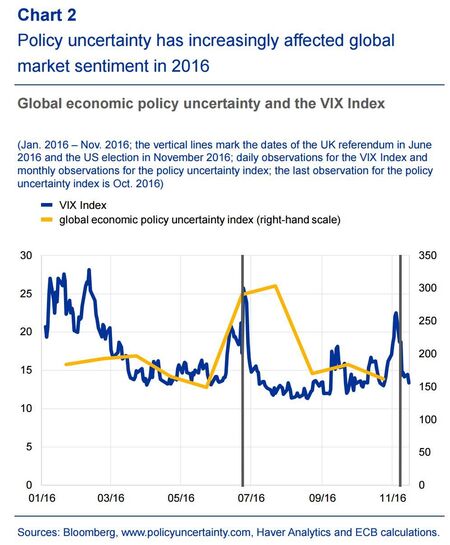
The report warns that the risk of an abrupt global market correction has intensified on the back of widespread political uncertainty, posing a threat to banks, stability and economic growth. While the policies of incoming President Trump may lead to higher spending and faster inflation in the U.S., their effect on the euro area is difficult to gauge given the possibility of protectionist tit-for-tats and higher chances of populist victories in votes across the continent.
Constancio: Will Keep Expansion Stance on Monetary Policy
 
Bloomberg
“More volatility in the near future is likely and the potential for an abrupt reversal remains significant,” according to the Frankfurt-based central bank. “Elevated geopolitical tensions and heightened political uncertainty amid busy electoral calendars in major advanced economies have the potential to reignite global risk aversion and to trigger a major confidence shock.”
For Constancio, U.S. expansionary policies may be accompanied by “some protectionist measures which would then reduce the impact on other parts of the world.” He said the recent rally in asset prices will only become sustained in Europe if inflation and growth in the region pick up, while a recent appreciation of the dollar won’t have a major effect on the continent as it did for emerging markets.
The U.S. elections capped a period of unexpected political results that started with the U.K.’s vote to leave the European Union, and that could continue as the region’s main economies face elections in coming months where populist and nationalist movements are slated to make inroads. Compared to its previous report six months ago, the central bank increased its concern over a “global risk repricing leading to financial contagion, triggered by heightened political uncertainty in advanced economies and continued fragilities in emerging markets.”

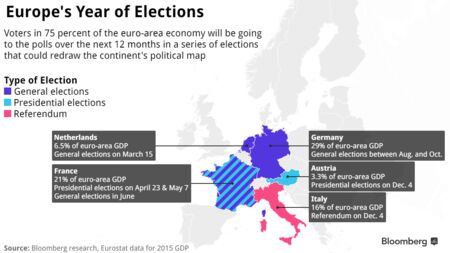
Euro-area countries with elections over the next 12 months
While the currency bloc’s economy and financial system have remained resilient so far, more political instability in coming months may put pressure on weak banks and countries with high sovereign debt. The central bank flagged the risk of a return of market pressure on the region’s weakest countries as the spread of populism hinders reforms.
“Higher political uncertainty may lead to more domestically focused, growth-hindering policy agendas,” the report said. “This, in turn, could delay much needed fiscal and structural reforms and could in a worst-case scenario reignite pressures on more vulnerable sovereigns.”

Vulnerable Banks

“We are in a new phase of weaker world trade” Constancio said in a press conference. “If, on top of that, there would be a wave of protectionist measures, world trade, and world growth would suffer.”
The ECB vice president confirmed that the despite the risk build-up, the ECB still sees euro-area growth around 1.6 percent in 2017, with inflation rising to about 1.25 percent in the spring. Even so, he stressed that some of the region’s lenders remain weak and need to continue addressing excessive costs and a high burden of non-performing loans.
“Vulnerabilities remain significant for euro-area banks,” the central bank said in its report. “Profitability prospects overall remain low across the euro area in a subdued economic growth environment.”
Even so, the U.S. election results spurred a pick-up in bank stocks as investors saw the risk of ever tighter regulation recede. If sustained, this would “provide some support for euro area banks’ profitability prospects,” according to the ECB.

http://www.bloomberg.com/news/articles/2016-11-24/ecb-warns-of-market-correction-as-political-instability-spreads