Showing posts with label Daniel J Mitchell. Show all posts

Monday, 30 April 2018

EU's Juncker celebrates Marxist totalitarianism

The ideology Marx gave rise to killed tens of millions of innocents. Jean-Claude Juncker, President of the European Commission, illustrates his own moral blindness and the bankruptcy of the EU itself as he celebrates the 200th anniversary of the birth of Karl Marx. Thank goodness Britain will soon be rid of this awful institution


Skulls
No cause for celebration
28afeec47808a46741242eeecfe39bbc94ff3741
Daniel J. Mitchell
On 30 April 2018 09:13
The evil ideology known as communism left a track record of unimaginable horror. Experts estimate that 100 million people were killed
Some were murdered. Other starved to death because of the pervasive economic failure of communism.
Yet there are dupes and apologists who overlook all this death and misery.
One of them is Jean-Claude Juncker, the President of the European Commission. A few days from now, this über-bureaucrat will help celebrate the 200th birthday of Karl Marx.
"The European Commission President will travel to Trier, Germany, where he will give a speech to celebrate the 200th anniversary of Marx’s birth. …The Commission President will give a speech at the opening ceremony of the Karl Marx exhibition in the city. …The chief eurocrat’s trip has received critics, who have suggested the 63-year-old forgetting how Marx’s “warped ideology” led to millions of deaths across the world. Ukip MEP and the party’s former leader Paul Nuttall said: “It is appalling that Jean-Claude Juncker feels it necessary to commemorate a man whose ideology – Marxism/Communism – led to more than 100 million deaths.
"…Conservative MP Daniel Kawczynski…, who as a seven-year-old boy fled to Britain with his family from the Communist regime in Poland, said Mr Juncker should reject any invitations to commemorate the event. He said: “I think it’s in very poor taste we have to remember that Marxism was all about ripping power and individual means away from people and giving to State. “Marxism led to the killing of millions around the world as it allowed a small band of fanatics to suppress the people we must learn the lessons from this and share with our children.”'
How disgusting. And let’s not forget that communism is still claiming victims in places such as Cuba and North Korea.
Here’s the part of the story that caused my jaw to drop.
"A commission spokeswoman defending Mr Juncker’s visit… She said: …“I think that nobody can deny that Karl Marx is a figure who shaped history in one way or the other."
In that case, why not celebrate Hitler’s birthday as well?
Writing for the Atlas Society, Alan Charles Kors expresses dismay that communism does not receive the same treatment as its sister ideology of National Socialism.
"No cause, ever, in the history of all mankind, has produced more cold-blooded tyrants, more slaughtered innocents, and more orphans than socialism with power. It surpassed, exponentially, all other systems of production in turning out the dead. The bodies are all around us. And here is the problem: No one talks about them. No one honors them. No one does penance for them. No one has committed suicide for having been an apologist for those who did this to them. 
"…The West accepts an epochal, monstrous, unforgivable double standard. We rehearse the crimes of Nazism almost daily, we teach them to our children as ultimate historical and moral lessons, and we bear witness to every victim. We are, with so few exceptions, almost silent on the crimes of Communism. So the bodies lie among us, unnoticed, everywhere. We insisted upon “de-Nazification,” and we excoriate those who tempered it in the name of new or emerging political realities. There never has been and never will be a similar “de-Communization,” although the slaughter of innocents was exponentially greater, and although those who signed the orders and ran the camps remain. In the case of Nazism, we hunt down ninety-year-old men because “the bones cry out” for justice. In the case of Communism, we insisted on “no witch hunts”
"… The Communist holocaust should have brought forth a flowering of Western art, and witness, and sympathy. It should have called forth an overflowing ocean of tears. Instead, it has called forth a glacier of indifference. Kids who in the 1960s had portraits of Mao and Che on their college walls —the moral equivalent of having hung portraits of Hitler, Goebbels, or Horst Wessel in one’s dorm—now teach our children about the moral superiority of their political generation. Every historical textbook lingers on the crimes of Nazism, seeks their root causes, and announces a lesson that should be learned. Everyone knows the number “six million.” By contrast, it is always “the mistakes” of Communism or of Stalinism (repeated, by mistake, again, and again, and again). Ask college freshmen how many died under Stalin’s regime, and they will answer, even now, “Thousands? Tens of thousands?”'
Of course, some of these kids are probably wearing t-shirts celebrating Che Guevara, so it goes without saying that they are ignorant.
Or, if they actually know Che’s track record, the kids are immoral punks.
In any event, Jean-Claude Juncker should know better. Sounds like he wants his name to be added to the biggest-clown-in-Brussels contest.
P.S. I’m embarrassed to admit that some economists were apologists for communism.
P.P.S. There’s a very small silver lining to the dark cloud of communism. You can click here, here, here, and here to enjoy some clever anti-communism humor.
Daniel J. Mitchell, a long standing contributor to The Commentator, is a former Senior Fellow at the Cato Institute, the free-market, Washington D.C. think tank. His articles are cross-posted on his blog by agreement

http://www.thecommentator.com/article/6792/eu_s_juncker_celebrates_marxist_totalitarianism

Thursday, 1 February 2018

MUST READ - US View: UK has a stronger Brexit hand than it thinks

he EU is terrified that an independent UK will become more market-friendly and thus put competitive pressure on its member states. It is also horrified at losing EU contributions. Theresa May needs to understand she has the upper hand, and stop behaving like a weakling against Eurocrats who genuinely have a lot to fear


Westminster
Britain should get tough with EU
28afeec47808a46741242eeecfe39bbc94ff3741
Daniel J. Mitchell
On 1 February 2018 14:33
If I was a citizen of the United Kingdom, I would have voted to leave the European Union for the simple reason that even a rickety lifeboat is better than a slowly sinking ship.
More specifically, demographic changes and statist policies are a crippling combination for continental Europe, almost surely guaranteeing a grim future, and British voters wisely decided to escape. Indeed, I listed Brexit as one of the best things that happened in 2016.
This doesn’t mean the U.K. has ideal policies, but Brexit was a good idea precisely because politicians in London will now have more leeway and incentive to liberalize their economy.
Though I wonder whether Prime Minister May and the bumbling Tories will take advantage of the situation.
The Financial Times has a report that captures the real issue driving Brexit discussions. Simply stated, the European Union is scared that an independent U.K. will become more market-friendly and thus put competitive pressure on E.U. welfare states.
"The EU is threatening sanctions to stop Britain undercutting the continent’s economy after Brexit…the bloc wants unprecedented safeguards after the UK leaves to preserve a “level playing field” and counter the “clear risks” of Britain slashing taxes or relaxing regulation. Brussels…wants…to enforce restrictions on taxation…and employment rights.
"…the EU negotiators highlight the risk of Britain ‘undermining Europe as an area of high social protection’…the UK is “likely to use tax to gain competitiveness” and note it is already a low-tax economy with a “large number of offshore entities”. …On employment and environmental standards, the EU negotiators highlight the risk of Britain “undermining Europe as an area of high social protection”.'
In case you don’t have a statism-to-English dictionary handy, you need to realize that “level playing field” means harmonizing taxes and regulations at very high level.
Moreover, “employment rights” means regulations that discourage hiring by making it very difficult for companies to get rid of workers.
And “high social protection” basically means a pervasive and suffocating welfare state.
To plagiarize from the story’s headline, these are all policies that belong in a bonfire.
And the prospect of that happening explains why the politicians and bureaucrats in continental Europe are very worried.
"…senior EU diplomats, however, worry that the political expectations go beyond what it is possible to enforce or agree. “This is our big weakness,” said one. Theresa May, the British prime minister, last year warned the EU against a “punitive” Brexit deal, saying Britain would fight back by setting “the competitive tax rates and the policies that would attract the world’s best companies and biggest investors”.'
Sadly, Theresa May doesn’t seem very serious about taking advantage of Brexit. Instead, she’s negotiating like she has the weak hand.
Instead, she has the ultimate trump card of a “hard Brexit.” Here are four reasons why she’s in a very strong position.
First, the U.K. has a more vibrant economy. In the latest estimates from the Fraser Institute’s Economic Freedom of the World, the United Kingdom is #6.
And how does that compare to the other major economies of Europe? Well, Germany is #23, Spain is #36, France is #52, and Italy is #54.
So it’s easy to understand why the European Union is extremely agitated about the United Kingdom becoming even more market oriented.
Indeed, the only area where the U.K. is weak is “size of government.” So if Brexit led the Tories to lower tax rates and shrink the burden of government spending, it would put enormous pressure on the uncompetitive welfare states on the other side of the English Channel.
Second, the European Union is horrified about the prospect of losing membership funds from the United Kingdom. That’s why there’s been so much talk (the so-called divorce settlement) of ongoing payments from the U.K. to subsidize the army of bureaucrats in Brussels.
A “hard Brexit” worries British multinational companies, but it worries European bureaucrats even more.
Third, the European Union has very few options to punitively respond because existing trade rules (under the World Trade Organization) are the fallback option if there’s no deal. In other words, any protectionist schemes (the “sanctions” discussed in the FT article) from Brussels surely would get rejected.
Fourth, European politicians may hate the idea of an independent, market-oriented United Kingdom, but the business community in the various nations of continental Europe will use its lobbying power to fight against self-destructive protectionist policies and other punitive measures being considered by the spiteful political class.
P.S. Here’s a Brexit version of the Bayeux Tapestry that probably won’t be funny unless one is familiar with the ins and outs of British politics.
P.P.S. Here are some easier-to-understand versions of Brexit humor.
P.P.P.S. And here’s some mockery of senior politicians of the European Commission.
Daniel J. Mitchell, a long standing contributor to The Commentator, is a Senior Fellow at the Cato Institute, the free-market, Washington D.C. think tank. His articles are cross-posted on his blog by agreement


http://www.thecommentator.com/article/6735/us_view_uk_has_a_stronger_brexit_hand_than_it_thinks

Saturday, 30 September 2017

UKIP leader right we should threaten to ditch Brexit talks

We are pointlessly allowing ourselves to be bullied by Brussels. We know how to deal with bullies. Stand up to them, tell them it is we who won't proceed to the next stage of Brexit talks if they don't buck their ideas up, and see how long Barnier and company's fake tough guy act can last


Barnier
Barnier isn't serious about a deal
The_commentator_logo_updated9
the commentator
On 30 September 2017 12:26
UKIP still has something to contribute after all. Its newly elected leader Henry Bolton's first public intervention since being elected last week was to urge the British government to be prepared to ditch Brexit talks with Michel Barnier and his motley crew leading the EU side in Brexit talks.
"I actually do not credit some of the people in the European Union with any wish whatsoever to have a smooth deal. There are other people who are more constructive in Brussels. But I think it’s going to be incredibly difficult to achieve a deal," the Guardian quoted him as saying yestereday.
“I do not believe we should be pushing this out and allowing the negotiations to be endless before we leave. It is absolutely crucial that this country is fully prepared to walk away because otherwise the European Union is just going to be negotiating forever on this and they would just string us along.”
He is absolutely right. Barnier is part of the cadre of Brussels apparatchicks which believes that Britain should be "punished" for its decision to quit the EU. He wants to create as many artificial problems as possible so as to discourage other countries from following Britain out of the door.
Barnier is thus not negotiating in good faith, and Bolton is right on target in warning that we risk being strung along.
We should call the EU's bluff. Prime Minister May has gone on record as saying that no deal is better than a bad deal, but now, after Angela Merkel appears to have secured another term as German Chancellor, is the time for Britain to ramp it up a notch.
As things stand, we have allowed ourselves to be put permanently on the back foot. We wait in fevered anticipation for Brussels to tell us that we are being good boys and girls and that we can, if we continue to behave ourselves, be allowed to move to the next phase of negotiations.
We need to reverse that power dynamic. We have all the cards. It is Brussels that cannot afford to let us leave without a deal, not the other way around. Just think about it. Imagine we walked away in 2019, started trading on WTO rules, and then did very well all the same.
Now that would be a green light for other countries to leave the EU with no fear whatsoever of the consequences.
If it comes down to the optics, Brussels needs to posit Britain as an exceptional case that did well because it got the kind of deal that would never be afforded to others. If we just show them the finger and walk away, all the while suffering no negative consequences at all, that would be a truly disastrous outcome for the Brussels establishment.
As leading US economist Dan Mitchell points out:
"Failure to reach a deal (also known as a “hard Brexit”) isn’t the end of the world. It’s not even a bad outcome. A hard Brexit simply means that the U.K. trades with Europe under the default rules of the World Trade Organization. That’s not complete, unfettered free trade, but it means only modest trade barriers."
"And since Britain trades quite successfully with the rest of the world under those rules, there’s no reason to fear a collapse of trade with Europe."
Exactly.
The fact is that we are pointlessly allowing ourselves to be bullied. One thing bullies can't cope with is when people turn round and push back at them.
We should tell Brussels that unless Barnier changes his tune, it is we who will not proceed to the next stage of Brexit talks. Then we'll see just how tough these eurocrats really are.

Thursday, 28 September 2017

US economist: Britain's post-Brexit path to prosperity

The EU is terrified that Britain will become a low tax, business friendly haven after Brexit. But that is exactly what Britain can now become, and it will ensure a stellar future outside the confines of the failing Brussels behemoth

Big_ben
Big Ben knows when it's time to leave
28afeec47808a46741242eeecfe39bbc94ff3741
Daniel J. Mitchell
On 28 September 2017 10:30
Since I’m in London for a couple of speeches, I’ve taken advantage of this opportunity to make sure I’m up to speed on Brexit.
Regular readers may recall that I supported the U.K.’s decision to leave the European Union. Simply stated, the European Union is a slowly sinking ship. Getting in a lifeboat doesn’t guarantee a good outcome, I noted, but at least there’s hope.
"The European Union’s governmental manifestations…are – on net – a force for statism rather than liberalization. Combined with Europe’s grim demographic outlook, a decision to remain would guarantee a slow, gradual decline. A vote to leave, by contrast, would create uncertainty and anxiety in some quarters, but the United Kingdom would then have the ability to make decisions that will produce a more prosperous future.
"Leaving the EU would be like refinancing a mortgage when interest rates decline. In the first year or two, it might be more expensive because of one-time expenses. In the long run, though, it’s a wise decision."
Others reached the same conclusion.
“Black Swan” author Nassim Nicholas Taleb…told CNBC’s “Power Lunch” the EU has become a “metastatic and rather incompetent bureaucracy” that is too intrusive. “The way they’ve been building it top down from Brussels is doomed to fail. This is 2016. They are still thinking 1950 economics,” said Taleb, who is also the author of “Antifragile” and is an advisor to Universa Investments. Taleb has warned about an EU breakup for some time, calling it a horrible, stupid project back in 2012.
That being said, there is a lot of angst in the U.K. about what will happen during the divorce process, in part because of the less-than-stellar performance of the Tory leadership.
There are three things, however, that British politicians need to remember.
First, the EU bureaucrats are terrified at the prospect of losing $10 billion of annual payments from the U.K., which is why they are desperately trying to convince politicians in London to cough up a big pile of money as part of a “divorce” settlement.
And “desperately” is probably an understatement, as James Hannam remarks:
"The UK…contributions to the EU do come to over €10 billion a year. That is a substantial fiscal hole for the European Commission to plug… The Commission would prefer not to reduce expenditure since the structural funds and agricultural subsidies it distributes help to justify the EU’s existence. …it is not surprising that the Brexit divorce bill has become a sticking point in the negotiations. If the amount is big enough, it could tide the EU over for a few years.
"In Brussels, a problem kicked down the road is treated as a problem solved. This gives the British some leverage because it is most unlikely that the Commission will have lined up any new sources of funding, or agreed what it can cut, before March 29, 2019, when negotiations have to be completed. With no deal, the EU might end up with nothing at all."
Second, European politicians are terrified that the U.K., which already has the world’s 10th-freest economy, will slash tax rates and become even more competitive in a post-Brexit world.
If you don’t believe me, maybe you’ll believe European officials who say the same thing.
"European leaders will insist that the UK rules out tax dumping as part of any trade deal struck during Brexit negotiations… Matthias Machnig, the German deputy economy minister, called for a “reasonable framework” in tax and regulation, and is warning “a race to the bottom in tax and regulation matters would make trade relations difficult”. Donald Tusk, the European Council president, also warned this morning that a deal must “…encompass safeguards against unfair competitive advantages through, inter alia, fiscal, social and environmental dumping”. The fear is that unless the trade deal which binds the UK into the European standards on tax, competition and state aid the UK will lead a regulatory “race to the bottom”."
Third, failure to reach a deal (also known as a “hard Brexit”) isn’t the end of the world. It’s not even a bad outcome. A hard Brexit simply means that the U.K. trades with Europe under the default rules of the World Trade Organization. That’s not complete, unfettered free trade, but it means only modest trade barriers.
And since Britain trades quite successfully with the rest of the world under those rules, there’s no reason to fear a collapse of trade with Europe.
Moreover, don’t forget that many industries in Europe will pressure their politicians to continue free trade because they benefit from sales to U.K. consumers.
"Around one in seven German cars is exported to the UK. Around 950,000 newly registered vehicles in the UK last year were made in Germany. As many as 60,000 automotive jobs in Germany are dependent on exports to the UK. Deloitte have explored the potential effect of a “tariff war” on the industry.
"…German politicians are realising this. The Bavarian Minister for Economic Affairs, Ilse Aigner, has said that “Great Britain is one of the most important trading partners in Bavaria. We must do everything we can to eliminate the uncertainties that have arisen.” …The Minister is correct. …A comprehensive free trade agreement is not only vital, but should be easy to achieve. In other words, spiteful protectionism from the Commission would accomplish nothing but impoverishing all sides."
The bottom line is that the U.K. has plenty of negotiating power to get a good outcome.
So what does this mean? How should British politicians handle negotiations, considering that they would like free trade with Europe?
Part of the answer is diplomatic skill. British officials should quietly inform their counterparts that they understand a hard Brexit isn’t a bad outcome. And they should gently remind EU officials that a hard Brexit almost certainly guarantees a more aggressive agenda of tax cuts and deregulation.
But remember that it’s in the interest of U.K. policymakers to adopt good policy regardless of what deal (if any) is made with the European bureaucrats.
The first thing that should happen is for British politicians to adopt a low-tax model based on Singapore. Some experts in the U.K. are explicitly advocating this approach.
"I call this the Singapore effect. When Singapore separated from the Malaysian Federation in 1965, it apparently faced a grim future. But the realisation that no one was going to do it any favours acted as a spur to effective government – with spectacular results. We could do the same. We need a strategy that lays out the path to reductions in corporation tax, lower personal tax."
Marian Tupy of the Cato Institute explains why copying Singapore would be a very good idea.
"Why Singapore? Let’s look at a couple of statistics. In 1950, GDP per capita adjusted for inflation and purchasing power parity was $5,689.91 in Singapore. It was $11,920.58 in the U.K. Average income in Singapore, in other words, amounted to 48 percent of that in the U.K. In 2016, income in Singapore was $82,168.33 and $42,287.17 in the U.K. Put differently, Singaporeans earned 94 percent more than the British. During the intervening years, Singaporean incomes rose by 1,344 percent, while British incomes rose by 256 percent.
'…the “threat” of Singaporean tax rates and regulatory framework ought not to be a mere negotiating strategy for the British government vis-a-vis the EU. It ought to be a goal of the British decision makers—regardless of what the EU decides!"
Here’s a chart from Marian’s article.
Or the U.K. could copy Hong Kong, as a Telegraph columnist suggests.
"Our political leaders still seem to lack a vision of what Britain can achieve outside the EU… Perhaps they are lacking in inspiration. If so, …Hong Kong…is now one of the richest places in the world, with income per capita 40 per cent higher than Britain’s."
And much of the credit belongs to John Cowperthwaite, who unleashed great prosperity in Hong Kong by limiting the role of government.
"Faced with…the approach being taken in much of the West: deficit financing, industrial planning, state ownership of industry, universal welfare and higher taxation. How much of this did the British civil servant think worth transposing to Hong Kong? Virtually nothing. He had a simple alternative: government spending depended on government revenues, and this in turn was determined by the strength of the economy. Therefore, the vital task for government was to facilitate growth.
"…He believed in the freest possible flow of goods and capital. He kept taxes low in order that savings could be reinvested in businesses to boost growth. …Cowperthwaite’s view was that higher government spending today destroys the growth of tomorrow. Indeed, over the last 70 years Hong Kong has limited the size of the state to below 20 per cent of GDP (in Britain it is over 40 per cent) and growth has been substantially faster than in the UK. He made a moral case for limiting the size of government, too."
In other words, the United Kingdom should seek comprehensive reforms to reduce the burden of government.
That includes obvious choices like lower tax rates and less red tape. And it also means taking advantage of Brexit to implement other pro-market reforms.
One example is that the U.K. will now be able to assert control over territorial waters. That should be immediately followed by the enactment of a property rights-based system for fisheries. It appears that Scottish fishermen already are agitating for this outcome.
"The Scottish Fishermen’s Federation says the UK’s exit from the European Union will boost jobs in the sector, reports The Guardian. It’s chief executive Bertie Armstrong said the exit will give them “the ability to recover proper, sustainable, rational stewardship through our own exclusive economic zone for fisheries”."
Let’s close with some Brexit-related humor.
I already shared some examples last year, and we can augment that collection with this video. It’s more about USexit, but there’s some Brexit material as well.
And here’s some more satire, albeit unintentional.
The President of the European Commission is so irked by Trump’s support for Brexit that he is threatening to campaign for secession in the United States.
"In an extraordinary speech the EU Commission president said he would push for Ohio and Texas to split from the rest of America if the Republican president does not change his tune and become more supportive of the EU. …A spokesman for the bloc later said that the remarks were not meant to be taken literally, but also tellingly did not try to pass them off as humorous and insisted the EU chief was making a serious comparison."
I have no idea why Juncker picked Ohio and Texas, but I can state with full certainty that zero people in either state will care what a European bureaucrat thinks.
And speaking of accidental satire, this tweet captures the mindset of the critics who wanted to pretend that nativism was the only reason people were supporting Brexit.
"The EU is an economic catastrophe unfolding in slow motion at huge scale!" "The only reason anyone wants to leave the EU is racism!"— Marc Andreessen (@pmarca) July 3, 2016
Last but not least, we have another example of unintentional humor. The pro-tax bureaucrats at the OECD are trying to convince U.K. lawmakers that tax cuts are a bad idea.
"The head of tax at the Organization for Economic Co-operation and Development, which advises developed nations on policy, said the UK could use its freedom from EU rules to slash corporate tax but the political price would be high. …”A further step in that direction would really turn the UK into a tax haven type of economy,” he said, adding that there were practical and domestic political barriers to doing this. …The UK is already in the process of cutting its corporate tax rate to 17 percent."
Though maybe I shouldn’t list this as unintentional humor. Maybe some British politicians will be deterred simply because some tax-free bureaucrats in Paris expressed disapproval. If so, the joke will be on British workers who get lower wages as a result of foregone investment.
By the way, here’s a reminder, by Diana Furchtgott-Roth in the Washington Examiner, of why Brexit was the right choice.
"As we celebrate Independence Day on July 4, we can send a cheer across the pond to the British, who declared independence from the European Union on June 23. For the British, that means no more tax and regulatory harmonization without representation. Laws passed by Parliament will no longer have to be EU-compatible.
"It even means they will be able to keep their high-efficiency kettles, toasters, hair dryers and vacuum cleaners. As just one example of the absurdity of EU regulation, vacuum cleaners with over 1600 watts were banned by Brussels in 2014, and those over 900 watts are scheduled to be phased out in 2017. Brussels bureaucrats say that these vacuum cleaners use too much energy.
"No matter that the additional energy cost of a 2300-watt vacuum cleaner compared with a 1600-watt model is less than $20 a year, that it takes more time to vacuum with a low-energy model, and, most important, people should be able to choose for themselves how they want to spend their time and money. I, for one, prefer less time housecleaning."
Amen. As much as I despise the busybodies in Washington for subjecting me to inferior light bulbs, substandard toilets, second-rate dishwashers, weak-flow showerheads, and inadequate washing machines, I would be far more upset if those nanny-state policies were being imposed by some unaccountable international bureaucracy.
Daniel J. Mitchell, a long standing contributor to The Commentator, is a Senior Fellow at the Cato Institute, the free-market, Washington D.C. think tank. His articles are cross-posted on his blog by agreement

Wednesday, 19 July 2017

Our demographic crisis is actually a policy crisis

he much talked about demographic crisis in the Western world is real. Just look at the fertility rates in Europe. But the bigger problem is not so much that we are having too few babies as that our bloated state oriented system needs radical reform


People
Too many people, or too few?
28afeec47808a46741242eeecfe39bbc94ff3741
Daniel J. Mitchell
On 19 July 2017 04:52
I will occasionally pontificate about a demographic crisis in the developed world, but I usually feel guilty afterwards. After all, how can it be a bad thing that we’re living longer? And what gives me the right to grouse about the number of children other families decide to have?
What I should be saying instead is that demographic changes are forcing us to recognize that we have a crisis of bad public policy. To be more specific, the entitlement state has become too large.
At the risk of oversimplification, I basically stated that there are two crises in the world.
The first crisis, based in the industrialized world, is that tax-and-transfer welfare states were created back when there were lots of workers and relatively few old people, and most people assumed that demographic profile would always exist.
But now that the “population pyramid” is becoming a “population cylinder” (I was talking faster than I was thinking in the interview and reversed the two concepts at one point), there aren’t going to be enough workers to finance all the redistribution programs, particularly the ones that funnel money to the elderly.
This is a big reason why nations such as Greece and Italy already are in deep trouble and why it’s just a matter of time before the fiscal crisis spreads to France and Japan (and the United States if we don’t enact genuine entitlement reform).
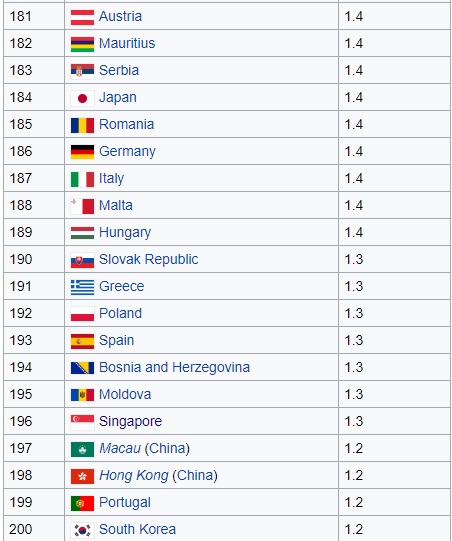
Here’s a table, based on World Bank data, showing the 20 jurisdictions with the lowest fertility rates. Which means, of course, the places with the fewest future taxpayers to finance redistribution.

The second crisis, based in the developing world, is that pervasive statism suffocates growth.
And while I largely agree with the late Julian Simon about people being a resource rather than liability, if a nation has a bloated and intrusive public sector that stifles the private sector, then a growing population can be a bad thing.
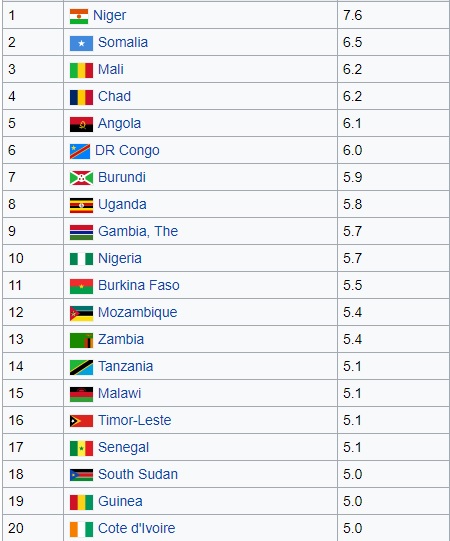
But it’s not the growing population that’s bad, it’s the statist policies. Here’s a list of the 20 counties with the highest fertility rates. The majority of them are ranked in the “least free” quartile according to Economic Freedom of the World. And none of them are in the “most free” quartile.


But the most important part of the interview, at least when thinking about problems in the industrialized world, is when I pointed out that nations such as Singapore don’t face a big problem.
Yes, Singapore has one of the lowest fertility rates in the world, but it also doesn’t have a pervasive tax-and-transfer welfare state. People are responsible for saving for their own retirement and healthcare. So the absence of future taxpayers isn’t a major challenge because the system doesn’t need to be propped up with tax revenue.
And the same thing is true in Hong Kong, another jurisdiction that is in good long-run shape even though the fertility rate is extremely low.
P.S. Given the demographic changes that are now occurring, many governments with big welfare states now recognize that they have a problem. Unfortunately, many of them think the solution is to artificially encourage more babies rather than entitlement reform.
Daniel J. Mitchell, a long standing contributor to The Commentator, is a Senior Fellow at the Cato Institute, the free-market, Washington D.C. think tank. His articles are cross-posted on his blog by agreement

http://www.thecommentator.com/article/6624/our_demographic_crisis_is_actually_a_policy_crisis


Friday, 23 June 2017

The endless failure (but bizarre allure) of socialism

The pattern is clear, and has been evident for many decades. Socialism is tried. Socialism fails. Socialists claim real socialism was never tried in the first place. The lesson here is that socialists are inaccesible to reason

Lenin-tomb-red-square-moscow_cs
Lenin is dead and buried, but socialists won't learn
28afeec47808a46741242eeecfe39bbc94ff3741
Daniel J. Mitchell
On 23 June 2017 08:10
Back in 2014, I wrote a column asking my leftist friends two very serious questions. And I often repeat these questions when debating proponents of bigger government.
** Can you name a nation that became rich with statist policies?
** Can you name a nation that with interventionism and big government that is out-performing a similar nation with free markets and small government?
I’ve yet to receive a good answer to either question. Many leftists point to certain European welfare states, but I debunk that claim by pointing out that those nations became rich when government was very small (about 10 percent of GDP, about one-half the size of the current Hong Kong and Singapore public sectors).
Others point to rapid growth in China, but that’s rather silly since improvements in that country’s economy are the result of partial liberalization. In any event, it’s not that difficult to have rapid growth rates when starting from a very low level.
But even with a couple of decades of good growth, living standards in China are still relatively low.
So my challenge remains. I want a leftist (or anybody) to identify a successful statist nation, but I’m not holding my breath for good answers.
Yet even though the real-world evidence against big government is so strong, it’s rather baffling that many young people are drawn to that coercive ideology and disturbing that a non-trivial number of voters favor this failed form of statism.
The London-based Institute for Economic Affairs has released a video on the false allure of socialism.
I suppose a caveat might be appropriate at this stage.
Socialism has a technical definition involving government ownership of the means of production and central planning of the economy.
But most people today think socialism is big government, with business still privately owned but with lots of redistribution and intervention (I’ve argued, for instance, that even Bernie Sanders isn’t a real socialist, and that there are big differences between countries like Sweden, China, and North Korea).
For what it’s worth, that’s actually closer to the technical definition of fascism. But I guess I’m being pedantic by wanting more precision in how terms are used.
In any event, the IEA video is spot on. If you like videos debunking socialism, I have other examples here, here, and here.
Last but not least, here’s my favorite visual from the IEA video.
P.S. If you like visuals mocking socialism, I’ve amassed a very nice collection. Click here, here, here, here, here, here, here, here, here, here, here, and here for examples.
P.P.S. The good news is that socialism isn’t very popular in the United States, particularly compared to free enterprise.
http://www.thecommentator.com/article/6610/the_endless_failure_but_bizarre_allure_of_socialism

Wednesday, 17 May 2017

Tories must use victory to revolutionise UK economy

While mad Jeremy Corbyn appears to advocate an Anglo-Saxon version of North Korea, Theresa May needs to use the thumping majority she is likely to get at the election to reduce the state and reinvigorate free market values and practices. A Tory victory is a necessary but not sufficient condition for UK economic success


Theresa-may
A more powerful woman on June 8
28afeec47808a46741242eeecfe39bbc94ff3741
Daniel J. Mitchell
On 17 May 2017 12:25
There’s an election next month in the United Kingdom, though there’s not much political suspense.
The Labour Party is led by Jeremy Corbyn, a crazed Bernie Sanders-style leftist, and British voters have no desire to become an Anglo-Saxon version of Venezuela. 
Or, since Corbyn’s main economic adviser actually has said all income belongs to the government and Corbyn himself has endorsed a maximum wage, maybe an Anglo-Saxon version of North Korea.
Given the Labour Party’s self-inflicted suicide, it is widely expected that the Conservative Party, led by Theresa May, will win an overwhelming victory.
But what difference will it make? Will the Tories have a mandate? Do they actually want to change policy?
Let’s start by asking whether policy should change. The good news is that the United Kingdom is ranked #10 according to Economic Freedom of the World. That means the U.K. is more market-friendly than the vast majority of nations (including the United States, I’m sad to report).
The bad news is that the U.K.’s score has been slipping throughout the 21st century. Basically, there were a lot of great reforms during the Thatcher era, but policy in recent years has been slowly deteriorating.
More worrisome is that the U.K. – like most developed nations – has a demographic problem.
In the absence of reform, the burden of government automatically will increase.
And that’s a big problem in a nation where a majority of people already are net dependents. In a column for the Telegraph, Daniel Mahoney of the Centre for Policy Studies analyzes this major threat to the U.K.
"This week, the Office for National Statistics published figures showing the level of net dependency on the UK state. …The figure now stands at 50.5 per cent. In the 1980s and 1990s, this figure was just over 40 per cent – that is to say that around four in ten households received more in benefits than they paid in taxes. But this dramatically changed in the New Labour era, which left office with well over half of the population being deemed net dependent on the state.
"…Labour’s enormous increase in spending on public services and welfare was equally responsible for this worrying trend. Public spending grew from just 34.5 per cent of GDP in 2000 to 41% of GDP just before the financial crisis hit the UK… There has been some progress in recent years, …but levels of net dependency remain too high. Over half of households are still net dependent on the state. …It is important for the next Government to reduce dependency further."
But rather than move policy in the right direction, there’s considerable concern that Theresa May is a British version of George W. Bush.
Thatcherites are worried.
"Theresa May has been warned not to abandon Margaret Thatcher’s free market economics as she prepares to reveal the most interventionist Tory manifesto for generations. …The Prime Minister has already announced an energy price cap and is expected to clamp down on executive pay and empower workers on boards in her election pitch. …cabinet ministers who served under Mrs Thatcher were scathing of the Prime Minister’s energy price cap when speaking off the record.
"One said it would create “incredible distortions” in the energy market, while another warned that Government cannot “force water uphill” by trying to stop free-market forces."
If you’re curious about May’s energy policy, Rupert Darwall has a helpful article in The Conservative.
"For some time, politicians of all parties have been imposing policies that force up energy costs. Now they want to cut the energy bills that have been driven higher by their own policies. …the Competition and Markets Authority noted the role of decarbonisation policies in pushing up costs. “Pressure on prices is likely to grow in the future, due in part to the increasing costs imposed by climate and energy policies,” the CMA stated.
"…BEIS ministers have convinced themselves that there is widespread popular support for the aggressive decarbonisation policies that are making energy more expensive. They should have the courage of their convictions and acknowledge that high and rising energy bills are a consequence of the decarbonisation policies they claim are so popular. Once they’ve done that, we can have an honest debate."
Sounds like a classic example of Mitchell’s Law. Politicians pursue a policy (green energy or decarbonisation) that leads to higher prices. They then respond to the problem created by their intervention with another form of intervention (energy price caps).
All of which will cause bigger problems in the future.
But for purposes of today’s column, what matters is that this bad policy is being pushed by the leader of the (supposedly) Conservative Party.
To be sure, it’s possible that this bad policy is just a gimmicky election promise and won’t be implemented. It’s also possible that it will be implemented but will be offset by better policy in other areas.
What matters is whether the overall burden of government is expanding or receding. Maybe May will cap spending (an area where her predecessor did a good job his last few years in office). Maybe she will cut tax rates (the corporate rate already has been slashed and will be reduced to 17 percent over the next few years).
At this stage, there’s no way to predict the direction of policy. But there is reason to worry because there aren’t enough people in the U.K. making the principled case for economic liberty.
Allister Heath explains what is needed to rejuvenate his country.
"Britain needs a new movement to sell free-market ideas. It is the only way that this country’s slow drift Left-wards, which began in 1997, will be halted and reversed. It’s the only way that Labour, which has reembraced Marxism under Jeremy Corbyn, and the Tories, which have fallen back in love with old fashioned economic interventionism, will ever see sense again.
"…Tories gave up fighting for free markets years ago, when David Cameron was elected leader…he decided…to accept all of Labour’s increases in state spending and regulation, including environmental and labour market rules…when the financial crisis struck, the Tories joined in the banker-bashing."
But it’s not just that the Tories did bad things.
They also failed to do good things.
"…they didn’t fight from the bully pulpit. They didn’t stand up and explain the merits of low taxes, which boost incentives. They didn’t shout from the rooftops that we need entrepreneurs to create wealth, and that people who make money by selling their wares to the public are performing a public service. They didn’t defend privatisation. They failed to make the case for profits…
"They conceded too much, including the destructive idea that the private sector is less moral and less law abiding than the state sector. They deferred to egalitarians and class warriors… When the financial crisis came, the Tories didn’t explain that much of it was actually caused by misplaced government intervention, including guarantees extended to financial institutions, pro-sub prime policies in the US, moral hazard and cheap money injected into the system by over-confident central banks. …We now have Mayonomics, a continuation of this trend, and its embrace of Ed Miliband-style energy price caps and yet more interventionism."
So Allister is urging a campaign for economic liberty.
"The campaign must explain why private companies that compete against one another always generate better outcomes than public sector monopolies. …All of the lessons that became part of the political conventional wisdom after the 1970s need to be relearnt and retaught, and we need a new generation of pro-free market activists to lead this struggle. It’s time for supporters of capitalism to stand up and be counted."
Sadly, the business community is unwilling to lead.
"The big business lobby groups are not up to the task… With a few exceptions, they don’t support real, genuine, free-markets."
For all intents and purposes, Allister is making the argument that Britain needs to become a more ethical society. In other words, he wants a campaign  to inform and educate about the value of liberty qua liberty. A belief in self reliance, work, and individual responsibility. Characteristics that could be considered part of social capital or cultural capital.
And I think he’s spot on.
I worry a lot about the erosion of social capital in America. But if the polling data is accurate, the problem is much bigger in the United Kingdom.
P.S. Brexit is a wild card in this discussion. I supported the decision to leave the European Union in large part because of my hope U.K. policy makers would feel pressure to shift policy in a more market-oriented direction.
Daniel J. Mitchell, a long standing contributor to The Commentator, is a Senior Fellow at the Cato Institute, the free-market, Washington D.C. think tank. His articles are cross-posted on his blog by agreement
http://www.thecommentator.com/article/6584/tories_must_use_victory_to_revolutionise_uk_economy