The Treasury has produced its 200-page report about the effects of Brexit on the economy. Predictably, it is highly negative. It is sad that the Treasury, for which I once worked for a few years, has become so politicised that it is reduced to rationalising the views of George Osborne.
Tuesday 19 April 2016 4:59 am
Tom Welsh Welsh Tom Welsh is City A.M.'s business features editor.
The modelling methods it has used to do Osborne’s bidding are the ones anyone would employ to rubbish Brexit. They involve estimating relationships over the past between such things as trade with the EU or Foreign Direct Investment, or tariffs and GDP. Unfortunately, as I pointed out in my book on the UK and the EU, these estimated relationships are highly unreliable when it comes to considering a whole new world of trading rules, which is what Britain would face after leaving the EU.
The basic point you have to ask is how the whole economy would react to the main alternative to our current regional EU rules, which is global trading rules under the World Trade Organisation (WTO). For this you need the sort of model I used in my book, a global world trade model. The results from such a model are perfectly intelligible to anyone and, what is more, they tally with what we all understand about free trade: that the wider the freedom we have to trade, the better the result.
Now consider what the EU arrangements we have actually are. The EU is a protectionist organisation known as a “Customs Union”; this raises barriers through tariffs and other non-tariff means against every country outside it. These barriers raise the price of goods sold inside the EU by the protectionist margin; so prices are higher for everything bought from anywhere that is protected against in this way. This is because, to sell into the EU, you must pay the tariff and also the extra costs of the non-tariff barriers.
The gainers from this Customs Union are the EU producers inside the protective wall: like children in a walled garden, they enjoy a cosseted life. EU producers sell their products inside the EU at inflated prices.
But the losers are the consumers who pay these inflated prices. It is a matter of some irony that our chancellor praises this Customs Union as a wonderful “free trade arrangement”! It takes your breath away that he should dare say this to UK voters and consumers. But of course they are blown away by his confident rhetoric, and who are they to argue?
When we measure the extent of the EU protective wall, we find that it is rather high, quite contrary to this rhetoric. Food prices are nearly 20 per cent higher on average, and average manufactured prices a bit more than 20 per cent higher. Even assuming, as I did in my book, that there is some reduction in this protection over time, to say 10 per cent on each, the overall effect of the EU on the consumer shopping basket is to raise it by 8 per cent – around £40 a week for the average consumer.
By leaving the EU, we move to global free trade; goods come in here from all over the world at world prices, without the EU add-on. Our consumers benefit. Our producers have to earn their way in the world at the true world prices of their products: the industries that do best will be our best industries, not our most protected ones.
But even the protected ones will not fare so badly: they will face world competition at home and they can still sell to the EU and pay the external tariff, which is only about 4 per cent on average. Under WTO rules, the EU would be unable to inflict the non-tariff barriers on them because our producers do not “dump” and they completely adhere to EU regulations already.
People ask: can we rely on the WTO to police these rules? Yes we can: the WTO is an active and powerful system of international courts that all members highly respect. Since all countries, including the US and the EU, use it repeatedly against others, they obey its judgements when they go against them. It enforces non-discrimination, the “most favoured nation” principle: that is all we need outside the EU because it means we sell our goods on a world market where no-one can arbitrarily discriminate against us, including the EU.
By leaving the EU, we go to global free trade and we rid ourselves of the intrusive EU regulation that bears down most heavily on our smaller firms who cannot afford huge HR and compliance departments. The gains to our economy from this are huge, as anyone would readily expect. The trade gain amounts to 4 per cent of national income, directly enjoyed by our voters even after spending some of it helping out those affected producers, including our farmers. The gain from getting out of the heavy-handed regulation of our whole economy by the EU is more again, and a boost to our growth rate. The Treasury report gets it precisely the wrong way round.
Patrick Minford is professor of applied economics at Cardiff Business School and author, with Sakshi Gupta, Mai Le, Vidya Mahambare and Yongdeng Xu of “Should Britain leave the EU?” (Edward Elgar, second edition, 2015).
City A.M.'s opinion pages are a place for thought-provoking views and debate. These views are not necessarily shared by City A.M.
There will soon be a sequel, analysing what the short-term impacts of leaving the EU might be. One doubts you’ll need the foresight of those who successfully predicted a Leicester City Premier League victory to guess what this will conclude.
Yet the economic methodology of the Treasury’s work really does need to be questioned. Due to the rapid response nature of modern media, it was impossible for those favouring Brexit to offer up a thorough critique of the first report quickly. One could only show it was riddled with bizarre assumptions. Not least, it assumed away by construction any benefit of Brexit in terms of signing third-party trade deals or deregulating the economy.
For those on the Remain side, of course, it sufficed to merely herald the Treasury’s results as reflecting the “economic consensus”. Surely if anything has been proven in the economic history of post-war Britain, it is that economic consensuses are a weak appeal to authority.
To fill the void of analysis on the Treasury study comes the second publication by the new group Economists for Brexit. In this report, professor Patrick Minford provides an accessible history of trade theory before critically evaluating the Treasury’s work.
Minford explains that the way the Treasury models Brexit is to focus on “openness”, the sum of imports and exports relative to GDP, and foreign direct investment (FDI). These two factors are each assumed to follow a so-called gravity model – where openness is related to things such as distance – estimated from multi-country data. The degree of openness and FDI are then assumed to determine productivity – the ultimate driver of living standards, estimated from industrial data. Finally, this productivity effect is added into a macro model to find the general effects on investment, GDP etc.
The broad story the Treasury tells is thus this: Brexit will make the UK less open and less attractive for FDI. This will lead to lower productivity and therefore less investment and lower living standards.
There are several major problems with this method. The first relates to identifying the effect of EU membership per se. In order to find this, large regressions over time and across countries are run to isolate the “EU effect”. But this is estimated using a binary assessment of whether a country is in or out. This throws up all sorts of potential biases because it calculates the EU effect across periods with many other different policies. Many of these factors may be related simultaneously to a country’s openness or FDI and its decision to be an EU member.
The second problem is that the Treasury modelling assumes that openness and trade drive improved productivity. While intuitive and in many cases true, this need not be the direction of causation. In fact, it might be that an industrial shock can cause increased trade, FDI and productivity simultaneously. In other words, the UK may receive FDI precisely because an industry becomes more productive. To assess how Brexit would affect this, you’d need to do far more extensive work on industries and causal testing than the Treasury attempts.
Finally, the Treasury comes to vastly different conclusions to Minford’s previous Economists for Brexit modelling (which suggests that we would be better off out of the EU) primarily because it assumes that, if we leave and do not sign a trade deal or remain in the Single Market, Britain will maintain EU-style tariffs on EU partners and non-EU trading partners who have EU trade agreements. These assumptions therefore generate large effects on openness and on FDI – and hence living standards.
In fact, if instead Britain were to adopt unilateral free trade (abolishing all tariffs), exiting the EU’s protected customs union would lead to UK consumers enjoying lower prices and would shift the structure of production towards non-protected sectors, enabling us to focus on real areas of comparative advantage and raising productivity. We would, of course, have full control over regulation too.
The need for a smoothed transition may prevent this “big bang” disruptive approach. As Roland Smith of the Adam Smith Institute pointed out this week, the government and Parliament that will negotiate our exit settlement will be overwhelmingly pro-Remain and may well choose the least disruptive short-term path: remaining in the Single Market in the European Economic Area. But the largest long-term gains from Brexit require an independent, free-trading Britain.
City A.M.'s opinion pages are a place for thought-provoking views and debate. These views are not necessarily shared by City A.M.
The EU now appears to be aiming to try and keep us within a Single Market-like state, as a de facto dependent vassal, continuing to pay vast sums of money into their ever-inflating, unaccountable budget. This cannot be allowed. We must get Britain out of the EU asap. Out means Out
The most recent rumblings to come out of the EU should worry even the most ardent Brexiteers. The comments made by Donald Tusk last week, echoed by Jean-Claude Juncker and the EU Parliament’s self-appointed chief Brexit coordinator Guy Verhofstadt, indicate that, in their minds, the opportunity for the British public to change their minds on Brexit remains open.
This is, after all, what the EU’s leaders actually want. Brexit is entirely reversible, they believe, regardless of our Referendum.
For the British Government and a ‘Real’ Brexit, this presents a problem. As long as in the minds of the EU’s leading figures Brexit is seen to be revocable, through a ‘Brexit in name only’ deal most likely, they have no incentive to creatively craft a mutually beneficial future relationship with the UK outside of the EU.
In fact, they actually have key reasons not to do so. By offering the UK a bad deal, the EU would no doubt be attempting to alter the British perspective on leaving. Using Project Fear Mark 2 in their efforts to halt a ‘Real’ Brexit' If the UK’s future relationship with the EU in any way resembles Single Market membership, it would be a betrayal of Brexit and what is best for Great Britain.
The EU now appears to be aiming to try and keep us within a Single Market-like state, as a de facto dependent vassal, continuing to pay vast sums of money into their ever-inflating, unaccountable budget.
To achieve this, the EU seems willing to use a very high-risk strategy, allegedly preparing to reject the UK Government’s comprehensive free trade proposals.
By doing this, the EU is now overtly offering the UK two choices. Either we accept Single Market membership (rebranded as regulatory alignment by Remainers) ‘or else’ – ie walking away with No Deal, and able to trade on World Trade Organisation (WTO) rules.
These rules would mean the introduction of import and export tariffs, which average under 2 percent, and form the basis of the majority of global trade. Not so bad after all.
The EU is clearly calculating that by doing this they are likely to reduce the British public’s support for a ‘Real’ Brexit. They are hoping we don’t call their bluff and walk away without a deal.
In their mind, having reduced support for Brexit with a bad deal offer, the UK would be only too willing to accept their preferred option of effective Single Market membership (‘regulatory alignment’) -- which many of our Remain voting politicians would doubtlessly be happy to accept.
However, the EU’s leaders are acting under the false premise there is a groundswell of support for Single Market membership, and that Britons are afraid of a WTO Brexit. This is simply untrue.
Within the EU, the idea of Britain remaining in the Single Market has been artificially inflated by a fervently Europhilic cabal of has-beens and professional malcontents. The leader of this faction is the Chancellor, Philip Hammond -- and he has continued this negative rhetoric in Davos this week, indicating the UK is seeking only ‘modest’ changes from its EU membership.
While many saw the Daily Telegraph’s branding of Conservative Remoaner Anna Soubry MP, and her gang “mutineers” as extreme, her recent trip to Brussels to meet Michel Barnier has undoubtedly undermined the UK’s negotiating position.
By fermenting the possibility of remaining, they have reinforced in the EU’s collective psyche, the need to propagate and enhance Project Fear Mark 2, in an attempt to assist their allies in keeping the UK tied to the decaying corpse of the Single Market. They don’t seem to care about undermining the British Government, and reinforcing the idea the EU should offer only two options -- Single Market ‘or else’.
However, the antics of Project Fear clearly failed during the EU Referendum campaign, and there is no reason to suspect this will work now. Britons are not changing their minds about Brexit. As we can see from Get Britain Out’s mailbag, the Great British Public are increasingly in favour of leaving the EU as soon as possible, and if needs be, on WTO rules.
As renowned economist Sir Patrick Minford, (a former economic advisor during the Thatcher years) has predicted GDP will surge by just under 10 percent -- an increase of £180 billion -- if we leave the EU on WTO rules next year.
If the EU continues to negotiate in bad faith, its high-risk strategy is doubtless going to backfire, as a No Deal WTO Brexit would cost the EU as much as £500 billion, according to the Professor. If the EU wants to secure a favourable Brexit deal with the UK, it is imperative its leaders desist in their current underhand tactics.
The British position is clear. Single Market membership (in any form) is against the spirit of the Referendum result and is wholly unacceptable. In the 2017 election both the Labour and Conservative manifestos included commitments to leave the Single Market. The Government must reinforce the point that leaving on WTO rules would not be such a bad thing, and the recent announcement of Government funding to prepare for a No Deal outcome was welcome news.
Only once the EU realises the UK is utterly committed to leaving, either with a good deal or on WTO rules, will they have the incentive to think creatively and negotiate a realistic, bespoke and mutually beneficial trade deal, instead of playing these games.
To Get Britain Out of the EU we must leave the Single Market and Customs Union, and under no circumstances can we give in to the EU’s blackmailing tactics.
While a free trade agreement with the EU might be preferable, leaving on WTO rules would allow our economy to flourish without being shackled to the EU’s coattails, and for the UK to regain its position as a global trading nation.
Daniel Huggins is a Research Executive at cross-party grassroots campaign Get Britain Out
One other issue at stake here is the very existence of that fragile creature, Democracy.
In the months preceding the EU Referendum of June 2016, all the issues of what leaving the EU would mean in practice were clearly spelled out. This took place in Parliament, in debates on the Referendum Bill. Both sides (Leave and Remain) made commitments during those debates to honour the will of the voters, without demanding any bigger margin than one single vote above or below 50%.
This was made very clear in campaign material, including the booklet which Cameron produced at our expense. Not only did he make it clear that the Leave vote meant LEAVE - including the single market - in his campaign speeches. In the booklet he made it clear that this was a once in a generation vote, that the government was handing this decision to the people, and that THE GOVERNMENT WILL DO WHAT YOU DECIDE.
Since the Referendum, Remain campaigners have done everything they can to cause unnecessary delay (Cameron's resignation before invoking Article 50; Gina Miller misrepresenting the parliamentary sovereignty issue, etc.) and to thwart the meaning of leaving the EU.
We had no doubt as to what our vote meant. (Remain voters may have thought that they were voting to stay in the EU as it was in December 2015, but that is another matter.)
If Theresa May, riding two horses going in opposite directions, fails to deliver a true and complete departure from the EU not later than March 2019, she will have delivered to the British democratic process a devastating if not fatal wound. Cameron gave Democracy a dagger thrust which amounts to GBH, when he resigned instead of keeping his promises to the voters. Theresa May could have given Democracy life-saving emergency treatment by invoking Article 50 during her first week in office instead of more than 6 months later.
Democracy is a patient still in intensive care. Paying a "divorce settlement", having a "transition period" after March 2019 when the only legitimate "transition period" ends, and any other betrayal of true Brexit risks dealing a fatal blow to British Democracy.
A group of economists who backed Brexit have predicted that leaving Europe could add £135bn a year to Britain's economy.
Economists for Free Trade (EFT), formerly known as Economists for Brexit, calculate that a so-called hard Brexit would lead to a surge in national output worth around £5,000 a year for every household on average.
Sunday 20 August 2017 9:11am
Economists say dropping tariffs could force a trade deal with the EU (Source: Getty)
In the new report due to be released this Autumn, they say that output surge should be accompanied by an eight per cent fall in prices, the equivalent of a £40 a week boost.
"Hard Brexit is good for the UK economically while soft Brexit leaves us as badly off as before…hard is economically much superior to soft," said Patrick Minford, professor of economics at Cardiff University and a former adviser to the Treasury, arguing that the UK should pursue global trade deals outside of Europe.
“Backers of soft Brexit say it would preserve jobs, but what they really mean is that it would preserve existing jobs by stopping competition from home and abroad. As every schoolboy knows and every politician ought to know, this aborting of competition reduces jobs in the long run…Competition increases productivity and so employment because higher wages paid for by higher productivity makes work more attractive. Competition also increases our general welfare because we are producing more.”
The group, which also includes Roger Bootle of Capital Economics and professor of economics at Cass Business School, David Blake, also believes the UK should eliminate all trade barriers and tariffs if new trade agreements can't be made with the EU and other countries to benefit from such gains
“This is unilateral free trade (UFT) whereby we simply abolish our trade barriers without asking others to do the same. The most famous example of this was in 1846 when Sir Robert Peel abolished the Corn Laws, greatly reducing the price of food and helping to stimulate the Industrial Revolution," said Minford.
Such a move would put pressure on the EU to agree a deal with the UK "flooded" with less expensive goods from non-EU countries.
Minford said it would be "A strong incentive for the EU to do a trade deal with us – which is what we want politically".
"This is the origin of the political soundbite – ‘No deal is better than a bad deal…Free trade acts as ‘the club in the closet’ to bring the EU to a proper trade agreement with us.”
However, anti-Brexit group Open Britain dubbed such a plan "absurd".
“Unilaterally scrapping our tariffs without achieving similar reductions in the tariff rates of other countries would see Britain swamped with imports, leaving our manufacturers and farmers unable to compete. The levels of bankruptcy and unemployment, especially in industry and agriculture, would sky-rocket," said Labour MP Alison McGovern.
And other economists were not convinced by his arguements.
"One thing that professor Minford gets right is that trade boosts our living standards and the economy standards. But he ignores decades of evidence on how trade actually works, and on the benefits of trade agreements," said Dr Monique Ebell, associate research director at the National Institute of Economic and Social Research.
A decision to remain in the EU would guarantee a slow, gradual decline. It really isn't smart to link Britain's future to a declining bloc of nations, and the failed, centralising tendencies of Brussels will get much worse if the UK stays. Brexit is the right way to go
On June 23, the people of the United Kingdom will have the opportunity to restore sovereignty and protect democracy by voting in a national referendum to leave the European Union.
They should choose “leave” over “remain.”
The European Union’s governmental manifestations (most notably, an über-powerful bureaucracy called the European Commission, a largely powerless but nonetheless expensive European Parliament, and a sovereignty-eroding European Court of Justice) are – on net – a force for statism rather than liberalization.
A vote to leave, by contrast, would create uncertainty and anxiety in some quarters, but the United Kingdom would then have the ability to make decisions that will produce a more prosperous future.
Leaving the EU would be like refinancing a mortgage when interest rates decline. In the first year or two, it might be more expensive because of one-time expenses. In the long run, though, it’s a wise decision.
From an American perspective, George Will has been especially insightful and eloquent. Here are some excerpts from a recent column in the Washington Post.
"Lord Nigel Lawson… is impatient with the proposition that it is progress to transfer to supra-national institutions decisionmaking that belongs in Britain’s Parliament. …The Remain camp correctly says that Britain is richer and more rationally governed than when European unification began.
"The Leave camp, however, correctly responds that this is largely in spite of the E.U. — it is because of decisions made by British governments, particularly Margaret Thatcher’s, in what is becoming a shrinking sphere of national autonomy. In 1988, Thatcher said: “We have not successfully rolled back the frontiers of the state in Britain, only to see them reimposed at a European level with a European super-state exercising a new dominance from Brussels.”'
Here’s a good visual of what’s happening. What began as a good idea (free trade) has become a bad idea (economic union) and may become an even worse idea (common government).
Here’s what Dan Hannan, a British Member of the European Parliament, wrote on the issue. He’s very pro-Europe, but understands that does not mean European-wide governance is a good idea.
"I’m emotionally drawn to Europe. I speak French and Spanish and have lived and worked all over the Continent. I’ve made many friends among…committed Euro-federalists. …they are also decent neighbours, loyal companions and generous hosts. I feel twinges of unease about disappointing them, especially the anglophiles. But, in the end, the head must rule the heart."
Dan identifies six reasons why it is sensible to leave.
Here are relevant portions of his arguments, starting with the fact that the EU is becoming a super-state..
"The EU has acquired, one by one, the attributes and trappings of nationhood: a president and a foreign minister, citizenship and a passport, treaty-making powers, a criminal justice system, a written constitution, a flag and a national anthem. It is these things that Leavers object to, not the commerce and co-operation that we would continue to enjoy, as every neighbouring country does."
Second, it is only pro-trade for members, not the wider world.
"The EU is not a free-trade area; it is a customs union. The difference may seem technical, but it goes to the heart of the decision we face. Free-trade areas remove barriers between members and, economists agree, tend to make participants wealthier. Customs unions, by contrast, erect a common tariff wall around their members, who surrender the right to strike individual trade deals.
"…Britain is one of only two of 28 member states that sell more to the rest of the world than to the EU. We have always been especially badly penalised by the EU’s Common External Tariff. Unlike Switzerland, which enjoys free trade with the EU at the same time as striking agreements with China and other growing economies… It’s a costly failure. In 2006, the EU was taking 55 per cent of our exports; last year, it was down to 45 per cent. What will it be in 2030 — or 2050?"
Third, the advocates of common government are candid about their ultimate goals.
"The Five Presidents’ Report sets out a plan for the amalgamation of fiscal and economic policies… The Belgian commissioner Marianne Thyssen has a plan for what she calls ‘social union’ — i.e. harmonisation of welfare systems. …These are not the musings of outlandish federalist think tanks: they are formal policy statements by the people who run Brussels."
Fourth, Europe is stagnant.
"…in 1973, the states that now make up the EU accounted for 36 per cent of the world economy. Last year, it was 17 per cent. Obviously, developing economies grow faster than advanced ones, but the EU has also been comprehensively outperformed by the United States, Canada, Australia and New Zealand. …Why tie ourselves to the world’s slowest-growing continent?"
Fifth, there are examples of very successful non-EU nations in Europe.
"…we can get a better deal than…Switzerland…and Norway…; on the day we left, we’d become the EU’s single biggest export market. …They trade freely with the EU…they are self-governing democracies."
And, last but not least, a decision to remain will be interpreted as a green light for more centralization, bureaucratization, and harmonization.
"A Remain vote will be…capitulation. Look at it from the point of view of a Euro-federalist. Britain would have demanded trivial reforms, failed to secure even those, and then voted to stay in on unchanged terms. After decades of growling and snarling, the bulldog would have rolled over and whimpered. …With the possibility of Brexit off the table, there will be a renewed push to integration, on everything from migrant quotas to a higher EU budget."
Dan’s bottom line is very simple.
"We have created more jobs in the past five years than the other 27 states put together. How much bigger do we have to be, for heaven’s sake, before we can prosper under our own laws?"
"…the 1970s turned out to be an odd period where many things that seemed like good ideas at the time turned out not to be. …While there may have been an element of truth about EEC membership in the 1970s that seduced many subsequent sceptics…our timing for joining “the club” could not have been worse.
"…globalisation was beginning to eat into the logic of a political European Union at the very point it was striding towards statehood with a single euro currency. …the European single market is being rapidly eclipsed. …The EU is therefore increasingly becoming a pointless middleman as a vast new global single market takes over."
Here’s a chart from the article showing the European Union’s rapidly falling share of global economic output.
Mr. Smith does not think it’s smart to link his country’s future to a declining bloc of nations.
"We are now less dependent than ever on our closest trading partners in Europe and this trend is marching relentlessly onward. For the first 40 years of our membership, the majority — over 60% — of UK exports went to the EU.
"But in 2012, for the first time, that figure dropped below 50%. It is now at 45% and continues to sink. …The demographics of the European continent, alongside the dysfunctional euro and its insidious effects across Europe have also played a large part in this change… This situation and these trends are not going to change."
Here’s his conclusion.
"This Brexit vision is therefore a global, outward-looking and ambitiously positive one. It eschews the inward-looking outlook of…the Remain lobby… So a parochial inward-looking “little Europe” and a demographically declining one, ranged against an expansive, liberal and global outlook. …The crux of the matter is that we in Britain want trade and cooperation; our EU partners want merger and a leashed hinterland."
These are strong arguments, so why does Prime Minister David Cameron want to remain?
And why is he joined by the hard-left leader of the Labour Party (actually, that’s easy to answer given the shared leftist orientation of both Jeremy Corbyn and EU officials), along with most big companies and major unions?
Most of them, if asked, will argue that a vote to leave the EU will undermine the economy. They’ll cite estimates of lower economic output from the International Monetary Fund, the Organization for Economic Cooperation and Development, the British Treasury, and other sources.
To be blunt, these numbers lack credibility. A pro-centralization, pro-EU Prime Minister asked for numbers from a bureaucracy he controls. As critics have pointed out, the goal was to produce scary numbers rather than to produce real analysis.
Indeed, the palpable mendacity of these numbers has probably boomeranged on supporters of the EU. Polls show that voters don’t believe these hysterical and overwrought numbers.
Instead, they laugh about “Project Fear.”
Yet, as reported by John Fund of National Review, the EU crowd is doubling down in their panic to frighten people.
"…the organizers of Project Fear have gone into overdrive. European Council President Donald Tusk said in an interview with the German newspaper Bild that radical anti-European forces will be “drinking champagne” if Brexit passes. …Tusk said. “As a historian I fear that Brexit could be the beginning of the destruction of not only the EU but also of western political civilization in its entirety.”'
End of western civilization? Seriously?
Gee, why not also predict a zombie apocalypse?
These chicken little predictions are hard to take seriously when Britons can look at other nations in Europe that are prospering outside the European Union.
Consider Norway. Advocates of the EU claimed horrible results if the country didn’t join. Needless to say, those horrible results never materialized.
This doesn’t mean there aren’t honest people who sincerely think it would be a mistake to leave the European Union.
Indeed, a survey by the Centre for Macroeconomics found very negative views.
"Almost all panel members thought that a vote for Brexit would lead to a significant disruption to financial markets and asset prices for several months, which would put the Bank of England on high alert. On top of the risk of a financial crisis in the near future, an unusually strong majority agree that there would be substantial negative long-term consequences."
Other economists seem to agree.
Four of them produced an article for VoxEU, and here’s some of what they wrote.
"The possibility of the UK leaving the EU has generated an unusual degree of consensus among economists. …analysis from the Bank of England, to the OECD, to academia has all shown that Brexit would make us economically worse off. The disagreement is mainly over the degree of impoverishment… The one exception is…Professor Patrick Minford of Cardiff University, who argues that Brexit will raise the UK’s welfare by 4% as a result of increased trade…
"Minford’s policy recommendation is that following a vote for Brexit, the UK should not bother striking new trade deals but instead unilaterally abolish all its import tariffs… we know of no cases where an industrialised country has ever implemented full unilateral liberalisation – and for good reason. Persuading other countries to reduce their trade barriers is easier if you can also say you’re going to reduce your own as part of the deal. If we’re committed to going naked into the world economy, other countries are unlikely to follow suit voluntarily.
"…In reality, the UK will still continue to trade extensively with our closest geographical neighbours, it’s just that the higher trade barriers mean that we will do less of it."
Other establishment voices are convinced that the United Kingdom would be crazy to leave the EU.
Robert Samuelson, in his Washington Post column, views it as a form of national suicide because of existing economic ties to continental Europe.
"Countries usually don’t knowingly commit economic suicide, but in Britain, millions seem ready to give it a try. …Leaving the E.U. would be an act of national insanity. It would weaken the U.K. economy, one of Europe’s strongest. The E.U. absorbs 44 percent of Britain’s exports; these might suffer because trade barriers, now virtually nonexistent between the U.K. and other E.U. members, would probably rise.
"Meanwhile, Britain would become less attractive as a production platform for the rest of Europe, so that new foreign direct investment in the U.K. — now $1.5 trillion — would fall. Also threatened would be London’s status as Europe’s major financial center, home (for example) to 78 percent of E.U. foreign exchange trading. With the U.K. out of the E.U., some banking activities might move to Frankfurt or other cities. …Brexit is an absurdity. But it is a potentially destructive absurdity. It creates more uncertainty in a world awash in uncertainty."
Allister Heath of the Daily Telegraph disagrees with these proponents of the status quo.
"David Cameron and George Osborne have been claiming, over and again, that those of us who support Brexit have lost the economic argument. …utter nonsense. …The free-market, cosmopolitan, pro-globalisation economic case for leaving is stronger than ever… The hysterical studies claiming that Brexit would ruin us are grotesque caricatures, attempts at portraying a post-Brexit Britain as a nation that suddenly decided to turn its back on free trade and foreigners.
"…a Brexit would almost certainly mean the UK remaining in the European Economic Area (EEA), like Norway: we would be liberated from much political interference, be allowed to forge our own free-trade deals while retaining the single market’s Four Freedoms. Europe’s shell-shocked corporate interests would demand economic and trade stability of its equally traumatised political classes, and they would get it.
"…with supply-side reforms at home, the UK would become more, rather than less, attractive to global capital. The Treasury, OECD and IMF’s concocted Armageddon scenarios wouldn’t materialise. Remain has only won the economic argument in the sense that most economists and the large institutions that employ them support their side."
And Allister points out that the supposed consensus view of economists has been wildly wrong in the past.
"Time and time again, the majority of economists make spectacularly wrong calls, and it is a small, despised minority that gets it right. In 1999, The Economist wrote to the UK’s leading academic practitioners of the dismal science to find out whether it would be in our national economic interest to join the euro by 2004. Of the 165 who replied, 65 per cent said that it would.
"Even more depressingly, 73 per cent of those who actually specialised in the economics of the EU and of monetary union thought we should join – the experts among the experts were the most wrong. Britain would have gone bust had we listened… The vast majority of economists did not foresee or predict the financial crisis or the Great Recession or the eurozone crisis. Yet they now have the chutzpah to behave as if they should be treated like philosopher kings… Remember the Twenties? The economics profession overwhelmingly failed to see the great bubble and subsequent crash and depression. The Thirties? It messed up on just about everything.
"…In the Sixties and subsequently, Paul Samuelson’s best-selling, dominant economics textbook was predicting that the Soviet Union’s GDP per capita would soon catch up with America’s. The Seventies? Most economists didn’t know how stagflation could even be possible. The Eighties? The profession opposed Thatcherism and the policies that saved the UK; infamously, 364 economists attacked Thatcher’s macroeconomic policies in the 1981 Budget and then kept getting it wrong.
"…The problem this time around is that Remain economists assume that leaving the EU would mean reducing globalisation and halting most immigration. They assume that there are only costs and no benefits from leaving the EU…the EU’s anti-democratic institutions are unsustainable and thus pose a great threat to the liberal international economic order its UK supporters claim to be defending."
The debate among economists is mostly focused on trade.
With that in mind, this television exchange is very enlightening.
In other words, nations all over the world trade very successfully without being in the European Union, so this view that somehow the United Kingdom can’t do likewise is a triumph of theory over reality.
It’s way past time to wrap this up, but there are a few additional items I can’t resist sharing.
A British parliamentarian (akin to a member of Congress in the U.S.) is understandably unhappy that some Americans, most notably President Obama, are interfering in the Brexit election.
Here are parts of Chris Grayling’s column in the Washington Post.
"Imagine if you were told that the United States should join an American Union bringing together all the nations of North and South America. It would have its own parliament — maybe in Panama City, a place on the cusp of the two halves of the Americas. That American Parliament would have the power to make the majority of your laws.
"A Supreme Court of the Americas in Panama would outrank the U.S. Supreme Court and take decisions that would be mandatory in the United States. …That is, more or less, where Britain finds itself today."
Sensible Americans obviously wouldn’t like that state of affairs.
And we would be even more unhappy if that Superstate of the Americas kept grabbing more power, which is exactly what’s happening across the Atlantic.
"It decrees that any citizen of any European country can come and live and work in Britain — and that if they do, we must give them free health care and welfare support if they need it. Millions have done so. …it is moving closer and closer to becoming a single government for Europe, and indeed many of its key players — leaders such as Germany’s Angela Merkel and France’s François Hollande — have that as a clear goal. Britain has a small minority of the voting rights, and loses out almost every time."
He’s especially mystified by those who think the EU is a force for liberalization.
"Bizarrely, given the EU’s appalling record, these folk see Brussels as the last guardian of enlightenment values; the only way to save the project, they believe, is rule by a transnational nomenklatura. …Remainians are petrified that the British public would…vote the wrong way: for protectionism, nationalisation, xenophobia and stupidity. We would..
"…support idiotic, growth-destroying and socially unacceptable policies. Astonishingly, given the Continent’s collectivist history, such folk equate membership of the EU with free trade and Britain’s Leave camp with protectionism. It’s a breathtaking error of judgement… They cannot grasp that there are other, better ways of opening markets than from within the EU, and that in any case it is just about as far from a libertarian project as it is possible to imagine. …pro-EU Left and Right agree that the people are dangerous, that they must be contained and that, slowly but surely, entire areas of public policy should be hived off beyond the reach of the British electorate.
"The strategy is to impose top-down restraints and to subcontract decision-making to external bodies… European institutions are actually the antithesis of true liberalism."
Let’s end with some passages from another George Will column.
"Michael Gove, secretary of justice and leader of the campaign for Brexit — Britain’s withdrawal from the E.U. — anticipates a “galvanizing, liberating, empowering moment of patriotic renewal.” …American conservatives would regard Britain’s withdrawal from the E.U. as the healthy rejection of political grandiosity...
"…If Britons vote to remain in the E.U., this might be the last important decision made at British ballot boxes because important decisions will increasingly be made in Brussels. The E.U.’s “democracy deficit” is…the point of such a state. …Under Europe’s administrative state, Gove says “interest groups are stronger than ever” and they prefer social stasis to the uncertainties of societies that welcome the creative destruction of those interests that thrive by rent-seeking. …most of binding law in Britain — estimates vary from 55 percent to 65 percent — arises not from the Parliament in Westminster but from the European Commission in Brussels.
"The E.U. has a flag no one salutes, an anthem no one sings, a president no one can name, a parliament that no one other than its members wants to have more power (which must be subtracted from national legislatures), a capital of coagulated bureaucracies that no one admires or controls, a currency that presupposes what neither does nor should exist (a European central government administering fiscal policy), and rules of fiscal behavior (limits on debt-to-gross domestic product ratios) that few if any members obey and none have been penalized for ignoring. …the 23rd of June can become Britain’s Fourth of July — a Declaration of Independence. If Britain rejects continuing complicity in the E.U. project — constructing a bland leviathan from surrendered national sovereignties — it will have…taken an off-ramp from the road to serfdom."
Well said.
If I lived in the United Kingdom, I would vote to leave the European Union.
Simply stated, the European project is controlled by statists and the one good thing it provides (free trade between members) is easily overwhelmed by the negative things it imposes (protectionism against outsiders, tax harmonization, horrible agriculture subsidies, bad fisheries policy, etc).
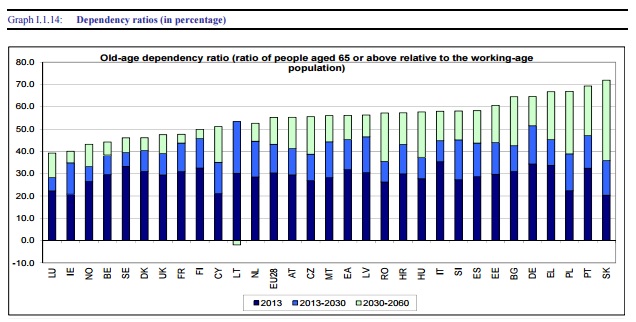
Moreover, the continent is demographically dying.
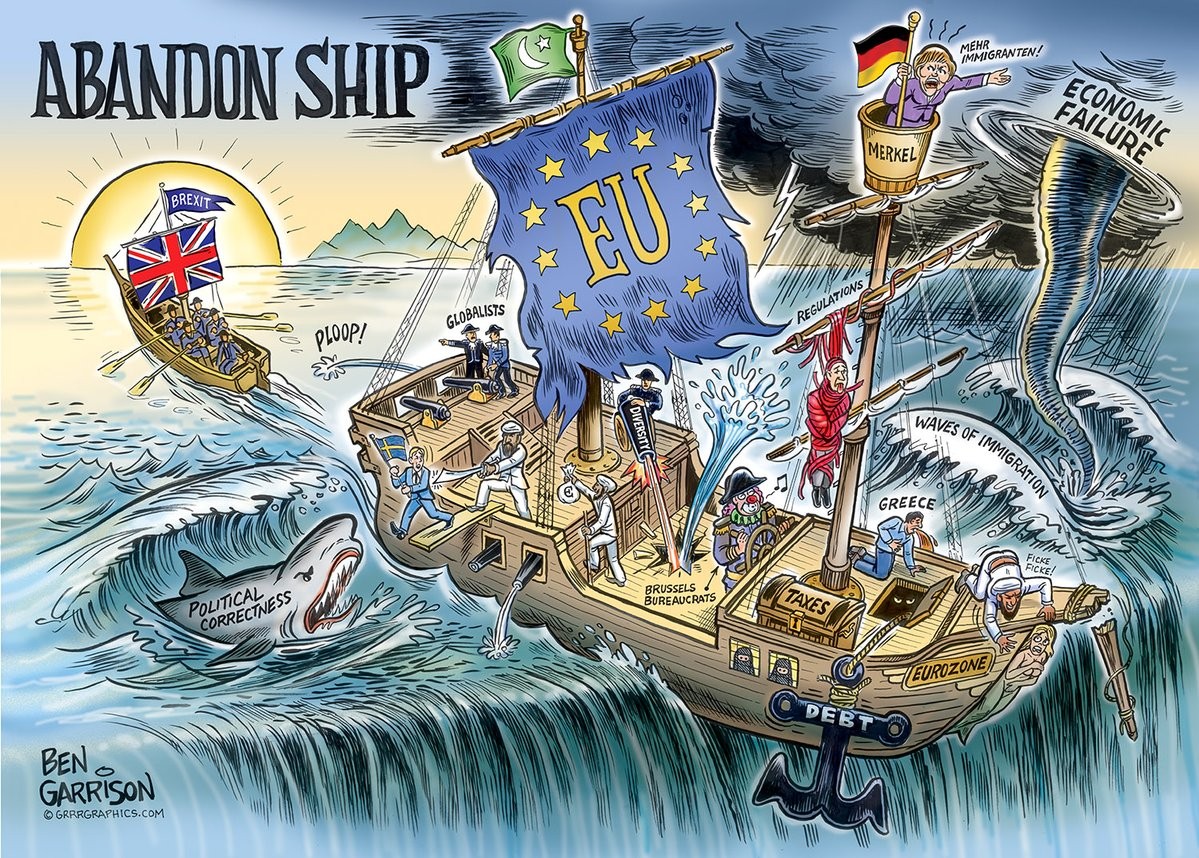
The bottom line is that the European Union is a sinking ship. This cartoon is a bit flamboyant, but it captures my overall sentiments.
If I had lots of money and was confident of the outcome, I would learn the words to this song and fly to London so I could sing in celebration on June 23rd.
Daniel J. Mitchell, a long standing contributor to The Commentator, is a Senior Fellow at the Cato Institute, the free-market, Washington D.C. think tank. His articles are cross-posted on his blog by agreement
A LEADING economist today called for George Osborne to resign after the EU referendum following the Treasury’s “politically criminal” analysis of the impact of a Brexit vote.
Professor Patrick Minford, a former advisor to the Treasury, hit out after the Chancellor’s team today published their assessment of the short-term economic impact of leaving the EU.
The Cardiff University academic branded the 83-page document “intellectually deceitful and politically deceitful” with the Treasury having “gone into the gutter” with their “shock and horror” report.
Asked by Express.co.uk if leading economists could continue to have confidence in Mr Osborne beyond the EU referendum on June 23, Professor Minford said: “The big problem for the Chancellor if we vote for Brexit is that he will think it’s going to be a disaster.
“Therefore I don’t think one could have any confidence that he would handle it right.
“You have to have somebody in charge who actually believes in the situation and how it can be dealt with so I think there would have to be a change.”
In the Treasury document Mr Osborne has warned of a “self-inflicted blow to living standards and aspirations of the British people” that would result from quitting the EU.
Supporting his close political ally, Prime Minister David Cameron said a Brexit vote would spark a “DIY recession”.
The Treasury analysis of the short-term impact of withdrawal from the EU claims Britain would be plunged into a year-long economic downturn.
George Osborne claims quitting the EU could plunge Britain into a year-long recession
The civil servants’ report adds between 520,000 and 820,000 jobs would be lost, house prices would fall by between 10 per cent and 18 per cent, and public sector borrowing would rocket by between £24 billion and £39 billion.
It is also claimed GDP could plummet by as much as six per cent.
This is intellectually disgraceful, politically deceitful and totally irresponsible
Top economist Patrick Minford
But Professor Minford, a leading Brexit supporter, trashed the Treasury document as “completely irresponsible”.
Appearing at a Politeia event alongside Tory MPs John Redwood and Peter Lilley, the academic said the Treasury’s “whole methodology is pretty badly founded”.
Professor Minford said the Treasury’s short-term assessment of Brexit was always bound to be wrong because their previous long-term analysis of the impact of leaving the EU - on which the new document is based - was “deliberately deceitful”.
He also said the uncertainty of a Brexit vote, on which the Treasury have based much of their doom-laden forecast, would “quickly dissipate” once the EU referendum is decided.
Professor Minford also argued the Treasury themselves are causing the most uncertainty with their downcast assessments.
He said: “They’re going around saying the economy’s going to be crap after Brexit. Then they’ll have to run it after Brexit happens, which of course it may well do.”
He added after Brexit the current uncertainty caused by the EU referendum will be viewed as “a big fuss over something that’s pretty good.”
The economist said if Britain pursued a free trade agenda after Brexit prices could fall as much as 20 per cent.
Professor Minford also accused the Treasury of an “astonishing” and “crazy” assumption that Britain would keep all the same trade tariffs post-Brexit that are currently put on UK goods as an EU member.
Professor Minford said this “assumes you are a complete lunatic” as he branded the notion a bit of “Mickey Finn” slipped into the Treasury analysis to forecast a negative GDP result post-Brexit.
He said: “What the Treasury have done, in my opinion, is two intellectually criminal things.
“And also I think politically criminal, they have actually deceived the British people deliberately by making this entirely false assumption.”
He added: “This is intellectually disgraceful, politically deceitful and totally irresponsible by the ministry that is supposed to be running the British economy and will be responsible for it after this Brexit vote, which could go, as they know, either way.”
Professor Minford said his former employer had “gone into the gutter” with such a “cynical approach”.
Also arguing for a Brexit vote on June 23, Mr Redwood claimed Britons would be “betterEuropeans” by quitting the EU.
The former Cabinet minister said it was “becoming increasingly” difficult for the UK to be in an organisation driven by the euro single currency, a drive for political union and a desire to establish a borderless continent.
Mr Redwood said these are all things the Government is “trying to avoid being part of”, adding: “It would be a more honest relationship to be outside.
“To be friends, allies, traders with them but not be trying to slow down the crucial elements of the strategy of the EU.”