Showing posts with label Visas. Show all posts

Wednesday, 19 February 2020

UK’s new points based immigration system explained

HOW TO SCORE: UK’s new points based immigration system and post Brexit visa rules explained


HOME secretary Priti Patel has published tough new border controls to stop unskilled EU migrants heading to the UK to work post Brexit.
Under the new system, foreign nationals will have to meet a strict set of criteria. Here’s how the new initiative works.

SEE VIDEO ON THE NEW IMMIGRATION SYSTEM ON:


https://www.thesun.co.uk/news/10993169/uk-points-immigration-system-brexit/


Foreign nationals will have to meet strict criteria under Priti Patel's new system

2
Foreign nationals will have to meet strict criteria under Priti Patel’s new system

What is Priti Patel’s new points-based immigration system?

Home secretary Priti Patel has published the full details of the new post-Brexit points-based system that will replace cheap labour from Europe.
Announcing the new system on February 19, 2020, she said: “Today is a historic moment for the whole country. We’re ending free movement, taking back control of our borders and delivering on the people’s priorities by introducing a new UK points-based immigration system, which will bring overall migration numbers down.
“We will attract the brightest and the best from around the globe, boosting the economy and our communities, and unleash this country’s full potential.”
The Home Office document sets out details of the new points-based system, which is due to come into force from January 1, 2021, when free movement from the EU halts.
Under the new system, foreign nationals applying to come to the UK for work purposes will have to meet certain criteria.
It will assign points for specific skills, qualifications, salaries or professions, and visas will only be awarded to those who gain enough points.
Minimum requirements will include having a job offer from an approved sponsor that suits their skill level and being able to speak English.

How many points  do workers need to come to the UK?

Foreign nationals wishing to come to the UK for work purposes will need to score 70 points to successfully apply for an online “e-visa”.
If an applicant meets the criteria of the minimum requirements, they will be awarded 50 points.
But to score above this threshold they will have to meet other criteria based on salary, seeking to work in a sector with a recognised labour shortage or a having a PhD.
While most will be expected to earn a minimum of £23,040 a year, some such as lab technicians with prized skills will be able to come in with a salary as low as £20,480.

What are low-skilled and high-skilled occupations?

To score 50 points, foreign nationals will need to be able to prove they have a job offer from an approved sponsor that is appropriate to their skill level.
They will also be able to speak English at a level specified by the Home Office.
A further 20 points will be scored if the job is in an occupation with a labour shortage such as engineering or information technology.
While a university doctorate gives ten points with the figure rising to 20 points if the qualification is in science, technology, engineering or mathematics.
Ten points will be awarded for an annual salary of £23,040, rising to 20 points over £25,600.
A builder’s labourer who cannot speak English but has been offered a salary of £18,000, for instance, would only score 20 points and would be blocked from coming to the UK to work.
Likewise, a skilled plumber with good English on £24,000-a -year, would also be awarded 20 points but denied access.
But a primary school teacher offered an annual salary of £26,000, who also speaks good English, would score 70 points and would secure a visa to work in the UK.
A university lecturer with a maths PhD with an offer of a £40,000 would be awarded 90 points and would also secure a visa.

Which other countries have points-based immigration systems?

Canada was the first country to introduce a points-based immigration system in 1967.
It came as Canada was moving past an immigration system that selected based on race and country of origin, with the new system focusing on youth, education and fluency in English or French.
Australia and New Zealand also have points systems.
All three have similarities to the system the UK uses for non-EU migrants, although each system awards different numbers of points for different attributes.
In Australia, being aged between 25 and 33 years old will get you 30 points – almost halfway to the eligibility threshold of 65 points.
Just now, people from within the EU do not need a visa to work in the UK as free movement is still in place  – however there are limits on claiming certain benefits.
A points-based system is already in place for those from outside the EU, with points awarded for having English language skills, being sponsored by a company and meeting a salary threshold.
A maximum number of work visas –  around 21,000 a year – are issued but it isn’t often met.
Based on points accrued, there are four “tiers” of visa.
Other visas such as family ones for relatives of people coming on work visas are also available.
The four points-based visas are for temporary workers, students, skilled workers and “high value” migrants or major investors.


SEE VIDEO ON THE NEW IMMIGRATION SYSTEM ON:

https://www.thesun.co.uk/news/10993169/uk-points-immigration-system-brexit/


MORE ABOUT PRITI PATEL


PRITI SERIOUS 

Furious ministers accuse civil servants of trying to oust Priti Patel

'A PATTERN' 

Priti Patel is accused of bullying civil servants for at least five years

RACE ROW 

The Home Office was 'institutionally racist', Windrush report finds

POWER PAIR 

Meet Alex Sawyer - Conservative councillor who is married to Priti Patel


BRITS FOR HIRE 

Home Sec tells firms to hire Brits rather than worry about losing EU staff

PRITI'S POINTS 

Home Sec unveils new immigration system & demands bosses hire more 

https://www.thesun.co.uk/news/10993169/uk-points-immigration-system-brexit/

Immigration: No visas for low-skilled workers, government says

Low-skilled workers would not get visas under post-Brexit immigration plans unveiled by the government.


Media captionThe BBC's Vicki Young asked people in Wanstead and Basildon for their opinions

Low-skilled workers would not get visas under post-Brexit immigration plans unveiled by the government.
It is urging employers to "move away" from relying on "cheap labour" from Europe and invest in retaining staff and developing automation technology.
The Home Office said EU and non-EU citizens coming to the UK would be treated equally after UK-EU free movement ends on 31 December.
Labour said a "hostile environment" would make it hard to attract workers.
But Home Secretary Priti Patel told BBC Breakfast the government wanted to "encourage people with the right talent" and "reduce the levels of people coming to the UK with low skills".
She added that businesses could also recruit from among eight million "economically inactive" potential workers in the UK.
But the SNP called this a "ridiculous or dangerous idea", as many in this group were suffering "ill health or injury".

Who is 'skilled'?

Under the plan, the definition of skilled workers would be expanded to include those educated to A-level/Scottish Highers-equivalent standard, not just graduate level, as is currently the case.
Waiting tables and certain types of farm worker would be removed from the new skilled category, but new additions would include carpentry, plastering and childminding.

How would it work?


Media captionPriti Patel: No more routes for cheap, low-skilled labour

The government wants to bring in a "points-based" immigration system, as promised in the Conservative election manifesto.
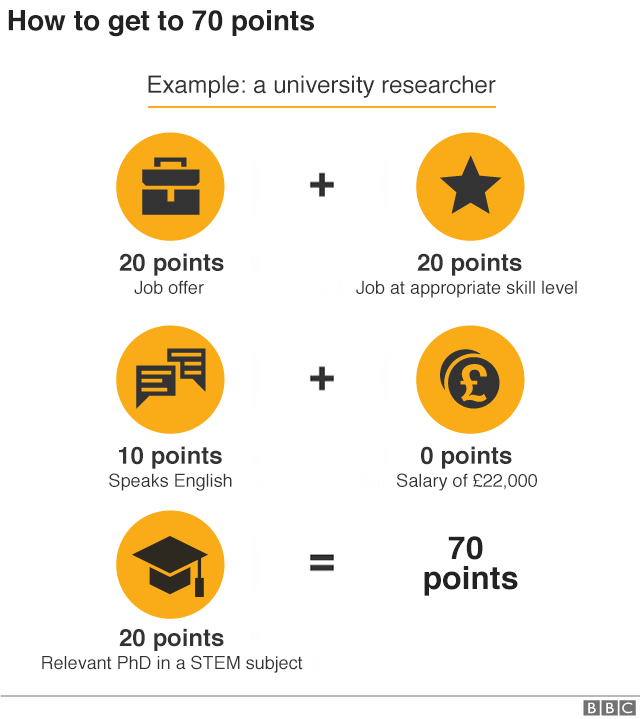
Under this, overseas citizens would have to reach 70 points to be able to work in the UK.


Media captionAbbott: Language plan is dog-whistle politics

Speaking English and having the offer of a skilled job with an "approved sponsor" would give them 50 points.
More points would be awarded for qualifications, the salary on offer and working in a sector with shortages.


Graphic showing how a university researcher could earn 70 points. Job offer (20 points) + appropriate skill level (20 points) + speaks English (10 points) + salary £22,000 (0 points) + PhD in relevant STEM subject (20 points) = 70 points.
Presentational white space

Workers from European Economic Area countries currently have the automatic right to live and work in the UK irrespective of their salary or skill level.
The government says this will end on 31 December, when the 11-month post-Brexit transition period is due to finish.

Pay levels

The salary threshold for skilled workers wanting to come to the UK would be lowered from £30,000 to £25,600.
However, the government says the threshold would be as low as £20,480 for people in "specific shortage occupations" - which currently include nursing, civil engineering, psychology and classical ballet dancing - or those with PhDs relevant to a specific job.
But there would no longer be an overall cap on the number of skilled workers who could come into the UK.

Presentational grey line

Problems ahead for social care


Analysis box by Nick Triggle, health correspondent

The immigration plans spell trouble for adult social care.
The majority of people employed by the sector are low-paid care workers. They are responsible for providing daily help to older and disabled adults in care homes and the community.
There are already significant shortages - one in 11 posts are unfilled.
Foreign workers make up a sixth of the 840,000-strong care worker workforce in England. It is hard to see how in the future these staff could qualify.
Even if it is classed as a skilled job - and even that is in doubt, as many workers do not come via an A-level route - the pay at under £20,000 on average is too low to qualify for any points. Nor is the role classed a shortage occupation.
It seems certain applicants will fall well-short of the 70 points needed.

Presentational grey line

What about lower-paid sectors?

The government said it would not introduce a route for lower-skilled/lower-paid workers, urging businesses to "adapt and adjust" to the end of free movement between EU countries and the UK.
Instead, it said the 3.2 million EU citizens who have applied to stay in the UK could help meet labour demands.
But bodies representing farming, catering and nursing are warning that it will be hard to recruit staff under the new system.
The Royal College of Nursing said the proposals would "not meet the health and care needs of the population".
National Farmers' Union president Minette Batters raised "serious concerns" about the "failure to recognise British food and farming's needs".
And the Food and Drink Federation spoke of concerns about bakers, meat processors and workers making food like cheese and pasta not qualifying under the new system.
However, the government pointed to a quadrupling of the scheme for seasonal workers in agriculture to 10,000, as well as "youth mobility arrangements", allowing 20,000 young people to come to the UK each year.

Presentational grey line

Laura's view


LauraImage copyrightBBC NEWS

Laura, an Italian living in London, says the government's proposals are "short-sighted".
She is now a communications manager but worked as a waitress when she arrived in the UK in 2015. Laura says she would not have met the new points requirements if they had been in place in back then.
"Through the complete dismissal of low-skilled workers, it fails to acknowledge that people who start at a lower skill level often progress further up the ladder, thus increasing their tax contribution over time," she says.
"Also, low-skilled workers are as vitally needed by any economy as high-skill people are."

Presentational grey line

Benefit entitlements

Under the plan, all migrants would only be entitled to access income-related benefits until after indefinite leave to remain is granted, usually after five years.
Currently, EU nationals in the UK can claim benefits if they are "economically active". Non-EU citizens become eligible for benefits when they are granted permanent residence, which usually requires five years of living legally in the UK.

What is the political reaction?

For Labour, shadow home secretary Diane Abbott said the government did not "appear to have thought through what the effects of this policy will be on the economy as a whole and what message it sends to migrants already living and working here".
Liberal Democrat home affairs spokeswoman Christine Jardine said the proposals were based on "xenophobia".
And Scotland's First Minister and SNP leader Nicola Sturgeon said the plans would be "devastating" for the Scottish economy.

https://www.bbc.com/news/uk-politics-51550421


SEE VIDEO ON THE NEW IMMIGRATION SYSTEM ON: