Showing posts with label Business Insider. Show all posts

Wednesday, 30 May 2018

Could Italy bring down the eurozone?

Everything you need to know about the Italian political crisis -- which is 9 years in the making and could bring about the demise of the eurozone

Will Martin
30 May 2018

© Provided by Business Insider Inc
  • Italy's political crisis has deepened over the weekend, with a fresh election in the country now a near certainty.
  • Many commentators now believe that the turmoil in the eurozone's third-largest economy has started to pose a threat to the wider euro area.
  • Markets are spooked, with major European assets selling off aggressively.
  • Business Insider looks at how Italy got to this point of deepening crisis.
5-Star Movement's leader Luigi Di Maio© Reuters 5-Star Movement's leader Luigi Di MaioWhisper it quietly, but the eurozone may be about to plunge headlong into another crisis as the political situation in its third-largest economy, Italy, deteriorates rapidly.
Almost three months after an inconclusive election left the country without a government, Italians could be headed back to the polls imminently.
Italy's political situation is notoriously complicated, so Business Insider has tried to break down exactly what's going on and why it's all happening now.

A nation in crisis

Actor, comedian and 5-Star Movement founder Beppe Grillo during a political meeting in Naples in 2013© Getty Actor, comedian and 5-Star Movement founder Beppe Grillo during a political meeting in Naples in 2013The growing crisis can trace its roots all the way back to 2009, with the foundation of the 5-Star Movement, which in less than a decade has grown to be the largest party in Italian politics, winning 222 out of 630 seats in Italy's lower house of government, the Chamber of Deputies, at March's election.
The party's policies don't fit neatly into the traditional left-right political spectrum, something it is keen to emphasise. It is variously antiestablishment, eurosceptic, anti-immigration, and pro-green. Its name refers to its five flagship issues: publicly owned water, sustainable (eco-friendly) transport, sustainable development, right to internet access, and environmentalism.
5-Star's popularity has led it to moderate its stance on certain issues and install a new leader, the 31-year-old Luigi Di Maio, who replaced 5-Star's founder, the comedian Beppe Grillo, in October.
© AP
Such political shape-shifting has allowed 5-Star to quickly grow into its position as Italy's largest and most powerful party.
But while it emerged from March's election as the biggest party, 5-Star fell well short of being able to form a government on its own.
This posed problems. For several years the party said it would not be willing to enter into a coalition government or power-sharing agreement with any other party. That is because much of 5-Star's appeal has been based on its rejection of the country's establishment parties, which it believed to be corrupt.
After the party gained a plurality in March, however, the party leader Di Maio relented, sensing the opportunity to govern the country. Over six weeks of talks with various parties followed, until eventually late last week it looked as though a government would be formed by 5-Star in coalition with the Lega Nord, a right-wing party led by Matteo Salvini.
The League, as the party is often known, previously had ties to Silvio Berlusconi's Forza Italia party, but it moved toward 5-Star when an opportunity to govern presented itself.
The League and 5-Star's alliance is an uneasy one, but the parties managed to put together a program of government that removed some of the more extreme policies from both sides - like plans to leave the euro - and just about pleased President Sergio Mattarella (who must approve any program of government) enough to govern.
Former senior International Monetary Fund (IMF) official Carlo Cottarelli arrives for a meeting with the Italian President Sergio Mattarella at the Quirinal Palace in Rome© Reuters Former senior International Monetary Fund (IMF) official Carlo Cottarelli arrives for a meeting with the Italian President Sergio Mattarella at the Quirinal Palace in Rome
Late last week it seemed as though the alliance would be governing Italy with the law professor Giuseppe Conte, a political novice, as prime minister. Mattarella had reluctantly agreed to allow Conte to form a government, and it looked as if months of deadlock were finally coming to a close.
That was until Mattarella began the process for approving the coalition's appointments to key offices within government. Under Italian law, the president can reject the appointment of an elected official.

Trouble with the finance minister

© GettyAll was going well until Mattarella got to the two parties' nomination for finance minister. The coalition had put forward Paolo Savona, a highly eurosceptic economist and former banker who was minister of trade and industry in the 1990s.
Savona has frequently advocated that Italy leave the euro, describing the single currency in a recent book as a "German cage." He has been highly critical of Germany in particular, saying in the book that "Germany didn't change its idea on its role in Europe after the end of Nazism, even if it abandoned the idea of imposing itself militarily."
He also claims that Italy's decision to join the euro back in the 1990s has "halved Italians' purchasing power."
© Reuters
Such assertions were enough for Mattarella, a europhile, to reject Savona's appointment as head of Italy's economic and fiscal policies.
Mattarella told reporters it was important for confidence in broader financial markets that Italy signal an intention to remain part of the euro.
"Membership of the euro is a fundamental choice for the future of our country and our young people," he said.
Mattarella's rejection of Savona as finance minister was viewed as a rejection of the mandate of 5-Star and the League to govern. This caused outrage from the two parties, with Di Maio calling for Mattarella's impeachment. Salvini, the League's head, stopped short of such calls but did criticise Mattarella's decision.
The rejection of the coalition left Mattarella with two choices: call another election or attempt to appoint his own technocratic government.
Mattarella sprung for the second option, on Monday appointing a former International Monetary Fund official, Carlo Cottarelli, as interim prime minister with a task to try to form a new government and bring order to political and constitutional turmoil.
Carlo Cottarelli, a former director at the IMF, has been asked to form a new government in Italy© Reuters Carlo Cottarelli, a former director at the IMF, has been asked to form a new government in Italy
Cottarelli is likely to struggle to form a government, as he will need to have the support of at least half of the country's 630 deputies to rule with any sort of efficacy. Given that the League and 5-Star account for 347 of those deputies and surely will not approve a Cottarelli government, it seems impossible that Italy will have a government anytime soon.
With no foreseeable path to a working government, it looks as if the only option for Italy will be to hold another election, with the most likely outcome of that election being a strengthening of support for 5-Star and the League. Indeed, a poll released on Monday evening showed the League increasing its vote share by almost 5 percentage points from the election.
The Dutch bank ING summed up the situation, with the economist Paolo Pizzoli writing to clients(emphasis ours):
"Should he [Cottarelli] manage to obtain the parliament confidence, he would try to have the 2019 budget approved, and resign before the end of 2018, taking the country to new elections in 1Q19. Instead, should he fail to get the parliamentary confidence, he would resign and remain in office as a caretaker for ordinary business, taking the country to new elections after August. We believe the chances of the government passing the confidence vote are extremely slim, and hold an autumn vote (in September or October) as our new base case.
"It is still too early to understand where the party leaders will position themselves in view of the upcoming election. Chances are that the perceived institutional wound might induce both the Northern League and the 5SM to radicalize their electoral message, but different political possibilities remain possible."
"His chances of succeeding are slim and elections are likely in September," Kit Juckes, a strategist at Societe Generale, wrote on Tuesday morning. "Which leaves us 3-4 months of uncertainty ahead of a vote that may be seen as a referendum on Euro-membership."

Markets are spooked

© RexAny such vote could be disastrous given that Italy is one of the three most crucial members of the eurozone project, alongside France and Germany.
Such an outcome seems to be something that senior figures in the eurozone are taking seriously. According to Yanis Varoufakis, who was Greece's finance minister during the height of the country's latest debt crisis, plans are being made for Italy's exit from the euro, which is being variously known as "Italexit" and "Quitaly."
"I have it on good authority that the German finance ministry, the European Central Bank and every major bank and corporation have plans in place for the possible exit from the eurozone of Italy, even of Germany," Varoufakis wrote in an editorial for the Guardian newspaper.
Perhaps the simplest way to imagine the eurozone is as a three-legged stool. Germany, France, and Italy are the legs holding up the rest of the project. Remove any one of those three pillars and the stool falls over.
Simply put, if Italy goes, it is likely to be curtains for the euro area.
This prospect has markets freaking out on Tuesday, with assets selling off sharply across a broad spectrum. Here's the full wrap from Business Insider's markets team:
  • Yields on Italy's two-year debt rose by almost 50 basis points overnight - the biggest one-day move since 2012, at the height of the eurozone crisis.
  • When European markets opened a short time ago, Italian two-year bond yields continued to rocket higher, climbing by another 70 basis points. They are now sitting at their highest level since 2013.
  • Demand for safe-haven German bonds is increasing, with the yield on both two-year and 10-year German debt falling to its lowest level this year.
  • Reflecting capital flows between Europe's periphery and core, the spread between German and Italian 10-year bond yields has soared to 261 basis points, the highest level in four years.
  • The euro has also come under pressure, dropping below 1.16 against the US dollar for the first time in 2018.
  • Italy's banking index is also getting hosed, down 3.4% at a 13-month low.
Markets do tend to be highly sensitive to euro-exit-related developments, so some of Tuesday's moves may be a knee-jerk reaction, but it certainly feels as if a crisis is brewing both politically and economically.
Analysts at the Australian investment bank Macquarie, however, urged calm for the time being.
"While we see near term market pressure, we do not think that events today are sufficient to derail the economic recovery (activity has been desensitised to political shocks in the past decade), suggesting that markets will soon present a buying opportunity," a team led by Ric Deverell wrote.
Deverell and co. were clear, however, that things could escalate. "A victory for the populist parties in a new election, while far from assured, could trigger a substantial risk-off event," they wrote.
https://www.msn.com/en-gb/money/news/everything-you-need-to-know-about-the-italian-political-crisis-which-is-9-years-in-the-making-and-could-bring-about-the-demise-of-the-eurozone/

Monday, 31 October 2016

How to move to Canada and become a Canadian citizen

One of the most common refrains this election season (and every election season, really) is people swearing they’ll move to Canada — a land where healthcare is free, people are friendly, and Prime Minister Justin Trudeau explains quantum computing just for laughs.

 Finance  

But to actually become a Canadian citizen, you’ll first need to go through several steps, like living in the country for at least six years, staying on your best behavior, and knowing a thing or two about the country you’ll soon call home.
For those who actually want to head up north, here’s how you move to Canada.

Preface: Make sure you’re not already a Canadian citizen.


Before you go through the hassle of applying for citizenship, take a short quiz to see if you may already be Canadian.
The government outlines several caveats for being a citizen even if you weren’t born there, many of which depend on your parents’ citizenship. Maybe you secretly inherited their status at some point along the way.

Be at least 18 years old.


If you’re not a legal adult, you’ve got an uphill climb ahead of you.
Minors need their parent or legal guardian to fill out the application for them; they need to be permanent residents in Canada (more on that later); and the parent must either be a citizen or applying to become one at the same time.

Or enter the pool for skilled immigrants.


Canada has a fast-track system for immigration called Express Entry. It’s how skilled workers transition into a role in the country.
All applicants into Express Entry are given specific scores based on their specific talents and job prospects and then ranked with other applicants. Those at the top of the rankings are invited to become permanent residents.

Have a permanent residence in Canada.


To become a permanent resident, people can choose between several avenues. They can apply through the province of their choice, go down a special entrepreneur route, get help from a family member who lives in Canada, or go through Quebec, which has a special immigration requirements.
Permanent residents are entitled to healthcare coverage and can work, study, and travel anywhere in Canada. You just can’t vote, run for office, or hold some jobs with high security clearance.

Declare your intent to reside.


If you’re invited to become a permanent resident, you must confirm your plans to stay Canadian. The government defines permanent residence as living in Canada for at least two years in a five-year period. If you don’t spend that much time within the borders, you could lose your permanent residence status.
If you don’t live in Canada, you must work outside Canada as a public official known as a Crown Servant or live abroad with certain family members who are Crown servants. 

Spend six years at that residence.


Permanent residents don’t always become citizens. The bar for citizenship is higher.
If you’re living in Canada, you must be physically present in Canada for at least 1,460 days (three 365-day periods) immediately before the date of your application. You must also be present for 183 days (half a year) during each of the four calendar years before the application date.
In other words, your time in Canada needs to be consistent. You can’t leave for an entire year and remain a permanent resident.

Provide your income tax filing.


Like the residence requirement, you must be able to provide four years’ worth of tax returns in the six-year period leading up to the date of your application.
Basically, they want to see if your job is legit.

Speak English or French.


Along with dozens of other countries, Canada has two official languages. In this case, it’s English and French.
To become a citizen, you need to know just one. You don’t need to be fluent, just conversational enough to make small talk, give directions, use basic grammar, and know your vocab well enough to describe yourself.
You’ll send along written documents with your application, but a citizenship officer will make the final call whether your English or French is up to snuff.

Know a thing or two about Canada.


You should probably brush up on your Canadian history anyway, but the government also issues a formal quiz to applicants on the history, values, institutions, and symbols of Canada.
You take the test if you’re between 16 and 64 years old. Typically, it’s a written test, but the citizenship officer may also ask questions orally.
There are no real surprises. Everything you’d need to know can be found here: Discover Canada: The Rights and Responsibilities of Citizenship.

Know why your application might get denied.


There are a number of reasons your past may prohibit you from becoming a Canadian citizen.
For instance, the government looks down upon granting citizenship to people who have committed a crime within four years of submitting their application or are currently on trial for a crime.
It also specifies that people currently in prison can’t use their sentence toward becoming a permanent residence. (That doesn’t quite fit with the “intent to reside.”)

Invest in durable clothes for your local climate.


Canada is the second-largest country on Earth behind Russia. As such, there is no singular “Canadian climate,” even if people may think it’s just cold most of the time.
Depending on how close you live to the British Columbia coast, for example, spring can begin as early as February and summer temperatures can rise into the 90s.
So if you’re looking for places to take up permanent residence, research what the weather’s like. You won’t waste money or space buying unnecessary items.

Take advantage of the customs of your new life.


Now that you’ve left your home country behind (and if you’re an American, abandoned the circus of presidential elections), embrace what makes Canada unique.
Many Canadians express deep fondness for Tim Hortons, quirky slang, celebrity ambassadors, and hockey.
No one will expect you to dive headfirst into this new world, but if you want to become a genuine citizen, formal requirements are only the start.


http://www.businessinsider.my/how-to-move-canada-2016-10/#67QEo886XrGK1RXD.97

Sunday, 30 October 2016

You’re in denial. The UK economy is heading off a cliff

The UK showed its strength in Q3, with data out last week that showed the economy grew 0.5% quarter-on-quarter, much greater than the 0.3% analysts expected ...

 Finance  

The UK showed its strength in Q3, with data out last week that showed the economy grew 0.5% quarter-on-quarter, much greater than the 0.3% analysts expected. That’s 2.3% growth year-on-year.
Not bad. Not bad at all.
Naturally, the government and its Greek chorus of pro-Brexit talking heads hailed this as yet more evidence that leaving the EU will not damage Britain.
They remind me of that perennial scene in the Road Runner cartoons, where Wile E. Coyote races over the edge of a cliff. For a brief moment, Coyote thinks he is soaring through the air. Only belatedly does he realise it’s too late, the plunge is coming.
That’s where we are right now — waiting for the plunge.
This isn’t an opinion. It’s what the granular, forward-looking data is saying about the UK economy. The UK will leave the Single Market, it will face increased barriers to trade (after Brexit in 2019), and the pound is sinking. These things will weigh us down. We cannot defy gravity for long. 
In the short-term, this GDP chart from HSBC makes Britain look really good right now:

GDP
HSBC
But GDP is a backward-looking measure. It tells us what just happened, not where we might be going.
In terms of the future, here is the scariest chart published last week (which Prime Minister Theresa May, trade secretary Liam Fox, and Brexit chief David Davis are unlikely to be boasting about). It shows the volume change in mutual fund money leaving UK investments:  

mutual funds
HSBC
This is a forward-looking metric. Investors don’t bet on what just happened (i.e. positive Q3 GDP). They’re betting on the future. And the smart money is getting the hell out of Britain right now.
The data was collated by HSBC analysts Robert Parkes and Amit Shrivastava. This is what they told their clients:
“Post Brexit, international investors continue to head for the exit. Since the Brexit vote, holdings of the UK have fallen by more than 100 basis points. Relative to history (on a z-score basis), the UK is now the most out of favour region globally.”
A big part of that is the falling pound. As Business Insider has noted before, the drop in sterling is bad in the long-run for Britain because it makes us all poorer, and it beggars anyone who keeps their money in the UK. 
Ordinary consumers are starting to catch on to this, too. Consumer confidence actually dipped this month — a bad sign for the future — because of the declining buying power of the pound, according to GfK:
GFK
GfK
Why would consumer confidence dip if GDP is so good?
The answer is that while GDP was growing in Q3 the pace of that growth was slowing. That’s what economies do before recessions.Barclays analysts Andrzej Szczepaniak and Fabrice Montagne told their clients, “Despite printing just above our forecast, it nonetheless confirms our overarching view that economic activity slowed post-referendum in light of rising post-exit uncertainty.” Industrial production actually shrank by 0.4% quarter-on-quarter — a weird thing to happen given that UK exports ought to be cheap right now. 
Here is what that shrinkage looks like in a chart, from HSBC’s Elizabeth Martins:

industrials
HSBC
Those downward-pointing lines at the far right should give you chills. 
Most analysts had predicted the economy would start slowing dramatically in the second half of 2016. They were wrong, apparently.Martins admitted to her clients that the current data makes economists looks bad, as if they were backers of “Project Fear.” The important thing, Martins says, is that while those economists may have got the timing wrong they have not changed their minds on its inevitability:
“In fact, despite the uncertainty, the UK looks to have seen faster growth than the Eurozone or the US in Q3. This affirms our view that the Bank of England will not cut rates next week, and poses upside risks to our 2016 growth forecast of 1.8%. It will also support the argument that economists overstated the impact of the vote as part of ‘Project Fear’. Unfortunately, however, it does not change our view that a slowdown is coming. We expect investment to fall and consumption to slow next year as higher uncertainty and costs start to weigh on the UK economy. …”
“For those who accused economists of subscribing to ‘Project Fear’, today’s numbers will be viewed as a vindication. Indeed, our near-term pessimism does appear to have been premature.” 
“However, higher uncertainty and costs are already starting to weigh on businesses, and could start to hit the consumer too in the coming months. We expect investment to fall and consumption to slow next year.”
That’s where we are right now. The UK is the Wile E. Coyote of global economies. We’re either soaring toward greatness, or we’re treading on thin air.
Meep-meep.
http://www.businessinsider.my/youre-in-denial-the-uk-economy-is-heading-off-a-cliff-2016-10/#j9yOLcuS3xD50DrA.97

Sunday, 31 July 2016

If you're a Leave voter, you're about to get exactly what you asked for

There has been a pronounced tone-change among UK economics analysts since the EU Referendum: They are in unanimous agreement that the UK will sink into recession in the second half of this year.

By Jim Edwards | Business Insider UK Finance – Sun, Jul 31, 2016 10:52 BST

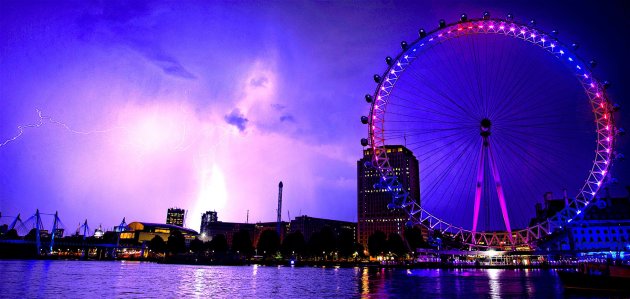
storm london lightning eye
Lewis Whyld / PA Archive/Press Association Images

There has been a pronounced tone-change among UK economics analysts since the EU Referendum: They are in unanimous agreement that the UK will sink into recession in the second half of this year.
They disagree only on the details and depth.
Call it the Silence of the Bulls: No one — literally, no one — is making a bullish case for the post-Brexit economy.
That is what is so scary about this recession. Usually, analysts and economists like to hedge their bets. Their opinions are spread over a range, with outright disagreements. They talk about "the risk" of something happening; they don't say "this will happen." 

BAMLLewis Whyld / PA Archive/Press Association Images

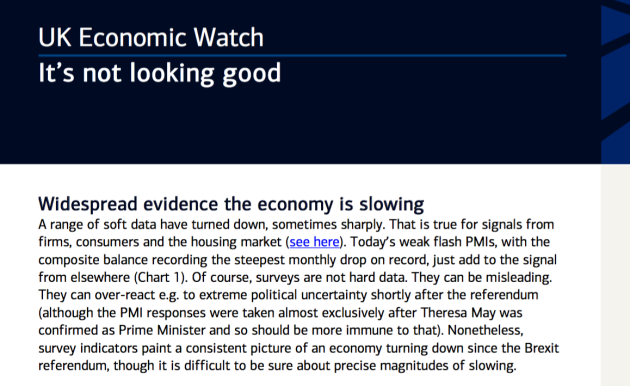
But right now everyone is saying the same thing. Bank of America Merrill Lynch's Robert Wood put out a note last week whose title says it all: "It's not looking good."
Here's another example, from HSBC's Robert Parkes and Amit Shrivastava, who cover stocks. They say that the recent spell of good news — in which the UK just notched record-high employment, at over 74%, record-low unemployment, at 4.9%, and healthy GDP growth of 2.2% in Q1 — is merely the "eye of the storm" to follow:
"Don’t believe the hope"
"Following the initial ‘shock’ from the Brexit vote, the last four weeks have been dominated by ‘hope’, in our view. ‘Hope’ surrounding the potential for further policy stimulus (both monetary and also fiscal), ‘hope’ that any economic damage from storm ‘Brexit’ will be short-lived and limited to the UK, and ‘hope’ that the political uncertainty will subside and a market-friendly outcome will be achieved. We don’t believe the ‘hope’."
"... An eerie calm has descended over European equities following the initial impact of storm ‘Brexit’ that struck in late June. Policy makers and politicians have been lining up to offer reassurance. This has helped equity market volatility to drop to below pre-referendum levels, and share prices have recovered accordingly. So the storm has now passed, correct? And therefore it is safe to assume that Brexit is no longer a relevant theme for European equities, correct? We think not. We think we are merely in the eye of the storm, and the potentially destructive ‘eyewall’ is rapidly approaching. Over the course of Q3 we see the economic headwinds intensifying and recession risk rising, not just in the UK, but also for the wider EU region."
The employment rate and GDP growth may look good, but those numbers are now in the rearview mirror. Neither of them were taken from samples prior to the Brexit vote.
By contrast, the data from after the referendum looks awful.

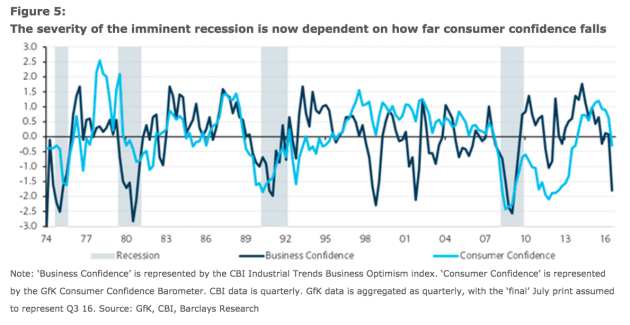
This chart from Barclays shows consumer confidence is heading back to where it was in the 2008 financial crisis:

BarclaysLewis Whyld / PA Archive/Press Association Images

The drop in consumer confidence was the fastest in 27 years:

GfK consumer confidenceLewis Whyld / PA Archive/Press Association Images

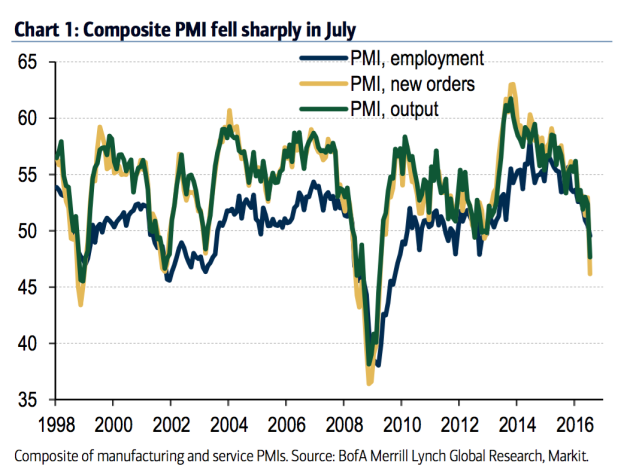
It occurred because data from companies about their future plans — for creating jobs, new order, and output — tanked immediately after Brexit:

PMILewis Whyld / PA Archive/Press Association Images

And CFOs say they don't intend to hire anyone for the next 12 months:

cfoLewis Whyld / PA Archive/Press Association Images

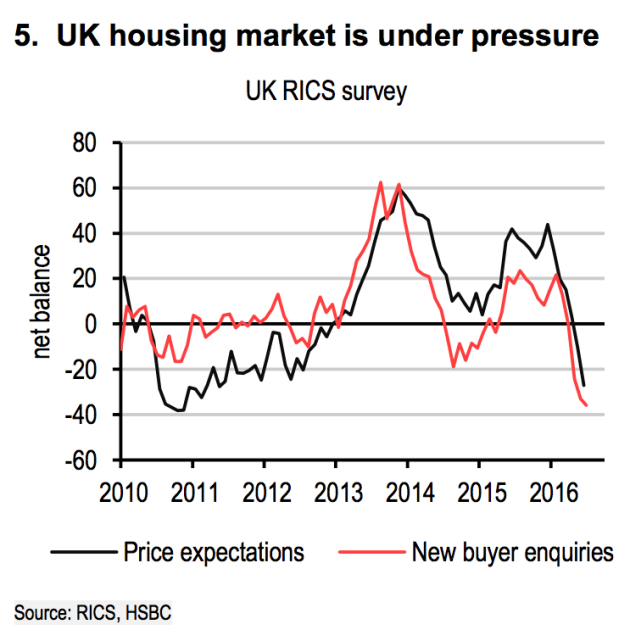
Unsurprisingly, the property market is about to grind to a halt as people cancel plans due to Brexit, and prices plummet as a result:

HSBCLewis Whyld / PA Archive/Press Association Images

OK, so maybe we're just talking ourselves into a recession? Maybe the Brexit shock will wear off? Maybe there will be a reversion to the mean? And maybe the UK will muddle through and everything will be all right?
Unlikely. 
This has been a long time coming.
The fundamentals in Britain are weak and have been that way for a long time. That's why the Bank of England has kept rates at nearly zero for years. (If the economy was strong, the BOE would be jacking up rates to squash inflation.)
We told you back in March that Britain — loaded with consumer debt and light on household savings — was sleepwalking into a recession. That same month we told you that Europe, and especially the UK, was walking into the storm naked. We have no weapons to fight the recession: Central banks can't make interest rates any lower and the EU's rules require governments to maintain austerity budgets even when their governments don't want them.
The Brexit vote was the straw that broke the camel's back.
If you're a Leave voter, you're about to get exactly what you asked for.

https://uk.finance.yahoo.com/news/youre-leave-voter-youre-exactly-095200848.html