Showing posts with label Judiciary. Show all posts

Thursday, 15 October 2020

15 Oct 20 Merkel Tells EU to Be Realistic, ADMITS UK Needs Good Deal From Brussels

 German Chancellor Angela Merkel said that the European Union must accept the “reality” than a UK-EU trade deal must be beneficial to the United Kingdom as well as the bloc.
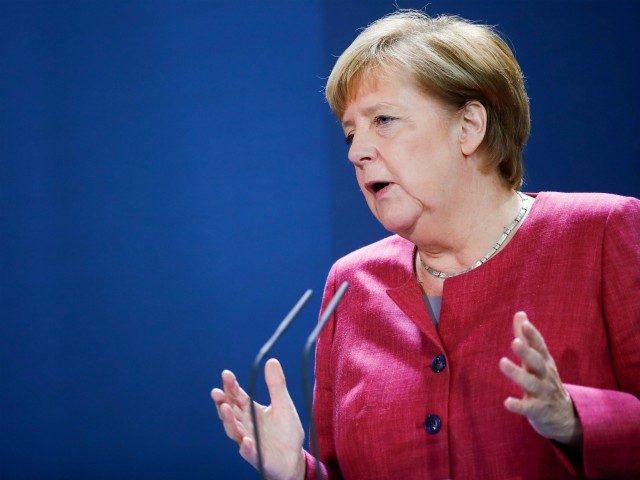
German Chancellor Angela Merkel gives a statement following her video conference with officials from Germany's largest cities in Germany on Covid-19, on October 9, 2020 at the Chancellery in Berlin - Germany is experiencing a "worrying jump" in coronavirus cases, Germany's Health Minister had said the day before, as the …

AXEL SCHMIDT/POOL/AFP via Getty Images
4:05

Dr Merkel, who currently holds the rotating Presidency of the Council of the European Union, told a meeting of European mayors on Tuesday that “we have to prepare for the event that there will be no agreement”.

“We also have to take into account the reality; an agreement has to be in the interests of both parties, in British interests as well as the interests of the 27 member European Union,” the council president said, according to The Telegraph.

The UK officially left the EU on January 31st, 2020, but remains tied to Brussels rules in a transition period which expires on New Year’s Eve. If a deal is not struck and signed in time for the end of the deadline, the UK will leave the bloc’s institutions and trade with it on World Trade Organization (WTO) terms.

So far, the EU and its negotiator, Michel Barnier, have refused to soften on London’s red lines, such as regaining full control of the UK’s waters, regulations, and laws. Some European leaders have said that they will resist any deal unless current fishing rights are retained, and the UK agrees to restrict itself by abiding by ‘level playing field’ rules.

However, for a deal to be struck, it needs to be mutually beneficial. The UK has already demonstrated that it is capable of signing such deals with third nations, after agreeing in principle early last month a free trade agreement with Japan that is due to be signed next week.

Last week, Prime Minister Boris Johnson and Ukrainian President Volodymyr Zelenskyy signed a Political, Free Trade, and Strategic Partnership Agreement between their countries which aims “to strengthen UK cooperation in political, security and foreign matters with Ukraine, while also securing continued preferential trade for businesses and consumers” — essentially, a continuation of the EU-Ukraine Association Agreement.

The German leader’s approach is in stark difference to that of France, which has vowed to show “no weakness” in negotiations, particularly in relation to fishing rights. Under the Common Fisheries Policy, the EU can plunder more than 60 per cent of the fish landed in the UK’s territorial waters, with the French, for example, free to catch more than 90 per cent of English Channel cod.

However, Mrs Merkel’s tone also conflicts with statements just from Tuesday from Germany’s own Europe minister. Michael Roth said that EU members “expect substantial progress by our friends in the United Kingdom in key areas: in particular on governance, ‘level playing field’ and fisheries” — suggesting it should be Britain making all the compromises, not the EU.

Mr Roth has been clear that the EU should prepare for the UK’s WTO exit. Likewise, Mrs Merkel has been consistent since the summer that both her country and the EU should prepare for the possibility of a no-deal scenario.

While Prime Minister Johnson had made Thursday the deadline for either agreeing on a deal or deciding to walk away from negotiations and preparing for WTO, reports circulated on Wednesday that the prime minister was already preparing to extend that internal deadline further, after already reneging on a similar deadline he had set for June.

Earlier this week, Mr Barnier expressed what may be a generally felt assumption in Europe — that Johnson does not stick by his deadlines and may be a soft touch — saying: “It is the third unilateral deadline that Johnson has imposed without agreement… We still have time.”

One government source told The Times that Brussels is using the “old playbook” of “running down the clock” to put pressure on the UK.

The Telegraph reports, however, that Mr Johnson told ministers he still believes a deal can be struck by tomorrow, but said that there should be “no fear” over a no-deal Brexit.

https://www.breitbart.com/europe/2020/10/15/merkel-tells-eu-to-be-realistic-admits-uk-needs-good-deal-from-brussels/


Friday, 2 October 2020

2 Oct 2020 This is why we voted Leave

 The EU’s legal action against the UK is an outrageous attack on sovereignty.

PADDY HANNAM


The latest unelected nobody to take charge of the European Commission, Ursula von der Leyen, has made a ludicrous announcement: the EU is beginning legal proceedings against the UK. The move comes after the British government missed an EU-imposed deadline for removing parts of the Internal Market Bill, which, if enacted, could break international law.

An obvious question to ask is, who cares? EU legal cases tend to take a fair amount of time, certainly much longer than the time that remains in which to negotiate a deal. We will have left the transition period, in one way or another, by the time any potential court case could be resolved.

Not only that, but the EU’s legal process can eventually lead to cases being heard in the European Court of Justice (ECJ). Freedom from the diktats of the ECJ has always been essential to restoring British sovereignty post-Brexit. It would be weak and wrong, therefore, for the government to regard any findings it produces on this question as binding.

Indeed, the idea of the EU disciplining the UK after we have left is both intolerable and absurd. Are the EU’s leaders still not taking seriously our intention to leave? Or do they just hope the looming prospect of a legal case will force 11th-hour concessions from the UK and make a deal more likely? Perhaps they just want to punish Britain for having the gall to leave in the first place.

Regardless, the EU’s move is incoherent: the EU is hardly consistent in enforcing its own rules on member states, let alone obeying international rules. For example, the EU’s member states are forever divided on how harshly to enforce its fiscal rules. This year, a ruling by Germany’s top court implicitly placed German national law above EU law. And overall, Germany is facing 83 infringement proceedings relating to potential breaches of EU rules. France is facing 63. Yet France’s Europe minister, Clement Beaune, had the gall to react to the legal action against the UK by saying, ‘respect for the law and the word given is a condition of trust’.

This all demonstrates the trifold problem with EU law. Firstly, these laws are intolerable for any truly independent nation – for example, the EU’s restrictions on state aid, which are holding up the negotiations. Secondly, they are inconsistently enforced, which undermines trust in the laws themselves. Finally, and most importantly, they suffer from a serious legitimacy problem, because of the enormous democratic deficit that exists between European voters and the EU laws their governments are expected to follow.

There is, then, no reason why Boris and Co should pay any attention to these latest EU theatrics. To live up to the slogans ‘Take Back Control’ and ‘Get Brexit Done’, we must disentangle ourselves fully from the EU’s legal system. The government should call the bureaucrats’ bluff. And we should not be afraid of leaving without a deal. If that is the cost of regaining sovereignty, so be it.

https://www.spiked-online.com/2020/10/02/this-is-why-we-voted-leave/

Friday, 31 July 2020

EU chief warns UK must obey European principles ...

EU chief warns UK must obey European principles to achieve Brexit deal

James Morris
Senior news reporter, Yahoo News UK

Ursula von der Leyen has warned the UK needs to obey EU principles in order to achieve a Brexit “future relationship” deal.
Von der Leyen, the president of the European Commission, warned Boris Johnson at a press conference on Friday: “We have to bridge wide divergences which remain to be solved.
“The topics are known: level playing field, fisheries, governance, the scope of our police and judicial co-operation.
“These are important points for the EU because these are principles – fair competition, rising social standards, protecting our citizens and the rule of law – at the heart of the EU.”
Johnson, having previously delegated to his chief negotiator David Frost – is set to take part in talks himself later this month.
Von der Leyen promised the EU will do “everything” to reach a “one-of-a-kind” agreement with the UK.
Her comments came after EU leaders met via video conference on Friday for the latest European Council summit.
The UK, after leaving the EU on 31 January, is currently in a “transition period” in which the two sides have until 31 December to agree their future relationship.
During the transition period, the UK effectively remains a member of the EU.
There is mounting concern among business – already hit hard by the fallout from the pandemic – at the prospect of a “cliff edge” break to the UK’s remaining access to the EU single market with no new deal to replace it.
https://uk.news.yahoo.com/brexit-news-latest-uk-deal-131257312.html

Saturday, 28 December 2019

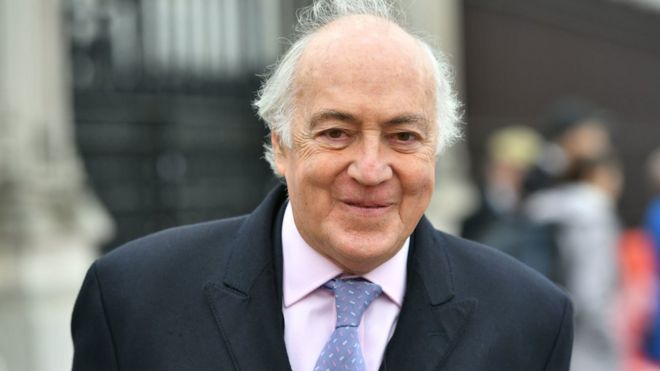
Michael Howard: Judges sometimes 'distort' the law to reach result they want

Former Tory leader Michael Howard has said judges sometimes "distort" the law they are interpreting "to reach the result they want to achieve".
28 December 2019
Lord Howard
Lord Howard said there had been a "significant increase" in the power of judges

Lord Howard, a former barrister, criticised the Supreme Court for ruling that Boris Johnson's suspension of Parliament was unlawful.
On Friday, outgoing Supreme Court President Lady Hale insisted judges were not "politically motivated".
But Lord Howard questioned whether unelected judges should make the law.
The Conservative manifesto pledged to review the "relationship between the government, Parliament and the courts" and the Queen's Speech included plans for a "constitution, democracy and rights commission".
In an interview with BBC Radio 4's Today programme, Lord Howard said there had been "a significant increase in the power of the judges at the expense of Parliament and indeed government".
He said this was partly because of the expansion of judicial review - where a judge reviews the lawfulness of a decision made by a government or other public body.
It was also because "they were invited by Parliament, under the Human Rights Act, to enter the political arena by considering, for example, whether the measures that Parliament had taken to deal with a particular problem were proportionate to the objectives they wanted to achieve", he said.
"Sometimes in order to reach the result they want to achieve, they... distort the meaning of the Act of Parliament of which they are interpreting," he added.
Lord Howard also criticised the Supreme Court ruling, delivered by Lady Hale, that Mr Johnson's decision to prorogue Parliament for five weeks was unlawful because it prevented MPs from carrying out its duties without reasonable justification.
Asked if he felt the ruling was a political act, he replied: "I think that judges have increasingly substituted their own view of what is right for the view of Parliament and of ministers."
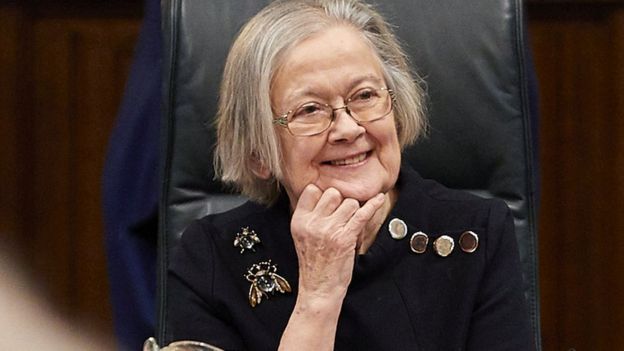
Lady HaleImage copyrightSUPREME COURT
Image captionLady Hale will officially retire from her post next month
The government has refused to rule out changes to the way judges in the court are appointed.
The prime minister has previously hinted at US-style confirmation hearings for Supreme Court justices, suggesting they should be subject to "some form of accountability".
UK Supreme Court judges are appointed on legal experts' advice, whereas in the US the President can nominate them.
Lady Hale has warned against any attempt to "politicise" the judiciary.
"We don't want to be politicised, we don't decide political questions, we decide legal questions. In any event, Parliament always has the last word," she told the Today programme on Friday.
"I hope very much that we never get to a situation where the politics of the judge - if he or she has any politics - come into whether or not they merit appointment as a judge at any level of the system."
"We are not politically motivated. I do not know the political opinions of my colleagues and they do not know mine, and long may it remain so," she added.
In a speech marking her retirement earlier this month, Lady Hale warned against adopting a US-style appointment system, where politicians choose judges.

https://www.bbc.com/news/uk-politics-50933535