Showing posts with label Donald Trump. Show all posts

Sunday, 13 April 2025

The Observer view on British Steel: saved for now, but for how long?

The UK’s last two remaining blast furnaces have hovered on the brink of shutting down over the past week. It has emerged that Jingye, the Chinese owner of Scunthorpe-based British Steel, was poised to refuse to buy further supplies of the coke and iron ore required to keep them running ...

 Story by Observer editorial 14h • 4 min read

... at which point it would not have been possible to restart them; effectively, a unilateral decision to put an end to Britain’s capacity to produce primary steel. 

In these circumstances, the government had no choice but to recall parliament for an emergency sitting to pass legislation to give business secretary Jonathan Reynolds the power to direct British Steel.

The British Steel site in Scunthorpe, owned by the Chinese conglomerate Jingye.
© Photograph: Ryan Jenkinson/Getty Images

The UK is starting from a low steel-producing base: it produced just 7.2m tonnes in 2021, compared with 13.9m tonnes in France, 24.4m tonnes in Italy and 40.1m tonnes in Germany. If British Steel were to shut its furnaces, this would leave the UK as the only G7 nation without primary steel-making capacity, with significant economic and security consequences. 

A range of industries rely on steel: construction, defence, transport, green energy. Without British-produced steel, global giant ArcelorMittal would attain what the defence thinktank Rusi has described as a “virtual monopoly” in the production of structural steel building frames for the UK market. Network Rail sources about 95% of its track from Scunthorpe. Parts of the defence industry are heavily reliant on British-produced steel; 90% of the steel used in Queen Elizabeth-class aircraft carriers was produced by Tata Steel at Port Talbot, for example.

There would be significant risks if UK industry were to become wholly reliant on steel imports, in a world characterised by increasing instability and the trade protectionism of Donald Trump’s White House. Europe may be considered a reliable trading partner, but the steel tariffs imposed by the US, combined with pressures for increased defence capability as the US goes cold on Nato, means the UK may not be able to count on sufficient supply from our European allies.

So the government had to intervene in this way: to let the furnaces in Scunthorpe go out would have been not only to lose thousands of jobs, affecting the community, but to put Britain’s security at risk. 

The power to direct British Steel does not amount to nationalisation, but this seems an all-but-certain outcome, given the situation with Jingye. It could end up costing the British taxpayer dear, but the risks of not maintaining domestic primary steel production would be even more costly.

There has been a complete lack of strategy for nurturing competitive British companies and removing barriers to their growth

It is far from ideal that ministers have found themselves in this situation, and for that governments of both colours over decades bear responsibility. The history of British steel-making has been lurching from crisis to crisis: the Scunthorpe furnaces were sold by Tata Steel to the private equity fund Greybull Capital in 2016, which left just three years later. The only buyer on the market was Jingye, which Boris Johnson, the then prime minister, saw as a more palatable option than closure or nationalisation. 

No government has set out a long-term strategy for maintaining British primary steel-making capacity, including realistic plans for decarbonisation, given it is a huge polluter. While steel producers in France and Germany have been relatively protected from high wholesale energy costs through government intervention, UK producers have been paying up to 50% more for electricity, a huge input cost into steel-making, than their competitors from these countries; Conservative business secretaries never addressed this asymmetry. The last government could also have done more to increase the market for low-carbon steel through regulation. It is an all-too-common aspect of British industrial policy: a complete lack of long-term strategy for nurturing competitive British companies and removing barriers to their growth.

There is a risk that, without a broader strategy for British Steel, the government nationalises the Scunthorpe furnaces in a way that will drain billions of taxpayer funds but is not part of a sustainable strategy for the future of primary steel-making in the UK.

 That needs to be the priority once the immediate crisis is averted. But the business secretary needs to learn the broader lessons of this sorry saga for industrial policy across the board. 

The UK is in a precarious position economically: long-term structural issues including low productivity growth and business investment and stagnant living standards have been compounded by the pandemic, by the energy crisis and by the global instability created by Trump’s tariffs policy. Britain’s long-term growth potential has been harmed irrevocably through Brexit and the erection of significant trading barriers with our largest and closest trading bloc.

We are living in a world in which Britain has declining economic and diplomatic agency. It is more important than ever to limit our dependence on other countries, including China, for the production of materials of strategic importance. 

The government deserves praise for taking swift action to prevent its primary steel-making capacity from being shut down. But that’s the easy bit: the much more difficult question is whether it’s possible to improve the competitiveness of British Steel in the medium term, while decarbonising, in a way that ensures the future of steel-making in the UK without it being forever reliant on huge subsidies from the taxpayer.


https://www.msn.com/en-gb/money/other/the-observer-view-on-british-steel-saved-for-now-but-for-how-long/ar-AA1CO1Em

Saturday, 3 April 2021

3 Apr 2021: BBC Ros Atkins On… Macron’s Covid-19 Crisis

Ros Atkins on Macron


Coronavirus has forced France into a third lockdown and raised questions about President Emmanuel Macron’s leadership.

3 Apr 2021


Coronavirus has forced France into a third lockdown and raised questions about President Emmanuel Macron’s leadership.

Producer credit: Courtney Bembridge, Henry Belot and Mary Fuller

https://www.bbc.com/news/av/world-europe-56606605


Friday, 8 January 2021

Trump: Welsh Tory criticised for US riots comparison to Brexit

 A senior Welsh Conservative has been criticised after comparing violent rioting in the US Congress to politicians who supported a second referendum on Brexit.

7 January 2021

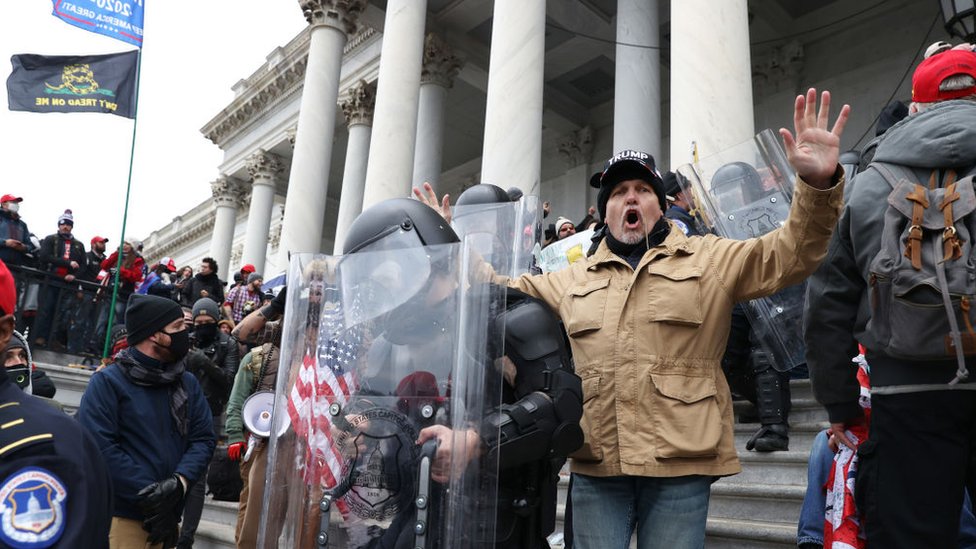
Protesters storming Capitol Hill building in WashingtonIMAGE COPYRIGHTGETTY IMAGES
image captionPro-Trump supporters stormed the US Capitol building in Washington DC on Wednesday

A senior Welsh Conservative has been criticised after comparing violent rioting in the US Congress to politicians who supported a second referendum on Brexit.

Andrew RT Davies faced calls to retract tweets aimed at Labour leader Sir Keir Starmer and Labour MS Alun Davies.

It follows pro-Trump rioters who stormed the US Capitol today, halting debate in the House and Senate.

Mr Davies later tweeted that "violence must never be tolerated".

The Welsh Conservatives have been asked to comment.

The Capitol in Washington was breached by the rioters as lawmakers met to confirm President-elect Joe Biden's win in the 2020 US election.

The joint session of Congress certifying Mr Biden's win has been suspended and forced into recess.

Quoting a tweet from Sir Keir, the former Tory Senedd leader said: "To be honest I'm not sure you're in the strongest position right now given you campaigned to overturn democracy and the will of the British people."

Mr Davies, now the Welsh Tory health spokesman, made the remarks about the Labour leader in response to Sir Keir saying the rioting was a "direct attack on democracy".

The BBC is not responsible for the content of external sites.View original tweet on Twitter
1px transparent line

Two Welsh Government cabinet members called for Mr Davies to reconsider his comments.

Mr Davies responded to Labour's Blaenau Gwent MS Mr Davies in a tweet, saying: "The scenes in Washington are a disgrace as I've said and all stem from politicians - like your good self - who refuse to accept the results of democratic elections."

In a further tweet, pinned to his profile, he said: "Awful scenes in Washington DC. This is what happens when the outcome of a democratic election is not respected."

Former Conservative MP and UK minister Alistair Burt, who briefly lost the whip in 2019 over a vote against a no-deal Brexit, said it was an "appalling and completely unworthy analogy".

"Have you taken leave of your senses equating the two? If you are an office holder of any sort in the Conservative Party, resign now."

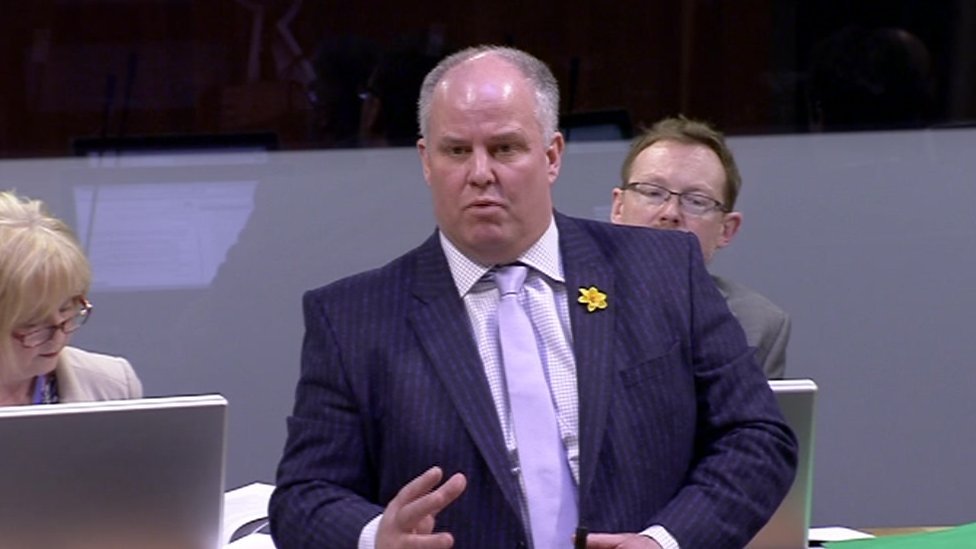
Andrew RT DaviesIMAGE COPYRIGHTWELSH ASSEMBLY
image captionAndrew RT Davies is the Welsh Conservatives' health spokesman

Antionette Sandbach, a former MP and Welsh Assembly Member who also had the Conservative whip withdrawn in 2019, replied to Mr Burt: "This is an embarrassing par for the course for Andrew and is a reflection of his thinking which he frequently demonstrated as leader of the Welsh Conservatives."

Labour's Rhondda MP Chris Bryant said Mr Davies's tweet to Sir Keir was a "disgrace".

"Equating democratic political debate with an armed violent assault on the Capitol validates violence," he said.

Mr Bryant wrote to Tory co-chairman Amanda Milling demanding the senior Welsh Brexit campaigner be suspended.

Cardiff South and Penarth MP Stephen Doughty said the tweet was "utterly disgusting" and "crass".

Meanwhile, Wales' mental health minister Eluned Morgan said it was "sickening political game playing".

Mr Davies said in a later tweet: "Violence must never be tolerated and I will work with politicians of all persuasions to ensure we never see scenes like those in Washington in this country.

"No one should be in any doubt about my position on this."


https://www.bbc.com/news/uk-wales-politics-55565693

Thursday, 7 January 2021

Facebook and Twitter lock Trump’s social media accounts after video address

Unprecedented actions by social media giants were aimed at addressing the president’s spread of misinformation and the incitement of violence

Facebook, Twitter and YouTube removed Donald Trump’s video post to the supporters who stormed the US Capitol.
 Facebook, Twitter and YouTube removed Donald Trump’s video post to the supporters who stormed the US Capitol. Photograph: Us President Donald J Trump Twitter/EPA

Twitter and Facebook took unprecedented actions to address the spread of misinformation and the incitement of violence by Donald Trump on their platforms on Wednesday, after supporters of the president stormed the US Capitol.

Both companies locked Trump’s accounts and removed several posts from the president that cast doubt on the election results and praised his supporters, who forcibly took to the government building as lawmakers attempted to tally votes for the election.

Facebook has suspended Trump from posting to his account for 24 hours. Instagram, which is owned by Facebook, also locked Trump’s account. Twitter locked Trump out of his account for 12 hours and is requiring him to delete three tweets the company says violates its policies. If he does not delete them, his account will remain suspended indefinitely, the company said in a public statement. If Trump again violates the policies, his account will be permanently suspended from Twitter.

The action is the most aggressive yet from Twitter and it comes after it joined Facebook and YouTube in removing a video post from Trump’s account in which the president praised the protestors.

Twitter blocked several of Donald Trump’s posts from being shared on Wednesday.
Pinterest
 Twitter blocked several of Donald Trump’s posts from being shared on Wednesday. Photograph: Twitter/Donald Trump/PA

Earlier on Wednesday, Twitter blocked several of Trump’s posts from being shared, citing a “risk of violence”.

As his supporters gathered on Wednesday to protest the certification of the 3 November election results, Trump in a tweet accused Vice-president Mike Pence of lacking “the courage to do what should have been done”.

In the video he shared on social media later in the day, Trump urged his supporters to “go home”, but also gave legitimacy to the falsehoods that fueled Wednesday’s attempted insurrection, calling the election “stolen” and telling the angry mob, “we love you”.

Later on Wednesday, Trump again falsely claimed his “election victory” was “unceremoniously” and “viciously” stripped away.

“In line with our civic integrity policy and recent guidance, we have placed a label on the tweet, and have significantly restricted engagement with the tweet due to the risk of violence,” a Twitter spokesman said. “This means this tweet will not be able to be replied to, retweeted, or liked.”

Facebook took a number of measures throughout the day, including the unprecedented decision to remove a post made by the president. “This is an emergency situation and we are taking appropriate emergency measures, including removing President Trump’s video,” said Guy Rosen, Facebook’s vice-president of integrity, in a tweet. “We removed it because on balance we believe it contributes to, rather than diminishes, the risk of ongoing violence.”

Facebook also said it would be removing content that praises the storming of the US capitol, calls to bring weapons to locations across the US, videos and photos from protestors at the Capitol, and any “attempts to restage violence” in the coming days. It has banned the hashtag #StormtheCapitol, which was used to organize Wednesday’s actions and designated it as “dangerous”, a category the platform usually reserves for hate groups and terrorists.

Facebook has also increased rules for content moderation in private Facebook groups, where extremism experts have long warned many such militarized actions are planned. The platform is now increasing the requirement of Group administrators to review and approve posts before they can go up and disabling comments that have a high rate of hate speech.

Still, dozens of ‘Stop the Steal’ Facebook groups and events remain live on the site.

Online activism group Color of Change launched a petition on Wednesday calling on social media firms to remove the president, saying they have ignored years of warnings about the dangers of white supremacists using these platforms to recruit, organize and fundraise.

“Big tech companies are complicit in the insurrection in DC today,” said Rashad Robinson, president of Color of Change. “Enough is enough. It’s time for Facebook and Twitter to kick Trump off their platforms.”

Twitter’s suspension of Trump’s account came after it faced intense pressure on Wednesday to suspend the president’s account as tensions in Washington rose.

“Threats of and calls to violence are against the Twitter rules, and we are enforcing our policies accordingly,” Twitter said.

The company’s safety account, which shares updates and enforcements of company policy, also said it is working to rein in violent language on the platform as the attempted coup continues to unfold.

Twitter in the past has flagged several Trump tweets sharing misinformation or calling for violence. Most notably, the president’s May 2020 tweets encouraging violence against protesters demonstrating against police violence were hidden and prevented from being shared.

But the company has also faced criticism for failing to remove tweets quickly enough and calls to remove the account entirely. Though Twitter doubled down on its enforcement of policies against misinformation and calls to violence in the weeks leading up to the presidential election, it was slower to take action in days and months following. On 11 November, the site took more than an hour to flag a highly misleading video shared by Trump. It was retweeted more than 70,000 times before the platform took action.

Facebook has also faced criticism for its role in promoting misinformation and allowing armed groups to organize. Facebook CEO Mark Zuckerberg faced intense criticism for the company’s decision to leave up the presidents’ message inciting violence against protesters demonstrating against police violence, as companies like Twitter removed them.

Facebook also began to remove militias from its platform in 2020 August, months after it was found thousands of extremist groups were using the site to organize anti-Democratic, armed actions, a shooting in Kenosha, Wisconsin organized on Facebook left two dead, and the violent kidnapping of Michigan governor Gretchen Whitmer was planned on the platform.

Surrounding the storming of the Capitol on Wednesday, Facebook was again targeted with blame as many of the events and protests that led to the action were organized there.

“The violent protests in the Capitol today are a disgrace,” a Facebook spokesman said. “We prohibit incitement and calls for violence on our platform. We are actively reviewing and removing any content that breaks these rules.”

https://www.theguardian.com/us-news/2021/jan/06/facebook-twitter-youtube-trump-video-supporters-capitol

American carnage: how Trump's footsoldiers ran riot in the Capitol

 Staffers barricaded doors and hid under desks as Trumpist rioters roamed freely, looking for members of Congress they saw as enemies


Members of the violent mob in the Capitol building. Police fired teargas as the rioters pushed inside the gleaming white edifice.
 Members of the violent mob in the Capitol building. Police fired teargas as the rioters pushed inside the gleaming white edifice. Photograph: Roberto Schmidt/AFP/Getty Images

A rioter leaned back in the chair of the speaker of the House Representatives and brought a brown boot down on the papers left strewn on her desk.

Elsewhere in the Capitol building, a lectern bearing the gold seal of Congress was ripped away and framed documents were torn from the walls, as Trump banners and Confederate flags were paraded through abandoned hallways.

It was Wednesday afternoon, 6 January, when Donald Trump’s four-year assault on US democracy reached its inescapable destination, an orgy of violence aimed at the heart of the republic.

Staffers in some offices barricaded their doors and hid under their desks like one of the active shooter lockdowns the country’s school children practised when they still went to school. “Where the fuck are the Capitol police?” a staffer texted to a journalist friend. The police were overwhelmed, and the mass ranks of national guard and federal agents who had crushed peaceful Black Lives Matter protests in the summer were nowhere to be seen until evening fell.

In the corridors outside, Trumpist rioters were able to roam freely, as they looked for members of Congress they saw as enemies. They found their way into the Senate chamber where minutes earlier the election results were being certified. A rioter stepped on to the dais and, according to a reporter on the scene, yelled: “Trump won that election.”

Police fired teargas as the rioters pushed inside the gleaming white edifice of the Capitol. One woman was shot and later died of her injuries, according to the Washington police. An explosive device was also found. Rioters attacked TV crews outside the building. Several police officers were also injured.

When the defeated president was first sworn into office almost four years ago, he raised the spectre of “American carnage”. He portrayed it as something that had gone before, but it very soon became clear it was what was still to come.

As Trump has made clear for months, he has been prepared to wreak carnage on the political system that elevated him to the most powerful office, if it ever threatened to spit him out.

The party who enabled his rise and then grew terrified of him has been left broken, so divided that the Republicans lost both Senate seats in the southern bastion of Georgia, results confirmed on Wednesday.

At the moment the Trumpist footsoldiers stormed the Capitol, the Republicans had split into duelling factions. A dozen senators and over a hundred representatives were prepared to follow him across the Rubicon and vote against certifying the confirmed results of November’s presidential election.

The vice president Mike Pence, the Senate majority leader, Mitch McConnell and most Republican senators wanted to jump off the Trump train before it reached its last stop, and tried to put an end to the president’s fevered delusion that the presidency would be handed back to him after electoral defeat.

It was the declaration from Pence – who had hitherto been assiduously loyal to the leader – that he would follow the constitution and read out the election result, rather than try to change it, that apparently triggered Trump’s wrath, and set in motion the events that let to the storming of the Capitol.

As senators were being hustled to safety, a leading member of the latter faction, former presidential candidate Mitt Romney, is reported to have told a leader of the loyalists, Ted Cruz, “This is what you’ve gotten” – a clumsy, desperate epitaph for the party the Republicans thought they were.

The orange genie, who had been out of the bottle for four years granting the Republicans every wish, was not going back in without tearing down the palace walls, turning the party’s own supporters against it.

Less than an hour before the Capitol was breached, Trump had told his supporters: “We want to be so respectful of everybody – bad people. And we are going to have to fight much harder.”

He told them to march from the White House along the national mall to the Capitol to “save our democracy”. He even said he would go with them, but it was just another promise he had no intention of keeping, taking his motorcade instead the hundred yards back to the White House.

Go to the Congress “peacefully and patriotically” he told them, but a matter of minutes later, the barricades outside the Capitol were down and the mob was charging. They had been told, again and again, their nation was at stake, child-trafficking Chinese-run socialists were taking over, and they had to fight harder.

Those Republicans who failed to overturn the election were “weak” and “pathetic”, allowing Democrats to destroy the country. Trump singled out his formerly loyal deputy. “Mike Pence is going to have to come through for us, and if he doesn’t, that will be a sad day for our country,” Trump yelled from a stage that had been set up a block from the White House, for a crowd that had gathered on the grassy Ellipse below the national monument.

As the president was speaking, Pence had however jumped ship. For the first time, with two weeks of the presidency to run, he did the opposite of what he was being told by his boss.

Hours after his supporters had stormed the Capitol, Trump released a video telling them: “Go home, we love you, you’re very special”. But he also used the video to repeat his baseless claims about the “fraudulent” vote which he lost.

 Members of pro-Trump mob wander Senate floor after swarming Capitol – video

As night fell over the capital he tweeted: “These are the things and events that happen when a sacred landslide election victory is so unceremoniously & viciously stripped away from great patriots who have been badly & unfairly treated for so long. Go home with love & in peace. Remember this day forever!”

The seeds of violence were disguised inside the husk of the old order. Wednesday itself had appear to begin like any other American political carnival, with bright flags, exuberant costumes and vendors selling T-shirts and hot-dogs. It was only with a closer look, that something far more dystopian was at hand, with a seething potential for violence.

“Fuck Your Feelings, Trump 2020,” was the message on the fastest-selling T-shirt. Some of the flags declared: “Fuck Biden”. The crowd that sprawled across the Ellipse was a mix of families and the elderly, men and women, young and old. Only about one in ten was wearing camouflage gear, though that was more than the percentage wearing masks.

A young couple, Kasey and Mike, were sitting under one of the ornamental cherry trees near the monument, having traveled down from Rhode Island. They spoke with with the dreamy smiles of two people in love, sharing a moment in history, but their message was one of looming conflict.

“People here are mad. they’ve watched so many people destroy our country like that. I don’t think they’re just gonna sit back any more,” Kasey said.

“I think Trump’s only option he really has left is to call military action into it because he has the right to do that.”

As Trump finished his speech, the crowd dispersed, thousands streaming along the mall to the Capitol. On a side street some distance from the crowd, a small group of young bearded men in military fatigues and hats lounged patiently, in readiness for they knew would come later, when the sun set.

It was unknowable, as the glass was being swept up in the Capitol and the police began to eject the jubilant rioters, whether they were the embodiment of a last spasm of a spent force, or the true face of America’s future.

https://www.theguardian.com/us-news/2021/jan/06/trump-capitol-american-carnage-washington