Showing posts with label Lib-Dem. Show all posts

Friday, 13 December 2019

Andrew Sparrow's election briefing: five more years for Boris Johnson?

Catch up with the aftermath of election night with the last of our election roundups
Andrew Sparrows
Fri 13 Dec 2019 18.42 GMT  Last modified on Fri 13 Dec 2019 19.20 GMT
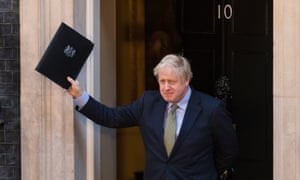

Boris Johnson outside 10 Downing Street.
 Boris Johnson outside 10 Downing Street. Photograph: Vickie Flores/EPA

Boris Johnson wins thumping majority


Johnson has won a resounding, 80-seat majority for the Conservatives, smashing the Labour party, confounding expectations and giving himself for the first time the opportunity to push a legislative programme through parliament. His majority is bigger than David Cameron’s for his coalition government, bigger than Tony Blair’s in his third term, and the largest for any Conservative prime minister since Margaret Thatcher. At times during the election Johnson talked about a 10-year agenda for government, and his victory is substantial enough to mean a decade-long premiership must now be a possibility. But he remains a deeply divisive figure, his predecessor Theresa May reportedly believes he is “morally unfit” to be PM, and he has reinvented his politics so often in his career that Britons don’t really know at all whether they’ve elected Britain’s Trump, as the US president sees him, or a pro-Brexit version of Michael Heseltine, as Johnson’s allies depict him. Perhaps he doesn’t even know himself.

PM promises ‘one-nation’ government


Johnson has claimed, with some accuracy, to have redrawn the electoral map of Britain, and has promised to govern as a one-nation party. Just as Ronald Reagan recast US politics by discovering “Reagan Democrats” (previous blue-collar Democrat voters who were attracted by Reagan’s demeanour and social conservatism), Johnson won his majority by taking seats that had been Labour for decades. He has promised to govern in the interests of these new voters. Whether he will or not remains to be seen. And what is also not clear is whether the composition of the parliamentary Conservative party has changed to push it in this direction. Johnson gave two short speeches on Friday (see here and here), but he has postponed what is expected to be a limited reshuffle until next week.

All roads lead to Brexit


The Conservative election victory has killed off any lingering prospect of Brexit being reversed, and the UK is now all but certain to leave the EU on 31 January, Johnson said on Friday morning.
With this mandate and this majority we will at last be able to [get Brexit done] because this election means that getting Brexit done is now the irrefutable, irresistible, unarguable decision of the British people.
And with this election I think we’ve put an end to all those miserable threats of a second referendum.
The People’s Vote campaign has effectively surrendered. In a statement on its behalf, Open Europe, one of the groups behind the campaign (it recently split), said:
The People’s Vote will now refocus its campaign to concentrate on vital social issues that this government must urgently prioritise in its Brexit negotiations.

Meanwhile


  • EU leaders have restated their call for the UK to remain aligned to EU standards if it wants a comprehensive trade deal to be negotiated next year. Johnson does want to conclude the trade talks next year, because his manifesto said he would not extend the transition beyond December 2020. But he has also said he wants the UK to be able to diverge from EU standards. This is set to be perhaps the dominant political issue of 2020, and the scale of the challenge Johnson faces suggests that his promise to have got Brexit “done” by 31 January (his central campaign promise) could soon look like a hollow joke. As usual with Johnson, it is impossible to predict what he will do, and there has been some speculation that he will end up betraying his hardline Brexiter supporters in the Tory European Research Group.
  • Jeremy Corbyn has accepted that his unlikely but transformational four-year leadership of the Labour party must come to an end, having led the party into its worst defeat (in terms of seats won) in more than 80 years. He suggested he would step down early in the new year. What is not clear, though, is whether Corbynism will survive him. “On some things he was a generation ahead of his time, but he couldn’t lead, and that’s what voters want, even if it means being lied to.” That is from the American journalist George Packer. Packer was writing about Jimmy Carter (in his book Our Man), but it serves equally well as a charitable assessment of Corbyn.
  • None of the potential contenders for the Labour leadership has declared, but the party has already begun an intense and acrimonious inquest into the reasons for its defeat. Corbyn’s supporters are blaming Brexit, while his many critics in the party are saying it was his leadership that was fatal to its chances. Others point out (rightly) that the party’s problems in some areas predated both Brexit and Corbyn.
  • Jo Swinson has apologised to the Liberal Democrats for a dismal election in which she lost her seat and the party slipped to 11 MPs, but said she did not regret fighting on a defiantly pro-remain platform. Having lost her seat, she had to stand down as party leader. One of the ironies of today is that the election would never have happened if it had not been for the Lib Dems calling for one, and Corbyn subsequently agreeing. (When the Lib Dems and the SNP both openly called for an early election, it became much harder for Labour to resist.) Without their backing, Johnson would not have been able to legislate to make it happen.
  • Pressure is growing on the Democratic Unionist party (DUP) and Sinn Féin to swiftly restore power sharing after voters punished both parties for Northern Ireland’s political dysfunction.
That’s it from me. Like the election itself, our daily briefing is done and this will be the final edition. A big thank you to all our readers - not least those of you who subscribed via email and app. If you’re looking for something to fill the gap, try the Guardian Morning Briefing for a news digest, bright and early on weekdays (get the email here, app users go here and tap ‘get notifications’). Or if you want to keep a close eye on Brexit manoeuvres, try Jon Henley’s weekly Brexit Briefing (email here or app here).

Video: Could Boris Johnson’s Brexit break up the UK? MUST WATCH Channel 4


Could Boris Johnson’s Brexit break up the UK?
237,853 views
•13 Dec 2019


930K subscribers

SUBSCRIBE

Scottish National Party leader Nicola Sturgeon has been speaking in Edinburgh, pledging to begin moves to enable a second independence referendum as soon as possible. (Subscribe: https://bit.ly/C4_News_Subscribe)


Britain speeds towards Brexit as Johnson wins large majority in election

LONDON (Reuters) - Prime Minister Boris Johnson won a resounding election victory on Friday that will allow him to end three years of political paralysis and take Britain out of the European Union within weeks.

DECEMBER 13, 2019 / 6:04 AM / UPDATED 3 HOURS AGO
Guy Faulconbridge, William James
7 MIN READ
https://uk.reuters.com/article/uk-britain-election-exit-poll/johnson-to-win-a-majority-of-86-exit-poll-id


The Brexit divorce represents Britain’s biggest political and economic gamble since World War Two, cutting the world’s fifth largest economy adrift from the vast trading bloc and testing the integrity of the United Kingdom.
For Johnson, who had faced gridlock in parliament and focused his campaign on a vow to “Get Brexit Done”, victory was a vindication.
“The people of this country have given us tonight a huge great stonking mandate,” he told activists at Conservative Party headquarters, according to a recording published by Buzzfeed.
“They’ve given us this mandate of course because they want us to do one thing, which you all know, they want us to get Brexit done.”
Nearly half a century after Britain joined the EU, Johnson faces the challenge of striking new international trade deals, preserving London’s position as a top global financial capital and keeping the United Kingdom together.
That last goal was looking more challenging as the election results rolled in, with Scotland voting for a nationalist party that wants an independence referendum, and Irish nationalists performing strongly in Northern Ireland.
In a political earthquake in England, the Conservatives won large numbers of seats in the opposition Labour Party’s so-called Red Wall, traditional working class heartlands once hostile to Johnson’s party.
Brexit, which has shattered old party loyalties and divided Britain along new fault lines, was the cause of the shift. In the Red Wall, a majority of voters favoured leaving the European Union and rejected Labour leader Jeremy Corbyn’s ambiguous stance on the issue.
In a symbol of the change, the Conservatives took Sedgefield, once held by former Prime Minister Tony Blair, Labour’s most successful leader.
U.S. President Donald Trump was quick to congratulate Johnson.
“Britain and the United States will now be free to strike a massive new Trade Deal after BREXIT. This deal has the potential to be far bigger and more lucrative than any deal that could be made with the E.U.,” Trump wrote on Twitter “Celebrate Boris!”
GRAPHIC-Live results (here)
LABOUR FLOP
Educated at the country’s most elite school and known for his bombastic rhetoric, the 55-year-old Johnson should now be able to lead Britain out of the EU by Jan. 31, the current deadline, but will face the complex task of negotiating his country’s future relationship with the bloc.
A divisive figure seen by many opponents as a populist charlatan who played fast and loose with the facts and made unrealistic promises, Johnson may struggle to reunite a divided nation.
But his party’s landslide win marks the ultimate failure of opponents of Brexit, who tried to thwart the 2016 referendum vote through complex legislative manoeuvres and could not convert huge anti-Brexit street protests into a coherent political strategy.
With results in from almost all 650 parliamentary seats, the Conservatives had won 361, their biggest election win since Margaret Thatcher’s 1987 triumph.
Labour, led since 2015 by the veteran socialist Corbyn, had won just 203 seats, the party’s worst result since 1935.
Corbyn’s offer of a radical agenda of failed to win over voters, while his equivocal position on Brexit left many angry and confused, especially in Red Wall areas where large majorities had voted for Brexit in 2016.
Corbyn said he would quit as Labour leader after a period of reflection.
Sterling soared, on course for one of its biggest one-day gains in the past two decades. The pound hit a 19-month high versus the dollar GBP=D3 and its strongest levels against the euro EURGBP=D3 since shortly after the 2016 Brexit referendum.
After Jan. 31, Britain will enter a transition period during which it will negotiate a new relationship with the EU.
This can run until the end of December 2022 under current rules, but the Conservatives have pledged not to extend the transition beyond the end of 2020.

SCOTLAND REJECTS BREXIT AND JOHNSON

A big majority may allow Johnson to extend the trade talks beyond 2020 because he could overrule the Brexit hardline European Research Group (ERG) faction in the party.
“The bigger the Tory majority of course the less influence over this the ERG and Eurosceptics will have,” said Brexit Party leader Nigel Farage, whose anti-EU campaigning played a major part in persuading former Conservative Prime Minister David Cameron to call the 2016 referendum.
“It will be called Brexit but it won’t really be,” Farage said. 
Johnson was helped by Farage’s party, which stood down hundreds of candidates to prevent the pro-Brexit vote from being split. The Brexit Party poached a significant number of voters from Labour.
Labour now faces a civil war between the socialists who control it and moderates who will demand power.
“This is obviously a very disappointing night for the Labour Party,” Corbyn said after being re-elected in his own north London electoral seat. He said he would not lead the party in any future elections.
Weary Labour candidates said his leadership had played a major role in the defeat.
“He should have gone many, many, many months ago,” said labour’s Ruth Smeeth, who lost her seat in Stoke-on-Trent.
The strongly anti-Brexit Liberal Democrats won only 11 seats, a crushing result. Party leader Jo Swinson lost her seat to the Scottish National Party (SNP) and resigned.
The SNP, which opposes Brexit, won 48 of Scotland’s 59 seats in the national parliament. It will now demand a second independence vote, after loosing a referendum in 2014.
Scotland’s first minister, SNP leader Nicola Sturgeon, said Johnson had no mandate to take Scotland out of the EU.
“Boris Johnson may have a mandate to take England out of the European Union, he emphatically does not have a mandate to take Scotland out of the European Union,” Sturgeon said.
See also:
What would a UK Conservative majority government do? here
EXPLAINER-Reality check for Johnson's Brexit: it's just the beginning here

Jo Swinson's 'Portillo moment' analysed: How Lib Dem leader joins illustrious list

JO SWINSON became the latest in a long line of high-profile MPs to face the humiliation of losing her seat on election night in what will go down in history as another “Portillo moment”.

Ms Swinson started her campaign saying she could become the next Prime Minister. Not only were her hopes catastrophically and brutally crushed by Boris Johnson’s huge Tory majority, she is now no longer an MP. However, the now former leader of the Liberal Democrats is not the first, and will not be the last, to see her dream of high office swept away by defeat at constituency level. 
The 39-year-old suffered what is commonly referred to as a “Portillo moment” – a term that came to prominence on May 2, 1997, at 3.10am, when Cabinet minister Michael Portillo, once tipped as a future Conservative Party leader, lost his Enfield Southgate seat to Labour. 
The result sent shockwaves around the nation, as it represented a whopping 17.4 percent swing to Labour and, as Prime Minister John Major was widely expected to lose the general election to make way for Labour’s Tony Blair, Mr Portillo was considered a frontrunner to replace him as Conservative Party leader in opposition. 
Reflecting on it recently, Mr Portillo said: “It is a very public humiliation and I don’t want to wish it on anybody. 
“But if it does happen to somebody they might reflect on the fact that in my own case, in my own humble view, it was the making of me.
“I went off and made another career and I had a tremendous amount of fun doing that.”
Jo Swinson and Michael Portillo
Jo Swinson lost her seat last night in what can be seen as a 'Portillo moment' (Image: GETTY)
Jo Swinson after her general election 2019 loss
Jo Swinson looked dejected after her defeat was confirmed (Image: GETTY)
Whether Ms Swinson can do the same remains to be seen.
More ominously for the pro-EU politician, Mr Portillo also reflected on his name being “synonymous with eating a bucketload of s*** in public”. 
Aside from Mr Portillo, perhaps the most famous case of a frontbencher losing in their own constituency came in the shape of Labour’s Ed Balls in 2015.
The former Shadow Chancellor was a huge scalp for the Tories, as Andrea Jenkyns won the seat by a margin of 0.9 percent.
Ms Swinson now joins Mr Balls and Mr Portillo among the most high-profile scalps in recent election history.  
Other notable oustings this year were Tory Zac Goldsmith, who lost his Richmond seat and Labour’s Dennis Skinner, the Beast of Bolsover, who represented his Derbyshire seat for 49 years.
However, Dominic Raab and Iain Duncan Smith managed to hold on in what will be remembered as a hugely successful night for Boris Johnson and the Conservative Party.
Michael Portillo losing his seat in 1997
Michael Portillo famously lost his seat in 1997 (Image: GETTY)
Betfair Exchange have Ed Davey as the frontrunner to replace Ms Swinson with 8/13 odds while Layla Moran has odds of 8/11.
Spokesman Sam Rosbottom said: “One of the big casualties of the evening was Jo Swinson, the Lib Dem leader, who lost her seat in East Dunbartonshire. 
“The early favourite to take over from her as leader is Ed Davey at odds of 8/13, while Layla Moran is closely behind him in the betting at 8/11.”
https://www.express.co.uk/news/uk/1216775/jo-swinson-lib-dem-general-election-2019-portillo-moment-boris-johnson-spt

How did Boris Johnson achieve his landslide victory? A visual guide

Johnson’s gamble on a ‘Brexit election’ paid off, with big gains in Labour’s leave-voting heartlands


https://www.theguardian.com/politics/ng-interactive/2019/dec/13/boris-johnson-achieves-landslide-victory-visual-guide

The Conservative party gained 66 seats to secure its biggest majority since Margaret Thatcher’s 1987 victory. Boris Johnson’s party cemented its lead in many of its existing seats and made gains in traditional Labour heartlands across the north. Brexit dominated the campaign, bringing the party a thumping win across England and handing Johnson control of Westminster with 365 seats.

The Conservatives made key gains in Labour’s ‘red wall’

The Conservatives eroded the band of traditionally Labour-held seats in constituencies stretching from North Wales to Grimsby and further to the north.
Seats such as the Vale of Clywd1, Bishop Auckland2, Redcar3 and Great Grimsby4turned from Labour to Conservative. The shift has recast the political geography of England and may change the face of the Conservative party.
Labour’s share of the vote in its traditional constituencies crumbled. The party’s only gain across the country on its 2017 result was in Putney.

The Tories made this election about Brexit and won

Brexit loomed large in voters’ minds, swinging traditional Labour constituencies to the Conservatives. Areas which voted heavily to leave the EU had more votes for the Conservatives compared with 2017. Boston and Skegness1, Castle Point2, Thurrock and Ashfield all swung for the Conservatives.

The Brexit party hurt Labour in their leave-voting seats

Labour lost 10 of its 20 strongest leave-voting seats to the Conservatives and its majority shrank considerably in the seats it managed to hold. In Doncaster North1, which voted 72% to leave in the EU referendum, Labour saw its 33-point lead over the Tories drop to just six points.
The Brexit party did not win any of these target seats, but it made significant advances in traditional Labour strongholds. In Barnsley Central2, the Brexit party won 30% of the vote and Labour lost 24 points compared with 2017.

The Conservatives only lost two of their 20 most marginal seats from 2017

The Brexit party’s decision not to stand in Tory-defended seats helped the Conservatives consolidate the leave vote in those areas. Out of their top 20 most marginal defended seats, they only lost two in remain-leaning Richmond Park and Stirling.
Everywhere else, the Labour vote share transferred directly to the Conservatives, with swings of over 14% in Thurrock, Stoke-on-Trent South1 and Mansfield2. The Conservatives also strengthened their grip on many former Labour areas, a change that will redraw Britain’s political landscape.

The Conservatives gained significant support outside of London and Scotland

The Conservatives gained support in most corners of England and Wales, with a huge 19% increase in Thurrock1in the south-east – their biggest increase of the election. They also performed well in leave-voting constituencies in the Midlands, such as Walsall North2 and Cannock Chase3.
It was a tough night for Labour as they struggled to pick up support across the country. Bradford West4 was their biggest vote share increase, where incumbent Naz Shah gained 11 percentage points.

A big night for the SNP had them gain 14 of their target seats

A buoyant Nicola Sturgeon has declared her party’s historic win in Scotland as “a renewed, refreshed and strengthened mandate” for a fresh independence vote after winning 47 of Scotland’s 59 Westminster seats.
The SNP took seats from both main parties, with gains from Labour in Coatbridge, Chryston and Bellshill1 and East Lothian, and gains from the Conservatives in Gordon2 and Aberdeen South.

https://www.theguardian.com/politics/ng-interactive/2019/dec/13/boris-johnson-achieves-landslide-victory-visual-guide