Saturday, 6 August 2016

Mark Carney should RAISE rates if he wants to rebuild economy confidence, says ROSS CLARK

AS THE Bank of England lowered its base rate to 0.25 per cent and announced an extra £60 billion of quantitative easing on Thursday, governor Mark Carney said he was prepared to “take whatever action is needed to achieve its objectives for monetary and financial stability”.

Mark CarneyGETTY
Mark Carney says he'll do anything to improve the economy - apart from talk it up
Everything, that is, except it seems talk up the economy. 
If the previous governor, Mervyn King, had a reputation as a bit of a misery guts, his Canadian successor sounds like more like Leonard Cohen on a bad day. 
It is alright Carney now trying to tell us now that Britain will avoid recession – but it isn’t what he said before the referendum.
Addressing the Treasury select committee in May he said that a vote for Brexit could lead to a ‘technical recession’. 
He also warned before the vote that a Leave vote would lead to soaring mortgage costs (in fact they have fallen).
Carney doesn’t seem to appreciate the power his words have. They can and do move markets. 
If there is a confidence problem in the UK economy at the moment it has a lot to do with the gruesome warnings which he – along with George Osborne and David Cameron – made about Brexit in the run-up to the vote.
The decision by him and other members of the Monetary Policy Committee to reduce interest rates to the lowest level ever doesn’t help build confidence. It does the opposite – giving the impression of panic. 
Mark CarneyGETTY
Carney warned that a Brexit vote would lead to soaring mortgage costs when they've actually fallen
Historically, the act of lowering interest rates was used as a tool to encourage individuals and businesses to borrow more, in order to stimulate the economy. 
But with interest rates already at a 400 year low of 0.5 per cent, no-one can claim that the price of debt was putting people off spending.
What lowering rates even further does do is to cut the income of people, especially pensioners, who are already struggling to live on meagre returns from their savings. Lower rates also help to undermine company pension schemes. 
By lowering the yield on gilts and bonds the bank has, according to one estimate, increased by £70 billion the reserves which companies need to meet their pension liabilities. 
Mark CarneyGETTY
Carney really doesn't appreciate the effect that his words have
Had Carney really wanted to rebuild confidence in the economy he might be thinking of raising rates from the level they were set in the depths of the 2008/2009 financial crisis. 
A base rate of 0.5 per cent was only ever supposed to be an emergency measure. 
Mark CarneyGETTY
If Carney really wants to rebuild the economy he might want to raise rates
Lowering it further seems to suggest things are even worse now than they were then – when actually our banks are not going bust as they were then and the economy expanded in the second quarter by an unexpectedly robust 0.6 per cent.
http://www.express.co.uk/comment/expresscomment/697076/Mark-Carney-RAISE-rates-rebuild-economy-confidence-ROSS-CLARK

Brexit can end managed decline, forge new global Britain

The British establishment adopted "managed decline" after Suez, viewing the EU as a crutch to sustain us. It was a historic mistake for many reasons. But Brexit means we have a new opportunity. We must seize it

Ryan Fiske
On 6 August 2016 06:42

Flag_latest

Now take that flag and make it global again

For over 50 years, the mindset of the British establishment has been of “Managed Decline”. But the idea Britain is no longer good enough to maintain past glories and achievements, and the best we can hope for is to manage our fall with as much grace and dignity as possible, is quite ridiculous.

This position undermines British achievements, and limits the UK to an increasingly minor role in the world. With Brexit, we now have the opportunity to break this mentality and see the UK stand confident on the world stage once again.
This has been a rot which set in after the Suez Crisis. While the failure of Britain to maintain control of the Suez Canal toppled the Prime Minister of the day, Anthony Eden, it also toppled the establishment’s faith in Britain.
To them it signalled the end of the UK as a world power; a country reduced in size and stature to the extent it was no longer capable of being able to shape events in the world on its own. We now have a chance to reverse this historic mistake through the Brexit vote.
So why is Brexit so important in ending Managed Decline and for the UK to no longer see itself as a failing nation?
Europe -- and what was then the European Economic Community (now the EU) -- was the crutch the politicians reached for. Why they made this choice is fairly obvious. Germany and France were booming economically, whilst Britain was becoming known as “the sick man of Europe”.
In their panic over Britain’s flailing economy, they turned to the European Community, and in doing so abandoned the global trading outlook which had served Britain so well in the past.
Tying the UK into the European Community has not been a success. A predicted export boom to Europe never happened, with Britain importing more and more from the European Community. Our Balance of Payments has never recovered and, to this day, we still import far more from the EU than we export to them. The UK joining the European Community was far more of an economic bonus for the EU than it has been for the UK.
Managed decline through the EU has entailed more than the economy. On the international stage, there has been a lessening of Britain’s role, and on many occasions it’s been a retreat to hide beyond the EU despite its repeated incompetence.
It is true, on some issues Britain has stood strong, but often only after suffering through the failures of the EU. The humanitarian efforts in Kosovo were eventually a success, but only after Britain acted outside the EU framework, acting as a global nation and not merely a European one.
The foreign policy interests of the EU will always be limited. With the possible exception of France, no other country within the EU has the same global outlook the UK has. Yet, because of our EU membership, we have progressively regressed, with our world view becoming smaller and smaller, less global and more focused on Europe.
This is what managed decline looks like: a nation in retreat from its global role and responsibilities.
Our membership of the European project may have started as an unnecessary leaning post for politicians whose faith in Britain had been shaken by the difficult times of the 1950s and 1960s, but over time it began to hinder Britain’s growth. Economically and internationally our abilities and national self-belief have been degraded. It has been a self-fulfilling prophecy.
In believing the UK is failing, decisions and policies have been made which reflect this. We do not need to accept this, and Brexit is what can break this mindset.
Brexit is acting as a sharp shock to the political establishment. No longer able to lean on the crutch of the EU, they cannot continue to follow the path of managed decline through it. The biggest problem was indeed our EU membership. Now we are on the way out, it would be impossible to continue in this vein anyway.
So, what is the alternative? The return of the UK as a global trading nation is a start. No longer hindered by the EU, the UK will forge trade deals with nations around the world. Not even a month and a half after the Brexit vote, countries from every continent have already come forward with requests for trade deals with the UK.
This is just the start. Outside the EU, issues such as aid, security and migration will once again be in the control of the British government. These are issues which are, by necessity, global in nature if we want to be a leading nation in the world.
Brexit forces politicians, no matter how unwilling, to embrace this role again. They simply have no other choice, as they will no longer have the EU to act on their behalf in these matters. The Great British Public are rightly proud of their country and can now demand our politicians act in order to develop Britain as a global nation rather than a country in decline.
With the right policies and by engaging with the world at large again, Britain can reclaim her rightful place in the world. For too long we have allowed politicians to dumb Britain down.
Now, once we finally Get Britain Out of the EU, the excuse that we are not good enough on our own will be exposed as the falsehood it truly is. From now onwards, politicians will have to do their utmost to live up to the potential of the UK and not fall for the easy path of managed decline.
Ryan Fiske is a Research Executive for the cross-party, grassroots, Eurosceptic campaign Get Britain Out

Britain Should Adopt a Points System for All Immigrants

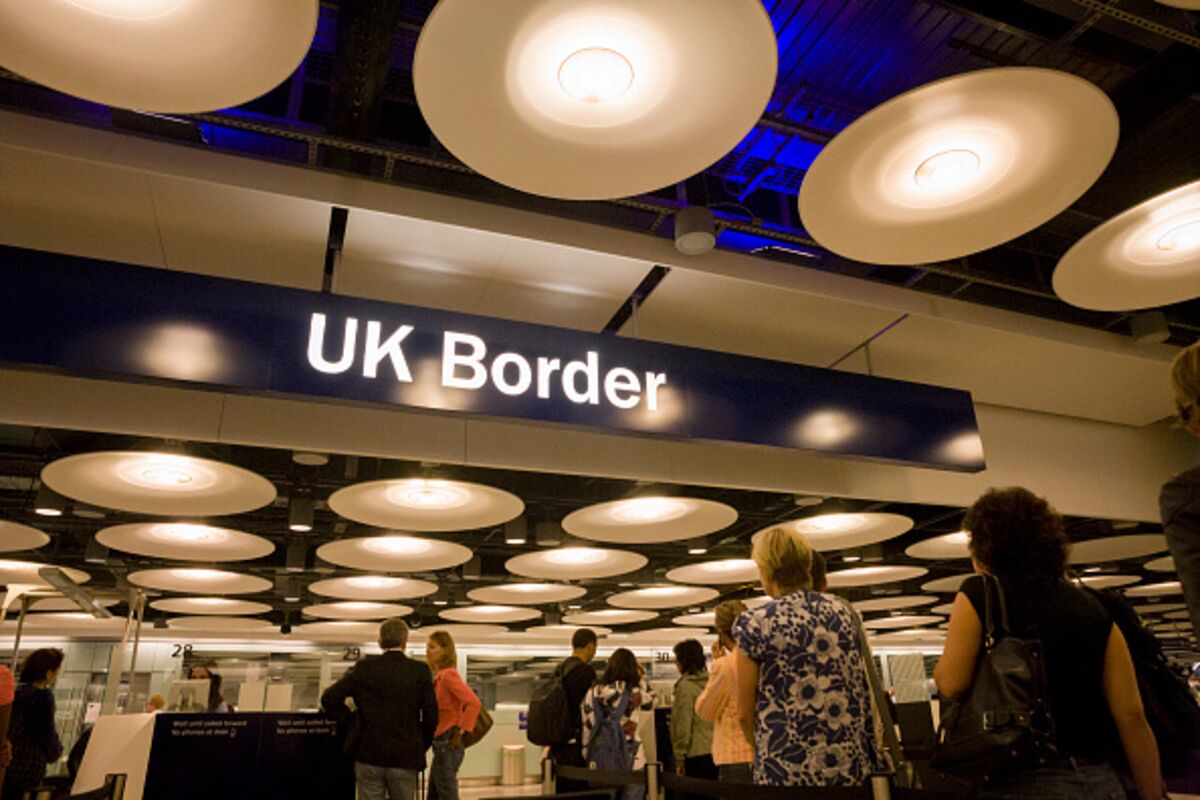
It was widely observed that Brexit was driven by anti-immigrant sentiment. A new Ipsos poll confirms that about half of Brits have a negative view of immigration, while only 35 percent view it positively. 

6


ENGLISH-SPEAKERS CAN APPLY.
PHOTOGRAPHER: RICHARD BAKER

It was widely observed that Brexit was driven by anti-immigrant sentiment. A new Ipsos poll confirms that about half of Brits have a negative view of immigration, while only 35 percent view it positively. Much concern has focused upon European Union citizens currently residing in the U.K (they’ll certainly be grandfathered, as will U.K. citizens living in the EU), but the real question is what kind of long-term immigration policy the U.K. should adopt.
Britain’s best option is a points-based system, along the lines of those in Canada and Australia. Both countries sought, a half-century ago, to replace a system of favoritism by race and national origin with measures of merit -- including education, English fluency (or French in Canada) and work experience -- with the obvious design of admitting the most qualified people.
“Remain” campaigners balked when Brexiters proposed the same during the campaign, but Britain should consider the proposal now. Canada and Australia, it is true, are bigger and less populous nations which seek to attract immigrants, but their experiences can work equally well for more densely populated nations such as Britain which seek to limit immigration without choking off supply of needed skilled labor and unskilled workers.
Points systems in these two countries have worked as intended, attracting large numbers of qualified people. Apart from the U.S. and the U.K., the two have sustained the most consistently high levels of net immigration among developed nations. Currently, they admit about one-quarter of a million annually.
Other nations have experienced spikes in net influxes, including Germany’s 1.1 million in 2015. This was not immigration -- that is, people seeking opportunity -- but rather asylum-seeking by refugees. A better example is Spain’s net immigration of 725,000 in 2007, powered primarily by Spain’s then-booming economy and its law granting citizenship to immigrants from the former Spanish Empire after just two years of legal residency, among other very lenient immigration policies. Since 2013, Spain has experienced net migration.
These huge spikes illustrate something else. While the EU enforces a uniform policy for internal movement, there is no uniform policy for entry from the outside its borders. Without such a common policy, every EU nation’s immigration policy is vulnerable to the discretion, whims and weaknesses of each and every other EU nation.
For its part, the U.K. has experienced markedly increased immigration since net immigration first topped 100,000 in 1998. According to the U.K. Office of National Statistics, the increase has been dramatic over the last four years, to 333,000 from less than 200,000, an obvious driver of the widely recognized anti-immigrant sentiment behind the Brexit vote. It is not surprising that this sentiment targeted the EU, since net immigration of EU citizens has skyrocketed to 184,000 in 2015 from less than 20,000 in 2004.
Not only do the Canadian and Australian successes recommend the point system, but the U.K. already employs elements of a point system introduced in its 2008 reforms for non-EU immigration, which replaced a maze of about 80 different types of visas.
Even a well-constructed points system won't satisfy those who want more draconian limits on immigration. But using explicit criteria for admissions ensures that the immigrants contribute to society and reduces fears that uncontrolled immigration poses social, cultural, economic and security threats. Awarding points for English language proficiency, for example, favors immigrants more predisposed to assimilate and reduces the likelihood of nativist opposition. Awarding points according to age, with twenty-somethings scoring the highest, helped both Canada and Australia improve the worker-retiree ratio so key to funding public retirement and healthcare benefits. Awarding points for educational achievement favors immigrants prepared for the technological economies of the developed nations they seek to join.
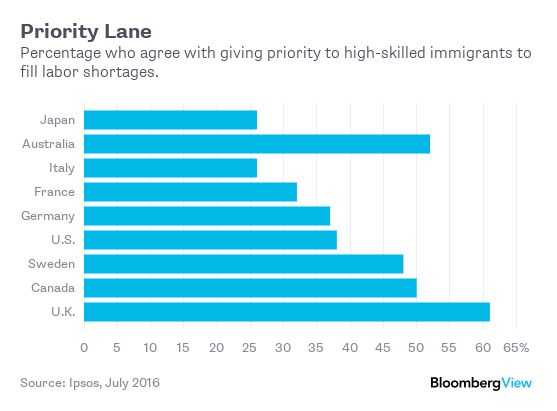
Points systems need not be inflexible. In recent years, Canada and Australia have modified their point systems from pure merit-based measures in order to match immigrant skills to labor-force needs. Both nations admit some people with job offers, waiving most points scoring (the employer effectively scores the person), as well as people without offers according to points scoring. Temporary work visas and seasonal or guest worker programs are used to satisfy demand for lower-skilled labor in their economies. Canada’s immigration operation has been called “a giant manpower agency.”  Polls suggest that Britons would be amenable to a similar system:
Brits are not alone in their negative view of immigration, with only an average of 20 percent in the 22-nation Ipsos poll thinking it has a positive impact on their own country. Citizens in 18 of the 22 nations in the Ipsos poll have even more negative views of immigration. Some people continue to believe that most immigrants find their own way to genuine opportunity and naturally fulfill labor market needs. However, this article of faith is difficult to prove where there is an absence of statistical information, as exists with migrants entering through other EU countries.
Of course, it cannot be disproved either. But a modified points system at least takes the guesswork out, and offers a way to address the urgent concerns expressed in the Brexit vote and by citizens across the globe in recent polls.
This column does not necessarily reflect the opinion of the editorial board or Bloomberg LP and its owners.

Every guilty party MUST be punished, blasts Frederick Forsyth

IN ANY society that even pretends to be a fair one there must be five what I would call “equalities”.

A composite of a banker and a lorryGETTY
Everyone should be sanctioned fairly and equally
Let me quickly list them: equality of civil rights – we all know we have them though sometimes it is hardly clear what they are. 
But they have to be equal between citizen and citizen. Equality before the law – that speaks for itself though there are severe doubts about that. 
Equality of the franchise – basically the vote of a duke carries no more weight than that of a ditch-digger. 
Our whole democracy depends on that. Equality of access – meaning it does not matter what your dad did or where on the social pecking order you come from, if you have the talent, brains and drive you can get to the very top. 
But the one rarely mentioned is equality of sanction, ie, punishment. If a truck driver behaves with insane recklessness such that he wrecks his lorry and its cargo, the law will descend like a ton of bricks. 
Loss of HGV licence of course, meaning loss of career. A charge of dangerous driving, possibly even criminal recklessness resulting in huge losses to someone else. 
Certainly an appearance in court, professional ruin and possibly jail. But if a banker takes insane risks with investment gambles, brings his bank to the verge of bankruptcy when they predictably fail, what happens? 
The bank is pronounced “too big to fail” and billions of taxpayer money are drafted in to save it. The board is fined eye-popping sums but these are paid by the bank (or what is left of it), which means shareholder money. 
The really guilty retire to their French chateaux, West Country manors or Riviera yachts, borne thither by private jet. 
But they never seem to face personal sanction. That is reserved for “the little people”. 
Those of us with a few miles on the clock recall the Robert Maxwell affair when a greedy tycoon raided the pension funds of the Trinity Mirror retired and working staff to prop up his ailing Pergamon Press. 
Not forgetting the Lonrho affair with Tiny Rowland. And now we have the BHS collapse and its former owner Sir Philip Green.
My point is that none of these men acted alone. There were cohorts of butter-smooth City slickers in the background helping them. 
A businessman on his phoneGETTY
If a HGV driver crashes their lorry they will be out of a job and could face prison
If these brokers and accountants were so dim they did not know what they were doing, the dodgy one would never have employed them. 
So they knew that when Maxwell was looting pension funds they were depriving honest, loyal staff who needed every penny to retire on. 
If sanctions are administered, and they must be, they should include all the aider and abettors, and they should be personal, not drawn from company reserves. 
In 1757 French writer JeanJacques Rousseau was being rowed across Portsmouth harbour when he witnessed Admiral John Byng being shot on his own quarterdeck. 
Why? he asked the boatman. He gave up Menorca to your lot, was the answer. All right, he replied, but why execute him? “To encourage the others,” was the reply. And no British admiral has ever turned tail since then. 
If the word goes round the City that Charlie Farnsbarns was involved in a swindle and has now lost his mansion, his Bentley and the place in the Dordogne, it really does encourage rigorous integrity among the others.
______________________________
Brits stuck in traffic at DoverGETTY
Brits have been held for 15 hours due to increased security

Travel misery was caused deliberately
WHEN utter misery is inflicted by governmental forces on hundreds of thousands of people the question has to be asked: incompetence or deliberation? 
Since the weekend before last such misery has been inflicted on the poor souls trying to cross the Channel via Dover to spend their holidays in France and thus do enormous benefit to the French economy. 
Add to them the thousands of poor truck drivers. They have all been held for up to 15 hours by increased “security” measures on the Calais side. 
An arial view of Dover trafficGETTY
The weekend before last a quarter of a million people were held up
There was nothing accidental about this. The French knew perfectly well that this is the height of the holiday season and the traffic volume would be enormous.
They could have drafted in extra passport checkers. Instead they have just seven booths, only three manned at most and sometimes just one. 
The weekend before last there were 250,000 held with their children in exhausting lines of hopelessness. 
They could not even hang a U-turn and drive home. It is not we who are exporting the illegal immigrants and terrorists to the continent, it is the other way round. 
And for the record, not one intercept of a suspicious person has been made. It has all been futile. And no, it was not accidental, it was deliberate
http://www.express.co.uk/comment/expresscomment/696915/Every-guilty-party-MUST-punished-blasts-Frederick-Forsyth

Friday, 5 August 2016

Mark Carney has lost his nerve but the UK economy is now in far better shape

THE decision to cut rates and unleash massive stimulus smacked of panic and will do little to help the UK thrive.

Mark CarneyGETTY
Mark Carney lost his nerve
Bank governor Mark Carney should be working to boost our resolve and help build an exciting future outside the EU, but he has lost his nerve.
Mr Carney - a key figure in Remain's Project Fear - is also taking revenge on Britons who ignored his scare-mongering and bravely voted to take back control of their country.
The monetary policy committee cut rates to 0.25 per cent and members indicated they are ready to cut again - dragging base rates to near zero.
Savers thought they suffered enough after seven-and-a-half years of record low rates.
But annuity rates have also plunged and savers' plight will worsen if forecasts are correct and inflation goes to 2.4 per cent over the next two years.
The pound fell again yesterday, making foreign holidays more expensive and pushing up the cost of imported goods, although at least it should help exporters.
Bank of EnglandGETTY
Outside the Bank of England
But cutting rates will have little impact as most Britons are now reluctant to take on more debt or chase house prices.
Naturally, Mr Carney will shift blame for his failings on Brexit, brushing over the fact bankers around the world have already made 55 rate cuts in 2016.
The global economy is slowing and would have continued to do so, and that is nothing to do with the EU referendum.
Mr Carney will shift blame for his failings on Brexit
In fact, signs are that after its initial Brexit wobble, the UK is quickly starting to fight back.
Stock markets have been rising, house prices hold steady, and although business and construction activity has dipped, this may largely be a reaction to initial uncertainty.
The Bank may be in a flap but the rest of us should keep calm.
Bank of EnglandGETTY
The economy is actually in good shape
Bank of EnglandGETTY
The Bank of England cut interest rates
The UK economy is in far better shape than yesterday's rash actions suggest, with the IMF recently predicting it will grow faster than France and Germany.
It may do better still when the benefits of Brexit finally start flowing, provided it can cope with panic at the top.
http://www.express.co.uk/comment/expresscomment/696967/Mark-Carney-lost-nerve-UK-economy-better-shape-finance-banking-markets-comment