Saturday, 21 April 2018

Italy, France, and the madness of the Euro

It is just possible that France will elect two candidates in the first round presidential elections who want to pull out of the euro. Italy, which is flat on its back due to a euro massively overvalued compared to its fundamentals, can only srcratch its head. Meanwhile, the lunacy will have to end some time

Euros
A pile of very damaging euros
Timwork
Tim Hedges
On 21 April 2017 08:49
The first round of the French elections is nearly upon us, and the Italians are looking over their north-west border with horror, tinged perhaps with wistful admiration.
It seems there is just a chance of the two loony candidates, Le Pen and Mélenchon, facing each other off in the second round. Predictions in the Italian press are to the effect that this would lead to the end of the euro, the end of the European Union, the end of the world. Italy is horrified.
Of course, Italy has had its brush with eccentricity, as a recent widely publicised clip shows: Silvio Berlusconi is seen implausibly campaigning against the slaughter of lambs at Easter. Some unkind wags have suggested he was in fact cuddling the attractive (and vegetarian) Michela Vittoria Brambilla, his former Animal Welfare Minister, and the lambs were photoshopped in.
But Italy does not embrace eccentric policies. Silvio may be odd, but he didn’t act oddly, he in fact did very little. Perhaps the difference with France is the way the Second World War is interpreted. Italy, despite finishing on the winning side, seriously -- blindly, even -- wants to redress the mistake of Mussolini.
I know a couple of Mussolini restaurants where old men tearily toast a past they think might have been better. But nobody takes them seriously. The constitution is centred around a fear of power, unlike the Fifth Republic’s constitution which makes the French President more powerful than an African dictator.
No Italian could say, as Le Pen did of the roundup of Jews at the Vel d’Hiv ‘It wasn’t us’.
And then there is the euro, opposed by both Le Pen and Mélenchon. It is of course opposed by Italian political parties, indeed by a majority, but few here suppose that Italy might seriously leave the euro.
This despite most economists saying that Italy cannot survive for long with an exchange rate probably at least 30 percent overvalued. The hope here is that the Germans will allow European Bonds (ie Italy borrows with a German guarantee), a banking union (where German banks cover for Italian ones) and a European Deposit Guarantee (where German depositors bail out Italian ones).
And yet there is this blinding truth that Italy cannot survive with an overvalued currency. What happens if the Germans make it clear, and they already have, that they will not participate in this grand bailout? Could Italy leave the euro, as so many of its politicians say they would like to, but don’t really mean?
The answer lies in the events nearly 25 years ago. In Britain, the AFL (forerunner to UKIP) had campaigned that the Exchange Rate Mechanism was damaging to Britain and could not survive, but John Major won a handsome victory in April. By the summer, the pound was under threat, the government only able to bleat euro-loving platitudes.
By September the pound and the Italian lira were forced out of the ERM and both devalued by 20 percent. And here is the story. The UK, with its flexible labour markets following Mrs Thatcher’s reforms, began to see its exports surge and saw a lengthy boom, cashed in on by Tony Blair and Gordon Brown five years later.
Italy stayed stagnant, still having a clientelist economy, a succession of governments hindering foreign investment, and a sclerotic labour market.
The Italian political economists of today have seen this and know it well. If Italy left the euro, to survive it would have to remove the blocks to success. Gone would be the regulations which stop supermarkets selling non-prescription drugs, meaning paracetamol is twenty times the British price.
The taxi drivers, the lawyers (more lawyers in Rome than the whole of France, and the French have too many), the petrol stations (the most expensive in Europe) would all have to be exposed to the market. The State, with its insatiable appetite for regulation and jobs for the boys, would have to be cut back.
The golden pensions for the people whose faces fit (I know a man who is still working but claiming a state pension of €840,000 a year) would have to go. The Chairman of Perugia’s bus company earns twice what Theresa May does.
All this would have to stop, and, frankly, stopping it is too much trouble. The people who matter would never agree. So it won’t happen. Italy would far rather France elected a lunatic and took the blame for the euro.
The changes will have to happen some time, though.
http://www.thecommentator.com/article/6555/italy_france_and_the_madness_of_the_euro

Wednesday, 18 April 2018

China’s gift to Europe is a new version of crony capitalism

My country, the Czech Republic, has bent over backwards for President Xi, with little benefit to citizens or the wider economy

Wed 18 Apr 2018 


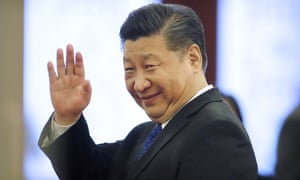
President Xi Jinping.
 President Xi Jinping. ‘Central Europe is very much part of China’s ambition to ‘move to the centre of the world stage’.’ Photograph: Mark Schiefelbein/AP

The scrapping of limits on Xi Jinping’s presidential term last month drew attention to the profound changes the Chinese leader has imposed on his country’s political system. But the significance of this move is global – and it concerns Europe in many ways. China has identified a “window of historic opportunity” for itself across the world. To make the best of this, so its logic goes, the country must be united and disciplined under a strong leader and supreme commander. Xi has been compared with Mao Zedong in that he’s created an entirely leader-centric political system – but to think this has consequences only for China risks missing the wider picture.
In my country, the Czech Republic, we’ve seen up close how China intends to expand its reach. Central Europe is very much part of China’s ambition to “move to the centre of the world stage” – the expression used by Xi during last year’s Communist party congress. The basic tool China relies on is the Belt and Road initiative, a trade and infrastructure project spanning Asia and Europe which encapsulates the regime’s overarching foreign policy goals, in what Xi has dubbed the “new era”.
The Belt and Road initiative is often misunderstood in Europe, not least because it keeps changing its name from one confusing moniker to another. Originally called the New Silk Road in 2013, it soon changed its name to One Belt, One Road, only to be rebranded as Belt and Road, apparently because the word “one” sounded unduly hegemonistic. While layers of propaganda often make it impenetrable to outside observers, its impact is very real – and growing. The project has been showcased with pompous rhetoric and music videos, and more than 60 countries have agreed to join.
But how has it affected us Czechs? I run a project that monitors China’s attempts to build its “smart” power through a nexus of business, political and media networks. In Europe, there’s arguably no fonder ally of Beijing than the Czech president, Miloš Zeman, a populist who was re-elected earlier this year. He is on record calling Xi his “young friend”, and Belt and Road “the most remarkable initiative in modern human history”.
A tipping point came in 2014 when the Czech government proclaimed that the country would aspire to become “China’s gateway to Europe”. This amounted to a major foreign policy change. It broke entirely with the pro-democracy principles and support for Chinese dissidents of Václav Havel, the hero of the 1989 Velvet Revolution who went on to become president. Havel saw clear parallels between the past struggles of dissidents behind the iron curtain in Europe, and those of contemporary Chinese dissidents – in particular the Nobel peace prize winner Liu Xiaobo, whose Charter 08 declaration was directly inspired by Charter 77, the Czechoslovak anti-communist movement.
Czech President Vaclav Havel with Dagmar Veskrnova following their private wedding ceremony in Prague, 1997.
Pinterest
 Czech President Vaclav Havel with Dagmar Veskrnova following their private wedding ceremony in Prague, 1997. Photograph: Stanislav Peska/Associated Press
With Zeman, the contrast couldn’t be starker. Here was the Czech Republic displaying total complacency about a regime that not only imprisoned Liu but denied him external medical help as his health dramatically deteriorated (he died last year). However, things went much further than just political signalling. By 2015, Zeman had named as his honorary adviser Ye Jianming, the chairman of a mysterious Chinese mega-company: CEFC, which had arrived in the Czech Republic promising billions of dollars of investments.
CEFC embarked on what resembled a shock-and-awe buying spree, announcing it would scoop up stakes in travel services, an airline company, a brewery, a football club and a media group. It also lost no time hiring scores of former Czech elected officials, who often double as advisers at various ministries, or indeed within the presidential castle.
As time passed, however, actual investments remained negligible. The few deals that did materialise were mostly real estate acquisitions. Then last month, Ye suddenly ran into trouble in Beijing. News broke that he’d been arrested and come under investigation for financial irregularities. Prior to that, last November, the head of CEFC’s non-profit arm, the former Hong Kong politician Patrick Ho, was arrested in New York and accused of bribing presidents and government ministers in Africa.
Ye’s disappearance obviously raised eyebrows in Prague. Zeman reacted by sending three close colleagues on a strange semi-private fact-finding mission to China. They came back with the information that the heavily indebted CEFC would effectively be taken over by the Chinese state, together with its Czech acquisitions. So much for the hopes that the company would save the Czech economy as a private investor.
These awkward developments for Zeman have since prompted a debate about the wisdom of tying the country’s future to mysterious Chinese entities and to the Communist regime in Beijing.
It might have helped to look more carefully before accepting Beijing’s embrace. Some of the metaphors Chinese media have attached to the Belt and Road project are revealing. They often call it “globalisation 2.0”, or the “New World Order”. What that vocabulary struggles to mask is that the whole endeavour is driven far more by politics than by markets.
Deals are negotiated at state-to-state diplomatic summits. Open tenders are shunned. Contracts are awarded by political fiat. Ostensibly commercial companies put former politicians on their payrolls by the dozen. As it turns out, CEFC’s main investments in the Czech Republic weren’t economic, they were about buying up the loyalty of Czech officials. What China has to show for itself in my country is hardly innovation. Rather, it has brought us a new take on age-old crony capitalism.
• Martin Hala is a Czech academic in Prague and director of the China studies project Sinopsis.cz
https://www.theguardian.com/commentisfree/2018/apr/18/chinese-europe-czech-republic-crony-capitalism

Tuesday, 17 April 2018

THOU SHALT NOT QUESTION THE GOOD FRIDAY AGREEMENT

Shadow international trade secretary Barry Gardiner came under fire last week for ‘trashing the Good Friday deal’, after letting slip that a customs border between the Republic of Ireland and Northern Ireland would not prompt an automatic return to paramilitary violence. Secretly recorded at a supposedly off-the-record discussion, organised by the Rosa Luxemburg Stiftung, a left-wing think-tank, Gardiner said there was no reason to fear a post-Brexit ‘hard’ border.
17 APRIL 2018
Thou shalt not question the Good Friday Agreement
Why Barry Gardiner was right to call it a ‘shibboleth’.
The Labour frontbencher drew a distinction between the old militarised border, with its ‘watchtowers, security paraphernalia and soldiers… with guns’, and the kind of checks and controls that operate on ‘normal borders’ between independent states. Acknowledging that his views were ‘deeply unfashionable’, Gardiner also suggested that the Dublin government had good economic and political reasons for ‘playing up’ concerns about Brexit and the border. He suggested it was using the ‘shibboleth’ of the Good Friday Agreement in pursuit of its national interest.
Gardiner’s challenge to the new orthodoxies surrounding the Good Friday Agreement came to light just as British, Irish and American dignitaries were gathering in Belfast to celebrate the 20th anniversary of that now sacred text. Cue waves of outrage, much angry tweeting and calls for resignation. Tony Blair, former PM and chief architect of the Good Friday deal, was lost for words. ‘I can’t believe that anyone could say that’, he said. Former shadow Northern Ireland secretary Owen Smith branded Gardiner ‘reckless’ and an ‘ideological Brexiter’. Cue Gardiner’s deeply felt apology, in which he said he didn’t intend to suggest the agreement was ‘in any way outdated or unimportant’. Call off the dogs! Barry was back on message, re-affirming his commitment to ‘no hard border between north and south’.
So what was the offence that drew such a clamour for public recantation? As a frontbencher, Gardiner stood accused of being out of line with Labour’s Brexit policy. But how could anyone know what its policy is, exactly? Labour’s manoeuvrings on Brexit are a masterclass in constructive ambiguity. More to the point, what is wrong with a politician expressing honest – if unfashionable – opinions in the context of a private discussion among his or her political comrades?
And what of the substance of his remarks? The claim that Ireland is pursuing its own economic and political interests in relation to Brexit and the border is hardly novel. The Dublin government has made no secret of its determination to exert maximum leverage at the negotiating table as a member of the EU 27. As I reported on spiked last year, the decision to designate the Good Friday Agreement as a ‘red line’ in the EU/UK divorce talks was hailed as a decisive victory for Irish diplomacy. One senior commentator rejoiced that Dublin had seized ‘absolute power under EU law to derail the whole Brexit process’.
Trashing the Good Friday Agreement used to be rather fashionable among politicians, commentators and academics on the left. But fears of Brexit suspended their critical judgement. Many thousands of papers have been published about the obfuscations and evasions in the agreement’s text. Northern Irish politicians used to rail against its legacy of unaccountable power-sharing structures, political cronyism and the way it has fuelled mistrust and entrenched communal division. While critical voices remain, it is a brave few who are still willing to state in public what many privately think – that the agreement has failed to deliver peace and stability. The power-sharing government has been inactive for over a year, following a scandal over a renewable energy scheme. Even if it were possible to restore the government tomorrow, it would simply mean, as one writer put it, returning Northern Ireland to ‘that same dysfunctional government which brought political, social and economic failure’.
The British and Irish 2003 Joint Declaration spelled out the aim ‘that Northern Ireland should be policed as a normal, peaceful society, building on the commitment in the [Good Friday Agreement] to as early a return as possible to normal security arrangements consistent with the level of threat’. And with that in mind, Gardiner’s distinction between militarised and ‘normal’ border arrangements raises key political questions. What is the level of threat and where is it coming from? What would constitute ‘normal border relations’ between the UK and Ireland? And what does a normal, peaceful society look like? Does it look like contemporary Northern Ireland? These are difficult questions, and answering them requires taking some political responsibility. But it is much easier to nod approvingly when Blair reassures us that the agreement is still ‘moving forward’ and clap politely when Bill Clinton sings its praises as a ‘work of surpassing genius’.
To borrow Seamus Heaney’s famous words, when asked about ‘the Irish thing’, ‘to be saved you only must save face, and whatever you say, you say nothing’. Say nothing. Not even as the winds of change blow open a window to rethinking all future political relationships across the island of Ireland. Not even among your political allies in a private discussion, in this instance hosted by a supposedly radical think-tank, named after a fearlessly outspoken German revolutionary who was dedicated to ‘critical thought and political alternatives’. When it comes to the ‘Irish thing’, just as when it comes to the ‘Brexit thing’ – whatever you say, say nothing.
Pauline Hadaway is a writer and co-founder of the Liverpool Salon. She is currently undertaking a professional doctorate at the University of Manchester’s Institute of Cultural Practices.
Picture by: Getty.
http://www.spiked-online.com/newsite/article/thou-shalt-not-question-the-good-friday-agreement/


Sunday, 15 April 2018

Petulant BBC continues to struggle with Brexit

The BBC continues to show that it can't get its head around the idea Brexit is going to go smoothly. In the latest contrived piece of reporting they asked all the wrong questions in a segment on Germany. These people -- the BBC not the Germans -- will never learn

Merkel
Merkel needs a smooth Brexit
6f37592038ebe4c2dc83c06bb82884256d790fa4
John Redwood MP
On 15 April 2018 11:40
On Wednesday morning the Today programme had the good idea of going to Germany to find out what they are thinking about the EU and Brexit. A few patsy interviews later we were little the wiser.
There was no cross examination of how Germany is changing, with the Eurosceptic AFD now the official Opposition and the CSU moving sharply in an anti migrant direction.
There was no proper examination of what the German government will now do post Brexit in response to Macron’s wish to push ahead with political Union and a common budget. There was no discussion at all about the 900 billion Euros Germany is lending the weaker members of the zone at zero interest through the ECB.
I would like to have heard what Germany thinks about the pace and style of more integration, how they wish to change the budget after our departure and above all how they will tackle the need for more transfers around the Euro area to help the struggling members with high unemployment.
Instead, the BBC was keen to get a few German interviewees to tell the UK what we should expect from Brexit, and keen to play up the latest approach of some senior Germans that it is such a pity the UK is leaving so they should now respond more positively to Mr Cameron’s requests for renegotiation.
I find it bizarre that some intelligent Germans seem to think that maybe a concession or two on freedom of movement, and some opt out or emergency brake on benefit rules will mean the UK then changes its mind and stays in.
They had their chance to keep us in by being positive about the Cameron renegotiation. Many of us thought Mr Cameron asked for too little, and clearly got a lot less even than he dared ask for.
Offering more of the too little he wanted is not going to change anything. The BBC seemed pleased that maybe there will be an offer of tariff free trade after all, as if that was some surprise.
Of course Germany wants tariff free trade in goods, given her huge surplus. Whether the EU as a whole can make a sensible offer on trade remains to be seen. Germany should work on the Commission. The BBC was also keen to highlight those Germans who say that the Transition period cannot be taken for granted as they sought to help Germany squeeze more concessions from the UK to secure a Transition many of us do not want.
It was predictable to hear the Germans say that in the case of us leaving the customs union and single market, as we have said we will do, there was scope to keep us in after all despite early EU rhetoric that of course you cannot be in them if you are out of the EU.
Again that boat has sailed. Leave voters voted in the knowledge we would be leaving the single market and customs union, and the EU confirmed the logic of that in all their comments.
It was also amusing to learn that maybe passports should be available for financial services, as of course German companies would like them into London, when the UK had ruled them out! It just goes to show that if the UK says No firmly on items Germany is quite keen to make an offer we might still refuse.
Mr. Redwood's writing is re-posted here by his kind permission. This and other articles are available at johnredwoodsdiary.com
http://www.thecommentator.com/article/6782/petulant_bbc_continues_to_struggle_with_brexit

Thursday, 12 April 2018

Slippery Brussels seeking EU army by the back door

Seizing control of armed forces from the nation state is essential to the creation of a federal super-state. The delusional neo-imperialists in Brussels will lose badly on this when Britain quits the EU, but we should actively scupper its chances anyway because slippery Brussels is trying to get us in by the back door

Eurofighter
Would a Eurofighter win a dogfight?
Img-20171201-wa0000
Peter Lyon
On 12 April 2018 12:20
A European army is a central aspect of the Europhile vision of a United States of Europe. We know a federal European state is the goal of politicians at the forefront of European integration – and has been since the 1950s.
Seizing control of armed forces from the nation state is essential to the creation of a federal super-state.
In certain EU Member States with a proud history of national democracy and armed forces, there has long been strong opposition to surrendering control to Brussels. For many years, the UK was the main opponent of EU defence integration, wanting to ensure any cooperation between countries is on an ad hoc, bilateral basis; consistent with the primacy of NATO.
The UK was supported in this by other countries such as Denmark, who value their national independence.
In the EU Referendum campaign in 2016, Leave supporters warned of a European army, as one of the ‘risks of Remain’. Remain campaigners such as the former Deputy Prime Minister, Nick Clegg, dismissed these concerns as a “fantasy”. How wrong he was.
The dangers of membership of a European army was one of many concerns which motivated the Great British Public to vote to Leave the EU.
It is therefore scandalous that despite having voted to Leave, Britain is being dragged into an EU army through the back door. EU integration across many areas of defence policy is escalating. Britain is becoming entrapped in this system, under the control of unelected bureaucrats in Brussels – and this will continue, even after Brexit.
The European Commission President, Jean-Claude Juncker, wants a “fully-fledged European Defence Union” to be in place by 2025. The EU has already created programmes to form its basis.
These include: a defence fund; Single Market rules for procurement of equipment and resources; and EU battlegroups to undertake small-scale missions. New schemes are continually being initiated to allow the creation of a European-wide force. The latest is a project to allow military units to move more quickly and smoothly across the Continent.
The EU will undoubtedly struggle to pay for this vast project. Brexit is already causing a black hole in the overall EU budget, from which the Defence Union will be partly funded. The plans may meet a stumbling block when it becomes clear to Member States they will be required to spend considerably more each year.
Students of history will know the true guarantor of European security for the last 70 years is NATO. However, nearly all EU Member States who are members of NATO do not meet the defence spending recommendation of of 2% of GDP. Germany only spends 1.2%, while France spends 1.8%.
The UK meets the 2% target. America spends 3.6% of GDP, meaning it contributes around 70% of defence spending across NATO members. US officials are justifiably concerned about the lack of commitment from EU Member States to NATO, as well as the possible duplication and undermining of NATO by the European Defence Union.
Surrendering our control and money over defence to a supranational state is a very scary prospect. It could result in our national armed forces being deployed, without us having a say. For the security of our country and our national independence, it is vital our Parliament and Government retains full control of our armed forces.
Even as we negotiate our exit from the EU, our ministers and officials are disgracefully signing us up to this overarching European Defence Union. Our politicians have committed us to sending huge sums of money and abiding by strict EU procurement rules which are the foundation of the European Defence Union.
Participation in these programmes means giving up the autonomy of our national Government and armed forces. This completely contradicts the rallying cry of the Leave campaign to “take back control”.
In response to a petition with over 14,000 signatures, calling for Britain to Leave all EU defence structures in March 2019, the Government has only just re-iterated its intention to form a “deep and special partnership” with the EU, covering defence. The response confirmed the Government is willing to “participate in EU missions and operations”. UK officials do not seem to, or want to recognise the detrimental effect any such participation would have on our defence autonomy.
It is right for the Government to confirm our unending commitment to the security of Europe. However, this commitment must be undertaken through either ad hoc, bilateral missions, or our participation in NATO. As President Trump apparently gears up for military intervention in Syria, he will want to know he has the support of his European allies in NATO.
EU Member States must be careful about side-lining NATO, given their huge dependence on US support. The Government’s current approach of participation in EU defence programmes is utterly misguided and represents a betrayal of the result of the EU Referendum.
We must urgently Get Britain Out of the European Defence Union.
Peter Lyon is a Research Executive at cross-party grassroots campaign Get Britain Out

http://www.thecommentator.com/article/6781/slippery_brussels_seeking_eu_army_by_the_back_door