Thursday, 15 November 2018

SKY - Brexit draft deal: The key points explained

Sky News breaks down the most important developments to emerge from the prime minister's 585-page proposed agreement.

Thursday 15 November 2018  20:50 UK
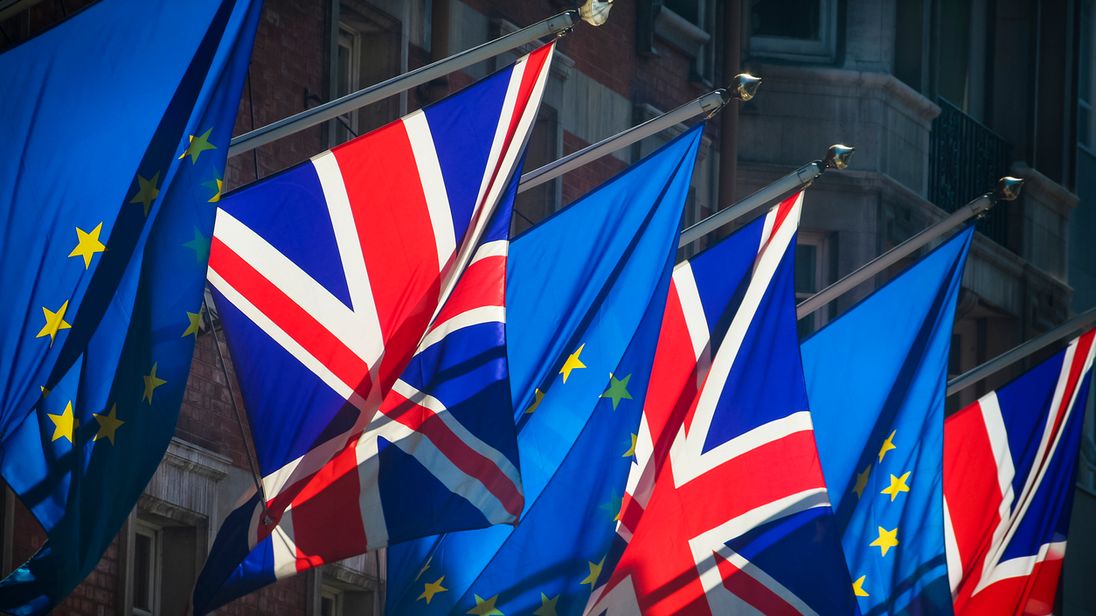
Stock photo ID:813708562
Upload date:July 11, 2017
The draft agreement outlines the future relationship between the UK and EU


Theresa May's draft Brexit agreement has been agreed by her cabinet after more than 18 months of negotiations with the EU.
It took five hours of discussions inside Downing Street before the prime minister was able to hail the "decisive step".
The Conservative Party has had a string of high profile resignations over Brexit, and it is understood around 10 ministers were opposed to Mrs May's draft deal.
Sky News breaks down the key points from the 585-page document:
:: UK will be a "single customs territory" from March 2019 until December 2020
:: UK to remain in EU customs union indefinitely if new agreement not reached by then
:: Northern Ireland to be in same customs territory as UK and EU if no future agreement made
:: EU nationals living in UK for five years in a row to have right to stay permanently in UK with families
:: UK will not be obliged to give student grants or loans to non-permanent residents
:: End of free movement - but visa-free travel to EU countries will continue
:: UK to become "independent coastal state" but will work with EU on fishing rights.


Theresa May emerged from 10 Downing Street after her cabinet discussed the deal for five hours
Image:Theresa May emerged from 10 Downing Street after her cabinet discussed the deal for five hours
Customs union
The draft agreement states the UK and the EU want to "establish ambitious" arrangements in this area in their "close future relationship".
It adds there will be a "single customs territory" until the end of the transition period on 31 December 2020.
The UK will remain in a customs union with the EU indefinitely if a new trade agreement is not reached in that time.
Maintaining such an agreement has served as a measure to avoid a hard border on the island of Ireland.
Irish Prime Minister Leo Varadkar said the issue has been "one of the most difficult challenges" of the negotiations.
He said a backstop will remain in place "unless and until" a better solution is agreed.
Michel Barnier, the EU's chief negotiator, has said a trade deal between the UK and EU is possible by the end of 2020.
Northern Ireland
The document details plans for what a backstop for the Irish border would look like - though it notes that neither side wants this outcome.
It would involve Northern Ireland being in the same customs territory as the rest of the UK, and the EU.
This would involve level playing field commitments to ensure trade in goods between the UK and the EU is based on fair principles.
But it would also mean different regulations for Northern Ireland - more EU law in agriculture, the environment, state aid and other areas.
There would also be checks on goods traded from Northern Ireland to the rest of the UK.
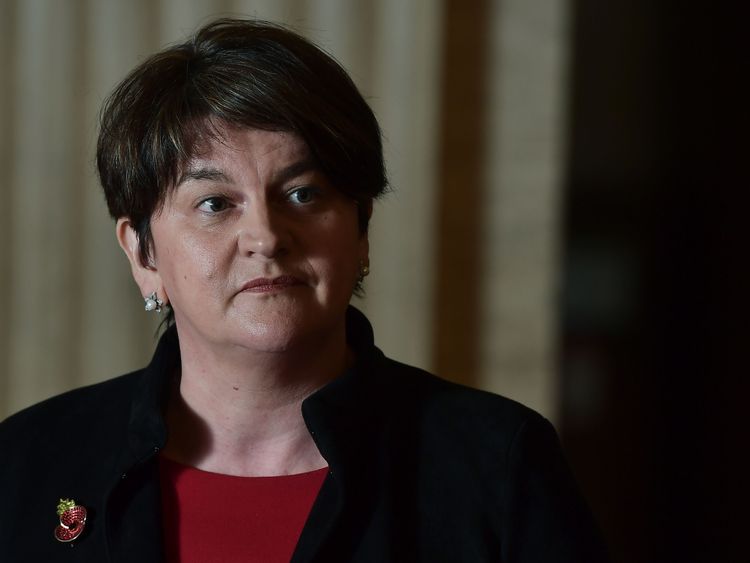

The DUP's Arlene Foster is unhappy with draft deal
Image:The DUP's Arlene Foster is unhappy with draft deal
Enforcing those laws will mean an EU presence: EU representatives will be present to enforce and implement the law relating to Northern Ireland, and the UK will have to facilitate their work and carry out necessary control measures.
The document states that the EU and the UK will use their "best endeavours" to come to a future trade agreement to avoid the backstop, and notes the transition period can also be extended.
Otherwise, it could be tricky to get out of the backstop.
One party would need to apply to the other to end it, and an exit would have to be decided by the joint commission by the top decision makers from the EU and UK.

Brexit: The jargon explained

Brexit: The jargon explained

White paper, common rulebook, facilitated customs arrangement... what do all the terms likely to be used in Brexit proposals actually mean?
Immigration
The document lays out rights for EU nationals living in the UK and vice versa.
EU nationals who have lived in the UK continually for five years, and Brits who have lived in EU countries, will have the right to stay permanently in the UK, along with their family members.
They will "enjoy equal treatment with the nationals of that state" and so will their family members.

Mood 'much worse' than after Chequers

Mood 'much worse' than after Chequers

All eyes now are on whether Brexiteers in the cabinet may resign
However, there are limitations on this: the host state will not be obliged to "confer entitlement to social assistance" in certain areas, and it will not be obliged to give student grants or loans to people who do not yet have permanent residence.
The deal also means the end of free movement, though there will be visa-free travel to EU countries.
Fishing
The UK has said it will work "bilaterally" with the EU but will become "an independent coastal state".
The draft deal says the UK will be "consulted" on "fishing opportunities" and invited to comment regularly on the EU's fishing policies.
A committee will be set up between the UK and Spain for "regular discussion between the competent authorities" in relation to Gibraltar.
Scotland Secretary David Mundell has given his backing to the draft Brexit deal, claiming it will deliver for the fishing industry.


Scottish Secretary, David Mundell, arrives in Downing Street
Image:Scottish Secretary David Mundell has said the deal protects Scotland's fishing interests
All 13 Scottish Conservative MPs said they would not support an agreement which would prevent the UK from independently negotiating access and quota shares.
Mr Mundell said: "I was content to move to the next stage of the process on the basis that Brexit will deliver for our fishing industry - as I and colleagues set out in our letter - and on the basis that arrangements for Northern Ireland will not undermine the economic or constitutional integrity of the UK.
"I hope there will be agreement at the European Council later this month and we can move to a vote in parliament.
"The worst possible outcome for Scotland and the whole of the UK would be a no-deal departure from the EU."

Brexit Forensics

Brexit Forensics

Sky News examines the issues dominating Britain's exit from the EU.
What have the UK and EU leaders said?
Theresa May, UK prime minister
Mrs May said the agreement was the result of "thousands of hours of hard negotiation".
"When you strip away the detail, the choice before us is clear," she said.
"This deal which delivers on the vote of the referendum, which brings back control of our money, laws and borders; ends free movement; protects jobs, security and our union; or leave with no deal; or no Brexit at all.
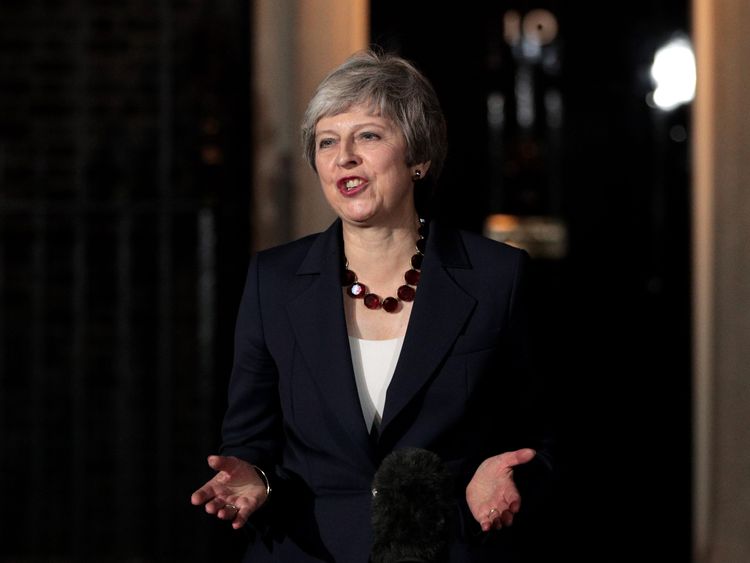

Theresa May delivers a statement after the cabinet approved the wording of the draft Brexit agreement
Image:Theresa May delivers her statement after the cabinet agreed the draft Brexit agreement
"I know that there will be difficult days ahead. This is a decision which will come under intense scrutiny and that is entirely as it should be and entirely understandable.
"But the choice was this deal, which enables us to take back control and to build a brighter future for our country, or going back to square one with more division, more uncertainty and a failure to deliver on the referendum."
Arlene Foster, Democratic Unionist Party leader
There was much in the agreement that the DUP may have felt unhappy about.
Arlene Foster tweeted a curt response a few hours after the big reveal: "We had a frank meeting tonight with the Prime Minister lasting almost an hour. She is fully aware of our position and concerns."
Michel Barnier, EU chief negotiator
Mr Barnier hailed the agreement as a crucial step in concluding the negotiations.
He stressed that the draft had found a solution to avoid a hard border on the island of Ireland.
"Much work needs to be done, the road is still long and it may be difficult to get an orderly Brexit," he said.


Michel Barnier gives provides some detail on the proposal for Northern Ireland under the draft Brexit agreement
Image:Michel Barnier said the UK and EU will have a 'close future relationship'
Leo Varadkar, Republic of Ireland prime minister
The Irish leader said Ireland will continue with its priorities: protecting the peace process, protecting trade, jobs and the economy, and keeping Ireland in the EU.
He said today had brought a satisfactory result to those aims.
"Our analysis has always shown that Brexit will be bad for Ireland, therefore our approach has always been to seek to minimise the harmful impacts of Brexit on Ireland and to maximise any opportunities, no matter how few."
https://news.sky.com/story/brexit-draft-deal-the-key-points-explained-11554494

Wednesday, 31 October 2018

JAPAN TIMES Brexit Headlines: 1 Oct - 31 Oct 2018

The Japan Times

BREXIT


Japan and EU eye early start to free trade deal


BUSINESSOCT 19, 2018


Prime Minister Shinzo Abe and European Commission President Jean-Claude Juncker on Thursday vowed utmost efforts to conclude their domestic procedures so a bilateral free trade agreement can be put into force at an early date, with the end of the year given as a ...

Britain expects 5,000 financial services jobs to leave by Brexit Day


BUSINESSOCT 11, 2018


As thousands of jobs look set to move to the continent due to Brexit, the U.K.'s financial services minister said Wednesday he would do all he could to ensure the City of London remains a major financial center. John Glen told lawmakers that he agreed ...


Britain will stop favoring EU workers after Brexit, May says


BUSINESSOCT 2, 2018


Britain will end preferential access for European Union workers after Brexit, Prime Minister Theresa May announced Tuesday, saying she wants to attract highly skilled immigrants wherever they are from. In an announcement at her Conservative Party conference, May said she will publish plans for a ...

Tuesday, 30 October 2018

Snap election not in UK's interest during Brexit talks - May

Prime Minister Theresa May said on Tuesday it would not be in Britain's national interest to hold another general election just as she is negotiating the terms of Britain's exit from the European Union.


Britain's Prime Minister Theresa May makes a statement on Brexit negotiations with the European Union at Number 10 Downing Street, London September 21, 2018 . Jack Taylor/Pool via Reuters

NEW YORK (Reuters) - Prime Minister Theresa May said on Tuesday it would not be in Britain’s national interest to hold another general election just as she is negotiating the terms of Britain’s exit from the European Union.

May is subject to intense criticism at home and in Brussels over her approach to leaving the EU, fuelling speculation that she could be ousted by her own party, or that her minority Conservative government could collapse.

What I’m doing is working to deliver a good (Brexit) deal with Europe in the national interest. It would not be in the national interest to have an election,” May told reporters on board her official plane en route to New York, where she will attend the United Nations General Assembly.

May’s Conservatives and the main opposition Labour party are running largely neck and neck in opinion polls.

She said Britain would reach a deal despite a current impasse in talks with Brussels and ruled out a second Brexit referendum. Britons voted by a 52-48 percent margin in a 2016 referendum to leave the EU.Asked if she was “bluffing” when she said no deal is better than a bad deal with the EU, 

May told the BBC: “No. What we issued yesterday was some more technical notices to help businesses and others who would need to prepare in a ‘no deal’ situation for doing that. That’s the right, sensible approach.”

PRO-BUSINESS BREXIT

Addressing business leaders on Wednesday, May will pledge that her government will be “unequivocally pro-business” as it seeks to forge a future role outside the EU.
The perceived likelihood that Britain leaves the EU without a deal in just over six months is increasing because May has yet to reach a full divorce agreement with Brussels.
May will say she has no plans to abandon her current Brexit plan, shrugging off criticism at home and in Brussels after an acrimonious meeting of EU leaders last week.
Her plan to keep a close trading relationship with the EU on goods, protect manufacturing jobs and resolve arguments over the borders of Northern Ireland, while ending unrestricted immigration from the EU, was the only way forward.
“There is no other plan that protects jobs and livelihoods and also meets our commitments in Northern Ireland, while respecting how people voted in the largest democratic exercise in our history,” May will say, referring to the 2016 vote.
“I am confident we can reach a deal about our future relationship. The prize is great: with the conclusion of the negotiations over the coming weeks ... business can look forward to the post-Brexit world with confidence.”
Britain will have one of the world’s most business-friendly economies after Brexit, she said.
“My message today is that a post-Brexit Britain will be an unequivocally pro-business Britain,” May will say. She will pledge to deliver an economy that is “knowledge-rich, highly innovative, highly skilled and high quality but with low tax and smart regulation.”
She also condemned policies unveiled by the opposition Labour Party at its annual conference this week.
“Frankly what we see is policies that would not be good for our economy, policies that would, as we’ve heard from others in business, lead to loss of jobs, and probably loss of investment.”
Labour’s finance spokesman John McDonnell announced on Monday that he wanted large firms to transfer a portion of their shares into a fund that would then pay out dividends to workers. The plan was swiftly criticised by business lobby groups.
“That’s not helpful for people - that’s putting his hand in people’s pockets,” May said.
https://uk.reuters.com/article/uk-britain-eu-may-election/snap-election-not-in-uks-interest-during-brexit-talks-may


Thursday, 11 October 2018

'Horror scenario': How Brexit could affect Germany

A so-called hard Brexit would cost German companies billions of euros, according to a new study.

11 October 2018
12:05 CEST+02:00
'Horror scenario': How Brexit could affect Germany
Frankfurt am Main, home to Germany's financial centre. Photo: DPA
German firms would have to pay more than three billion euros in customs duties in the case of a hard Brexit, and UK-EU trade could be halved, a report by the Cologne-based German Economic Institute (IW) says.

Although the bulk of the consequences will impact the profit of firms, consumers in Germany could face higher prices on products as companies react to the shake-up to trade in Europe.

It came as the German government on Thursday slashed its growth forecasts for 2018 and 2019, blaming "a weaker international trade environment" for sapping the export powerhouse, AFP reports.

Gross domestic product should expand by 1.8 percent this year and next, the economy ministry said in a statement, lowering its outlook for 2018 by 0.5 percentage points and for 2019 by 0.3.

A hard Brexit arrangement is commonly seen as the UK leaving the EU's customs union  - an agreement that allows countries to set common external tariffs - and the single market, which allows free movement of goods, services, money and people in the bloc.

Initially, this would mean the UK would likely fall back on World Trade Organisation (WTO) rules for trade with its former EU partners.

“The instability and disorientation of the British negotiation position increases the risk of a hard Brexit that would cut off most ties with the EU in a more or less chaotic and sudden manner,” the report authors said.

This scenario could cause “considerably high costs on both sides of the channel," the report authors say.

In the short term, companies on both sides of the channel could be faced with more than €15 billion of annual tariffs, and in the long term, UK-EU trade could be reduced up to 50 percent, the report estimates.

However it should be noted that Brexit is also set to provide a boost, as companies have been planning to move away from the UK to Germany. Frankfurt, the country's financial capital, is one city that will particularly benefit from this.

Meanwhile, there are still ongoing concerns that a no-deal scenario could take place where no agreements are in place when the UK leaves the EU at the end of March next year. Politicians are hoping to finalize the terms of the increasingly bitter divorce at a two-day summit beginning next week on October 17th.

SEE ALSO: Brexit planning - what you'll need to do if there's a no-deal

High costs of Brexit

Assuming WTO rules are in place, the report estimates that Germany would have to pay on average 4.3 percent more for exports to the UK. For its part, the EU could impose an average tariff of 2.8 percent on British products, reports Zeit.

If the volume of trade remained the same, EU companies would incur costs of more than €10 billion per year, with German companies having to pay more than three billion euros in custom duties. 

According to the study, the British government could even impose 3.6 percent tariffs on goods from the rest of the EU and exports from Germany to the UK could fall by up to 57 percent.

The researchers believe this would hit the car industry in Germany particularly hard: Around 60 percent of the additional costs from the extra tariffs would be incurred by this sector. Germany’s auto industry is one of the country’s biggest exporters, employing around 800,000 people.

Companies in Germany are likely to react to the additional costs with higher prices and import and export products via new trade routes, the report states.

'Horror scenario'

The IW institute said they hoped the research would help show country leaders that action was needed. In the conclusion of the report, the authors recommended that "negotiations should not only be aimed at avoiding a hard Brexit but should explicitly seek a customs union".

"This horror scenario should drive politics towards constructive action," warned IW researcher Markos Jung.

The UK is currently the third biggest trading partner of German firms, says IW. A total of five percent of Germany's gross domestic product is linked to trade with the UK.

The Federation of German Industries (BDI) also expressed concern about Brexit consequences.

"A hard Brexit would be a disaster that would put tens of thousands of companies and hundreds of thousands of workers on both sides of the English Channel in great difficulty in Europe," said Joachim Lang, managing director of the BDI.

Meanwhile, German media reports that the government expects tens of thousands of German employees in the UK to be directly affected by the EU withdrawal.

The government gathered the data from the British Statistical Office which showed that in the years 2014 to 2016 about 80,000 German citizens were employed in Britain.
https://www.thelocal.de/20181011/horror-scenario-how-brexit-could-affect-germany


Tuesday, 2 October 2018

Theresa May: We'll prioritise skilled immigration after Brexit

Theresa May plans to prioritise immigrants’ skills, rather than their country of origin, in a post-Brexit shake-up of the visa system.

Tuesday 2 October 2018 9:55am
Joe Curtis

GBR: Security Documents Found Near Heathrow Airport
E-gates would be available for short-stay tourists and business people after Brexit (Source: Getty)

The Prime Minister will focus on tackling low-skilled immigration and place more value on those with skills desirable to British businesses, following a recommendation from the Migration Advisory Committee (Mac).
"The new skills-based system will make sure low-skilled immigration is brought down and set the UK on the path to reduce immigration to sustainable levels, as we promised,” she told the BBC.
"At the same time we are training up British people for the skilled jobs of the future."
The new policy, to be unveiled by home secretary Sajid Javid at the Conservative Party Conference later today, is expected to reduce immigration of low-skilled workers from Europe.
The plans will be covered in more detail in a forthcoming white paper this autumn.
The post-Brexit strategy would impose a minimum salary for workers wanting to stay for longer periods, according to the BBC, to stop them competing with Brits for jobs.
Meanwhile, highly skilled immigrants who secure jobs would be able to bring their families to the UK if they are sponsored by their future employers.
At customs, e-gates would be available to holidaymakers and business people from so-called low-risk countries - something currently only available to EU citizens.
The proposals are based on the Mac’s report recommendations, which the Cabinet agreed to last week.
In reported remarks, May said: "Two years ago, the British public voted to leave the European Union and take back control of our borders.
"When we leave we will bring in a new immigration system that ends freedom of movement once and for all."
"It will be a system that looks across the globe and attracts the people with the skills we need.
"Crucially it will be fair to ordinary working people. For too long people have felt they have been ignored on immigration and that politicians have not taken their concerns seriously enough."
http://www.cityam.com/264323/theresa-may-well-prioritise-skilled-immigration-after
