Friday, 16 November 2018

CNN: Brexit basics: Key points from the draft deal

CNN)After close to 20 months of fraught negotiations, the European Union and the United Kingdom have at last reached an agreement on Britain's exit from the bloc.

Updated 1057 GMT (1857 HKT) November 16, 2018

But it's far from a done deal. The full 585-page draft withdrawal agreement is long and complex and contains several highly contentious clauses.
With both supporters and opponents of Brexit likely to provide strong opposition to the deal, albeit for very different reasons, it remains unclear whether it will get approval from the UK Parliament.
    What, then, are the major sticking points? And how might they be resolved?
    You can read the full draft document here. But to help save you time, we've summarized some of the key points below.

    Transition period

    Britain will formally exit the EU on Friday, March 29, 2019, at which point it will cease to be involved at any level in EU decision-making.
    However, under the draft agreement, the UK will stay inside the bloc's single market and remain subject to EU laws and regulations until the end of December 2020 while the two sides attempt to iron out a new trade relationship.
    During this period, all existing EU "regulatory, budgetary, supervisory, judiciary and enforcement instruments and structures" will continue to apply within the UK, including rulings made in the Court of Justice of the EU.
    In effect, the transition period provides the two parties with additional time in which to continue negotiations. If the extra 21 months prove insufficient -- and critics suggest they almost certainly will -- the transition period can be extended, by joint agreement before July 1, 2020, for an unspecified period of time.

    Irish border and customs union

    There will be no hard border between Northern Ireland, which is part of the UK, and EU member the Republic of Ireland, at least in the short term.
    In the event of the transition period being extended beyond 2020, the draft deal commits both parties to a "backstop" solution, consisting of a "single customs territory between the (European) Union and the United Kingdom."
    That customs union would remove all tariffs, checks on rules of origin and quotas, and would cover all goods except fishery products. "To this end, the United Kingdom will harmonize the commercial policy applicable to its customs territory with the common commercial policy of the Union," the agreement says.
    During this period, the UK will adopt what the document terms "level playing field" conditions, ensuring that UK businesses are unable to undercut EU competitors, effectively removing the possibility of the UK transforming into a Singapore-style low-tax business haven, as envisioned by some pro-Brexit supporters.
    Under these conditions, the UK will be required to agree to a number of "non-regression clauses," preventing it from introducing new, lower standards on key environmental, labor and social regulations, including such things as health and safety policy and working hours.
    While part of the customs union, the UK will be bound by all EU international trade agreements. Controversially, this would mean that countries outside the EU, such as the United States and China, would have access to the UK market under conditions set out in the EU's trade agreements.
    Furthermore, once the backstop has come into place, it can only be removed through the agreement of both parties, essentially preventing the UK from exiting the customs union without the approval of the EU.

    Financial markets

    The City of London has played an outsize role throughout Brexit negotiations, with both the pro- and anti-Brexit camps attempting to leverage the capital's status as the world's leading financial center.
    That status could now be at risk. While many of London's financial institutions have been preparing for a no-deal Brexit, the new agreement is by no means advantageous.
    Throughout the entire 580-page document, a mere three paragraphs totaling fewer than 300 words are devoted to the UK's financial sector.
    Under the draft agreement, "entities established in the United Kingdom shall be treated as entities located outside the Union." In practice, this is likely to result in London's financial center being granted a level of EU market access similar to that granted to US and Japanese firms, under an arrangement known as "equivalence," potentially jeopardizing London's attractiveness to international financial companies.

    Freedom of movement

    The draft document provides protections for the more than three million EU citizens in the UK, and over one million UK nationals in EU countries to continue to live, work or study as they currently do.
    Crucially, "no exit visa, entry visa or equivalent formality shall be required of holders of a valid document issued" for EU and UK nationals when crossing national boarders within the bloc.
    Freedom of movement will be maintained until a final agreement is reached, and EU citizens and UK nationals arriving in the host state during the transition period will enjoy the same rights as those who arrived in the host state before March 30, 2019.

    UK divorce bill

    According to an EU summary document, the "agreement is not about the amount of the UK's financial obligation, but about the methodology for calculating it."
      Under this rationale, the UK will honor all existing joint commitments to EU programs as outlined in the EU budget until 2020, "including outstanding commitments at the end of 2020 and liabilities which are not matched by assets."
      Previously this has been estimated at about 50 billion pounds ($64.8 billion).
      Video of Theresa May's speech on the Agreement is on:
      https://edition.cnn.com/2018/11/15/uk/brexit-deal-key-policy-takeaways-intl-gbr/index.html

      Brexit: What I've learned sifting through 585-page draft withdrawal agreement

      Sky's Jason Farrell says the proposal is both intriguing and impenetrable, with some interesting revelations about security.

      09:25, UK,Friday 16 November 2018

      Jason Farrell


      Home editor


      Draft Brexit agreement
      Theresa May's draft agreement is 585 pages long
      The 585-page draft withdrawal agreement could become the most important document of recent times, setting rules and regulations and forming the foundation of our relationship with the EU.
      Or it could end up in the bin.
      Either way someone had to read it and I drew the short straw.
      There is plenty to chew on, but I'm going to start with something we haven't discussed much in the political maelstrom of the last 24 hours - security.
      Article 62 (p103), suggests there will be a criminal co-operation cliff-edge after the transition period.
      As things stand, our ability to apply the European Arrest Warrant looks set to end in January 2021 as will our access to the European Criminal Records Information System, which allows countries to easily share conviction details on suspects.


      The draft withdrawal agreement also suggests that we will lose access to the Secure Information Exchange Network Application (SIENA).
      This contains a tool to share information on terrorist activity.
      The agreement says the UK "shall be entitled to use (it), for no longer than one year after the end of the transition period".

      Draft Brexit agreement: What you need to know
      Draft Brexit agreement: What you need to knowAll the draft Brexit agreement details, from what will happen to Northern Ireland to trade and security
      It also makes clear that there would be a kind of pay-as-you-go charge for accessing the system in this final year, with the UK reimbursing the Union "for the actual costs incurred by the Union as a consequence of facilitating the United Kingdom's use of SIENA (p108)".
      Reacting to this, a security source told Sky News: "The Secure Information Exchange Network Application is essentially a database of people and groups who are a threat to the security of Europe.
      The Brexit withdrawal agreement has a few areas of controversy - @JasonFarrellSky explains what article 6 could mean to the UK...

      Read the key points of the deal here: http://po.st/5I1AFh  pic.twitter.com/U9GdpIYjL9

      "The UK prides itself for having the best security services in Europe.
      "In fact, we provide most of the intelligence that ends up in this database.
      "Europe relies on our security services to keep the union safe.
      "The idea that we now have to pay for access to our own security intelligence is outrageous.
      "It's beyond a farce.
      "This news has not gone down well at all."
      Politically the thing that has not gone down well at all is the so called "backstop", which if no other solution is found to the Irish border problem, creates "a single customs territory between the Union and the United Kingdom (p310)".
      There are lots of reasons why this is creating the political heat you've seen in the last 24 hours.
      First up, in the last two years no one has come up with a solution to the Irish border problem - so that makes the backstop seem quite likely.
      Secondly, Theresa May said remaining in a custom's union with the EU was a red line.
      Thirdly it would tie Northern Ireland to closer EU regulations than the rest of the UK, and fourthly and most importantly, it doesn't look like there would be an easy way out of this customs arrangement once in it.
      Page 330 contains the most controversial clause which confirms any attempt to get out of the backstop would have to be a joint decision between the UK and the EU.
      That would leave the UK more tied into the customs union than it is now.
      A joint committee comprising EU and UK representatives would be set up to consider an application to get out of the backstop, and it appears this committee would oversee other significant decisions that would affect the UK.
      Page 363 for example suggests it would set the overall level of support that the UK could provide to its agricultural industry.
      "The determination of the maximum exempted overall annual level of support and the minimum percentage shall be set by the joint committee."
      Go to the Annex 2, page 337, and you see that under the customs arrangement the UK is also barred from making trade deals with third countries by for example applying lower tariffs or setting different rules of origin.
      While at the same time if the EU decides to amend the commons tariff the UK has the honour of being "informed".

      With no index and no discernible order to its clauses, I'll be honest this document is a tough read.
      In places it is intriguing while also impenetrable.
      For example, I spent some considerable time staring at the clause on page 328 referring to the Northern Ireland backstop which says: "If the application of this protocol leads to serious economic societal or environmental difficulties liable to persist, or to diversion of trade, the EU or the United Kingdom may unilaterally take appropriate measures."
      I think this means there is one way the UK could independently get out of the backstop agreement - but only if all hell breaks loose.

      Thursday, 15 November 2018

      SKY - Brexit draft deal: The key points explained

      Sky News breaks down the most important developments to emerge from the prime minister's 585-page proposed agreement.

      Thursday 15 November 2018  20:50 UK

      Stock photo ID:813708562
Upload date:July 11, 2017
      The draft agreement outlines the future relationship between the UK and EU


      Theresa May's draft Brexit agreement has been agreed by her cabinet after more than 18 months of negotiations with the EU.
      It took five hours of discussions inside Downing Street before the prime minister was able to hail the "decisive step".
      The Conservative Party has had a string of high profile resignations over Brexit, and it is understood around 10 ministers were opposed to Mrs May's draft deal.
      Sky News breaks down the key points from the 585-page document:
      :: UK will be a "single customs territory" from March 2019 until December 2020
      :: UK to remain in EU customs union indefinitely if new agreement not reached by then
      :: Northern Ireland to be in same customs territory as UK and EU if no future agreement made
      :: EU nationals living in UK for five years in a row to have right to stay permanently in UK with families
      :: UK will not be obliged to give student grants or loans to non-permanent residents
      :: End of free movement - but visa-free travel to EU countries will continue
      :: UK to become "independent coastal state" but will work with EU on fishing rights.


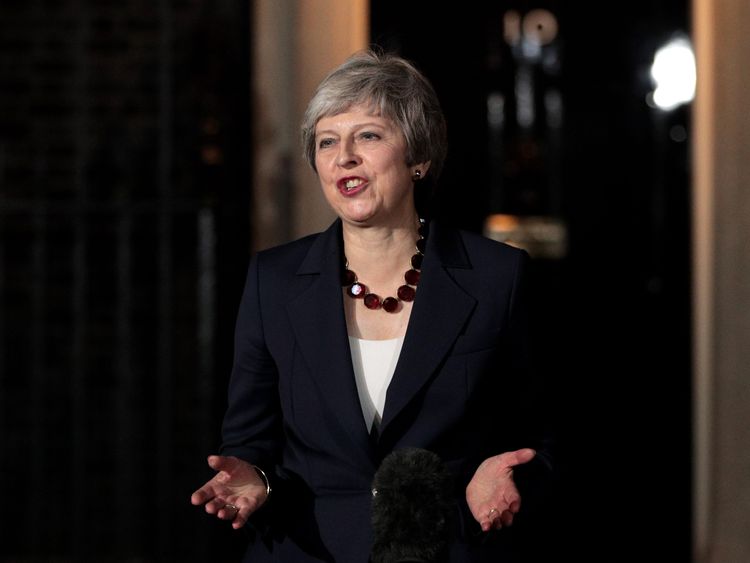
      Theresa May emerged from 10 Downing Street after her cabinet discussed the deal for five hours
      Image:Theresa May emerged from 10 Downing Street after her cabinet discussed the deal for five hours
      Customs union
      The draft agreement states the UK and the EU want to "establish ambitious" arrangements in this area in their "close future relationship".
      It adds there will be a "single customs territory" until the end of the transition period on 31 December 2020.
      The UK will remain in a customs union with the EU indefinitely if a new trade agreement is not reached in that time.
      Maintaining such an agreement has served as a measure to avoid a hard border on the island of Ireland.
      Irish Prime Minister Leo Varadkar said the issue has been "one of the most difficult challenges" of the negotiations.
      He said a backstop will remain in place "unless and until" a better solution is agreed.
      Michel Barnier, the EU's chief negotiator, has said a trade deal between the UK and EU is possible by the end of 2020.
      Northern Ireland
      The document details plans for what a backstop for the Irish border would look like - though it notes that neither side wants this outcome.
      It would involve Northern Ireland being in the same customs territory as the rest of the UK, and the EU.
      This would involve level playing field commitments to ensure trade in goods between the UK and the EU is based on fair principles.
      But it would also mean different regulations for Northern Ireland - more EU law in agriculture, the environment, state aid and other areas.
      There would also be checks on goods traded from Northern Ireland to the rest of the UK.


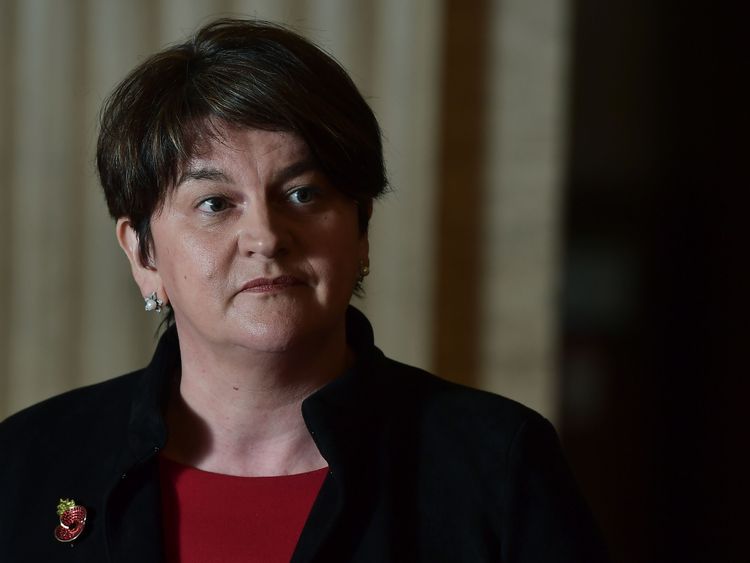
      The DUP's Arlene Foster is unhappy with draft deal
      Image:The DUP's Arlene Foster is unhappy with draft deal
      Enforcing those laws will mean an EU presence: EU representatives will be present to enforce and implement the law relating to Northern Ireland, and the UK will have to facilitate their work and carry out necessary control measures.
      The document states that the EU and the UK will use their "best endeavours" to come to a future trade agreement to avoid the backstop, and notes the transition period can also be extended.
      Otherwise, it could be tricky to get out of the backstop.
      One party would need to apply to the other to end it, and an exit would have to be decided by the joint commission by the top decision makers from the EU and UK.

      Brexit: The jargon explained

      Brexit: The jargon explained

      White paper, common rulebook, facilitated customs arrangement... what do all the terms likely to be used in Brexit proposals actually mean?
      Immigration
      The document lays out rights for EU nationals living in the UK and vice versa.
      EU nationals who have lived in the UK continually for five years, and Brits who have lived in EU countries, will have the right to stay permanently in the UK, along with their family members.
      They will "enjoy equal treatment with the nationals of that state" and so will their family members.

      Mood 'much worse' than after Chequers

      Mood 'much worse' than after Chequers

      All eyes now are on whether Brexiteers in the cabinet may resign
      However, there are limitations on this: the host state will not be obliged to "confer entitlement to social assistance" in certain areas, and it will not be obliged to give student grants or loans to people who do not yet have permanent residence.
      The deal also means the end of free movement, though there will be visa-free travel to EU countries.
      Fishing
      The UK has said it will work "bilaterally" with the EU but will become "an independent coastal state".
      The draft deal says the UK will be "consulted" on "fishing opportunities" and invited to comment regularly on the EU's fishing policies.
      A committee will be set up between the UK and Spain for "regular discussion between the competent authorities" in relation to Gibraltar.
      Scotland Secretary David Mundell has given his backing to the draft Brexit deal, claiming it will deliver for the fishing industry.


      Scottish Secretary, David Mundell, arrives in Downing Street
      Image:Scottish Secretary David Mundell has said the deal protects Scotland's fishing interests
      All 13 Scottish Conservative MPs said they would not support an agreement which would prevent the UK from independently negotiating access and quota shares.
      Mr Mundell said: "I was content to move to the next stage of the process on the basis that Brexit will deliver for our fishing industry - as I and colleagues set out in our letter - and on the basis that arrangements for Northern Ireland will not undermine the economic or constitutional integrity of the UK.
      "I hope there will be agreement at the European Council later this month and we can move to a vote in parliament.
      "The worst possible outcome for Scotland and the whole of the UK would be a no-deal departure from the EU."

      Brexit Forensics

      Brexit Forensics

      Sky News examines the issues dominating Britain's exit from the EU.
      What have the UK and EU leaders said?
      Theresa May, UK prime minister
      Mrs May said the agreement was the result of "thousands of hours of hard negotiation".
      "When you strip away the detail, the choice before us is clear," she said.
      "This deal which delivers on the vote of the referendum, which brings back control of our money, laws and borders; ends free movement; protects jobs, security and our union; or leave with no deal; or no Brexit at all.


      Theresa May delivers a statement after the cabinet approved the wording of the draft Brexit agreement
      Image:Theresa May delivers her statement after the cabinet agreed the draft Brexit agreement
      "I know that there will be difficult days ahead. This is a decision which will come under intense scrutiny and that is entirely as it should be and entirely understandable.
      "But the choice was this deal, which enables us to take back control and to build a brighter future for our country, or going back to square one with more division, more uncertainty and a failure to deliver on the referendum."
      Arlene Foster, Democratic Unionist Party leader
      There was much in the agreement that the DUP may have felt unhappy about.
      Arlene Foster tweeted a curt response a few hours after the big reveal: "We had a frank meeting tonight with the Prime Minister lasting almost an hour. She is fully aware of our position and concerns."
      Michel Barnier, EU chief negotiator
      Mr Barnier hailed the agreement as a crucial step in concluding the negotiations.
      He stressed that the draft had found a solution to avoid a hard border on the island of Ireland.
      "Much work needs to be done, the road is still long and it may be difficult to get an orderly Brexit," he said.


      Michel Barnier gives provides some detail on the proposal for Northern Ireland under the draft Brexit agreement
      Image:Michel Barnier said the UK and EU will have a 'close future relationship'
      Leo Varadkar, Republic of Ireland prime minister
      The Irish leader said Ireland will continue with its priorities: protecting the peace process, protecting trade, jobs and the economy, and keeping Ireland in the EU.
      He said today had brought a satisfactory result to those aims.
      "Our analysis has always shown that Brexit will be bad for Ireland, therefore our approach has always been to seek to minimise the harmful impacts of Brexit on Ireland and to maximise any opportunities, no matter how few."
      https://news.sky.com/story/brexit-draft-deal-the-key-points-explained-11554494