Tuesday, 5 February 2019

Merkel says 'still time' to find Brexit solution

There is still time to find a solution to Britain's exit from the EU, German Chancellor Angela Merkel said Tuesday, voicing optimism on a political deal over the tricky "backstop" that has stymied progress.
AFP
news@thelocal.de @thelocalgermany
5 February 2019 09:25 CET+01:00
Merkel says 'still time' to find Brexit solution
Merkel speaking to Japanese students at Keio University on Tuesday. Photo: DPA

Speaking to Japanese and German business leaders in Tokyo, Merkel stressed that "on the one hand, time is pressing" and businesses using "just-in-time" delivery processes could not afford lengthy customs procedures.

However, she added: "From a political point of view, there is still time. Two months is not a long time but there is still time, and this should be used by all sides."


Britain is poised to leave the EU at the end of March following a 2016 referendum.
Merkel acknowledged the issue of the unpopular Northern Ireland backstop
provision was "complicating" Brexit talks.

The backstop is intended to ensure there is no return to a hard border with
Ireland, but Brexit supporters fear it will keep Britain tied to EU customs rules.

She said the issue with the backstop was a "problem that is precisely defined and therefore one should be able to find a precisely defined solution".


"But this solution depends on the question of what the future relationship
between Britain and the EU will be like and what type of trade deal we sign
with each other," added the chancellor.

Throwing the ball into London's court, she stressed: "It will be very important for us to know what exactly the British side sees as its future relationship with the EU."

After meeting Japanese counterpart Shinzo Abe Monday, she urged "creativity" and "goodwill" to find a solution. 

However, she was clear that any solution could only come via the political
declaration attached to the withdrawal agreement -- rather than re-opening
talks on the actual exit deal.

There are concerns in London that any tweaks to the political declaration  will not be legally binding.

Her Monday comments were seen as conciliatory and boosted the pound as British Prime Minister Theresa May prepares to engage in further talks with EU officials to break the Brexit deadlock as the exit date approaches.

A top EU official, however, sounded the alarm bell after talks with British MPs.

Martin Selmayr, the right-hand man of European Commission President Jean-Claude Juncker, said the meeting had confirmed the view that the EU was right to start in December 2017 preparations for a "no-deal" Brexit.

Merkel said relations between Britain and the EU bloc were currently strong and would remain that way. 

"Over the last two years during which we have been dealing with Britain's exit, we have worked more closely together than during several years when Britain was a member of the European Union," she quipped to laughter.
https://www.thelocal.de/20190205/germanys-merkel-says-still-time-to-find-brexit-solution

Also:

Merkel urges EU and UK to find Brexit compromise (21 January 2019)

Germany to UK: We will miss you, please stay  (24 January 2019)

With creativity, we can find Northern Ireland solution, Merkel says (4 February 2019)

Merkel says 'still time' to find Brexit solution (05 February 2019)

From a no-deal Brexit to a no-Brexit deal

With the recent signing of the Treaty of Aachen, French President Emmanuel Macron and German Chancellor Angela Merkel have renewed the Franco-German friendship pact and taken an important and necessary step forward for Europe. But the United Kingdom should not have been left out.
FEB 5, 2019 

The U.K. is an integral part of Europe; as the European Union’s second-largest economy, its GDP equals that of the 19 smallest EU member states combined. Its exodus thus would shake Europe to its core and destroy the European postwar order.
Moreover, it is worth remembering that in 1963, the Bundestag prefaced the Elysee Treaty with a preamble stipulating that Germany hoped to bring Britain into the European Economic Community; in 1973, that is what happened. A similar overture to Britain would be no less appropriate today.
As it happens, the leaders of Germany’s three largest political parties, as well as business leaders and members of the public, recently published an open letter inviting the British people to stay in the EU. Given this, it is not inconceivable that the Bundestag could adopt a resolution along the same lines.
Now that British Prime Minister Theresa May’s negotiated exit treaty has been soundly defeated in the House of Commons, all options are on the table. The looming tragedy of Brexit could still be averted at the last minute.
Lest we forget, a British withdrawal would endanger the EU’s fundamental position of openness to the world, particularly with respect to trade, from which everyone, not least Germany, has profited. It would also introduce a new security risk, as Europe would lose the unconditional protection of one of its two nuclear powers just when U.S. President Donald Trump is undermining the cohesion of NATO.
For its part, the U.K. would lose either its national integrity or the framework for ensuring peace in Northern Ireland. There is no way around it: Brexit requires that Northern Ireland adopt a new border, either with the Republic of Ireland or with Great Britain. A border between Northern Ireland and the Republic would likely propel the Irish Republican Army back into action, threatening renewed civil conflict. But a border between Northern Ireland and Great Britain would augur the breakup of the U.K., especially if Scotland renewed its own push for independence.
May’s exit treaty represents a second option, because it includes a “backstop” in the event that negotiations over the future EU-U.K. relationship fail.
Pending a resolution, Northern Ireland would remain closely attached to the EU, and Great Britain would retain only its membership in the EU customs union. But this would mean that goods traveling from Northern Ireland to Great Britain — that is, within the national territory of the U.K. — would be subject to new checks. It is little wonder that a majority of British MPs rejected a deal that would allow for such an outcome.
Meanwhile, many EU politicians have been trying to figure out what it would take to convince Parliament to ratify May’s exit treaty after all. I find this annoying. Why focus on casting Britain out of the EU when you could be coming up with an offer to keep it in? Obviously, the latter scenario would be much better for Europe itself.
For example, the EU could offer a deal that picks up where it left off with former British Prime Minister David Cameron, before he called the Brexit referendum. Cameron’s main demand back in 2015-2016 was to reduce the appeal of intra-EU migration to the better-developed European welfare states. He had a point. If people come to a country to earn higher wages, the pie available for distribution gets bigger; but if they come for the social benefits, the pie gets smaller.
Given this, why not have a system in which host countries and countries of origin share the costs of social benefits for migrants? Host countries could assume the responsibility for administering benefits such as unemployment insurance, sick pay, and pensions. And countries of origin could continue to provide benefits not related to the employment relationship, such as allowances for children staying at home and services for migrants who are too old or sick to work when they arrive.
Such a change would create a win-win situation for the EU, because it would reduce the destructive appeal of welfare magnetism and give the British grounds to reconsider their exit decision with their heads held high.
Which is more important: insisting on the principle that host-countries pay for the provision of all social benefits, or maintaining the U.K.’s membership of the EU? For anyone who is genuinely committed to the European project, the answer should be obvious.
Hans-Werner Sinn, a professor of economics at the University of Munich, was president of the Ifo Institute for Economic Research and serves on the German economy ministry’s Advisory Council. © Project Syndicate, 2019 www.project-syndicate.org
Comments

Avatar
The author's idea is a good one, but it is a bit late, and like most continental European perspectives, fails to understand that the motivation for many Brexit supporters was not an economic one, but an emotional, xenophobic and racist one. The Little Englanders won, and will now make England (and the rest of the UK) a good deal littler in terms of its economy, its stature and the opportunities on offer to its citizens.
-all options are on the table.
All except one, unfortunately.
Brexit was not a party policy, it was a referendum. That means that it has to happen, regardless of the cost, and the collateral damage, or democracy is undermined. That is why sensible governments rarely hold referendums on such issues. And when they do, they demand that more than 50% of all those who are elligible to vote, must vote for change, rather than 50% of those who do vote.
Personally, I think we should build a corner on the fourth plinth of Trafalgar Square and make David Cameron stand in it, for at least an hour every day, for the rest of his life.
Post-Brexit Britain will be an example to the planet of the consequences of inadequate leadership and, with regard to the EU, the importance of reminding your citizens of the benefits of being part of any supra-national entity. Something the EU never really bothered to do, allowing themselves to become the go-to fall guy for political problems within the UK, for decades.
The EU does not seem to understand that persistent, creeping Federalisation will be counter-productive to the future coherence of the EU project, and will merely alienate an increasing number of people in member states. If their entire nation were to vote one way, and be out-voted by other nations, they would feel like a vassal state, and stripped of their voice and right of self-determination. That matters to people, and not just to nationalists. That is why the EU needs to accept a cap on the extent of Federalisation, and needs to evangelise the limits of Brussels' reach, embracing European diversity. If it does not, one of two things will happen: more nations will break away, or multiple nationalist regimes will take control of it, democratically, and turn the EU into a Fourth Reich - a toxic entity that will victimise people across Europe.
Ironically, should nationalists sweep to power as soon as the coming EU elections, those of us who voted 'remain' might consider the UK to be well out of it, and Brexit supporters will be heartbroken.

https://www.japantimes.co.jp/opinion/2019/02/05/commentary/world-commentary/no-deal-brexit-no-brexit-deal

BBC Video: The customs union explained in 45 seconds

The UK will face "unavoidable" trade barriers if it leaves the customs union and single market.
That's according to the EU's chief negotiator Michel Barnier.
Here's Newsbeat's quick guide to what it all means.

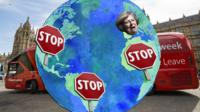
A globe with "stop" signs across various countries and Theresa May's face covering the UK.
  • 05 Feb 2018


https://www.bbc.com/news/av/newsbeat-42952324/the-customs-union-explained-in-45-seconds

Monday, 4 February 2019

With creativity, we can find Northern Ireland solution, Merkel says

TOKYO (Reuters) - With creativity and goodwill, Britain and the European Union can still perhaps resolve the issue of Irish border arrangements after Brexit, German Chancellor Angela Merkel said on Monday.
Speaking at a news conference with Japanese Prime Minister Shinzo Abe in Tokyo, Merkel said Germany did not want to see Britain’s divorce deal with the EU - the so-called Withdrawal Agreement - renegotiated.

FEBRUARY 4, 2019 / 6:47 PM


German Chancellor Angela Merkel attends a joint news conference with Japan's Prime Minister Shinzo Abe in Tokyo, Japan, February 4, 2019. REUTERS/Kim Kyung-hoon
“But, we have an agreement for the future relationship and in this future relationship (agreement), one can of course settle questions that are still being discussed such as the question we have with the backstop,” Merkel said.
“There are definitely options for preserving the integrity of the single market even when Northern Ireland isn’t part of it because it is part of Britain while at the same time meeting the desire to have, if possible, no border controls,” she said.
“To solve this point you have to be creative and listen to each other, and such discussions can and must be conducted,” she added. “We can still use the time to perhaps reach an agreement if everyone shows good will.”
British Prime Minister Theresa May said on Sunday she would seek a “pragmatic solution” to a parliamentary impasse over the terms on which Britain leaves the European Union when she tries to reopen talks with Brussels.
Merkel said: “We want to do everything to avoid a no-deal ... as that would increase uncertainties.”
https://uk.reuters.com/article/uk-japan-germany-brexit/with-creativity-we-can-find-northern-ireland-solution-merkel-says


Also:

Merkel urges EU and UK to find Brexit compromise (21 January 2019)

Germany to UK: We will miss you, please stay  (24 January 2019)

With creativity, we can find Northern Ireland solution, Merkel says (4 February 2019)

Merkel says 'still time' to find Brexit solution (05 February 2019)

Brexit is a revolt against a German-run European super-state

Britain's idea of a united Europe has never been more than a free-trading area.
In spite of that, the Germans and the Dutch liked the prospect of sharing the European Union membership with British free-traders, apparently as a counterweight to overbearing French state interventionists.
Dr. Michael Ivanovitch

Brexit is a revolt against a German-run European super-state
Although the form of the British exit from the EU is often presented as a reductionist binary choice, London has in effect restated the fundamental question of what is a European project, Michael Ivanovitch writes.
Having twice vetoed in the 1960s the British entry into what was then called the European Common Market, France eventually relented and agreed to Britain's accession in 1973.
Soon, however, France and other EU members had to deal with British "opt-outs" from legislative and regulatory provisions London was finding contrary to its government traditions and requiring sovereignty transfers to unelected officials running the European Commission in Brussels.
Nearly three years after the successful referendum to leave the EU, Britain is now in the final stages of negotiating its exit.

Germany planted the seeds of destruction

Although the form of the British exit from the EU is often presented as a reductionist binary choice — "a no-deal exit" or "a deal the U.K. and the EU can live with" — London has in effect restated the fundamental question of what is a European project: A Europe of sovereign nation states, or a federal European super-state.
The disastrous fiscal austerity policies imposed by German Chancellor Angela Merkel on sinking euro area economies at the beginning of this decade, and her subsequent disorderly open-door immigration waves in 2015 have been a catalyst and a detonator of strong centrifugal forces throughout the European Union.
In response to cataclysmic shocks of the Great Recession, Merkel set out to teach a lesson to euro area "fiscal miscreants" and those unable to control their banks (Spain). In the process, she rebuffed American President Barack Obama's request to ease up on her devastating fiscal austerity, because Washington was rightly concerned that a deep and intractable European recession would hit hard one-fifth of American exports.
To those calling for some European solidarity, Merkel retorted that it's everybody for themselves, with Germany continuing to live off its trade surpluses with the euro area partners while pursuing a "black zero" budget balance.
Presidential candidate and later President Donald Trump understood all that. He told Merkel that trade free-riding on the U.S. was over, and so was Washington's total underwriting of German security. Apparently shocked by the lack of American solidarity (stupidity), Merkel's response was that "Europeans truly have to take our fate into our own hands." In other words, never mind, Germany will continue to bilk Europe.
That, however, was too late for Merkel and Germany. Her policies have led to the extreme-right xenophobic Alternative for Germany (AfD) shooting up from zero votes in 2013 to the country's third-largest political party now.
And that was also an eye opener for some smarter Europeans. When the Hungarians saw that Merkel was going to direct refugees their way, Budapest said it didn't want Berlin to decide who was going to live in Hungary.
Berlin and a Berlin-run European Commission were outraged at that lack of Hungary's European solidarity. Worse, an arrogant German EU budget commissioner publicly threatened that he would cut off regional development funds to which Hungary was entitled.

France's 'civil war'

Germany got its next comeuppance in Italy. Rome finally summoned the courage to say "basta!" (enough!), after being left alone for years to handle thousands of African and Middle-Eastern migrants and refugees landing on its shores. Berlin's only response to Italian appeals for European solidarity was to criticize Rome for refusing to honor the maritime traffic laws and to secure people in danger.
To get back at Italy for refusing to follow Germany's diktat on immigration policies, Berlin led the assault, with its French sidekicks, on Italy's attempts to rescue its sinking economy with fiscal policies that were well within the euro-area budget rules.
Germany and its EU Commission now got exactly what they wanted: The Italian economy sank into recession late last year, and will probably remain there for most of 2019.
The story is not over, though. Italy is now teaming up with Hungary and Poland to create an anti-German and anti-French block, with unpredictable consequences for the EU's future.
All that is happening at a time when France is split by a violent and deepening social unrest — some conservative French thinkers call a "civil war," in a country prone to "violence" and "revolutions." The government has no answer to three months of demonstrations and rioting of a social movement dubbed "yellow vests." Watching an increasingly violent police warfare, the French governing elites are organizing town hall discussions, apparently believing that they can wear down, and wait out, their opponents.
But, as things now stand, there seems no end to the French political crisis. Last Saturday, for example, about 60,000 people demonstrated and rioted in all major French cities, confronted by 80,000 police in lethal combat gear.
For the time being, the French government is hanging on thanks to massive police operations and the fact that the rioting social groups have neither the leadership nor the programs that would offer viable alternatives for the transition of power in the quasi-imperial presidential system of the Fifth Republic.
By comparison, a weak and disoriented German government looks like a paragon of stability. The governing coalition forces can't wait to see Merkel's back, the right-of-center CDU/CSU sister parties are still settling their differences, and their hapless Socialist (SPD) partners are looking for a major leadership change.
And everybody is waiting to see what political forces will emerge from the European parliamentary elections in late May. The event is billed as a decisive showdown between established and highly contested governing circles, and what are derisively called "populist" demagogues and illiberal democracies.

Investment thoughts

That huge European mess is exactly what Trump and the U.K. need to settle their trade scores with a disintegrating European Union.
Will the euro survive all that?
The probability is very high that it will. The euro is in the hands of the European Central Bank, and no member country now has an overwhelming anti-euro constituency.
Upon reflection, the Europeans will also realize that a demise of the euro would herald Germany's total political, economic and financial domination of a system of fragmented European states. The long pre-euro experience shows that no country could be protected from that by managed or free-floating exchange rates. The German central bank would then be on par with the U.S. Federal Reserve, and the Bundesbank's president would reclaim its old role as a lecturer-in-chief on world economy and finance.
But many in Europe would find such a German domination unacceptable. Europe's old demons would soon take over, and Washington would have to step in to keep the erstwhile European "brothers" off each other's throats.
And here is how Henry Kissinger talks in his memoirs about a most humiliating history lesson he received on that topic from the towering French President Charles de Gaulle. Egged on by President Richard Nixon, during his visit to France in the 1960s, to challenge de Gaulle's ideas about Germany, Kissinger piqued the haughty general with the question how he would prevent Germany from dominating Europe. De Gaulle's answer was simple: "Through war."
Commentary by Michael Ivanovitch, an independent analyst focusing on world economy, geopolitics and investment strategy. He served as a senior economist at the OECD in Paris, international economist at the Federal Reserve Bank of New York, and taught economics at Columbia Business School.