Wednesday, 8 May 2019

Brexit: UK will take part in European elections, says David Lidington

The UK will have to hold European elections, despite hopes from the government a Brexit deal would be done by then, says the PM's de facto deputy.
The vote is due on 23 May, but Theresa May said the UK would not have to take part if MPs agreed a Brexit plan first.


  • 7 May 2019

  •  
    Brexit: European elections will go ahead says senior minister
    Now, David Lidington says "regrettably" it is "not going to be possible to finish that process" before the date the UK legally has to take part.
    He said the government would try to make the delay "as short as possible".
    The UK was due to leave the EU on 29 March, but as no deal was agreed by Parliament, the EU extended the deadline to 31 October.
    It can leave the bloc earlier, but if the UK has not left by 23 May, it is legally obliged to take part in the EU-wide poll and to send MEPs to Brussels.

    'Very robust'

    Mrs May's spokesman said she "deeply regrets" that the UK did not leave as planned in March and recognised many people felt "great frustration" that the European elections were going ahead.
    But she hoped Parliament would agree a Brexit plan before MEPs start their session in July.
    The government has resumed talks with Labour to try to break the deadlock in Parliament over the terms of withdrawing from the EU. It has promised that if no compromise is reached it will offer indicative votes on possible next steps to Parliament.
    Labour's shadow business secretary Rebecca Long Bailey said Tuesday's talks were "very robust", but nothing had been agreed, and the government still needed to move on its "red lines" in order to reach a compromise.

    A Labour source told BBC political editor Laura Kuenssberg that talks had been "tense" with some frustration on the Labour side and said there were still "fundamental" problems and divisions between the two sides.
    The government was being "disingenuous" to suggest that ministers were offering a significant new compromise beyond what was already available in the existing agreements with the EU, the source said.
    Downing Street said the talks had been "constructive and detailed" and they would continue on Wednesday afternoon.




    Presentational grey line
    Analysis box by Laura Kuenssberg, political editor

    "Constructive and detailed" - that sounds quite positive - Number 10's description of the talks today.
    "Robust" - not quite so chirpy - Labour's use of political speak for what most of us might call a bit tricky.
    "Disingenuous" - oh dear - a different Labour source's description of ministers' claim that what they were putting on the table in the cross-party talks today was something genuinely new on the vexed question of customs arrangements after we leave the EU.
    As we reported this morning there didn't really seem to be much from the government that was concrete beyond what's already possible under the agreement that's been hammered out with Brussels.
    The divorce deal and indeed yes, you guessed it, the backstop, both have forms of temporary customs unions in them to make trade between the UK and the EU easier.
    Of course the precise language and mechanisms matter enormously.
    But was there some big shiny new offer today? The short answer is: no.


    Presentational grey line

    A number of other parties have already announced their candidates and launched their European election campaigns, but the Conservatives have yet to do the same.
    Cabinet Office Minister Mr Lidington said: "We very much hoped that we would be able to get our exit sorted… so that those elections did not have to take place, but legally they do have to take place unless our withdrawal has been given legal effect."
    Mr Lidington said the government would be "redoubling efforts" in its talks with other parties to find a way forward to "make sure that the delay after [the elections] is as short as possible".
    He added: "We would like to be in a situation… certainly to get this done and dusted by the summer recess."
    Government sources say if the Brexit process is completed before 30 June, UK MEPs will not take up their seats at all. If it is done and dusted after that date but before Parliament begins its summer recess in July, MEPs will only need to sit for a month, until 1 August.
    Sources estimate that the cost of holding the European elections will be roughly £150m.

    Analysis: By Chris Morris, BBC Reality Check


    EU flagImage copyrightPA

    Even if an unexpected deal were to emerge in the next few days between the Conservatives and Labour, it would only be a very tentative first step towards Brexit, with no guarantee that it would enjoy a parliamentary majority.
    And a first step isn't enough.
    The conclusions of last month's EU summit, agreed by all EU leaders including Theresa May, said that if the Brexit withdrawal agreement has not been ratified in parliament by 22 May, the European elections will have to take place in the UK.
    The ratification process means Parliament would have to pass a meaningful vote on the withdrawal agreement (the deal negotiated between the government and the EU), and then turn it into UK law in the form of a Withdrawal Agreement Bill.
    And, as Mr Lidington has now conceded formally, time to do all of that has run out.


    Presentational grey line

    Some Brexiteers are angry at Mrs May's efforts to find a compromise with Labour after her deal with the EU was effectively rejected by MPs three times.
    One leading Eurosceptic, Sir Bill Cash, told the Press Association "the time has come" for the PM to resign and she "needs to be given a date".
    But Chancellor Philip Hammond defended the cross-party talks, suggesting the government had no other option.
    The BBC's political editor Laura Kuenssberg says No 10 is trying to get Labour over the line by presenting the withdrawal agreement as a stepping stone - i.e. hold your nose for now and you can carve out your own deal if you win the next election.
    Key to that, she says, is the promise of a "temporary customs union", but Labour sources are warning that would not be enough.
    Labour has previously said it wants a permanent customs union - an arrangement not to carry out checks or put tariffs (extra payments) on goods that move around between the UK and the EU after Brexit.


    Presentational grey line

    Who is standing in the European elections?
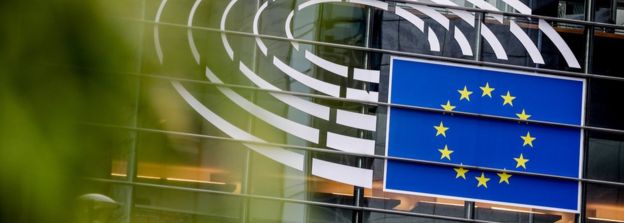


    European ParliamentImage copyrightEPA

    The election in May will see 751 MEPs sent to the European Parliament to make laws and approve budgets for the EU.
    Each country is allocated a set number of seats, depending on the size of its population.
    The smallest member, Malta (population: around half a million) has six MEPs, while the largest, Germany (population: 82 million) has 96.
    The UK is divided into 12 regions, each represented by between three and 10 MEPs depending on population size, ending with a total of 73.
    Seats in England, Scotland and Wales are awarded to parties according to their share of the vote, then to the candidates on the lists drawn up by the parties.
    Northern Ireland elects MEPs using a single transferable vote system, with voters able to rank candidates in order of preference.
    The European Parliament has agreed that 46 of the UK's 73 seats will be abolished after Brexit, and the remaining 27 will be redistributed among countries that have complained of under-representation.


    https://www.bbc.com/news/uk-politics-48188951

    A really simple guide to the European elections


    Voters across the EU go to the polls on 23-26 May to elect more than 700 MEPs - members of the European Parliament.
    8 May 2019
    European elections
    MEPs represent more than 500 million EU citizens from 28 countries.

    The last European elections were held in 2014.

    What does the European Parliament do?

    The parliament is the only  EU institution.
    After the MEPs are elected, most join  in the EU parliament.
    The main job of the EU parliament is to pass laws, working with ministers from the member states, who are collectively known as .
    MEPs also monitor the work of the European Commission, which drafts EU laws and enforces EU rules.

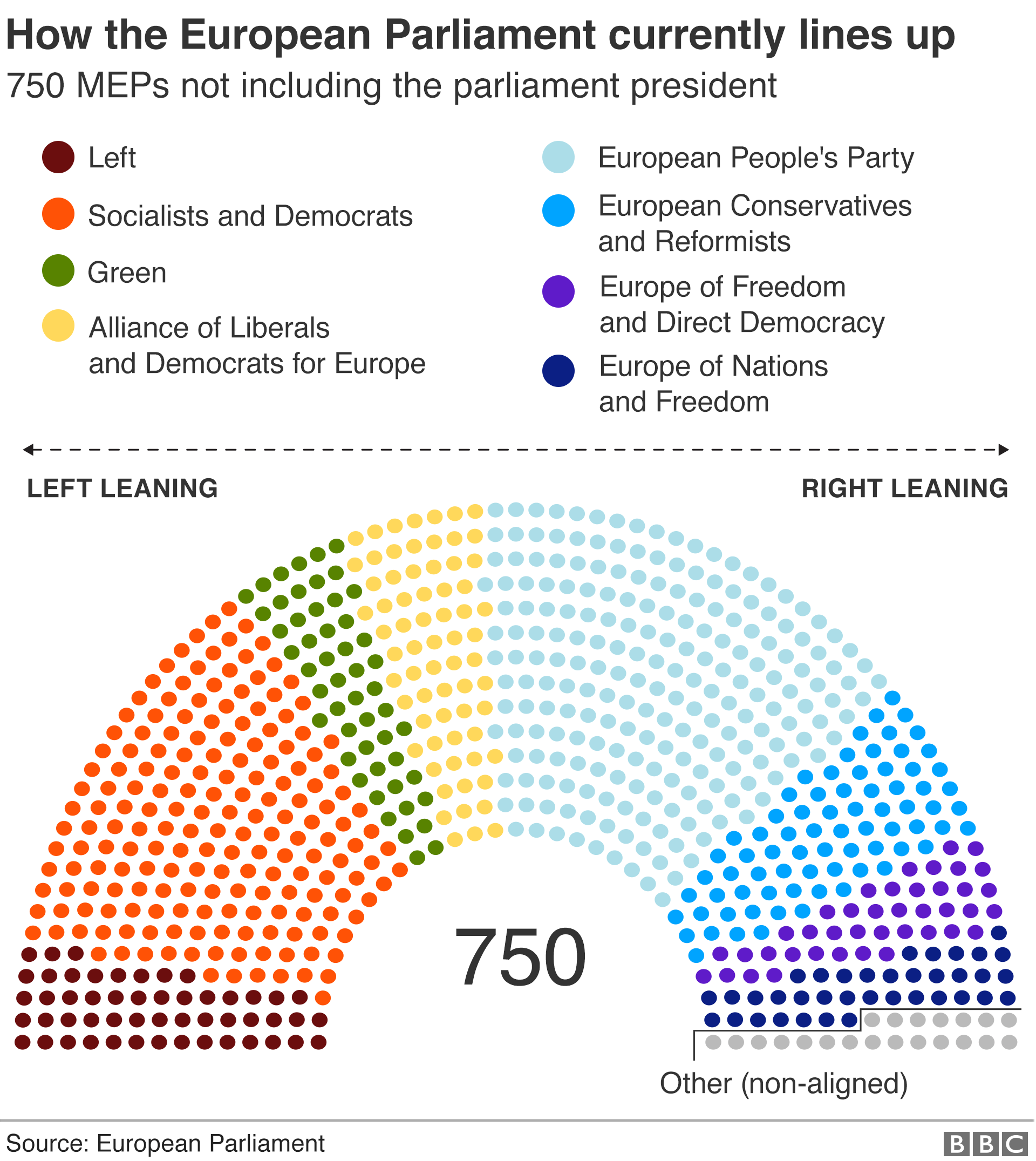
    Graphic: How the parliament currently lines up

    Is the UK in or out of these elections?

    The UK voted to leave the EU in 2016 – and was expected to leave by 29 March 2019 – but UK politicians have been .
    The UK is legally obliged to take part in the elections, unless it approves a  by 22 May, enabling it to leave the EU with a deal.
    That looks unlikely, as MPs have already rejected it three times.

    So who could win in Europe?

    In recent years  have been gaining ground and - though they are unlikely to gain a majority in the new parliament - more are expected to get elected as MEPs this time.
    Those opposed to the EU are often from  parties.
    Pro-EU parties say the EU plays a crucial role in big issues such as the environment, renewable energy, workers’ rights, financial stability and combating terrorism.
    They say Europe needs to work together, faced with the economic clout of powers like the US and China.

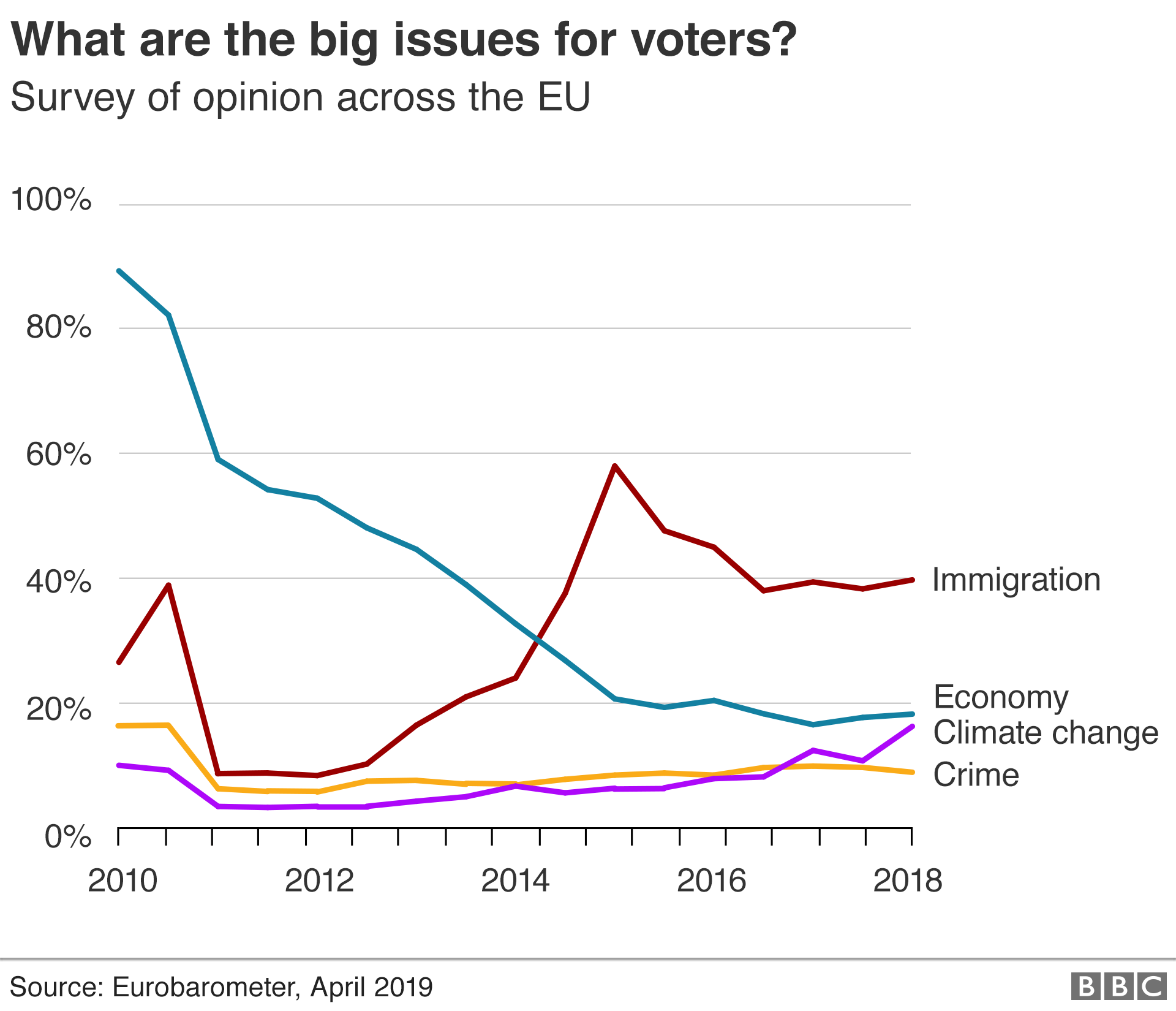
    Graphic: What are the big issues for voters?
    Immigration from non-EU countries surged in importance for voters across Europe from 2015 to 2016, during the 
    There was a nationalist backlash, especially in Germany, Hungary, Austria and Poland.
    Many voters want more determined action to tackle climate change, an issue highlighted by  and her Fridays for Future youth campaign.
    The  gripped Europe between 2010 and 2012, but anxiety about the euro has declined since then.

    Which are the countries to watch?

    Besides Brexit uncertainty in the UK, anxiety about immigration could influence voting in several countries, to the advantage of nationalist and populist parties.
    One of those countries is Italy where the government is a nationalist-populist coalition between Matteo Salvini's right-wing, anti-immigration .
    The League has forged an election alliance with the far-right , the Finns Party and the Danish People's Party.
    France is also one to watch. It is the first European election for President Emmanuel Macron’s liberal .
    Written by Laurence Peter and produced by David Brown, Steven Connor and Joy Roxas


    Short presentational grey line

    More on the European elections


    https://www.bbc.com/news/world-europe-48186027

    Tuesday, 7 May 2019

    May regrets Britain will hold European elections - spokesman

    British Prime Minister Theresa May regrets that Britain will hold European Parliament elections and is determined to find a way to get a Brexit deal through, her spokesman said on Wednesday.


    FILE PHOTO: Britain's Prime Minister Theresa May arrives at church, as Brexit turmoil continues, in Sonning, Britain, May 5, 2019. REUTERS/Simon Dawson/File Photo


    Sterling slid nearly half a percent on rising concerns about the progress of Brexit talks between the government and the opposition Labour Party and fears May’s position was increasingly coming under pressure.
    Asked about speculation she might resign, May’s spokesman said he was unaware of any change in her intent to only step down after the first part of the Brexit process was completed.
    https://uk.reuters.com/article/uk-britain-eu-may-regret/may-regrets-britain-will-hold-european-elections-spokesman

    Gavin Esler vs the idiots

    This irascible Remainer thinks only ‘experts’ should get to discuss Brexit on TV.


    Brendan O'Neill
    7th May 2019

    Gavin Esler vs the idiots

    Every now and then, a hardcore Remainer will accidentally let his or her contempt for the throng slip out. The niceties will fall away, the euphemisms evaporate, and their disdain for other people, for allegedly stupid people, will be clear for all to see. This week, it was the turn of Gavin Esler, the Newsnight anchor turned professional irascible loather of Brexit and Euro-election candidate for the anti-democratic group, Change UK.
    In an interview with the Huffington Post, Mr Esler suggested that certain Brexit voices should be kept off the airwaves. As the HuffPostheadline summed it up, he thinks ‘TV news must stop giving airtime to the “village idiots” of Brexit’. Idiots? A striking choice of word. Esler said: ‘Brexit is about expertise. You cannot and should not have someone who really knows what they are talking about balanced by someone who is essentially the village idiot.’
    These comments are incredibly revealing. First, there’s the casualness, the nonchalance, with which Mr Esler demands the blacklisting of certain people. For that’s what this is – a call for a blacklist, a suggestion that certain voices and opinions should be kept out of the media. Mr Esler echoes other commentators who have suggested that some Brexit Party and UKIP candidates be banned from the airwaves. It is testament to the self-righteousness of hardcore Remainers, to their blinkered belief that they are morally correct and other people are bothersome or even dangerous ‘idiots’, that they can so cavalierly propose the erasure of certain views from the news.
    And secondly, there is Mr Esler’s use of the phrase ‘village idiot’. He may well protest – and no doubt already has – that he is talking about certain Brexit-backing loudmouths from the political and media spheres, not about ordinary Brexit voters. But that won’t wash with many people. His claim that ‘Brexit is about expertise’ will strike many as a reprimand to the uneducated, to the little people; a warning that those who lack the supposed wisdom of the expert class should back off and pipe down.
    This is a common refrain from the Remainer camp – that only experts can really understand Brexit, and thus expert voices should be elevated over idiot voices. This is elitism. It is fuelled by a belief that the clever should have a greater say in media debate than those deemed by the likes of Mr Esler to be ‘village idiots’. Some have even argued that it was a mistake to put the question of EU membership to the masses because, in Richard Dawkins’ words, many of them are ‘ignoramuses’ and thus cannot comprehend ‘highly complex economic and social issues’.
    The idea that there are experts and village idiots, the wise and the dim, the ‘philosopher kings’ and the ‘plebs’, has been around for millennia. And it has always been used as an argument for reining in democracy and limiting the right of ordinary people to make decisions on important matters. From the Chartists to the Suffragettes to Brexit voters today, people have been told time and again that they lack the ‘expertise’ to make important, nation-changing decisions. Change UK? Plus ça change… more like.
    Brendan O’Neill is editor of spiked and host of the spiked podcast, The Brendan O’Neill Show. Subscribe to the podcast here. And find Brendan on Instagram: @burntoakboy

    https://www.spiked-online.com/2019/05/07/gavin-esler-vs-the-idiots/