Sunday, 31 July 2016

If you're a Leave voter, you're about to get exactly what you asked for

There has been a pronounced tone-change among UK economics analysts since the EU Referendum: They are in unanimous agreement that the UK will sink into recession in the second half of this year.

By Jim Edwards | Business Insider UK Finance – Sun, Jul 31, 2016 10:52 BST
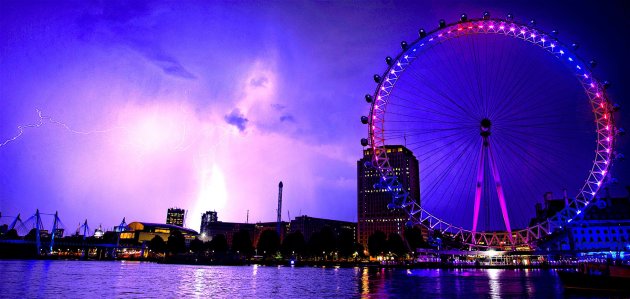
storm london lightning eye
Lewis Whyld / PA Archive/Press Association Images

There has been a pronounced tone-change among UK economics analysts since the EU Referendum: They are in unanimous agreement that the UK will sink into recession in the second half of this year.
They disagree only on the details and depth.
Call it the Silence of the Bulls: No one — literally, no one — is making a bullish case for the post-Brexit economy.
That is what is so scary about this recession. Usually, analysts and economists like to hedge their bets. Their opinions are spread over a range, with outright disagreements. They talk about "the risk" of something happening; they don't say "this will happen." 
BAMLLewis Whyld / PA Archive/Press Association Images

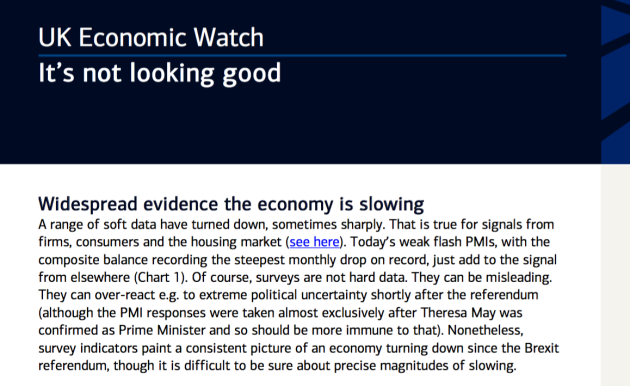
But right now everyone is saying the same thing. Bank of America Merrill Lynch's Robert Wood put out a note last week whose title says it all: "It's not looking good."
Here's another example, from HSBC's Robert Parkes and Amit Shrivastava, who cover stocks. They say that the recent spell of good news — in which the UK just notched record-high employment, at over 74%, record-low unemployment, at 4.9%, and healthy GDP growth of 2.2% in Q1 — is merely the "eye of the storm" to follow:
"Don’t believe the hope"
"Following the initial ‘shock’ from the Brexit vote, the last four weeks have been dominated by ‘hope’, in our view. ‘Hope’ surrounding the potential for further policy stimulus (both monetary and also fiscal), ‘hope’ that any economic damage from storm ‘Brexit’ will be short-lived and limited to the UK, and ‘hope’ that the political uncertainty will subside and a market-friendly outcome will be achieved. We don’t believe the ‘hope’."
"... An eerie calm has descended over European equities following the initial impact of storm ‘Brexit’ that struck in late June. Policy makers and politicians have been lining up to offer reassurance. This has helped equity market volatility to drop to below pre-referendum levels, and share prices have recovered accordingly. So the storm has now passed, correct? And therefore it is safe to assume that Brexit is no longer a relevant theme for European equities, correct? We think not. We think we are merely in the eye of the storm, and the potentially destructive ‘eyewall’ is rapidly approaching. Over the course of Q3 we see the economic headwinds intensifying and recession risk rising, not just in the UK, but also for the wider EU region."
The employment rate and GDP growth may look good, but those numbers are now in the rearview mirror. Neither of them were taken from samples prior to the Brexit vote.
By contrast, the data from after the referendum looks awful.

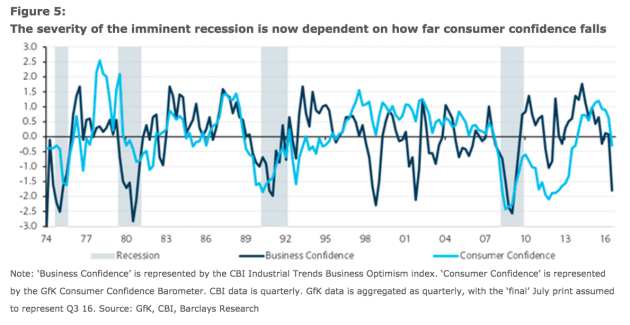
This chart from Barclays shows consumer confidence is heading back to where it was in the 2008 financial crisis:
BarclaysLewis Whyld / PA Archive/Press Association Images

The drop in consumer confidence was the fastest in 27 years:

GfK consumer confidenceLewis Whyld / PA Archive/Press Association Images

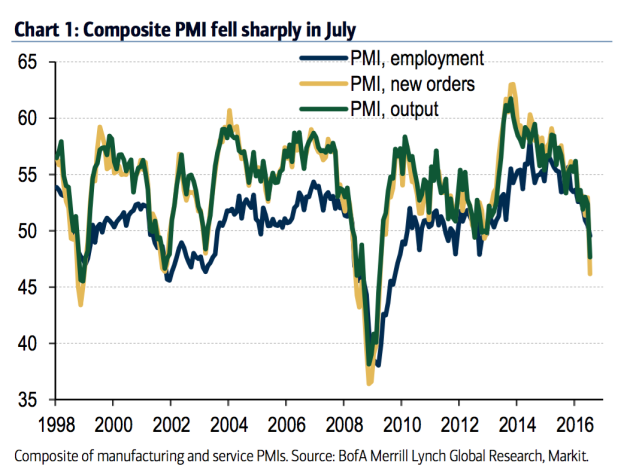
It occurred because data from companies about their future plans — for creating jobs, new order, and output — tanked immediately after Brexit:
PMILewis Whyld / PA Archive/Press Association Images

And CFOs say they don't intend to hire anyone for the next 12 months:

cfoLewis Whyld / PA Archive/Press Association Images

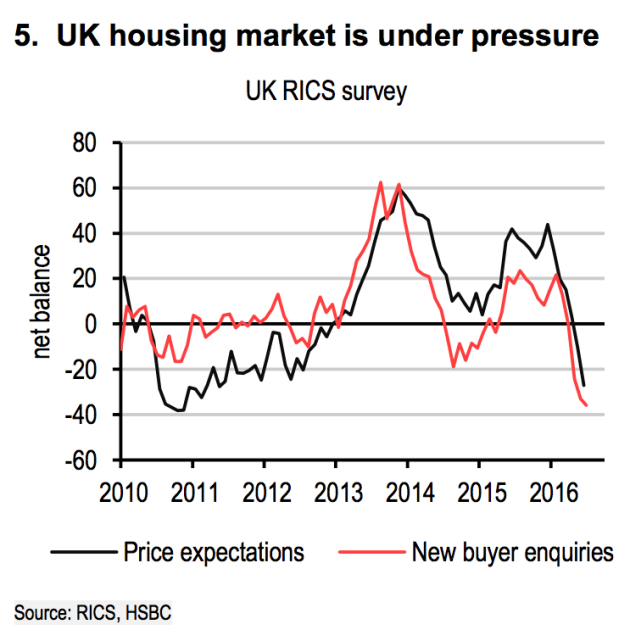
Unsurprisingly, the property market is about to grind to a halt as people cancel plans due to Brexit, and prices plummet as a result:
HSBCLewis Whyld / PA Archive/Press Association Images

OK, so maybe we're just talking ourselves into a recession? Maybe the Brexit shock will wear off? Maybe there will be a reversion to the mean? And maybe the UK will muddle through and everything will be all right?
Unlikely. 
This has been a long time coming.
The fundamentals in Britain are weak and have been that way for a long time. That's why the Bank of England has kept rates at nearly zero for years. (If the economy was strong, the BOE would be jacking up rates to squash inflation.)
We told you back in March that Britain — loaded with consumer debt and light on household savings — was sleepwalking into a recession. That same month we told you that Europe, and especially the UK, was walking into the storm naked. We have no weapons to fight the recession: Central banks can't make interest rates any lower and the EU's rules require governments to maintain austerity budgets even when their governments don't want them.
The Brexit vote was the straw that broke the camel's back.
If you're a Leave voter, you're about to get exactly what you asked for.

https://uk.finance.yahoo.com/news/youre-leave-voter-youre-exactly-095200848.html

Saturday, 30 July 2016

MUST READ: Why the EU stress test is a farce and the Eurozone is set to IMPLODE, writes Paolo Barnard

“A horse! a horse! my kingdom for a horse!”. After the results of the European banks’ stress test I want to cry: “A Brexit passport! a Brexit passport! My house for a Brexit passport!”

The EU stress test was launched yesterday
And I’m not joking. 
The much expected results of the 2016 EBA’s stress test of the main EU lenders is a farce, and it’s not funny, because the lives of millions could be jeopardised by it.
The desperate EU regulators rigged the test to the point of ridicule: first it did not examine lenders from Greece or Portugal, where banks’ balance sheets are akin to a warzone. 
Second, the test lacked a pass/fail mark. 
Then EU regulators pretended that the catastrophic NIRP factor (negative interest rates set mainly by the ECB) didn’t exist.
Well, if they had, Deutsche Bank would have exploded the test, as NIRP is the reason why Deutsche is falling to bits recently (not to mention that the German juggernaut harbours explosive derivatives to the tune of twenty times the German GDP). 
But the rigging yesterday went on.
EU lenders have amassed some 1.7 trillion euros in Non Performing Loans (NPLs), with Italian banks accounted for 360billion euros of that nightmare. How did Unicredit and Intesa come clean yesterday with 84 and 63 billion euros in rotten loans respectively?  
BarnardRAI2
Barnard says the Eurozone is about to implode
Brexit Britain must, Mrs May, rush to protect the UK banking system as best as it can, now
Barnard
The hard truth is that most EU banks emerged alright from this stress tests because they were allowed to. 
Here are the tricks: set up bad banks, submit “risk adjusted” figures (not the much more reliable “Leverage Ratio” proposed by Britain), establish Special Purpose Vehicles, frantically offload Asset Backed (rotten) Securities to Vulture Funds, and more. 
Draghi always turned a blind eye on these tricks, exploiting loopholes in the EU regulations, as it happened in the previous banks’ stress test of October 2014.
So yesterday’s stress test was shamefully rigged. It had to be, Mr Draghi had no choice. Could he tell the truth and trigger the implosion of the global financial world? No.
Deutsche Bank headquarters in FrankfurtGETTY
Deutsche Bank struggled in the EU stress test
Now to the main point. Britain has some shaky banks too, notably Barclays Plc, but nothing like the rest of the EU nightmare. 
In fact it ranks fourth best in the EU NPLs Financial Times charts - 24 other EU nations are in much worse shape. 
However ‘contagion’ from an EU massive banking crisis would make the UK suffer.
So here is more bad news from Eurohell, I’m afraid. As the world’s leading financial analysts have been saying for years now, the reason why EU, and above all Italian banks, went down the drain is the so called ‘Optimal Currency Area’, the Eurozone that is. 
As this absurdly constructed Monetary Union progressed from the year 2000, EU banks’ balance sheets started crumbling under the weight of millions of firms and families who were unable to repay their loans. 
Why couldn’t they? Because the Troika’s (IMF, EU Commission and ECB) now fully shamed austerity policies devastated our previously good economies.
As a matter of logic what follows is that since the Troika has no intention whatsoever to mend its destructive economic ways. EU banks will continue to suffer over and over and over, with no end in sight.
There is no point in recapitalising them, or injecting liquidity, or reassuring investors with fabricated stress tests as long as Mrs Merkel’s self defeating economic Bible keeps hitting EU banks and borrowers at the same time. 
Billions of Europeans’ taxpayers money will be thrown down the drain in this crazy ballet called EU bail-outs/bail-ins, and eventually the implosion will come, dragging with it British banks and others in many more countries. 
Brexit Britain must, Mrs May, rush to protect the UK banking system as best as it can, now! 
Mark Carney and UK regulators free of Brussels interference can act from today. Just tell them to do it Brexiters. 
Eurohell could still hit your lenders and your economy even if you voted out of it. Beware of Draghi’s rigged school reports.
Paolo Barnard is an Italian journalist and economist 
http://www.express.co.uk/comment/expresscomment/695002/EU-stress-test-farce-Eurozone-european-union-finance-Paolo-Barnard

3 'Devastating' Charts Show How Brexit Is About To Hit House Prices

Brexit is going to kill house prices, says the Royal Institute of Chartered Surveyors in a new report.

By Ben Moshinsky | Business Insider UK Finance – Sat, Jul 30, 2016 10:00 BST

Housing
REUTERS/Marko Djurica

Brexit is going to kill house prices, says the Royal Institute of Chartered Surveyors in a new report.
But we were warned about this already. Before Britons voted for the UK to leave the European Union on June 23, the Remain campaign, backed up by Treasury analysis, stressed that a Brexit would reduce UK house prices.
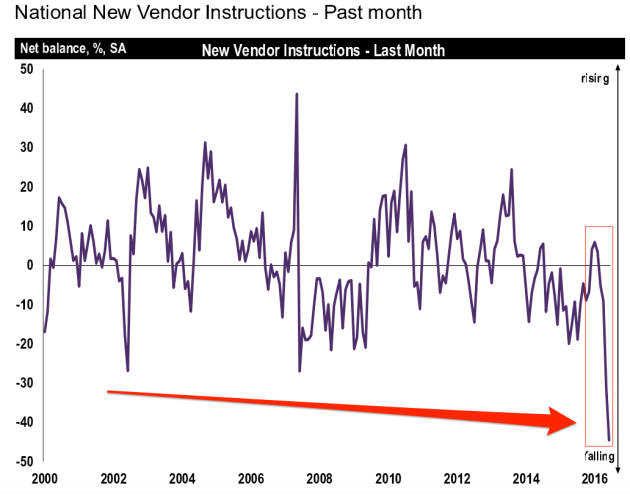
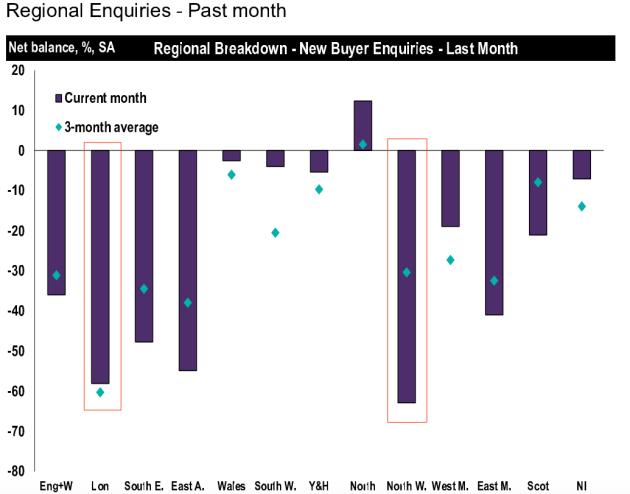
RICS said this month that new buyer enquiries "declined significantly" in June, with 36% more chartered surveyors reporting a fall in interest as part of the June housing survey.
This is the lowest reading since mid-2008 when the financial crisis was in full swing.
Just over a quarter of surveyors said they expected a further drop in sales across the UK for the coming three months, which is the "most negative reading for near term expectations since 1998," according to RICS.
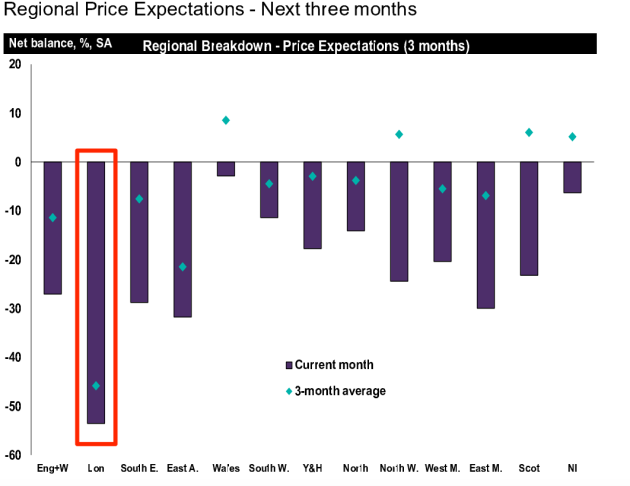
London is already seeing declines in prices with a net balance of 46% seeing values slashed, mostly in central areas. Nationally 27% more respondents across the UK expected to see prices fall rather than rise. RICS said the trend had started a few months ago, with changes in stamp duty introduced earlier this year. 
Here is the chart showing low levels of new vendor instructions:
RICS1REUTERS/Marko Djurica
And here is how bad it is getting for house prices in London:
RICS4REUTERS/Marko Djurica
And finally, here is buyer interest across the UK:
RICS2REUTERS/Marko Djurica
That has not put off AIM-listed property developer Telford Homes, which said on Thursday: "Following the outcome of the referendum, the Group still firmly believes in the longer term merits of building homes in London."
"There remains a chronic shortage of supply and that will not change as a result of leaving the EU. The Board also believes that London will not lose its attraction both as an international centre of finance or as a place where people want to live and work," the company said.
See Also:

https://uk.finance.yahoo.com/news/3-devastating-charts-show-brexit-090000645.html

RBS among worst performing European banks as stress test results are published

Saturday 30 July 2016 8:50am
William Turvill

Royal Bank of Scotland was the stand-out British performer in the European Banking Authority’s (EBA) stress test results. But not in a good way.
The assessment of how European banks might perform in adverse conditions found RBS’s capital levels down 7.5 per cent, making it the third biggest faller of 51 lenders tested. Under the conditions, it was left with a capital buffer of 8.1 per cent.
The tests are based on financial figures for the 2015 year end and the scenarios are then applied through to the end of 2018.
Ultimately, what the tests are trying to show is whether the banks in question are financially healthy enough to stay up and running should the foreseeable worst-case scenario happen.
RBS, which in 2008 was bailed out by the government and is 73 per cent owned by the taxpayer, said the results showed “our continued progress towards transforming the balance sheet to being safe and sustainable”.
Chief financial officer Ewen Stevenson said: “Over recent years we have materially strengthened our CET1 ratio [Common Equity Tier 1, or capital ratio], substantially reduced our balance sheet and leverage, and continued to de-risk our asset exposures.
“We are confident that in delivering our strategy, we will transform RBS into a low risk, resilient bank.”
Three other UK banks – BarclaysHSBC and Lloyds – participated in the test.
The EBA found that, under the conditions, Barclays’ capital ratio would fall from 11.4 per cent to 7.3 per cent, HSBC’s from 11.9 per cent to 8.8 per cent and Lloyds from 13 per cent to 10.1 per cent.
Italian bank Monte dei Paschi di Siena was the worst performer. The test found a fall from 12.9 per cent to -1.6 per cent.

Reaction

Marcus Evans, a partner in KPMG’s ECB office:
"Banks have broadly passed the EBA test, but will they pass the market’s test? The 2016 Stress Test confirms stronger capitalisation across the sector, yet Price-to-Book ratios are at almost unprecedented lows. There is a tension between the Stress Test results and the market’s view of sector strength, which has yet to be resolved."
David Strachan, partner and head of Deloitte’s EMEA Centre for Regulatory Strategy:
"Analysts are likely to pore over the results for some time. Differences in capital positions between two banks could be superficial; what matters more is to understand the full regulatory capital requirement for each bank, and its capacity and flexibility to take actions to respond to the shock. This complexity may add difficultly in initially understanding the results."
As resilience of banks has improved, challenges around qualitative aspects of the exercise – such as data quality and governance – have come to the fore on the ground with banks. The EBA has refrained from challenging banks publicly on those factors, but further scrutiny should be expected in future.
http://www.cityam.com/246512/rbs-among-worst-performing-european-banks-stress-test


Scots back remaining in UK despite Brexit vote

Most Scots still back remaining in the United Kingdom despite Britons voting to leave the European Union, a move which was opposed by the majority in Scotland, according to an opinion poll ...

Saturday, 30 July 2016 | MYT 10:50 AM

Scotland's nationalist First Minister Nicola Sturgeon has said the June 23 vote for Brexit had put Scottish independence back on the agend

LONDON: Most Scots still back remaining in the United Kingdom despite Britons voting to leave the European Union, a move which was opposed by the majority in Scotland, according to an opinion poll published on Saturday.

Scotland's nationalist First Minister Nicola Sturgeon has said the June 23 vote for Brexit had put Scottish independence back on the agenda just two years after it was rejected in a referendum.

While Britons backed leaving the EU by 52-48 percent, Scots voted by 62-38 percent to remain in the bloc, an outcome Sturgeon argues has changed the political landscape regarding possible Scottish secession.

However according to Saturday's YouGov survey, 53 percent of Scots wanted to stay part of the United Kingdom with 47 percent backing independence.

Even when asked if they would rather stay in the EU but leave the UK, 46 percent of the 1,006 respondents said they wanted to remain in the UK and only 37 percent preferred Scotland becoming an independent nation within the bloc.

"Inevitably, some will suggest that the high-water mark of Scottish independence has now passed, especially as it was thought that leaving the EU might persuade 'No' voters to change their minds and vote against the Union," said Joe Twyman, YouGov's Head of Political and Social Research.

"However, the situation is, naturally, more complicated than that. There remains a great deal of uncertainty about what the UK's relationship with the EU will look like in the long term. A lot could, and almost certainly will, change on this front in the coming years."

Scots rejected independence by 55-45 percent in the 2014 referendum, but since then Sturgeon's Scottish National Party has gone from strength to strength, winning 56 of Scotland's 59 seats in the British parliament in the 2015 election.

She said on Monday she would start preparatory work on making independence an option, depending on the outcome of British Prime Minister Theresa May's Brexit negotiations to determine the United Kingdom's future relations with the EU.

May has made keeping Scotland in the UK a priority in the wake of the Brexit vote, and has she would not trigger Article 50, the formal mechanism to start EU divorce talks, until she had concluded an agreement that suited all regions of the country. - Reuters


http://www.thestar.com.my/business/business-news/2016/07/30/scots-back-remaining-in-uk-despite-brexit-vote/