Tuesday, 20 February 2018

Inspired by Macron, new anti-Brexit party launches in Britain

A new anti-Brexit party was launched in London yesterday (19 February), lacking any big names but vowing to revitalise the centre ground of British politics, inspired by French President Emmanuel Macron’s En Marche movement.
 Feb 20, 2018 (updated:  Feb 20, 2018)

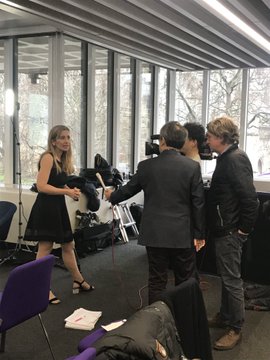
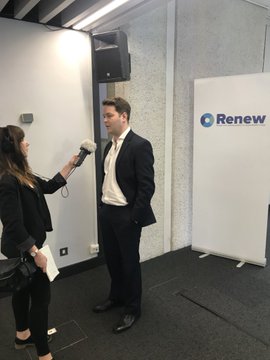
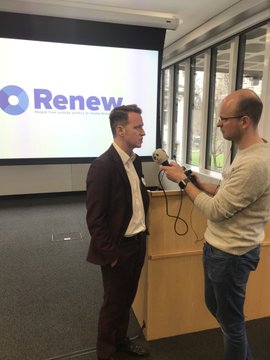
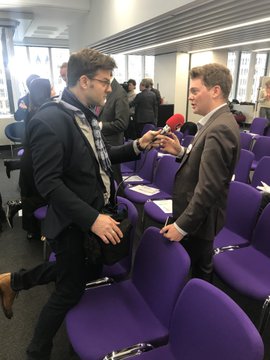
Sandra Khadhouri, James Clarke and James Torrance at the launch of new political party Renew [Twitter]
Renew is one of several new initiatives by pro-European Union campaigners, hoping to capitalise on uncertainty over Brexit to pressure politicians into stopping the process.
The party’s goal is to be “the vehicle for people who feel politically homeless”, said James Clarke, one of three co-leaders.
The ruling Conservatives and opposition Labour party both back Britain’s withdrawal from the EU in March 2019, while the smaller pro-European Liberal Democrats have failed to capitalise on anti-Brexit sentiment.
Renew said it had received informal advice about how to proceed from En Marche (On the Move), French President Emmanuel Macron’s upstart centrist party which came from nowhere to sweep to victory last year.
“Mr Macron showed that it was possible to do something extraordinary in a short amount of time,” Clarke said.
Asked about the absence of any high-profile names, he told AFP: “Renew is not a personality cult, it’s not a vehicle for the ambitions of one or other politicians.”
It was formed after last year’s general election after a number of independent anti-Brexit candidates in London, including Clarke and co-founder Chris Coghlan, a former financier, decided to work together.
Renew now claims to have more than 450 applications for stand as candidates for the 650-seat House of Commons.
Despite the fragility of Prime Minister Theresa May’s Conservative government, an election is years away, however — and the party admits it is still seeking financing.
Its current income was said by Clarke to be in the “low five figures”.
Renew‘s main influence would likely come in lobbying existing MPs, who will have the final vote on the Brexit deal agreed by the government with the EU.
‘Nation divided’
In this, they are not alone.
Several campaigns have emerged in recent weeks calling for a re-run of the 2016 EU membership referendum and putting pressure on MPs to oppose a Brexit agreement.
One of them, Best for Britain, captured the headlines this month because of a large donation from billionaire investor and philanthropist George Soros.

Soros donated money to campaign for second Brexit EU referendum

George Soros, the billionaire who earned fame by betting against the British pound in 1992, contributed 400,000 pounds (€453,000) through his foundations to a campaign group which is seeking to halt Brexit, the group’s chairman said yesterday (7 February).
Former Labour party politician Andrew Adonis, a member of the House of Lords, has launched his own campaign alongside the youth group “Our Future, Our Choice”.
Several campaigns earlier this year united in a Grassroots Coordinating Group chaired by Labour MP Chuka Umunna, a leading pro-EU political voice.
They have taken heart from opinion polls since last year’s election showing growing support for staying in the bloc.
However, polling expert John Curtice said last month that it was “not exactly a dramatic change” — and there was no significant evidence to suggest a significant shift in support for a second referendum.
Some 52% of Britons voted for Brexit, and 48% percent against, after a campaign dominated by warnings about mass migration from the continent, and demands for sovereignty.
Renew says there were many causes for the vote: co-leader Sandra Khadhouri said Britain was “a nation divided, with deep discontent at inequality”.
The party said it would increase the minimum wage, boost infrastructure outside London and create more affordable housing, and look at “better ways to manage immigration”.
Detailed policies will be drawn up after a “listening tour” of Britain involving university visits and public meetings.

Monday, 19 February 2018

New anti-Brexit party launches in Britain

A new anti-Brexit centrist political party holds its official launch in London Monday (Feb 19), one of several intiatives by pro-European Union campaigners drawing hope from a perceived shift in the British public's mood.

PUBLISHED
FEB 19, 2018, 8:40 PM SGT

The new political party said it already had more than 300 candidates ready to contest the next general election and was aiming to recruit a total of 650 to stand in every constituency in Britain.

The new political party said it already had more than 300 candidates ready to contest the next general election and was aiming to recruit a total of 650 to stand in every constituency in Britain.PHOTO: AFP

LONDON (AFP, REUTERS) - A new anti-Brexit centrist political party holds its official launch in London Monday (Feb 19), one of several intiatives by pro-European Union campaigners drawing hope from a perceived shift in the British public's mood.
The Renew party, founded last year after French President Macron’s En Marche! movement propelled him to power, said it would target pro-Brexit lawmakers in constituencies with high levels of support for EU membership. 

“We intend to be tough on Brexit and tough on the causes of Brexit,” said James Torrance, the party’s head of strategy.“We’ll pressure MPs to consider the national interest and put Remain back on the table in a vote on the final EU deal.”
The party, founded by an accountant, a former journalist and a consultant ahead of last year's general election, plans to contest seats in May local elections and all 650 parliamentary seats if there is a national election. 
In the United Kingdom’s 2016 referendum, 51.9 percent, or 17.4 million people, voted to leave the EU while 48.1 percent, or 16.1 million, voted to stay.  Blocking any withdrawal deal that Prime Minister Therema May brings back from Brussels in October would probably sink her minority government and prompt a national election that could throw Britain’s exit into doubt. 
"We aim to reverse Brexit and restore our influential position in Europe, allowing us to focus on what really matters in the UK," the party said on its website ahead of the launch in central London.
The fledgling political party said it already had more than 300 candidates ready to contest the next general election and was aiming to recruit a total of 650 to stand in every constituency in Britain.
Co-founder Chris Coghlan stood as an independent candidate in last year's election, running on an anti-Brexit platform, and came fourth with 1,234 votes in Battersea in south London.
The next elections are not due until 2022 but many commentators believe they could come much earlier because of May's precarious leadership and feuding inside her Conservative party.
Several campaigns have emerged in recent weeks calling for a re-run of the EU membership referendum and putting pressure on MPs to oppose a Brexit agreement when it comes before parliament as expected this year.
One of them, Best for Britain, captured the headlines this month because of a large donation from billionaire investor and philanthropist George Soros.
Former Labour party politician Andrew Adonis, a member of the House of Lords, has launched his own campaign alongside the youth group "Our Future, Our Choice".

'A NATION DIVIDED'

May campaigned for a “remain” vote in 2016, but now insists Britain will leave at 2300 GMT on March 29, 2019. She says there will be no rerun of the referendum. 
An ICM survey published last month showed 47 per cent of voters favour having a final say on Brexit once the terms of the departure are known, while 34 per cent oppose a rerun of the referendum.  But the survey showed just a two-percentage-point lead for remaining in the EU once the “don’t knows” are excluded. 
EU leaders, if they voted unanimously, could allow Brexit to be delayed if there was political turmoil in Britain on the eve of Brexit. That would still probably leave investors uncertain about the nature of the future trading relationship. 
Among those who have called for Brexit to be halted are former Prime Minister Tony Blair, Goldman Sachs Group Inc Chief Executive Lloyd Blankfein and George Soros, who made a fortune by betting against the British pound in 1992. 
“We have had informal discussions with En Marche,” said Torrance, a former accountant who helped found Renew.  “They are providing advice to us about how they got going in France. So we can understand that in more detail and apply some of the lessons from that.”
Renew has so far received about 100,000 pounds in donations, including 30,000 from a lawyer and 20,000 from a restaurant owner, according to a senior party official. 
Supporters of Brexit say attempts to stop Brexit run against the democratic will of the people and could thrust Britain into a constitutional crisis.
Opinion polls since last year's general election have shown growing support for staying in the bloc but polling expert John Curtice said last month that it was "not exactly a dramatic change".
Curtice also said that there was "not of lot of evidence in support of the idea that there has been a dramatic increase in support for a second referendum".
Renew said it aims to address what it called the root causes of the 2016 Brexit referendum.
"The Brexit referendum was a wake-up call that we are a nation divided, with deep discontent at inequality.
"Leaving the EU will only make things worse. We should reconsider Brexit, now we know more," it said.
The party said it would focus on inequality by increasing the minimum wage, boosting infrastructure outside London and creating more affordable housing.
It said it would also "look at better ways to manage immigration" - one of the main issues in the campaign.
http://www.straitstimes.com/world/europe/new-anti-brexit-party-launches-in-britain

Friday, 16 February 2018

MUST READ: Bullying Brussels won't defeat Brexit Britain

While the UK has been conciliatory and has stressed a commitment to long term cooperation with the EU, the European Commission has undertaken a ‘black ops’ media strategy through leaks and briefings by backroom staff. Cowardice and bullying usually go hand in hand. Brussels will soon see that it just won't work with Britain


Barnier
Bully Barnier won't get his way
Img-20171201-wa0000
Peter Lyon
On 16 February 2018 13:18
Since Britain voted to Leave in the EU Referendum on 23rd June 2016, British politicians have repeatedly stressed our unending commitment to European cooperation, trade, and security.
As Prime Minister Theresa May said, “we may be leaving the EU, but we are not leaving Europe.” The British Government has proposed a deep and special partnership with the EU after Brexit, including a comprehensive free trade agreement. However, EU leaders have continually responded to this message of cooperation with threats of sanctions and bullying rhetoric towards Britain.
While Theresa May has set out her vision in public set-piece speeches at Lancaster House and in Florence, the European Commission has undertaken a ‘black ops’ media strategy through leaks and briefings by backroom staff.
On two occasions last year, details of dinners attended by Theresa May and the European Commission President Jean-Claude Juncker were inappropriately leaked to the German press. Juncker’s Chief of Staff, Martin Selmayr, is thought to be responsible for the leaks.
At a dinner in Downing Street last May, Juncker was reported to have left the event “ten times more sceptical” on Brexit than when he arrived. He allegedly thought the Prime Minister was “deluded” and “in a galaxy very far away”! In October, a meal in Brussels was the scene of a similar leak from the EU side. The source in the German press claimed Theresa May “begged” Juncker and appeared anxious, tired and despondent.
This style of negative briefing -- via advisers and press contacts -- is a dirty tactic in any political negotiation. Selmayr, or whoever was responsible, clearly wanted to undermine the authority of the British Prime Minister, in the hope she would be forced into accepting the EU’s onerous demands over Brexit. This interference is particularly outrageous considering one of the dinners was during the General Election campaign.
The EU’s bullying tactics have recently been escalated by the EU’s Chief Brexit Negotiator, Michel Barnier, regarding the Implementation Period. The EU has demanded Britain follows all EU laws during this 21-month phase, even though we will not have a say in any new EU legislation which will be imposed on us. EU guidelines also state the UK would not regain control of its borders or its fishing quotas during this period.
The Brexit Secretary, David Davis has rightly raised objections to these ridiculous demands. He has proposed a British right to object to new EU laws and sought assurances from the EU they will not use this Implementation Period to impose laws which Britain had previously vetoed, such as a financial transaction tax.
Yet, as has now become a hallmark of the Brexit talks, EU chiefs responded to this spirit of cooperation and mutual respect with punitive statements. Barnier pronounced that the Implementation Period “is not a given” if the UK does not surrender to the EU’s terms.
It seems Barnier’s bullying rhetoric may be going too far for many Member States, reliant on the UK for trade. These countries are concerned about the threat of a No Deal Brexit, which will cause a huge black hole in the EU budget and disrupt their trade.
French and Polish politicians were reportedly incensed by the “punishment clause” in a draft document leaked to the Financial Times last week. Get Britain Out immediately expressed our displeasure, and alerted the press with our comments.
The EU’s document provided unlimited power for the Commission to cut off British access to the Single Market during the Implementation Period ‘if’ EU officials determined Britain has the temerity to break their rules. This aggressive stance would be completely unacceptable to Britain and would render the Implementation Period pointless. Fortunately, Barnier was yesterday forced to back down and take this clause out of the draft text!
It is clear the EU’s bullying tactics are detrimental to the chances of the deep and special partnership the UK wants after Brexit. Certainly, there are positive signs national Governments are pressuring the EU to agree a mutually beneficial Brexit deal, as they clearly realise the risks.
Yet, if the Commission’s unacceptable demands and disrespectful pronouncements continue, the time will come for the UK to walk away from these negotiations and we will Get Britain Out on WTO terms without a doubt.

http://www.thecommentator.com/article/6745/bullying_brussels_won_t_defeat_brexit_britain