Thursday, 13 August 2020

Labour’s Brexit Silence is Deafening

The Labour Party under its current Leader, Sir Keir Starmer, is definitely a far slicker political machine than under Jeremy Corbyn. 

AUGUST 13, 2020
|IN BREXIT

The Labour Party under its current Leader, Sir Keir Starmer, is definitely a far slicker political machine than under Jeremy Corbyn. However the Party's policy of not taking sides on the biggest issues of the day, means voters are being left in the dark and deprived a proper opposition, argues Jayne Adye, Director of Get Britain Out 
While the Government pushes on with its COVID-19 'Recovery Plan' and the mission to deliver Brexit, the Labour Party has been very conspicuous in its silence. On some of the biggest issues of the time, the official Opposition in this country seems set on a strategy of saying nothing and then claiming support for whichever outcome seems to come out on top. Sometimes this lack of opposition for opposition sake is welcome, especially regarding the response to COVID-19. However, when it comes to Brexit, the voters of this country are being left in the dark over the position of the current Labour Party.
Sir Keir's history of pushing a 'Remain' agenda while in his previous role as Shadow Brexit Secretary in traditionally Eurosceptic Jeremy Corbyn's Shadow Cabinet, means there is no doubt, we all know where Starmer's allegiances lie in the Brexit debate. However, as a whole, his Party is refusing to be upfront and honest with the public about the Party's current policy. Why is it we are hearing no pressure from the Opposition, or even questions about areas where improvement is needed?
Sir Keir has claimed he believes in the Government and trusts them to get a trade deal with the EU. Yet, while this is a bold claim from Labour, believing in the Government's policy on this issue should still mean raising questions on areas which need scrutiny. It should not just be left to backbench Conservative MPs to be voicing their opposition to the many failings contained within the Withdrawal Agreement. What does this Labour Party actually want for their voters in finalising Brexit?

On the biggest issues of the moment, Labour have time and again held back from the debate. On July 15th, the SNP put forward a motion to demand an extension to the Transition Period – Labour MPs were told to abstain. Have they suddenly abandoned their long held pro-EU beliefs, or is it now the case that under Sir Keir Starmer, Labour are intentionally hiding from the public in an attempt to deceive them over their true motives?
On the few occasions Labour has voiced opposition – for example on the new Immigration Bill, which effectively ends Freedom of Movement – this goes against their own commitments to accept the Brexit debate is over. Why on some occasions are Labour so clearly against delivering Brexit and then on others, show no interest at all? It clearly appears to be just one big political game to Starmer and his staff.
The lack of concern shown by Labour over the recent push for renegotiating the Withdrawal Agreement to remove issues including UK liabilities to the European Investment Bank, is of great importance. If Sir Keir is really pushing for a 'good Brexit' as he claims – and he now accepts the result of the EU Referendum – then he and his MPs should also be pushing for these changes to be made. Or is the truth simply that Sir Keir could not care less about delivering on Brexit and is simply trying to ride out the storm, planning to use his powers as 'Captain Hindsight' (which have been so prominent in the COVID-19 crisis) to claim he was always on the prevailing side. After all, being party to changes to the Withdrawal Agreement would not suit a man intent on trying to overturn Brexit if he ever gets to be Prime Minister!
While much of this may sound hypothetical, Sir Keir and the Labour Party have categorically failed to put out a clear message about Brexit since the General Election – nor, in fact, a clear message about anything. So those of us who are working tirelessly to try and achieve what is best for the public as a whole, are left wondering what Labour's motives are. The People deserve to know what the official Opposition's rationale really is – if anything – and what they will do if push comes to shove come the end of Transition Period on December 31st.  Will they support the outcome of the trade negotiations; any changes to the Withdrawal Agreement; or Leaving on World Trade Organisation terms – or will they again try to wriggle out of any public commitments and attempt to put a spoke in the wheels at the last minute, with the intent to delay the final part of Brexit?
Sir Keir Starmer might have been a success in the courtroom in his past life, but now he is part of mainstream politics – and he is answerable to the voters. The Great British Public need to know what is going on in the minds of those in the official Opposition Party, prior to our launching the United Kingdom onto the global stage. At the moment, Labour's Brexit Silence is Deafening.

Wednesday, 12 August 2020

UK economy faces long climb back to health after historic 20% crash

LONDON (Reuters) - Britain’s economy shrank by a record 20.4% in the second quarter when the coronavirus lockdown was tightest, the most severe contraction reported by any major economy so far, with a wave of job losses set to hit later in 2020.

REUTERS
AUGUST 12, 2020 / 2:14 PM
David MillikenWilliam Schomberg


The scale of the economic hit may also revive questions about Prime Minister Boris Johnson’s handling of the pandemic, with Britain suffering the highest death toll in Europe. More than 50,000 UK deaths have been linked to the disease.
“Today’s figures confirm that hard times are here,” finance minister Rishi Sunak said. “Hundreds of thousands of people have already lost their jobs, and sadly in the coming months many more will.”
The data confirmed that the world’s sixth-biggest economy had entered a recession, with the low point coming in April when output was more than 25% below its pre-pandemic level.
Growth restarted in May and quickened in June, when the economy expanded by a monthly 8.7% - a record single-month increase and slightly stronger than forecasts by economists in a Reuters poll.
However, some analysts said the bounce-back was unlikely to be sustained.
Last week the Bank of England forecast it would take until the final quarter of 2021 for the economy to regain its previous size, and warned unemployment was likely to rise sharply.

Any decision to pump more stimulus into the economy by the BoE and finance minister Sunak will hinge on the pace of growth in the coming months, and whether the worst-hit sectors such as face-to-face retail and business travel ever fully recover.
The second-quarter GDP slump exceeded the 12.1% drop in the euro zone and the 9.5% fall in the United States.
Some economists said the sharper decline partly reflected the timing of Britain’s lockdown - which fell more in the second quarter - and its dependence on domestic consumer spending.
PENT-UP DEMAND
Suren Thiru, an economist with the British Chambers of Commerce, said the recent pick-up probably only reflected the release of pent-up demand rather than a sustained revival.
“The prospect of a swift ‘V-shaped’ recovery remains remote,” he said.
Britain’s unemployment rate is expected to jump when the government ends its huge job subsidy programme in October.
Sunak - who told the BBC he saw some “promising signs” in GDP data for the month of June - reiterated his opposition to extending the programme.
In July he cut sales tax for the hospitality sector and in August is subsidising restaurants to draw in diners.
Hotels and restaurants did just one fifth of their normal business in June, when the lockdown was still largely in force.

LATER LOCKDOWN

British GDP shrank by 2.2% in the first quarter of the year, reflecting the lockdown that started on March 24.
Britain closed restaurants, shops and other public spaces after many other European countries, meaning more of the hit was felt in the second quarter.
However, the Office for National Statistics said that over the first six months of 2020, British GDP fell by 22.1%, slightly less than Spain’s 22.7% but more than double the 10.6% fall in United States.
“The larger contraction of the UK economy primarily reflects how lockdown measures have been in place for a larger part of this period in the UK,” it said.
Non-essential shops in England did not reopen until June 15, and pubs and restaurants were shut until July 4.
Sunak, as well as some economists, said Britain’s greater reliance on consumer-facing services businesses - many of which were completely shut in the lockdown - also explained why the economy suffered more than its peers.
In both Britain and Spain spending on hotels, restaurants, recreation and culture make up around 13% of the economy, compared with around 10% or less elsewhere in Europe and the United States.
Although some sectors appear to have made a rapid recovery, businesses are wary about the outlook, especially as a second wave of COVID infections could lead to the reimposition of lockdowns.
Employers have already shed more than 700,000 jobs since March, according to tax data.
Reporting by David Milliken and William Schomberg; editing by William Schomberg and Toby Chopra

Friday, 7 August 2020

Full Independence in Brexit Deal Not ‘Realistic’ - MUST READ

Germany Complains British Insistence on Full Independence in Brexit Deal Not ‘Realistic’


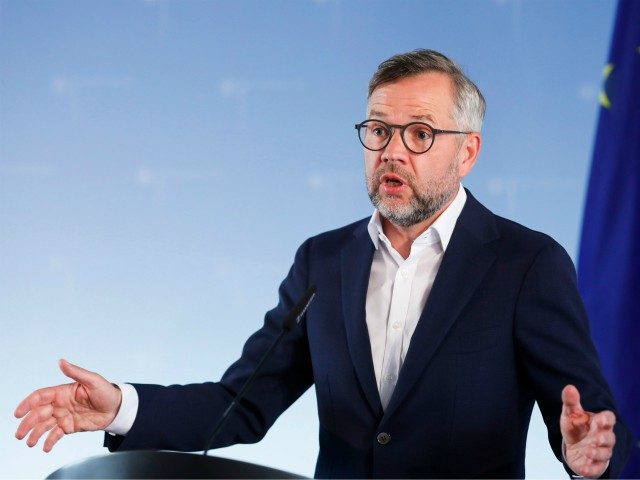
Minister of State for Europe at the German Federal Foreign Office Michael Roth gives a press statement at the foreign ministry in Berlin on June 16, 2020 prior to a video conference of the European Union's General Affairs Council. (Photo by Markus Schreiber / POOL / AFP) (Photo by MARKUS …
MARKUS SCHREIBER/POOL/AFP via Getty Images
3:25
Germany’s Europe minister has complained that Britain is not being “realistic or pragmatic” in Brexit negotiations, with British negotiators insisting on full sovereignty at the end of the transition period.
British negotiators have been consistent in demanding full sovereignty over the country’s laws, trade, and borders, while the EU insists the British stick to aspects of so-called regulatory alignment.
There is also disagreement on the role of the European Court of Justice, and the EU continues to demand long-term arrangements for European fishermen to take fish from Britain’s lucrative territorial waters, as well.
Michael Roth said on Thursday that he was “disappointed” that the United Kingdom was standing firm by its red lines, claiming that “London is shifting further and further away from the political declaration agreed between us as a reliable basis for negotiations”.
“I would love those responsible in London to be more realistic and pragmatic. The Brits are known for the latter,” the German minister told AFP, according to The Sun.
Reports from last month claimed that the United Kingdom was close to abandoning the prospect of achieving a deal with the bloc and was preparing for World Trade Organization (WTO) arrangements. Days later, the EU’s chief negotiator Michel Barnier admitted that a trade deal was “unlikely” given the current deadlock.
In July, German Chancellor Angela Merkel, who took over the rotating seat of the European Council presidency, said her country and the bloc “must be prepared … for the possibility that a deal doesn’t materialise”.
Technically, the United Kingdom left the EU in early 2020, but for now it remains in a “transition” period, still tied to the EU’s rules, Single Market, Customs Union, and migration regime until the end of the year. During this time, London and Brussels negotiate for a future trading arrangement.
While the British government has remained firm on taking back full sovereignty, recent claims suggest British taxpayers could be on the hook for EU loans until the 2040s.
Former Conservative Party leader Sir Iain Duncan Smith said this week that the United Kingdom faces up to £160 billion in loan repayments — due to the country’s ties to the European Financial Stability Mechanism and the European Investment Bank — beyond the £39 billion divorce bill.
Sir Iain called on the British government to cancel the Withdrawal Agreement, saying: “Buried in the fine print, unnoticed by many, is the fact we remain hooked into the EU’s loan book.
“You can’t be half in the EU and half out, the problem is the [Withdrawal Agreement]. It costs too much, and it denies us true national independence. This WA giving the EU future control over us has to go.”
Brexit Party leader Nigel Farage has warned Prime Minister Boris Johnson not to “fall at that last hurdle” in the final months of the transition period and reject any form of “Brexit in name only”.
Any terms to a deal that does not result in Britain being “completely free of EU rules” would be “a betrayal of the referendum vote and the huge general election victory”, Mr Farage said.
Follow Breitbart London on Facebook: Breitbart London

https://www.breitbart.com/europe/2020/08/07/germany-complains-british-insistence-full-independence-brexit-deal-not-realistic/

Friday, 31 July 2020

Michel Barnier warns Brexit deal is ‘unlikely’ as he accuses UK of being ‘unwilling to break the deadlock’

James Morris
Senior news reporter, Yahoo News UK

Michel Barnier has said a 'future relationship' Brexit deal with the UK is 'unlikely'. (European Commission)

Michel Barnier has warned a Brexit deal is “unlikely” after he accused the UK of being “unwilling to break the deadlock”.
It follows the latest round of talks seeking to agree a “future relationship” deal between the UK and EU beyond 31 December.
Barnier, the EU’s chief Brexit negotiator, said talks remain at a stalemate: “We are still far away.”
At a press conference on Thursday, he accused Boris Johnson’s government of “not showing a willingness to break the deadlock”.
Boris Johnson and Michel Barnier pictured in October last year. (AFP via Getty Images)
He added: “Over the past few weeks the UK has not shown the same level of engagement and readiness to find solutions respecting the EU fundamental principles and interests.”
Barnier said there had been no progress on two key points: the “level playing field” to ensure fair competition between businesses, and fisheries.
“We have been saying the same thing since the very beginning of these negotiations,” he said.
“They were part and parcel of our engagement with Boris Johnson eight months ago [when the UK and EU agreed a Brexit blueprint]. We are simply asking to translate this political engagement into a legal text, nothing more.
“The time for answers is quickly running out.
"By its current refusal to commit to open and fair competition, and to a balanced agreement on fisheries, the UK makes a trade agreement – at this point – unlikely."
The UK, after leaving the EU on 31 January, is in a “transition period” in which the two sides have until 31 December to agree their future relationship.
During the transition period, the UK effectively remains a member of the EU. It could have been extended for up to two years but Michael Gove “formally confirmed” the UK wouldn’t seek an extension last month.
Barnier also warned the EU and UK have until “October at the latest” to strike a deal or risk the imposition of quotas and tariffs.
He said: “If we do not reach an agreement on our future partnership there will be far more friction.
“For instance, on trading goods – in addition to new customs formalities there will be tariffs and quotas.
“This is the truth of Brexit... and I will continue to tell the truth.

Read more: Russia report: Seven revelations from the damning document that was delayed for nine months

“If we want to avoid this additional friction we must come to an agreement in October at the latest so that our new treaty can enter into force on 1 January next year.”
David Frost, the UK’s chief Brexit negotiator, said in a statement: “Considerable gaps remain in the most difficult areas. That is the so-called level playing field and on fisheries.
“We have always been clear that our principles in these areas are not simple negotiating positions but expressions of the reality that we will be a fully independent country at the end of the transition period.”

EU chief warns UK must obey European principles ...

EU chief warns UK must obey European principles to achieve Brexit deal

James Morris
Senior news reporter, Yahoo News UK

Ursula von der Leyen has warned the UK needs to obey EU principles in order to achieve a Brexit “future relationship” deal.
Von der Leyen, the president of the European Commission, warned Boris Johnson at a press conference on Friday: “We have to bridge wide divergences which remain to be solved.
“The topics are known: level playing field, fisheries, governance, the scope of our police and judicial co-operation.
“These are important points for the EU because these are principles – fair competition, rising social standards, protecting our citizens and the rule of law – at the heart of the EU.”
Johnson, having previously delegated to his chief negotiator David Frost – is set to take part in talks himself later this month.
Von der Leyen promised the EU will do “everything” to reach a “one-of-a-kind” agreement with the UK.
Her comments came after EU leaders met via video conference on Friday for the latest European Council summit.
The UK, after leaving the EU on 31 January, is currently in a “transition period” in which the two sides have until 31 December to agree their future relationship.
During the transition period, the UK effectively remains a member of the EU.
There is mounting concern among business – already hit hard by the fallout from the pandemic – at the prospect of a “cliff edge” break to the UK’s remaining access to the EU single market with no new deal to replace it.
https://uk.news.yahoo.com/brexit-news-latest-uk-deal-131257312.html