On Friday (March 26), China’s Ministry of Commerce announced that import duties between 116.2% and 218.4% will be imposed on Australian wines effective Sunday (March 28). The massive tariffs arrived after the ministry concluded that domestic wine industry had been hurt by the dumping of cheap Aussie wine. Worse, the anti-dumping punishment will last for 5 years.
26 March 2021
The ministry said in a press release – “China’s domestic wine industry has suffered material damage, and there is a causal relationship between the dumping and subsidies and the material damage. The Ministry of Commerce conducted investigations in strict accordance with relevant Chinese laws and regulations and World Trade Organization (WTO) rules, and made the final ruling.”
In August 2020, China began a second investigation into imports of Australian wine, just after announcing a separate “anti-dumping” inquiry into its wine industry 2 weeks earlier. Beijing had wanted to impose an anti-dumping tariff of 202.70%, which would triple the price of Australian wine, as part of its punishment against Morrison administration.
 |
| Trade War - China Officially Imposed 220% Tariffs on Australia Wine |
By November, the Chinese government announced its initial finding, and preliminarily imposed anti-dumping tax – in the form of deposits – which ranged from 107.1% to 212.1%. Today’s official tariff rate is clearly higher than the preliminary tariffs. Additionally, the ministry also slapped anti-subsidy duties between 6.3% and 6.4%, but decided to drop it to prevent double taxation.
Among the major wine exporters, Treasury Wine Estates – owner of the popular Penfolds label – has been slapped with an anti-dumping duty of 175.6%. Yellow Tail, an Australian brand of wine produced by Casella Family Brands will pay a 170.9% tariff. Accolade Wines, which can be traced its beginning to Thomas Hardy and Sons, a company founded in 1853, have to pay the 167.1% import duties.
Other Australian wine exporters will pay up to 218.4% duties. But the damage is already done as far back as November 2020. Australian wine exporters watched in horror as stockpiles of wine stuck in warehouses thanks to “unofficial” boycott from its biggest customer. They had been warned by Chinese importers that shipments of Australian wine will not clear customs.
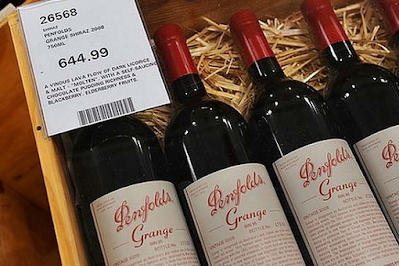 |
| Treasury Wine Estates - Penfolds Premium Brands |
The custom clearance problems saw how more than 3,000 litres of wine from Penfolds and nearly 20,000 litres from Badger’s Brook Estate were detained at Chinese ports in January alone. With the new tariffs to take off officially this Sunday, Chinese wine traders said the 5-year anti-dumping punishment could completely wipe out Australian wine’s competitiveness in the Chinese market.
While large and established winemakers like Treasury Wine Estates may survive, small Australian wine producers will definitely collapse. Even Treasury Wine, the world’s largest listed winemaker with total revenue of A$2.88 billion in 2019, was forced to sell off some of its U.S. brands and assets to raise A$300 million in a desperate effort to increase sales.
China does not need wines from the land Down Under, but the same cannot be said about Australian wine growers. The ban and jaw-dropping huge tariffs were designed to cripple Australian wine exports to China which are worth A$1.2 billion a year – 167% more than the value of exports to its next biggest market, the United States.
 |
| Treasury Wine Estates Wine - China Market |
Australia’s Department of Foreign Affairs and Trade officials told Senate Estimates the value of Australian trade with China for almost all industries has plummeted by 40% since a trade dispute exploded between the two countries. And wine exports had fallen to less than $1 million in January, from a high of $164 million last October – a plunge of more than 99%.
Last month, several months after Beijing started its trade war against Canberra, the Australian wine giant Treasury Wine reported a 43% drop in first-half net profit to A$120.9 million (US$94 million), forcing it to cut its dividend by 25% to 15 Australian cents per share. To make matters worse, the second-half earnings are expected to come in “below” first-half earnings.
Australian Grape and Wine chief executive Tony Battaglene said – “When you’re at 200% you’re not viable and when you’re at 215%, you’re even less viable, so the market remains closed to Australian wine. We know we’re going to have a tough couple of years. The real pressure has come on those people who solely export into China and we have 1,000 businesses set up to do that”.
Everything started when the Australian government chose to support Trump, who accused China’s incompetence in controlling the Covid-19 from spreading, despite tons of evidence that the U.S. president sat on his hands for months. Referring to the Covid-19 as the “China Virus” or a “Chinese Plague”, Trump’s political rhetoric included claims that the virus was “sent by China”.
It was a huge mistake when Prime Minister Scott Morrison’s campaigned in April, 2020 – urging top allies France, Germany and New Zealand to pressure China to give the foreign countries the “weapons inspector-like” powers to investigate the outbreaks. Beijing, of course, was not impressed that Canberra used the Coronavirus pandemic to engage political manipulation.
China had mocked Australia of parroting U.S. President Donald Trump in its call for an inquiry to determine the origins of Covid-19, despite Morrison’s own admission that he had no evidence to suggest the disease originated in a laboratory in the Chinese city of Wuhan. Trump was the only leader who said he was convinced the virus may have originated in the Chinese virology lab.
Last April, Chinese Ambassador to Australia Cheng Jingye warned the Morrison government that its dangerous manoeuvre would spark a consumer boycott against Australian goods. Beijing made good on its promise, slapping an 80.5% tariff on all Australian barley grain in May after banning imports from four major Australian beef suppliers, allegedly over labelling issues.
By November, the situation was so bad that Chinese import agents warned their clients they had been informed that no Australian shipments of wheat, barley, sugar, red wine, timber, wool, lobster and copper ores would be cleared. The Aussie’s tourism and education sectors have also been targeted when Chinese tourists and students were advised to stay away from the country.
And by December, China’s top economic planner had granted approval to power plants to import coal without clearance restrictions, except for Australia, the world’s top exporter of coal. Beijing’s refusal to import Australian coal will cripple the country, which exported coal worth almost A$14 billion to China – the third largest export from the land Down Under.
In the same month, Australia’s Trade Minister Simon Birmingham confirmed that Australia has launched a formal complaint with the WTO over heavy tariffs – 80.5% – imposed by China on its barley exports back in May. The tariffs are expected to cost Australian farmers a whopping A$2.5 billion over the next 5 years. It would be interesting to see if Canberra will also complain about the latest tariffs on wines.
But even if China has breached the rules set under WTO (World Trade Organization) or even China-Australia Free Trade Agreement (ChAFTA), there’s very little Australia can do. Mr Birmingham admits it could take years to settle the disputes between the two countries. Australia currently has 106 anti-dumping and anti-subsidy investigations ongoing related to Chinese products.
Elizabeth Sheargold, a postdoctoral research fellow at the University of Wollongong School of Law in Australia, said – “ChAFTA, like most free trade agreements, does not oblige either party to the treaty to purchase goods or services from the other. Instead, in ChAFTA both countries committed to eliminate or lower some of the barriers to trade such as tariffs or import quotas.
In a nutshell, experts said neither country appears to have violated specific rules of the trade pact contained in WTO or ChAFTA simply because the deals are not a binding contract. They are just a set of trading guidelines and rules that are mutually agreed upon by China and Australia. The rules do not say that China “must trade” with Australia, and vice versa.
China is Australia’s biggest trading partner – about one-third of the country’s total exports goes to the Chinese, contributing A$135 billion annually and providing thousands of jobs. Perhaps the Aussie, the U.S.’ “deputy sheriff” in the Asia-Pacific region could redirect A$1.2 billion of its wine exports to allies such as the United States, United Kingdom, Canada and European Union.
Other Articles That May Interest You …
- Australia’s Treasury Wine Forced To Sell Brands & Assets – Profit Suffers 43% Drop After China’s Tariffs Punishment
- China Will Import Coal From Any Country, Except Australia – PM Morrison Upset Over Impact On The A$14 Billion Industry
- Australia Hopes RCEP Will Fix Problems With China – But It Gets Worse As Beijing Reveals Three Issues With Canberra
- Australia’s Economy Being Hit Again – China Bans Wheat, Lobster, Barley, Sugar, Wine, Timber, Coal, Copper
- China Punish Australia Again – Recession-Hit Aussie Saw Its A$2 Billion Cotton Industry Targeted
- Australia Upset! – China Now Uses “Asian Discrimination” To Target Aussie’s A$38 Billion Education Industry
- Coronavirus Inquiry Backfired On Aussie – China Slaps Tariffs, Warns It Has The Power To Hurt Australia Economy
- Lawsuits For Trillions Of Dollars Against China Over Spread Of Coronavirus – Here’s Why It’s A Waste Of Time
- 3 Coronavirus Variants Discovered – Surprisingly, “Type-A” Found In Americans, Wuhan’s Type-B And Type-C In Europe
- National Security Threat – China’s Huawei & ZTE “5G Technology” Banned In Australia
- Corruption In Australia? – Huawei The Biggest Sponsor Of Australian Politicians
http://www.financetwitter.com/2021/03/australia-1-billion-dollar-wine-industry-in-trouble-china-officially-slaps-218-4-percent-import-duties-for-five-years-effective-sunday.html

March 25th, 2021 by financetwitter
If you boycott Xinjiang cotton, we'll boycott you - said an internet user. That angry Chinese consumer is just one of 1.4 billion consumers in China who has started a nationwide boycott of Swedish fashion giant H&M. However, the attack against the world's second-largest clothing retailer was fir [...]