It is a great shame that most politicians with any clout in this country have their programming set so rigidly to damage control that it falls to past leaders of other nations to make the optimistic case for Brexit.
To Australians, the Brexit vote was an opportunity to rekindle the trade, cultural, and people-to-people links (Source: Getty)
To that end, The Spectator’s event last week at London’s Australia House was both a tonic and a bitter pill to swallow for globally-minded Brexiteers.
That great liberaliser of the Australian economy, former Prime Minister John Howard, spoke about the success that Australia has seen since moving from protectionism to a more open economic stance, in particular with countries in the Asia Pacific region, while retaining faith in the nation state as central to any useful trade policy.
The Asia Pacific region’s potential far exceeds that of the EU, and the UK is in a better position than most to capitalise on it. One of the consequences of the British Empire is that many countries in the region retain similar legal and political systems to ours, which would ensure at least an initial degree of mutual sympathy in any trade negotiation.
These ideas were picked up by the Australian high commissioner to the UK, George Brandis. He reminded us that Australians have enjoyed 27 consecutive years of economic growth, and are the tenth richest people in the world. Bilateral free trade agreements are the foundation of this growth, and an ambitious Free Trade Agreement (FTA) could act as a bulwark against perceived US protectionism.
What about the difficulties of regulatory alignment? The British MEP Daniel Hannan made the point that an FTA is in essence an expression of trust – and if you trust the Australians not to put strychnine in your bottle of Jacob’s Creek, there is little need for it in most cases.
FTAs with other countries may necessitate differing degrees of regulation, but therein lies the advantage which would come from negotiating our own trade deals. We could have as much or as little impediment to trade as we like. These deals need not be over-complicated: Australia’s FTA with the US was negotiated in a mere 15 months.
Then there’s the oft-repeated concern of British farmers being undercut by cheap Australian beef and lamb. But according to Brandis, Australia cannot even fulfil demand from the Asian market, while Hannan made the blindingly obvious point that we exist on separate hemispheres so our respective livestock production is contra-seasonal.
As for immigration, Lynton Crosby – the political strategist who orchestrated David Cameron’s campaigns – pointed both to polling data and post-referendum analyses to suggest that what the British people want is more control of immigration.
Control does not necessarily mean a reduction, as long as the quality of that immigration is of an acceptable standard. Part of any deal could be formal, mutual recognition of professional qualifications, useful in sectors like health and services.
Now for that bitter pill: the tantalising prospect of Britain once more engaging as a formidable globally minded entity in its own right – and on its own terms – will become a mirage in the desert if we stay in the EU customs union, continuing to outsource our trade policy to a third party which perceives the referendum result as an affront.
All we will have achieved will be instability without any corresponding relief, leaving us with the worst of all possible worlds.
In the end, it is confidence that will win the day. The UK can hardly be said to be exuding confidence, thanks to our unwillingness to look beyond the narrow confines of the EU.
Our strategy should be to forge partnerships with nations that are like us, not falling over ourselves to accommodate the desires of a bloc which – lest we forget – we voted to leave.
To Australians, the Brexit vote was an opportunity to rekindle the trade, cultural, and people-to-people links between our nations. That’s the kind of optimism we should be pursuing.
Prime Minister Theresa May said on Monday she wanted a future customs relationship with the European Union in place by the end of 2020 so that a backstop arrangement for the border between the north and south of Ireland would not be required.
JULY 3, 2018 / 1:54 AM
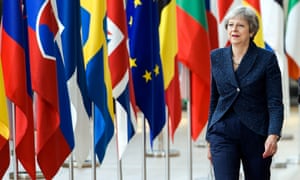
British Prime Minister Theresa May arrives at an European Union summit in Brussels, Belgium June 28, 2018. Virginia Mayo/Pool via REUTERS
Ahead of a meeting of UK ministers later this week a report said officials had drafted a new option for how to handle customs with the European Union.
“I am very clear that we should be doing everything that we can to ensure that at the end of December 2020 we are able to see our future customs relationship in place such that that backstop is not necessary,” she told Parliament.
May also reiterated that keeping Britain in the European Economic Area after Brexit was not an option being considered by the government.
It’s not often I say this, but we should be grateful to Gina Miller. Ms Miller is the wealthy businesswoman who says the Brexit vote made her physically sick and who is so barren in the category of self-awareness that she once gave an interview to a fawning New Statesman hack in which she gabbed about the problems facing 21st-century Britain while ‘spread across a velvet sofa’ in a ‘high-ceilinged drawing room’ while her ‘multimillionaire husband’ acted as her bodyguard. So Caligulan! These are the people the left now loves. Anyway, we should nonetheless be grateful to Ms Miller because her latest outburst has really shone a light on what is driving elitist Brexitphobia.
On Friday, Ms Miller and a host of other female members of the great and good – lawyers, professors, peers, the daughters of filthy-rich capitalists, etc – wrote a letter to the Guardian – where else? – in which they opined that women’s rights would collapse post-Brexit. Because before the EU came into existence in 1992 – the year of Wet Wet Wet, John Major and Damien Hirst’s shark, in case you’re one of those people labouring under the illusion that the EU has existed forever – British women basically had no rights, right? It is only thanks to the grey, stale, quite male oligarchy in Brussels that British women were able to shake off the shackles of oppression. What an insult to the generations of British Suffragettes and libbers who spent decades struggling for freedom before the EU was even a glint in the eye of scheming bureaucrats.
Not surprisingly, Miller and Co’s ridiculous letter – long on initials after the signatories’ names, short on facts – caused annoyance. Not least among some of the millions of women who voted for Brexit. Ms Miller, incredulous that such inhabitants of the plebeian sections of society would presume to question her and her friends, all of whom are well-educated and read broadsheet newspapers, fired back at these little people on Twitter. ‘People responding negatively to our letter [regarding] loss of women’s rights post-Brexit know more than the top women signatories?’, she asked. Then she listed some of these ‘top women’. ‘Jessica Simor QC, Caroline Criado-Perez feminist activist, Cherie Blair QC, Helena Kennedy QC, Shona Jolly QC, Susie Courtault rights campaigner…’
We get it, you know a lot of QCs! And QCs count for more than you and me. This is what Miller is saying. She knows this is what she is saying, we know it is what she is saying, so can we cut to the chase here? Ms Miller is really asking, in the tone of a 17th-century monarch, or 19th-century boss, ‘Do you think you know more than me?’. And we should be glad she is, because this Twitter freakout, this rage of a businesswomen who puked over our vote, this listing of people who are better and cleverer than the rest of us, captures the essence of elitist Remoanerism – which is the belief that some people’s political views are worth more than other people’s, and therefore should carry more weight. Autocracy, as some of us might call it. Whatever it is, it isn’t democracy, which is a system in which everyone’s views, regardless of our racial, gender or educational background, are meant to impact equally on the fate of the nation.
Miller’s unguarded snobbery, her probably accidental exposure of her belief that lesser citizens should stop criticising people with letters after their names, confirms what lies behind Remoaners’ deification of expertise. It is a belief, as old as politics itself, that the well-educated and well brought-up are better placed to make political judgements than the rest of us. Right from Plato’s ‘Philosopher Kings’ to the complaint that was made about women demanding the vote in the late 19th century – as one misogynist politician put it, women ‘lack the expertise… which is necessary for informed political activity’ – there has always been this idea that some people, us, are better at thinking and deciding and doing politics than other people: them. You know them: the kind of folks who vote for Brexit or who outrageously clog up Ms Miller’s Twitterfeed with – brace yourselves – negative comments.
This is the tyranny of expertise. This is the thing Michael Gove was dead right about – and you could tell he was dead right because his comments sent the chattering classes into a political tailspin – when he said people have ‘had enough of experts’. This public bristling against the elevation of expertise in political and social matters isn’t philistinism, as the elitists claim it is, and nor is it a folk-wisdom that prefers the diagnosis of a witch doctor over the insights of Western science. Rather, it is part of a great and democratic growing discomfort with the way in which the beatification of experts grates against the ideal of ‘one person, one vote’ by suggesting, or outright arguing, that some people and some groups should have more say than us.
The populist revolt against experts is a wonderful and positive moment in British politics. This is people saying, ‘Our views count as much as yours. When it comes to politics, our say is absolutely equal to your say, even if we might be poorer than you and have fewer PhDs’. This is in keeping with virtually every stab for the expansion of democracy in history, all of which have relied upon a scepticism about elevated expertise and a conviction that ordinary working people have just as much to contribute to political debate as lords and ladies and business owners do.
In fact, I’d go further: in answer to the question Miller is really asking – which is, ‘Do you lot think you know better than us?’ – we should say ‘Yes’. Yes, by dint of the fact that ordinary people really live in society in a way that bureaucrats and business people often don’t, and therefore are very often more sensitive and alert and thoughtful about the difficulties facing that society, they know more than you. They are better than you at making long-term political decisions that will benefit everyone. They are more politically trustworthy than those who have vested interests, narrow experiences, and a sometimes jaundiced view of society and its inhabitants. But don’t worry, we are democrats, which means we won’t let the fact that ordinary people are better placed than the elites to make sensible political decisions get in the way of your rights. So you’ll still have a vote. That’s all, though. One vote. Like the rest of us.
Brendan O’Neill is editor of spiked. Find him on Instagram: @burntoakboy
Female parliamentarians, businesswomen, campaigners and others sign a letter to the Guardian highlighting the real risk of losing hard-won rights after Britain leaves the EU
Theresa May arrives at this week’s European Council summit in Brussels. Photograph: Nicolas Lambert/EPA This week’s European summit marks a critical moment in the Brexit negotiations. Much attention has been focussed on arguments about trade and the economy but not enough on the impact leaving the EU will have on our rights. The UK is unique in Europe in not having a written constitution. Post-Brexit, we will be the only country in Europe where politicians will be free to remove and diminish hard-won rights, especially for women and minority groups.
Many employment and social protection rights are derived from the EU treaties and directives, as interpreted by the case-law of the European court of justice. For example, equal pay for work of equal value, parental leave, anti-harassment laws, properly paid holiday rights, working time and important features of our anti-discrimination provisions, including on pregnancy and maternity, have been introduced or substantially developed by the EU.
The importance of equality and social protections is being lost in the wrangles over customs and trade. Theresa May has already promised to leave the EU charter of fundamental rights with no British replacement lined up to ensure we don’t lose almost 50 years of protection.
Let’s not forget that marriage bars existed in some workplaces until the 1940s. Some of our grandmothers had to resign from their teaching jobs when they tied the knot. More recently, a woman could be dismissed for pregnancy. It was argued that this was not discrimination on the basis of sex, because a man could be dismissed for long-term illness. Now, it is illegal to choose a woman who is not pregnant over a pregnant woman when the pregnant woman is better qualified. Any disfavouring of a person because of pregnancy is direct sex discrimination.
These are huge developments – and they are grounded in EU treaty rights. No state can remove or diminish them. Poland will try. Hungary will try. But as long as they are members of the EU, they will fail.
Once the EU treaties and the charter of fundamental rights, with which all EU law and EU-derived law must comply, are removed from UK law, there will be nothing to stop politicians from diminishing rights that have taken many years to win, in a race to the bottom when it comes to employment practices. Indeed, some may be motivated by the power Brexit will give them to do this.
Even if the rights and protections we currently have are automatically absorbed into UK law by the withdrawal bill (and that is not the case because the government has removed the application of the charter of fundamental rights), parliament can in the future remove and diminish these protections.
The real risk to people from all walks of life of losing hard-won rights needs to be understood. This is why we believe people must be given the chance to vote on the final deal.
Nina de Ayala ParkerWomen’s rights activist Tulip Siddiq MPLabour, Kilburn and Hampstead Jessica Simor QC Specialist in public/regulatory, EU and human rights law Fiona MillarJournalist and campaigner on education and parenting issues Nicola HorlickInvestment fund manager Livia Firth Executive producer of 2015 documentary The True Cost, and Founder Green Carpet Challenge Gina MillerBusiness woman, transparency campaigner Ruth ChapmanCo-founder and co-chief executive of Matches Fashion Bonnie GreerPlaywright, novelist, critic and broadcaster Layla Moran MPLiberal Democrats, Oxford West and Abingdon Caroline Criado PerezFeminist activist, journalist Eloise ToddCEO, Best for Britain Cherie Blair QC Zoe WilliamsJournalist Amanda LeveteArchitect and businesswoman Farshid Moussavi Architect and businesswoman Alice RawsthornDesign critic and author Tessa MilliganCampaigner and actress Clare Moody MEPLabour Rupa Huq MPLabour, Ealing Central and Acton Rushanara Ali MPLabour, Bethnal Green and Bow, Senior fellow of the Young FoundationCaroline Lucas MPBrighton Pavilion and Green party LeaderAlison McGovern MPLabour, Wirral SouthRos AltmannPensions expert and political campaignerHelena Kennedy QCLabour, House of LordsPatience WeatcroftConservative, House of LordsScarlett CurtisActivist, Co-founder Pink ProtestNaomi SmithSchona Jolly QCSpecialist in human rights and equalities lawSiobhan Benita2012 London mayoral candidateTanja BueltmannProfessor of history, Northumbria UniversityGrace CampbellActivist, producer, Co-founder of the Pink ProtestAmelia DimoldenberghJournalist and comedianAlice SkinnerIllustrator and visual artistElena RemigiFounder of the Limbo ProjectSusie CourtaultWomen’s rights campaignerMadeleina KayIllustrator and political activistJessica GottgensPolitical activistWomen Against Brexit
This letter was amended on 29 June 2018 to correct the spelling of Rushanara Ali’s name, and because Ali is a senior fellow of the Young Foundation, not associate director as an earlier version said.
Financial services firms increased hiring and investment in the second quarter in spite of continued nerves over the Brexit process, new figures show.
Monday 2 July 2018 12:01am
Increased competition and the need to update creaking IT are among the drivers of investment (Source: Getty)
Employment across financial services rose at the fastest pace in a year, with a balance of 24 per cent saying they had increased hiring in the second quarter, according to the survey of major firms by the Confederation of British Industry (CBI) published today.
Meanwhile, booming spending on information technology continues to be a major driver of investment, with a balance of 70 per cent of the 100 firms polled saying they will increase spending compared to last year.
The CBI’s survey of Square Mile firms also reveals that 70 per cent of banks, insurers and investment managers say they are “confident” they will have plans in place by the time the UK leaves the EU at the end of March 2019, even if there is no deal.
Yet nerves remain for the City, as contingency planning for the most damaging Brexit scenarios continue, with optimism over the business environment for financial services staying flat.
Rain Newton-Smith, CBI chief economist, said: “Despite fairly subdued growth last quarter, it’s good to see financial firms stepping up hiring and investment, with digital technologies and new services seen as the best way to grow in a fiercely competitive environment.”
The figures come at the end of a quarter in which British banks reported big increases in profits amid a feeling that they are finally escaping from the legacy of the financial crisis.
Separate figures from the Banker magazine to be published today will show British lenders enjoyed the third-largest increase in profits across the world during the last year.
Pre-tax profits rose by 118 per cent to reach $37bn (£28bn), a jump of more than $20bn thanks in part to a stronger performance from HSBC, the UK’s largest bank by tier one capital.
Brian Caplen, editor of the Banker, said: “UK banking used to punch above its weight but then fell backwards after the financial crisis. It now seems to be recovering despite the headwinds of Brexit and tougher regulation.”
The stronger UK performance has boosted the share of global banking profits earned by Western European firms from 13 per cent to 20 per cent.
The research also shows the inexorable rise of the Chinese financial system, with the top four banks, all state-owned, hailing from the world’s second largest economy for the first time ever. The world’s largest bank by tier one capital is ICBC.
US giant JP Morgan Chase was the largest non-Chinese bank, while India’s banking sector suffered the worst year of any nation, the research found.
More than 30 Conservative lawmakers have signed a letter demanding Theresa May “get tough” in negotiations to leave the European Union, increasing the pressure on the British prime minister before a crunch government meeting.
JULY 1, 2018 / 8:28 PM
FILE PHOTO: Britain's Prime Minister Theresa May leaves 10 Downing Street in London, Britain, May 23, 2018. REUTERS/Toby Melville/File Photo
May has pledged to overcome deep divisions in her cabinet of ministers at a meeting at her country residence this week and come up with a blueprint for the future relationship with the EU, a step needed to move forward all-but-stalled Brexit talks.
The letter from Conservative lawmakers adds to the pressure on the prime minister, who has so far been reluctant to spell out detailed Brexit plans because of the rifts inside her own cabinet over the terms of Britain’s biggest foreign policy shift for decades.
Dated June 29, the letter calls on May to “demonstrate courage and leadership in the face of those who seek to undermine the express wish of the British people in the 2016 referendum”.
“Our departure must be absolute. We must not remain entangled with the EU’s institutions if this restricts our ability to exercise our sovereignty as an independent nation. Anything less will be a weakening of our democracy. Britain must stand firm.”
It also lists what the lawmakers will not accept, including any extension of a transition period beyond Dec. 31, 2020, remaining part of a customs union and any deal which fails to link the payment of a divorce bill to getting a good trade deal.
With only nine months to go before Britain leaves the EU, May is also under pressure in Brussels to set out her vision for future ties and offer ways of meeting a promise to prevent a return to a hard border on the island of Ireland.
The lack of a proposal on how to keep a near-invisible border between the British province of Northern Ireland and EU member Ireland has stalled Brexit talks, increasing frustration among the other EU leaders.
Last week, they again offered more flexibility if May would rethink her so-called red lines, including a commitment to leave the bloc’s customs union, a pledge some EU officials say complicates any potential solution to the border question.