Friday, 1 November 2019

General election 2019: A really simple guide

The UK's main parties are gearing up for a general election on 12 December.
1 November 2019
The Houses of Parliament
These national votes, to choose a government to run the country, are supposed to be held every five years.
But this would be the third since 2015.

What is an election for?

A total of 650 people will be chosen as members of Parliament (MPs), to decide laws and policies.
MPs are elected to the House of Commons, one of two chambers of Parliament in London, where the government is based.

What do voters care about more, the NHS or Brexit?

Detailed proposals for everything from the economy to defence and policing are set out before any general election in .
These come from the UK's political parties - groups of people with similar political beliefs who come together to try to win power.
The issues UK voters care most about have changed a lot, according to the polls.
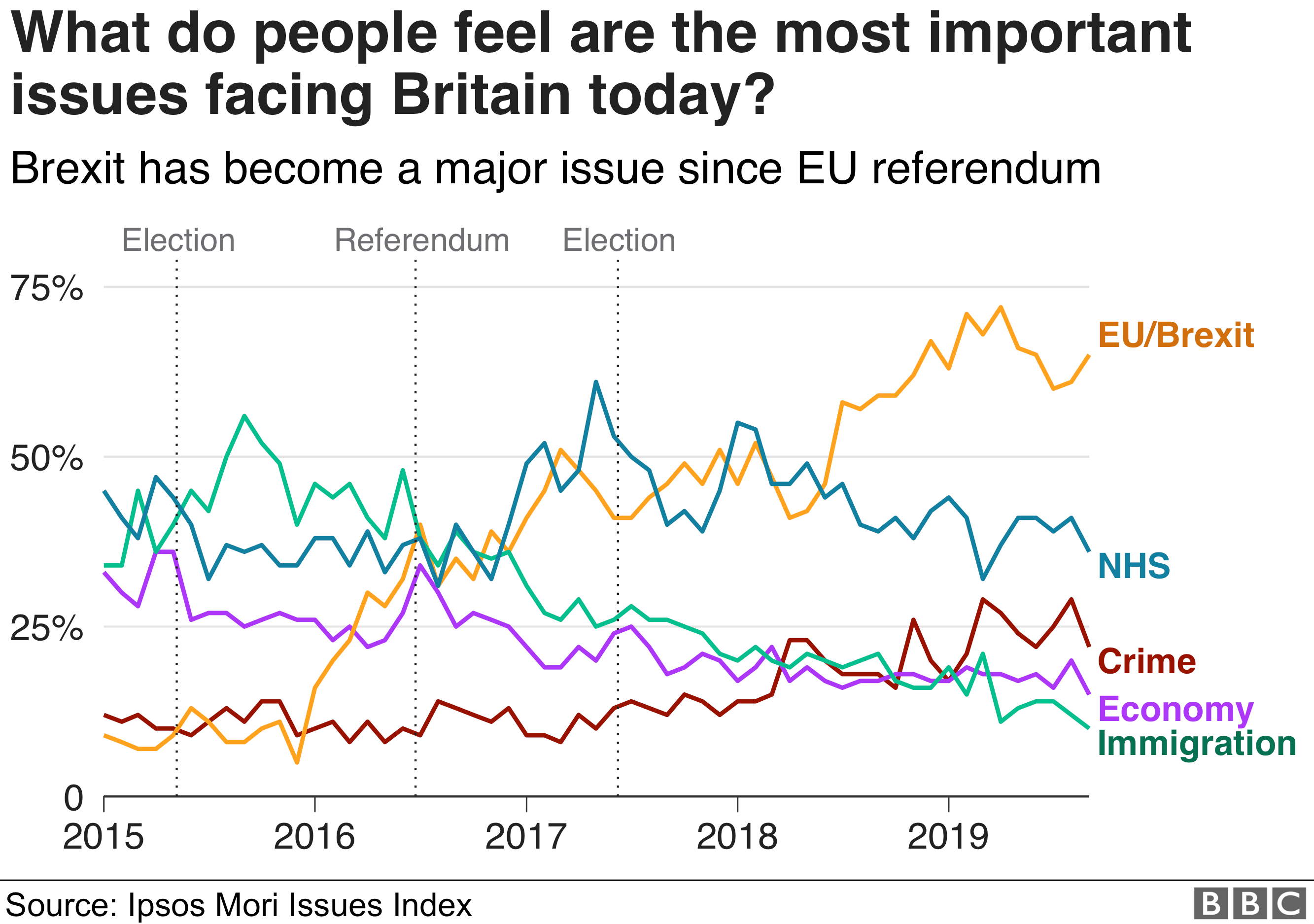
Graph of issues concerning voters over the years. Latest figures show greatest concern is EU/Brexit, followed by NHS, Crime, Economy then Immigration
The  and immigration were the things that most concerned voters in 2015.
The  was of far less interest.
Now, however,  - the UK's departure from the EU - is by far the biggest issue.

Why have an election now?

Nearly three-and-a-half years after the UK voted for Brexit in the , it has not happened.
Politicians are divided: some want the UK to leave the EU as soon as possible, some would prefer another referendum, and others to cancel Brexit altogether.
 doesn't have enough MPs to easily pass new laws.
He hopes an early election will increase the number of  MPs, making his Brexit plans easier to achieve.
The next general election was due to be in 2022, but Parliament has now agreed to hold an early election.

How does voting work?

In a general election, the UK's 46 million voters are invited to choose an MP for their area - one of 650 constituencies.
Anyone aged 18 or over can vote, as long as they are registered and a British citizen or qualifying citizen of the Commonwealth or Republic of Ireland.
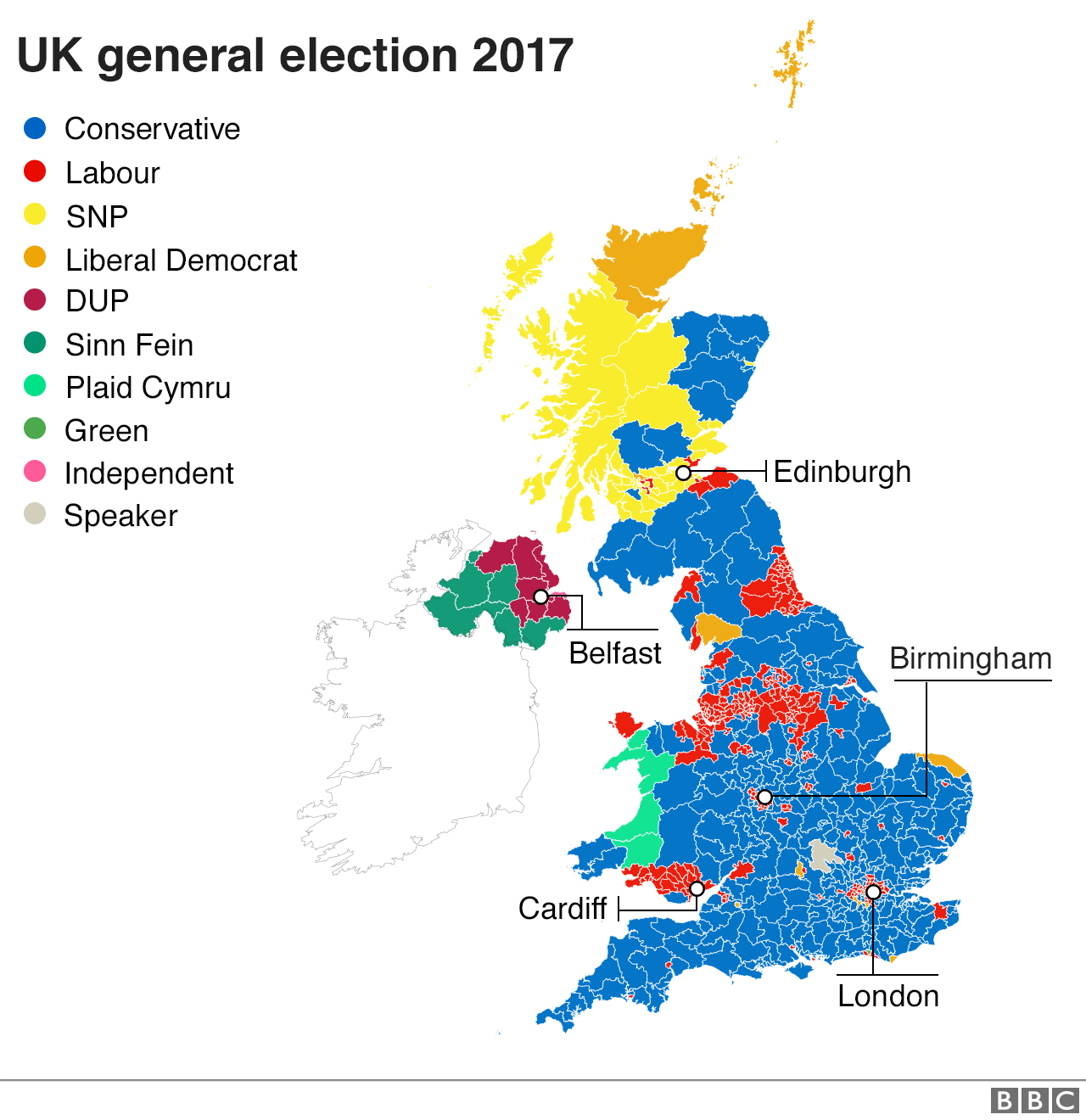
Graphic: Map of 2017 election results
Older people are more likely than younger ones to vote. At the 2017 general election, 59% of 20- to 24-year-olds voted, compared with 77% of 60- to 69-year-olds.
Voting takes place at local polling stations, set up in places such as churches and school halls. Voters put a cross on the ballot paper beside the name of their chosen candidate and drop it into a sealed ballot box.

How are the winners chosen?

The candidate with the most votes in each constituency is elected to the House of Commons.
To win, they simply need more votes than anyone they are standing against. They could receive fewer than half of the votes in their constituency.
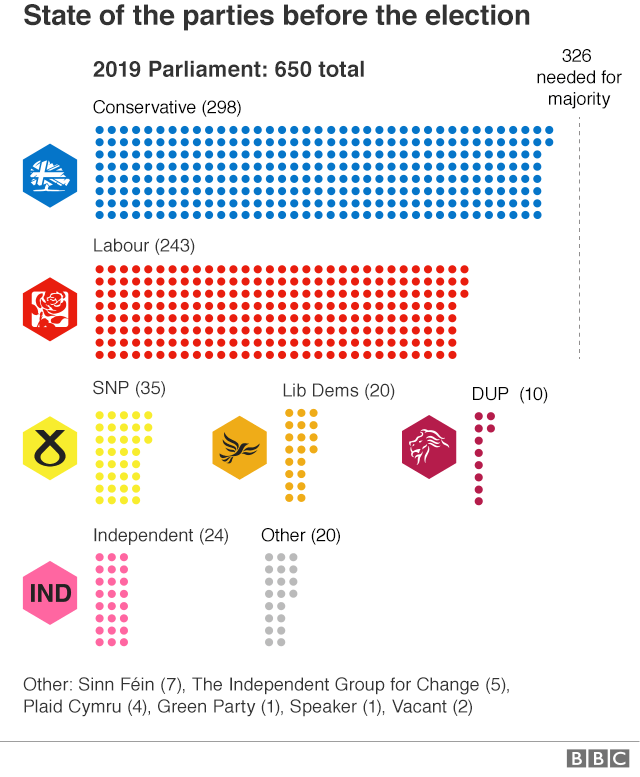
Graphic: How the parties stand in 2019 shows the Conservatives with 298 MPs, Labour 244, SNP 35, Lib Dems 20, DUP 10, Independents 24, Sinn Fein 7, The Independent Group for Change 5, Plaid Cymru 4, Green Party 1, one Speaker and one vacant seat.
Most MPs represent a political party but some stand for election as independent candidates.
Any party with more than half the MPs (326) in the Commons usually forms the government. Parties with well below 50% of the national vote can take power as a result of the .
If no party has a majority of MPs, the one with the most can form a coalition - or partnership - with one or more other parties to gain control.
The prime minister is not directly voted for by the public. He or she is chosen by the winning party's MPs and appointed by , who is duty bound to follow their advice.

What happened at the last election, in 2017?

Every election since 1922 has been won by either the Conservative or  parties.
They were again the two biggest parties in the 2017 vote but neither had enough MPs to form a majority government. The Conservatives were the biggest and they partnered with the  in order to win votes in the Commons.
Since the election, the Conservatives and Labour have both lost MPs, while the  have made gains.
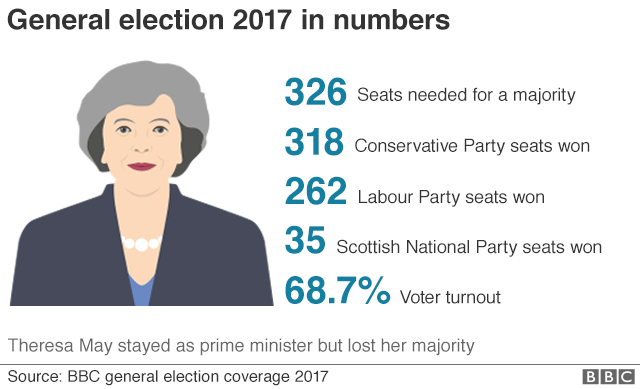
Graphic: General election 2017 in numbers shows 326 seats were needed for a majority, the Conservatives won 318, Labour won 262, SNP won 35 and voter turnout was 68.7%
Parliament's second chamber is the .
Its members are not elected but are appointed by the Queen, on the prime minister's advice.

Who can stand for Parliament?

Most people over 18 on polling day can stand as a candidate - as long as they are a British citizen or a qualifying Commonwealth or Republic of Ireland citizen resident in the UK.
They must also pay a £500 deposit, which will be lost if they do not get at least 5% of the votes in their constituency.
Candidates must meet certain conditions - prisoners, civil servants, judges and members of the police and armed forces cannot stand.

When do we find out the result?

On general election day, voting takes place between 07:00 and 22:00. The results are declared through the night and the following day.
When the overall result is known, the leader of the winning party, if there is one, visits Buckingham Palace to ask the Queen for permission to form a new government.
Once they have that, which is a formality, they return to the traditional home of the prime minister .
Often they will stand outside to deliver a speech about their party's plans for the coming years.
Written by Ian Westbrook and produced by Dominic Bailey, Steven Connor and Prina Shah

Short presentational grey line
BBC graphic
BBC graphic

More on this story


https://www.bbc.com/news/uk-politics-49826655

It's voters, not pollsters, who will write the story of this election

A hard Brexit and entrenched inequality – or a nation where we can feed our kids and save the planet? It’s up to us


Gary Younge
 

Illustration: Eleanor Shakespeare

Election night, 2017, at Harrow leisure centre was a tense affair. I had been in the borough for more than a month covering the battle for Harrow West – a Labour-held marginal that was 19th on the Tories’ target list. Labour won it in 1997 with a slim majority and had clung on to it ever since.
The tension however, related to next-door Harrow East, a Tory constituency. It went to recounts, sending the Tory candidate pacing nervously in every direction. He had considered his seat safe; the Labour MP for Harrow West believed his was at risk. Yet Labour won Harrow West by 13,314 votes, increasing its majority fivefold, while in Harrow East the Tory majority was reduced to just 1,757. I had been in the area to write about a seat that Labour might lose. It hadn’t occurred to me they might gain one.
I wasn’t alone in this error. Labour had ploughed nearly all its resources into Harrow West. Its activists from both constituencies were grateful for the new votes but had no idea where they had come from.
Today, Harrow East is the 36th target seat for Labour (Jeremy Corbyn was there earlier this week); Harrow West is 149th for the Tories, effectively off the radar but not necessarily out of the danger zone completely. After all, they are the same places they were two and a half years ago: the provenance of many of those votes remains a mystery and they could yet switch again. And much, politically, has happened since 2017 that could make them change their minds.
We don’t know what the story of this forthcoming election will be. We may not know until it is over. The campaigns have only just started. People haven’t voted yet. Electability is, ultimately, decided not by opinion-forming elites but by the voters.
Elections are not political thrillers. They are, or should be, about something real. Their significance should go beyond who wins, to what might change. Those two things are connected, of course, but not inextricably so. One of the reasons poor people are among the least likely to vote is because they often end up remaining poor, regardless of who wins. That doesn’t mean it doesn’t matter who wins – they could always get poorer. But nobody ever put that on a bumper sticker.
Far more significant is what will change. There is more to politics than elections. The electoral conversation draws its energy from polls, gaffes, ads and swings. But none of that is particularly relevant unless it impacts people’s livelihoods, potential, challenges and life chances.
Jeremy Corbyn speaks to Labour activists in Harrow East on Wednesday.
Pinterest
 Jeremy Corbyn speaks to Labour activists in Harrow East on Wednesday. Photograph: Peter Summers/Getty Images
It is easy to get stuck in the electoral. This particular moment is finely balanced. The situation is incredibly volatile; the context unprecedented. Those who claim to know how things will turn out are simply revealing how little they actually know. Because the outcomes of elections are always of national significance, we tend to always treat them as national events – when sometimes they more closely resemble a range of electoral microclimates, each with its own ecosystem. This feels like one of those times.
More than 50 MPs are standing down. More than 50 seats have majorities of less than 1,000; and 97 seats were won in 2017 by a margin of 5% or less of the votes cast (compared with just 56 in 2015). Of the 31 most marginal seats, less than half are Labour/Tory. We have a minority government and our voting system has only produced an outright winner in one of the last three elections, and even then with a small majority. It could hinge on the weather (there’s a reason why winter elections are so rare), which students go home (more than 30 seats have a local university and a majority below 5,000), and how effective on-the-ground organising might be.
The truth is we don’t know who is going to win. But we do have a clear idea of why it matters. This election is about something: indeed in a sense it’s about everything. It offers as stark a choice in terms of the direction of the country, both at home and abroad, as most can remember.
Unfortunately, on the issue that brought us to this point, Brexit, there may not be any clear resolution. The country has narrowly voted to do something it does not want to pay the price for doing, and which its polity has been unable to bring itself to do. The best many of us can hope for is to put whatever deal is done to a referendum and vote again. But whatever the result, that won’t resolve it. The country is horribly divided. We have voted ourselves into a mess and we’ll have to vote ourselves out of it.
Yet Brexit was always a symptom of a broader crisis rather than the cause. We live in a society where work is not a route out of poverty but may well be a route into it. As Aditya Chakrabortty pointed out on these pages this week, nine children in every classroom of 30 live in poverty, while the number of food parcels given to children by the Trussell Trust has leapt from 14,000 to 580,000 since the Tories came to power. Official figures show there’s been a 165% increase in homelessness under the Conservatives, and homeless charities say the real figure is much worse. This election is about nothing less than how we incorporate protection of the planet into everything we do as a society. Put bluntly, there’s a lot on the line here.
Pretty much every party in England and Wales has policies to deal with these issues that I can live with apart from one – the Conservatives. It’s not hard to see why they want to make this election about Brexit: they have nothing else. Their message is clear if nonsensical. “Get Brexit done” is no more a policy than “Brexit means Brexit” was a strategy. But beyond that, the best they can offer is to soften some of the worst of austerity while doubling down on the worst of everything else – from stop and search to shredding regulations.
Which brings us back to the electoral. Because while we can’t know what will happen, we do know what has happened. In Margaret Thatcher’s famous 1983 victory, the Conservatives lost 685,000 votes and a 1.5% vote share – but gained 37 seats. They managed this primarily because of a significant rise in Liberal/SDP support which did far more for the Tories than it did for themselves.
One scenario, among many, this time around is that the Conservatives lose votes, win a majority and get to pursue their agenda anyhow. That could be the story of the election: that a country with a majority opposed to the politics of poverty, greed, deregulation and austerity, a hard Brexit and entrenched inequality could not or would not unite, strategically, to prevent them. Fortunately there are a myriad of other possible stories, where we help feed our children and save the planet. We still have time to write them.
• Gary Younge is a Guardian columnist

What Brexit reveals about the EU

The bloc's biggest problem is indifference, not Euroskepticism.


NOV 1, 2019
BY BILL EMMOTT


What Brexit reveals about the EU


In another bizarre twist in the Brexit saga, the U.K. Parliament has signaled its acceptance of Prime Minister Boris Johnson’s withdrawal deal with the European Union but has also decided there must be a general election on Dec. 12 before the deal can finally be ratified. EU leaders could be forgiven an ironic smile. Even though opinion polls give Johnson’s pro-Brexit Conservatives a commanding lead as the campaign opens, they also indicate that a clear majority of British voters — larger than the one that backed “leave” in the 2016 referendum — actually favors remaining in the EU.

https://www.japantimes.co.jp/opinion/2019/11/01/commentary/world-commentary/brexit-reveals-eu/

Making sense of the Brexit confusion

Brexit, which was meant to regain sovereignty from the EU, might result in an eventual disintegration of the U.K.

NOV 1, 2019
BY KAZUHITO YAMASHITA

Making sense of the Brexit confusion

A general election is now set to be held in Britain on Dec. 12, making it likely that the agreement over its exit from the European Union, reached between Prime Minister Boris Johnson and the EU, will be approved by Parliament, finally paving the way for Brexit to take place by the end of January.


https://www.japantimes.co.jp/opinion/2019/11/01/commentary/japan-commentary/making-sense-brexit-confusion/